this is pure f*cking treasure
a Stanford AI research group just figured out how to run Claude Opus 5.5 and GPT-6.1 Sol as one team, and it breaks straight through the search scaffolding wall
most developers combine frontier models in one of two ways:
-> chain prompts inside a single context window and burn tokens on bloat
-> hardcode an evolutionary loop and freeze the models into search rules that go stale within 5 iterations
Stanford deletes the human-designed scaffolding and splits the stack in two:
> search director: Claude Opus 5.5 plans the search on top of a persistent idea-graph, where MAP-Elites and MCTS collapse into single Cypher queries
> candidate proposer: GPT-6.1 Sol explores high-entropy code variations inside isolated sandboxes
> no context bleeding: every session resets after each iteration, the graph keeps the lineage
> evaluator isolation: candidate code never touches the scoring process, so reward hacking and test leakage die on arrival
> meta-agent distillation: an offline pass pulls out verified lessons and updates search guidance across every branch
and the numbers beat the standard discovery baselines:
> 3.2x lower model spend than fixed evolutionary frameworks
> 1st place across 7 competitive AtCoder heuristic contests against human competitors
> above published SOTA on Anthropic's kernel builder and 11 mathematical optimization tasks
> 0% reward hacks: candidate-controlled metric tampering is gone
Opus directs the graph. Sol explores the code.
stop writing rigid search harnesses. let the frontier models own the discovery loop.
UC Berkeley's "CS 188: Introduction to Artificial Intelligence"
by John Canny & Oliver Grillmeyer
The legendary Pacman-based AI course: search, CSPs, games, MDPs & ML, taken by tens of thousands online.
Course Website: https://t.co/PKlVUbyaZD
Lecture Videos: https://t.co/qljuhKnbIv
How is agentic AI reshaping global supply and value chains? Join Professor Zhixi Wan of HKU Business School for case studies from China and a participant perspective from Roberto Meyer.
15 October | 20:00–21:00 HKT.
19 year old Japanese student built a trading bot with Claude Code in 2 days.
Used his iPad as a second monitor.
First night: $6,732 profit.
Starting capital: $68.
Total profit so far: $750,000.
[ 𝐍𝐨𝐭𝐞: 𝐅𝐨𝐥𝐥𝐨𝐰 𝐌𝐞 @tec_marco10 𝐅𝐨𝐫 𝐢𝐧𝐬𝐭𝐚𝐧𝐭𝐥𝐲 𝐚𝐮𝐭𝐨 𝐃𝐌]
Here's how it works👇
The bot scans over 50 markets simultaneously.
Syncs live BTC data from Binance every second.
Spots price errors before humans even notice.
The edge is pure speed + pattern recognition.
While traders stare at charts trying to predict the next move, his bot is already executing on mispricing across dozens of markets.
No guessing.
No emotions.
No hesitation.
Just Claude Code logic finding gaps that close in seconds.
He built the entire system in 48 hours:
→ Claude Code handles the trading logic
→ Binance API feeds real-time BTC data
→ iPad displays multi-market monitoring
→ Executes trades when arbitrage windows open
The system runs 24/7.
Every price dislocation = profit opportunity.
Most people are still trading manually, refreshing charts, second-guessing entries.
Meanwhile this 19 year old engineering student turned $68 into $750K by letting Claude Code do what humans can't: process 50 markets instantly and execute without fear.
Why are people still trading manually?
I'm giving away the exact Claude Code setup for free.
24 hours only.
To get it 👇
1️⃣ Comment " Claude "
2️⃣ Like and Repost
3️⃣ Follow @david_marco45
(so I can send it via DM)
Udah ngantuk banget tapi kangen yuyu🥹😭 mereka pasti capek seharian syuting🫶🏻🫶🏻 I love you my boys, please rest well & have a nice dream na, LeeithPutter🎸🎧❤️
#ujeenayp_#yugeneyannawat#yujeenyugene#CCCSummerCrush
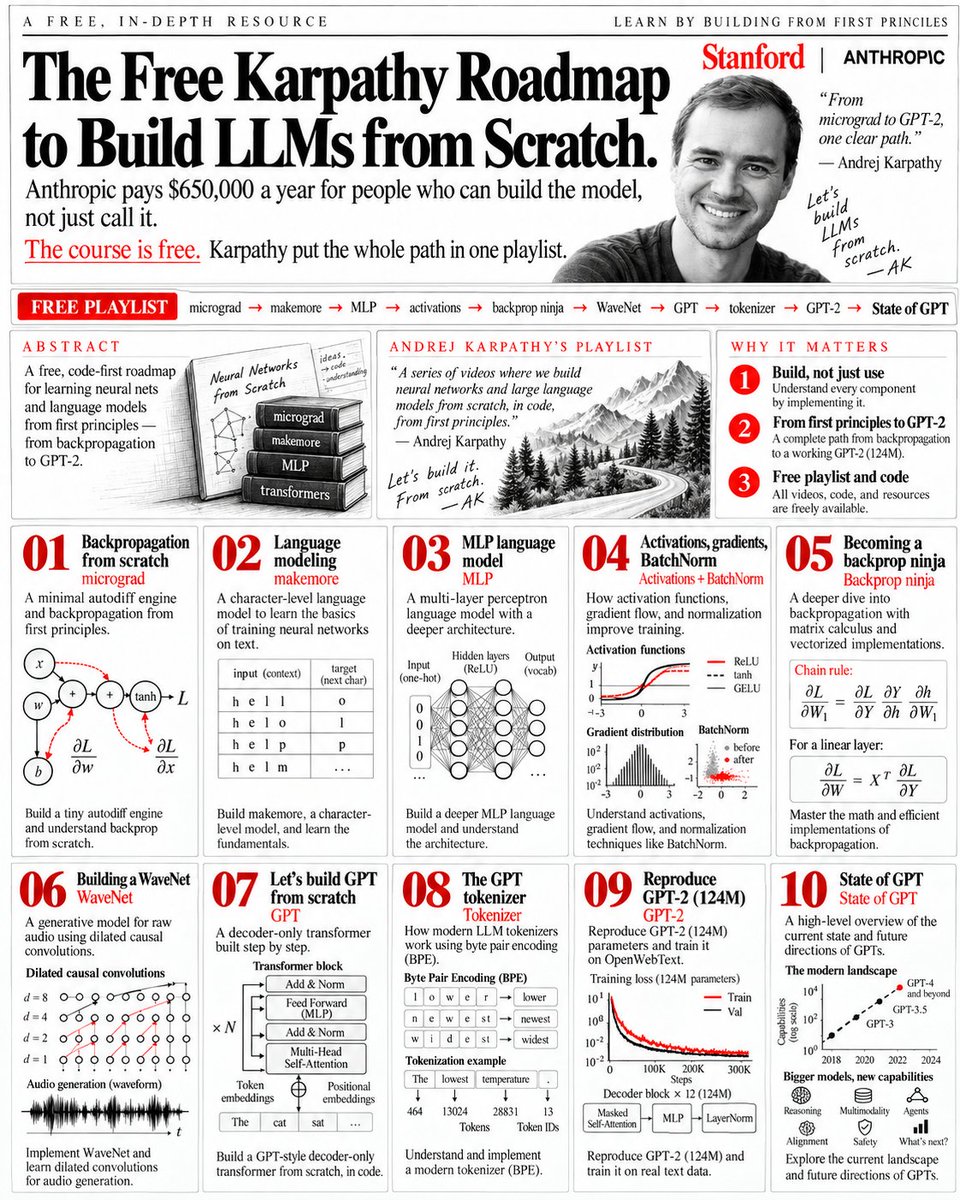
Andrej Karpathy earned $1,000,000+ at Anthropic.
He has published everything you might be asked about during an interview.
1 playlist. 10 FREE lectures.
micrograd => makemore => MLP => activations => backprop ninja => WaveNet => GPT => tokenizer => GPT-2.
01 Backpropagation from scratch. micrograd.
https://t.co/n47rlwcbAx
02 Language modeling. Building makemore.
https://t.co/pgHnlTbocg
03 MLP language model.
https://t.co/EDIldyKAiY
04 Activations, gradients, BatchNorm.
https://t.co/PRE69oAMEF
05 Becoming a backprop ninja.
https://t.co/J3u9GzvSOi
06 Building a WaveNet.
https://t.co/QUSSVMpT3m
07 Let's build GPT from scratch.
https://t.co/Kn0Zdno07Y
08 The GPT tokenizer.
https://t.co/xxL6Kz4c9P
09 Reproduce GPT-2 (124M).
https://t.co/DzV9gyJ8WI
10 State of GPT.
https://t.co/LO1gxvumDh
Playlist and code are free.
save this ⭣