Free machine learning education.
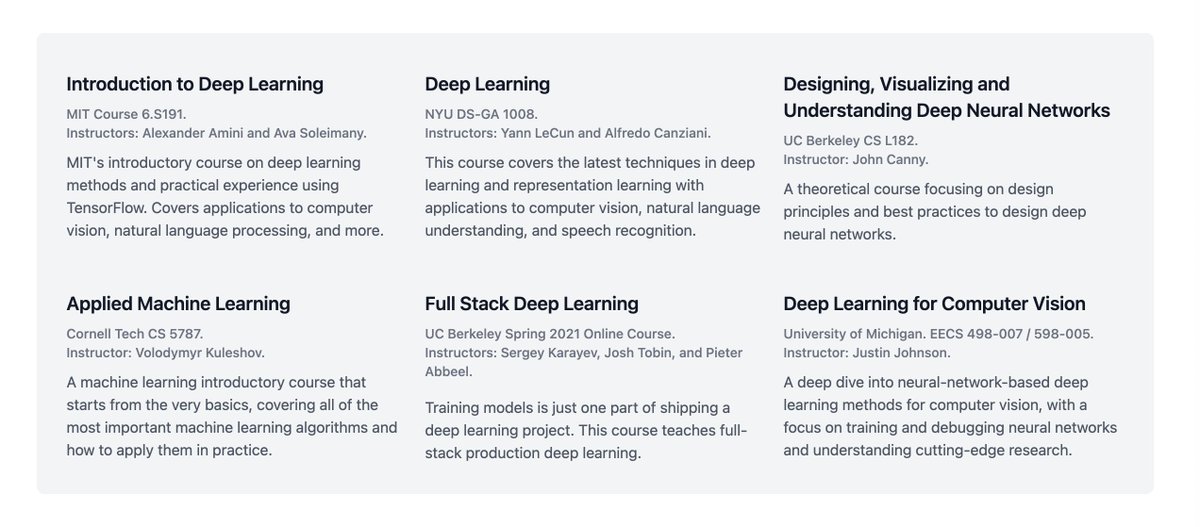
Many top universities are making their Machine Learning and Deep Learning programs publicly available. All of this information is now online and free for everyone!
Here are 6 of these programs. Pick one and get started!
↓
To get the intuition behind the Machine Learning algorithms, we need to have some background in Math, especially Linear Algebra, Probability & Calculus. Consolidating a few cheat-sheets here. A thread 👇
I had never seriously read a research paper 📃 before and I certainly didn't plan to write one, until I had to.
But I ended up finishing one that got accepted in a conference, it wasn't revolutionary but I was glad that I decided to do it and was able to finish
Here's how:👇
@svpino You can find the links for these course and many more other from top university at
https://t.co/DYIgB9xqkd
if you find this helpful, pls give star as I am continue working on this adding more and more resources.
Looking for kick-ass, 100% free machine learning courses?
- MIT 6.S191 Introduction to Deep Learning
- DS-GA 1008 Deep Learning
- UC Berkeley Full Stack Deep Learning
- UC Berkeley CS 182 Deep Learning
- Cornell Tech CS 5787 Applied Machine Learning
Find them and pick one.
a piece of deep wisdom from @twominutepapers which can be abstracted to life in general. good things can take time and as long as you're trying & trending in the right direction you'll come out the other side ✌️https://t.co/0BXaxSpxKo
Do you wanna know why do we use ReLU when doing deep learning?
When starting out with neural networks, it's common to work with examples using the sigmoid activation function.
The sigmoid function squeezes any input value to a value between 0 and 1.
This is a 🧵👇
@dmokafa Code without tests (A.K.A legacy code) is not designed to write tests after, so we must break its dependencies first. There are lots of strategies to do so with a minimal impact and risk
Michael Feathers refers to that as the "legacy code algorithm"
https://t.co/CrJ2yvzp1c
How to refactor code that has no tests:
1. Write tests for happy paths
2. Write tests for edge and negative cases
3. Execute mutation tests
4. Improve the quality of the tests based on the mutation test result
5. Now you can refactor your code with high confidence
Enjoy! ���❤️
Anyone can learn to code. It's way harder to come up with good solutions to difficult problems.
Stop obsessing about languages, libraries, and frameworks. They won't get you far.
Thinking will.
In 2014 I did a software engineer internship at Amazon.
It was no joke.
The goal: to earn a full-time offer. They told me I’d find out on the last day.
I’m now a team lead. The internship experience laid the foundation for my career success.
Time for a story. And lessons! 📝
A more scientific way to read Twitter that shows only paper links posted or retweeted by people you follow: https://t.co/QuUZ2v2F05 (Modify as necessary if you care about different journals than I do.)