@TorbjrnBullJens This is certainly a good step toward improving the visibility of K33. In general, more visible efforts to increase the visibility of K33 would be beneficial.
@K33HQ@TorbjrnBullJens “… the focus now is on commercialization.” What does that mean specifically? A PR campaign like the one in the summer of 2025? “Look-through exposure” instead of the stated goal of 1,000 direct BTC? “European expansion” — what steps are being taken?
Settlement is where #digitalasset infrastructure gets tested at scale, specifically what happens when the cash leg has to move in lockstep with the asset leg, across multiple banks, accounts and currencies.
This isn't theoretical. Quant is one of 18 firms participating in the Bank of England's #SynchronisationLab as a Synchronisation Operator, testing synchronised multi-bank treasury rebalancing: large corporates coordinating transfers across several banks as a single settlement bundle, rather than as sequential legs each carrying its own exposure.
Discover where the infrastructure is heading, and what institutions building now need to solve for in this article: https://t.co/g2NsJ0Sy1x
#ProgrammableSettlement
Before a bank writes a single line of code for #tokeniseddeposits, there's one architectural decision that shapes everything downstream: where the fiat sits, and which ledger is authoritative for customer positions.
Choosing it late or getting it wrong is an expensive mistake to unwind once a programme is already underway.
In this joint piece with @Capgemini, we break down two account models for tokenised deposits:
- Mirror model - core banking stays the source of truth, the token is a synchronised 1:1 representation
- Omnibus model - a single pooled reserve backs all tokens, and the token ledger becomes authoritative
Neither is universally right. This paper covers where each model holds up, where it strains, and the five-layer architecture emerging for legacy-to-DLT integration: https://t.co/3F1dmHYElR
#Payments #DLT
🚨 THIS ethereum:0x4a220e6096b25eadb88358cb44068a3248254675 PATENT IS MUCH BIGGER 🇺🇸
“Secure Multi Distributed Ledger System.”
Read what the patent actually covers.
Technology providing communication between two or more different distributed ledgers, including monitoring transactions, verifying instructions, executing them across those ledgers, and recording the results.
That’s important because the financial system isn’t moving toward one blockchain.
Banks will use different networks.
Institutions will use private and public infrastructure.
Tokenized deposits, digital assets and traditional systems will all need to coexist.
And the more fragmented that world becomes, the more important interoperability becomes.
That’s the problem Quant has spent years building around.
Now here’s the part I find interesting:
The patent traces priority back to November 2020.
Long before institutional tokenisation became one of the biggest narratives in finance, Quant was already protecting technology designed around connecting distributed ledgers.
Does a patent guarantee ethereum:0x4a220e6096b25eadb88358cb44068a3248254675 adoption?
No.
Does it mean Quant owns the entire interoperability industry?
No.
But it does mean something tangible:
Quant Network now holds granted U.S. intellectual property around the exact technical problem at the center of its thesis.
Granted. Patented. U.S. protected IP.
The financial system is becoming more digital.
It’s also becoming more fragmented.
ethereum:0x4a220e6096b25eadb88358cb44068a3248254675 has been preparing for both.
BOOM!
Quant's Fusion Rollup turns seven copies of USDC into one asset
A stablecoin like $USDC exists as separate, incompatible versions across chains such as Ethereum, Solana and Base, each with its own liquidity pool. Institutions holding it across networks manage seven balances rather than one.
@quantnetwork's Fusion Rollup, live on mainnet since June 2, represents the same token as a single canonical asset inside one execution environment connected to 74 networks. Quant calls the unified versions uUSDC and uBUIDL, one asset with one pool of liquidity.
Each asset keeps its anchoring to its origin chain and can be withdrawn back at any time. Quant describes the design as a Layer 2.5, since $QNT's rollup isn't bound to a single base chain.
🚨MASSIVE! QUANT JUST LOCKED IN A MASSIVE U.S. PATENT!
@quantnetwork has officially been granted U.S. Patent 12,695,634 for a secure system designed to connect multiple distributed ledgers.
That goes straight to Quant’s core thesis, interoperability between financial networks and could unlock even stronger commercial adoption for Quant!
This gives institutions patented infrastructure to securely connect different blockchains and financial networks through one interoperable system. $QNT
🚨 RUMOR: Apple could reportedly announce a $3.5 BILLION purchase of $XRP. 🍎
Yes, you read that correctly: $3.5 BILLION.
Nothing has been officially confirmed yet, but if this rumor becomes reality, the entire crypto market will be talking about XRP.
Keep your eyes open. 👀
What are #tokeniseddeposits, and why should you care?
This is the first in a short video series where we're exploring some of the key topics we'll be talking about at @Sibos: tokenised deposits, cross-border payments, and programmable settlement.
Martin Hargreaves, our Chief Product Officer, breaks down how tokenised deposits work and why they're set to change how banks move money and assets, synchronised across borders and ledgers.
Find us at @Sibos Miami, stand DISL51: https://t.co/g1yJaw7mbm
#ProgrammableFinance #SibosMiami
#XRP They will do EVERYTHING try to deceive you in believing that the SWIFT "ledger" is not the XRP Ledger and that SWIFT is not going to use XRP but my deep dives expose it and prove that SWIFT is going to use the XRP Ledger! The SWIFT "shared ledger" is the XRP Ledger..100%! Watch these videos here and don't be deceived anymore! 👇https://t.co/LwHHzsxLfd 👆
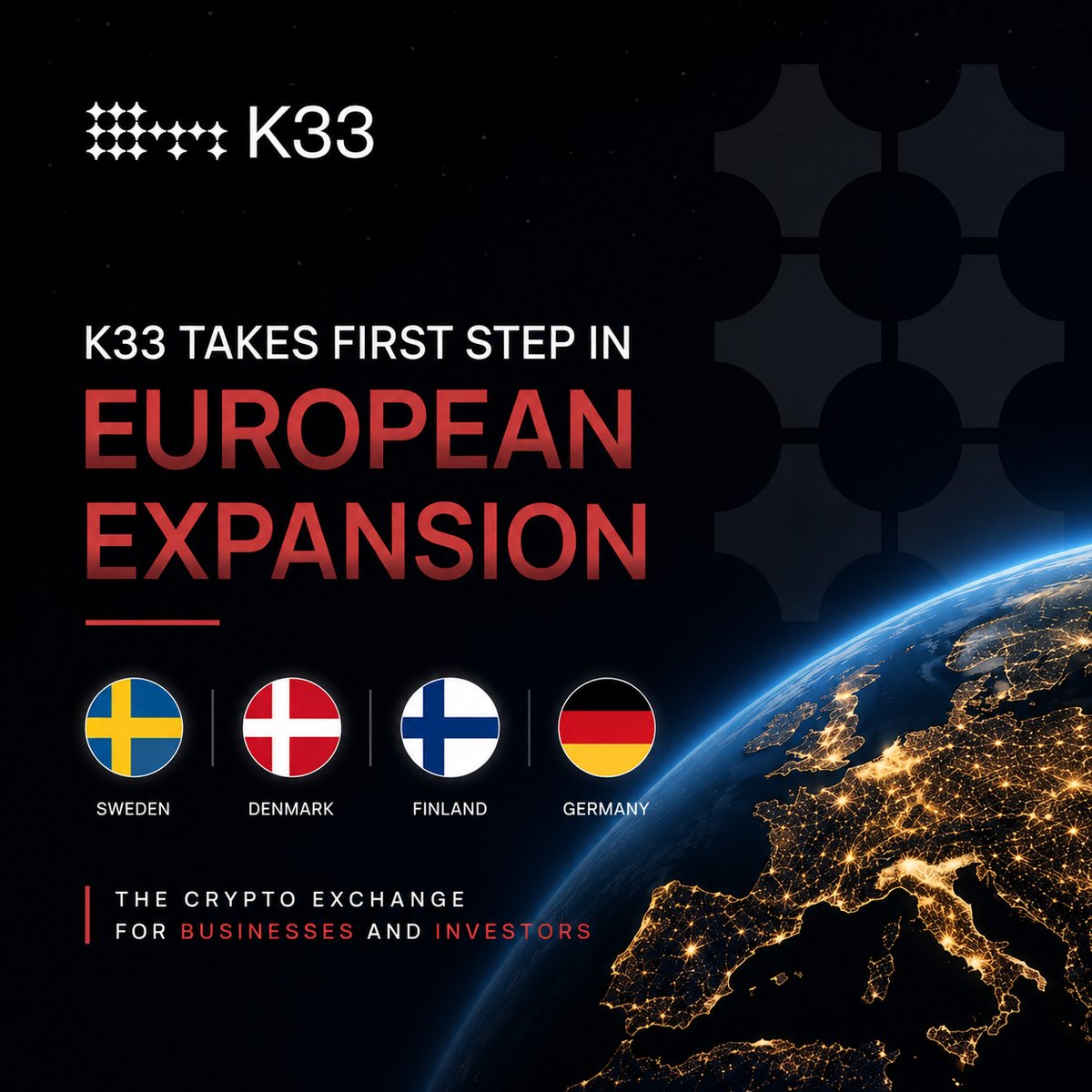
K33 is taking the first step in its active European expansion by passporting its MiCA authorization into Sweden, Denmark, Finland, and Germany.
Read more: https://t.co/milHhqGx6Q