New paper online: Chemical efflux imaging using an annular nanosensor array for in situ bladder cancer detection.
"A catheter-integrated carbon nanotube #nanosensor array enables NIR mapping of bladder #cancer biomarkers with 182× higher sensitivity."
https://t.co/ROyIrY1CGa
Integrating experimental and computational approaches we elucidated the role of nanoparticle size and cross-linking on plant cell wall-nanoparticle interactions for advancing plant nanobiotechnology and nano-enabled agriculture.
https://t.co/d6lZ9x2cIo
Monitoring Molecules in Neuroscience (MMiN) conference in Amsterdam abstract deadline is approaching. https://t.co/IbxkVpEM3h
Highly interesting for anyone interested in neurochemical technologies. There will be also a symposium on @nanocarbons for neuroscience.
Nanoscale rheological heterogeneity revealed by Single Particle orientation Tracking (SPoT) of ultrashort carbon nanotubes in brain tissue https://t.co/OuADng9oTZ
Read our latest: Detecting organophosphates with nanosensors! 💡Identical defect sites in SWCNTs produce opposite fluorescence responses depending on the corona phase.
A new design principle for optical sensing in complex environments 🌊Now in Nanoscale https://t.co/67nTeG9uQ2
Quantum defects make carbon nanotubes better! A massive expansion of quantum well defect chemistry that can improve sensors for cancer and many other applications. Congratulations team, funders, and collaborators! @MSKCancerCenter@nanocarbons https://t.co/gapabA9sdl
📢How many sensors do you really need for reliable chemical fingerprinting?
In our new work with @sycho_lab, we introduce a transparent framework that selects minimal sensor subsets from small screening datasets while preserving classification accuracy.
https://t.co/Qc7cPK5AjP
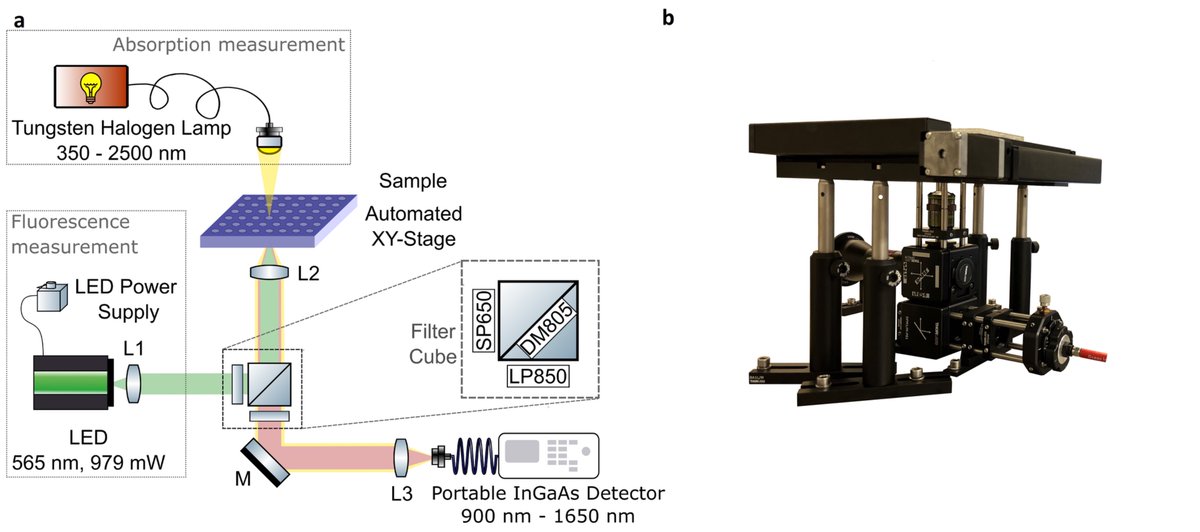
If you are interested in near infrared (NIR) absorption and fluorescence spectroscopy: Here is a a simple, low cost instruction. https://t.co/ckF9TU3EeM You can also equip It with a xy controller for high throughput screenings. Congrats to Krisko. @ruhrunibochum@SolvationSci
@krusslab report a new method to incorporate tiny perturbations (quantum defects) into the lattice of carbon nanotubes: it works without purification, creates brighter fluorescence and enables applications in sensing #openaccess
https://t.co/OnslKRvuQa
Where did carbon nanotubes go? Were they just hype? No! They’re in your lithium ion batteries and more! “Industrial Adoption of Carbon Nanotubes” - Open access! https://t.co/ebIrcpOqDW
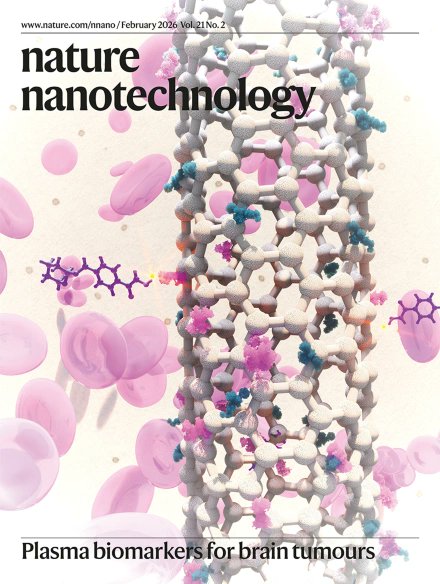
On the cover of this month's issue of Nature Nanotechnology! Our nanosensor + AI-based liquid biopsy (blood test) for brain tumors that also enables the discovery of new biomarkers. https://t.co/AnhR4rXzNV
Our lab has had a productive, exciting couple of weeks! We had a review article come online in Advanced Sensor Research, in which we focus on rational design of optical nanosensors with molecular recognition elements Great work led by Dr. Amelia Ryan! https://t.co/9KKDu8CsXf
Great collaboration with @PhilipTinnefeld@Vukovic_Lab and special congrats to Izabela and Justus. We show in @angew_chem that @nanocarbons quench dyes with a beautiful d^-5 scaling law. Interesting perspectives for nano engineering... @SolvationSci https://t.co/7V2oJSTUC0
Congrats to Christina on her work in @ACS_Sensors . She developed a new biofunctionalization strategy for biosensors to detect CRP in human serum, which is an important biomarker for inflammation. @nanocarbons@ruhrunibochum@SolvationSci https://t.co/UFlWvtOpkK
Jeong lab published several papers in Jan. DNA-SWCNT evolution for prostate cancer (https://t.co/U5DBfOM5xn), semi automated DNA/SWCNT fab machine (https://t.co/PkyaPuJ1VQ), DNA-NP review (https://t.co/Hl7vnuiz71) Thanks to lab members and colaborators. @nanocarbons
Our new paper at Adv. Funct. Mater. We reviewed the sensing modalities required across the biological hierarchy from the cellular level to the organ scale. Check it out!
https://t.co/XTglrXFCTM
So, how reversible are your optical nanosensors? 🤔
📢Check out our latest preprint, where we quantify single-sensor recovery across repeated analyte exposure cycles and introduce a Population Reversibility Score ✅ https://t.co/VPlRgzBEpj
@TelAvivUni@nanocarbons@Tel_Aviv_Uni
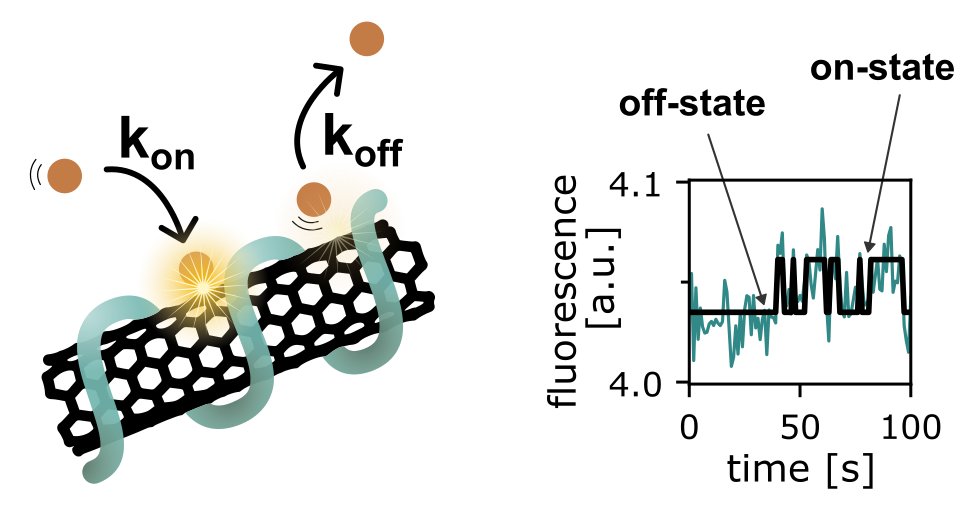
Congrats to Juliana! She measures in @acsnano the rate constants of nanosensors on the single molecule level. She found two kinetic pathways and one can use this knowledge for Kinetically Improved Sensor Selectivity (KISS). @nanocarbons@SolvationSci https://t.co/9x8FWsrE7j