up is powered by the most valuable asset there is: time.
If you provide liquidity on up and stake it, you're paid in $UP instead of trading fees, and those fees go to the people who lock.
The obvious question is why an LP would make that trade. The answer is that most $UP is locked. People commit it for up to four years to earn a share of every fee the exchange makes, and that commitment is what gives the reward its value.
The emissions are only paid while your liquidity is in range. So it stays tight on the price, the tight price wins the trade, and the trade earns a fee. The fee goes to the lockers.
Everyone wins the same way, so everyone pulls the same way, and the more aligned they are, the better up performs.
And unlike previous (3,3) deployments, the printing is capped. up only emits what each pool's fees can justify, which is how $242k went to lockers this week while barely inflating the supply to pay for it.
up.
Over 42,000 traders have stress-tested FX100 in eight weeks.
We already knew traders wanted more leverage.
The question behind FX100 was whether they also wanted more control when a leveraged trade moved against them.
More than 1.5 million positions have now been opened, and nearly 20,000 referral codes used.
The answer is becoming clear.
Traders aren’t only testing liquidation protection. They’re bringing other traders with them.
Join the testnet: https://t.co/cUMEEUpozq
up is a native exchange built on Robinhood Chain.
A public good, created for the chain from day one.
Two months in: nearly $1bn traded, $1.6m+ in revenue to users.
@koolkrypto223 you're missing the most important point. UP is different from most other veDEXs because of the dynamic emissions and gague caps.
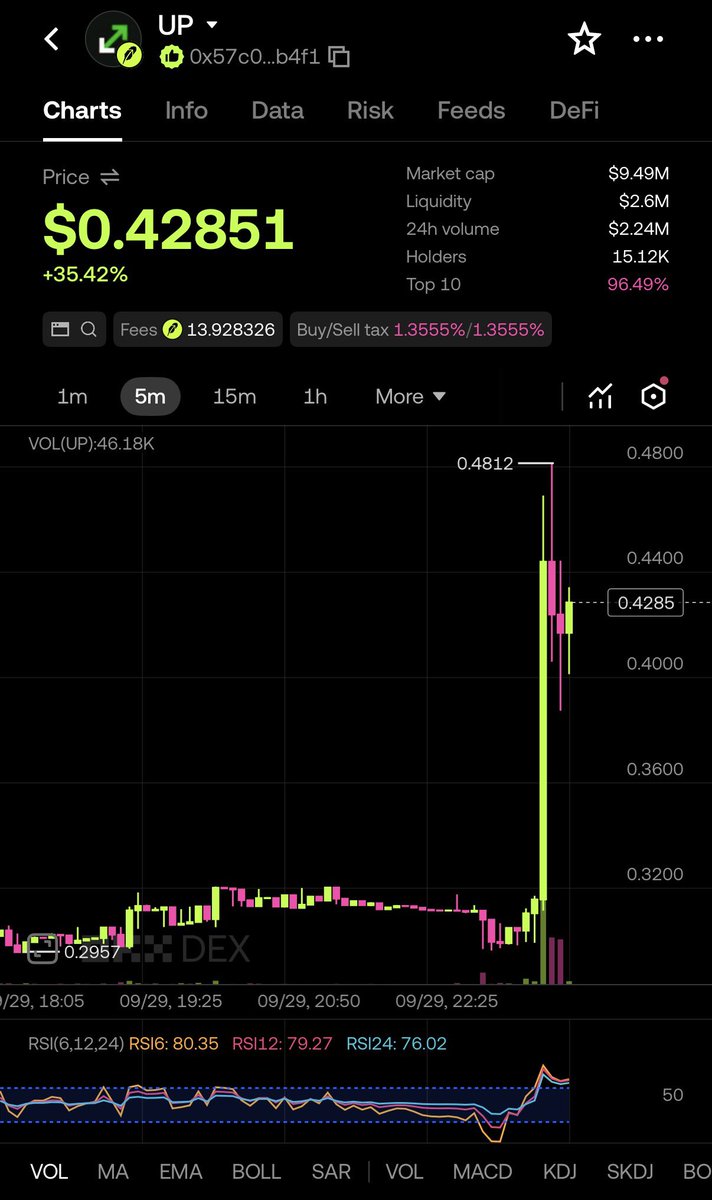
Pull up the chart of $THE, $HYDX, $AERO, $NEST and tell me how that looks like $UP's chart in the first 3 months of their launches.
Votes on up set a ceiling for each pool. Fees decide how much of it gets paid, and the rest is burned.
That ceiling can be raised at any point in the epoch. If a pool starts pulling more volume, more emissions can reach its LPs while it's happening, where the growth is.
Emissions follow demand within the week, without waiting for the next vote or a cooldown to run out.
Coming up: releasing emissions mid-epoch to new pools with no votes yet, the moment demand appears.
up.
If @coinbase and its founder @brian_armstrong are backing your base:0x940181a94a35a4569e4529a3cdfb74e38fd98631, you sleep well at night.
$2 —> $5 —> $20
@dcfgod Yup revenue is king. That's why I'm very bullish on $up. They are the #2 dex behind $uni on RH and the #1 native dex on RH.
Team understands capital efficiency and has optimized the protocol to generate fees without diluting holders.
Very undervalued right now.
up is the first ve(3,3) DEX to combat inflation while still creating substantial value ($1.65m) for investors.
All previous ve(3,3) deployments emit too much and become inflationary, or don’t produce enough revenue to justify their emissions.
up does both - supply flat, revenue up.
700,000 UP burn ($323,000) 🔥
Protocol owned liquidity is staked, so it earns emissions like any other LP, while the fees it generates go to UP lockers.
We just burnt every emission it has ever earned and will continue to do so as we shrink the supply and move towards decentralisation.
Txn: https://t.co/SWYgvFvyP3