Remarks from Anthropic CEO @DarioAmodei on our initial public offering:
My co-founders and I started Anthropic because we believe that the most powerful technology of our time should be built for the benefit of humankind.
Daniela and I lost our father to a disease that, just a few years later, became curable. I started my career in biology, hoping to help future cures come sooner. In the lab, I saw the vast thicket of complexity that scientists face when they’re trying to understand disease and develop new treatments.
So many of the scientific tools that can cut through that thicket—tools for gene editing, gene synthesis, controlling brain cells with light—started as pure ideas. In other words, they came from thinking. From intelligence.
Human intelligence has already made diseases like plague, smallpox, and polio history for most of the world. But progress on other diseases has been too slow for so many patients and their families. Going from a great idea to a treatment can take decades: it took many years from the first discovery of a strange repeating pattern in DNA to the approval of the first treatment for a disease using CRISPR.
Nature is full of these patterns. But we’ve had too little intelligence to decipher most of them; too few scientists, with too little time. Now we can build that intelligence. Whether it’s protein folding, drug design, cancer genetics, or clinical trial administration, scientists across many areas of biology and medicine are finding Claude can help them do their research in a fraction of the time it would’ve taken just a couple of years ago. I believe sufficiently powerful AI, working in concert with humans, could compress a century of scientific and medical progress into a decade.
I don’t want to get ahead of myself. At this point all we have are early results. Experiments and clinical trials will still take time. And although they involve slow and ponderous processes, I believe those processes can be substantially accelerated by AI. We hope that in the future fewer families miss a cure by just a few years.
Medicine is just a particularly vivid example, but there are many others. Our customers—the world’s most ambitious companies, nonprofits, and individual people—are already applying the intelligence we’ve built to stimulate economic growth; lift people out of poverty; protect democracy and free societies; even make everyday services like the DMV work better. We’re proud to work alongside them. And I’m extremely optimistic about what we can do together in the future.
At the same time, we have always been honest that this technology has very real risks. These range from misuse of the technology by individuals or nation-states, to economic disruption, to losing control of AI systems. We discuss these risks not because we think they are inevitable, but because we think they are avoidable.
Avoiding them depends on the choices made by the people building AI. There is a gigantic difference between how AI will go if we pay little attention to safety, versus how it will go if we are obsessed with safety. And an obsession with safety and with public benefit has been woven into Anthropic’s DNA from the start. From safeguards against biological and cyber risks, to alignment training and testing, to looking inside our models like an X-ray, Anthropic has pioneered methods for understanding and steering the behavior of AI systems.
There is much work still to be done, and the most difficult safety work lies ahead of us. The incredible talent of the company that has enabled us to build the most capable AI systems will need to be directed, even more so than it has already, towards double- and triple-checking that those AI systems are safe and secure.
And to state it unequivocally, we will pace the training and deployment of AI systems, taking as long as is necessary to have confidence that they are safe and will remain under human control. We will not bend to either business or political pressure. Today puts the company in a stronger financial position, and in doing so only strengthens our resolve to do the right thing.
If we can show it’s possible to make the right choices on safety and still build an incredibly successful company, others in our industry will be inspired to do the same. We call this a race to the top. When the race to the top is working properly, it doesn’t matter which company has the best models—everyone wins because everyone is building safely. The race to the top works best when driven from the front of the pack, and we fully hope and expect to do so, but the goal is to make the whole industry better, regardless of whether Anthropic is winning or losing at any given time.
The advent of machine intelligence is one of the seminal moments in human history, and we have a rare opportunity to shape it for the better.
This moment is bigger than any one company, or any one country. It will take all of us, working together, to ensure this technology goes well for us and the many generations to come. Starting today, we hope that you’ll join us on this mission.
JUST IN: $230,000,000,000 wiped out from the crypto market cap in the past 24 hours.
$BTC crashed 6.74%
$ETH crashed 9.36%
$BNB crashed 9.34%
$XRP crashed 10.92%
$SOL crashed 11.79%
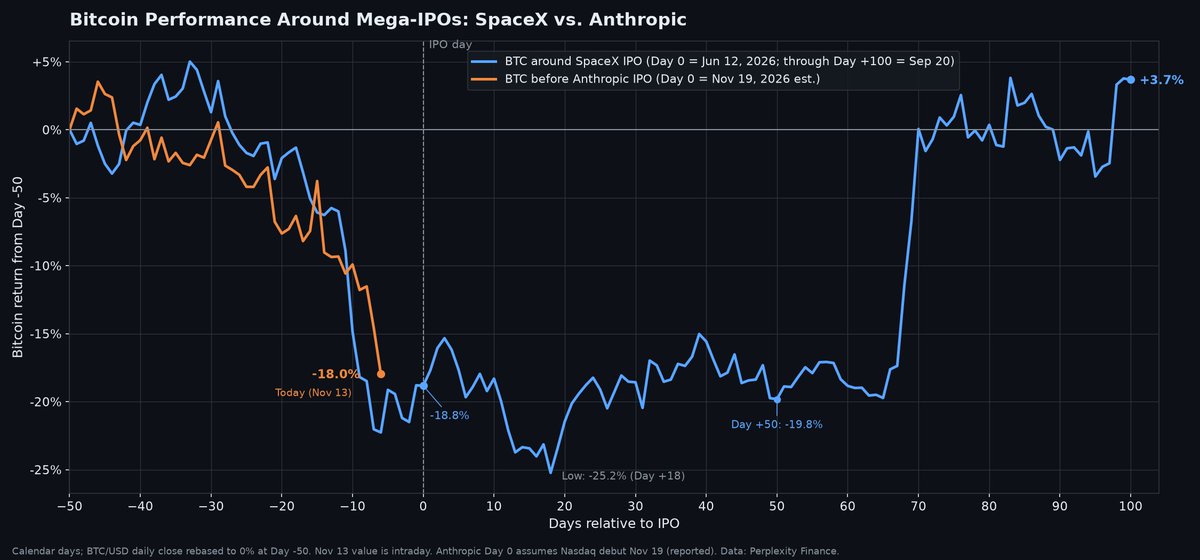
Bitcoin fell 19% into the biggest IPO ever. Now it's down 18% heading into the second biggest.
SpaceX raised $75B when it went public on June 12. In the 50 days before it listed, Bitcoin dropped 19%. Anthropic plans to raise up to $64B when it lists next week, and Bitcoin is down 18% over the same stretch. Overlay the two and they look almost the same.
What happened after the SpaceX IPO is the notable part. Bitcoin bottomed 18 days after the listing, then recovered all the way. By Day 100, it was above where it started.
Bitcoin around the SpaceX IPO:
Day -50 to IPO day: -19%
Low (Day +18): -25%
Day +50: still -20%
Around Day +70: a sharp rally
Day +100: +3.7%
From the IPO-day close to Day +100, Bitcoin gained 28%. From the low, it gained 39%.
The takeaway is that the selling came in the run-up to the listing. The bottom had effectively happened by the IPO, and the recovery came relatively shortly after, and it came all at once.
If Anthropic follows the same pattern, most of the drawdown is behind us, and it could reverse quickly over the next couple of months. And Bitcoin is sitting right at its 200-week moving average.
Map the SpaceX path onto today's price and you get roughly $90k by late February. Markets rarely follow a comparison like this exactly. But we remain very constructive on both the technicals and the fundamentals heading into 2027, and it's not hard to imagine what the narrative would be if anything close to this plays out.
Today, Jensen Huang announced he is stepping down as CEO of Nvidia.
He founded $NVDA when he was 30 years old to transform gaming by making powerful 3D graphics accessible to everyone.
33 years later, it is now the backbone of the AI revolution, worth over $4,000,000,000,000
The recent security incidents involving Bybit, Bitget, and now Binance should serve as a wake-up call for every leader in the crypto industry.
Security should never be an area of commercial competition. It is a shared responsibility to protect our customers and the entire industry.
Over the past decade, major crypto exchanges have made significant progress in protecting private keys. We have seen relatively few incidents involving direct private key compromises in recent years. So far, we have not seen conclusive evidence that Binance’s hot wallet private key was leaked. The greater concern may lie in vulnerabilities in access controls and wallet management systems.
Companies that have never experienced a major security incident should not assume they are inherently safer or immune to attacks.
At OKX, we have built multiple layers of sophisticated security protection and maintained a strong security track record over the past decade. But we also recognize that no system is absolutely secure. We must remain humble, vigilant, and constantly challenge our own security assumptions.
A major security breach at any exchange undermines trust in the entire crypto industry, ultimately hurting every company and every customer.
I believe CEOs across the industry need to come together, just as we did during the Bitcoin fork crisis in 2017, to establish stronger industry-wide security standards and coordinated response mechanisms.
For example, transfers and settlements between verified exchanges could be processed in real time, while large withdrawals to unknown or unverified addresses, as well as transactions granting smart contract permissions, should be subject to additional verification and appropriate security delays.
Crucially, these safeguards should be enforced at the cryptographic signing layer, rather than relying solely on application-level controls. Even if an attacker compromises an exchange’s wallet management system, they should not be able to bypass these fundamental security restrictions.
We should also establish industry-wide mechanisms for real-time security incident notifications, coordinated monitoring of suspicious funds, and rapid responses to potential attacks. Exchanges, stablecoin issuers, and other major industry participants should work together to enable the rapid, lawful temporary freezing of suspected stolen assets when necessary.
We should also work together to accelerate the industry’s transition to quantum-resistant cryptography and strengthen our defenses against emerging AI-powered security threats. These are long-term challenges that no single company can solve alone, and they require coordinated research, shared standards, and collective action across the industry.
Security is everyone’s responsibility. No company can protect the future of crypto alone.
BREAKING: World's largest crypto exchange Binance hacked with over $5.6 billion stolen:
• $1.45 billion $BTC
• $875 million $ETH
• $234 million $TRX
• $50 million $XAUT
• $1.57 billion $USDT
• $823 million $USDC
• $75 million $WBETH
• $88.5 million $RLUSD
+ $447.5 million additional cryptocurrencies
This is the largest hack in crypto history.
your phone number is personal and sometimes you want to connect without handing it over. that's why we're introducing usernames for WhatsApp.
starting this week, you can reserve a username to use later this year when we launch the feature. It takes just a few seconds, make sure you have the latest version of WhatsApp and then go to Settings > Account > Username.
What a huge loss? A loss for whom—European regulators or the people of Europe? What exactly did Europeans lose? Another October 11?
According to public reports, the company failed to demonstrate that its AML, sanctions compliance, and market integrity programs are effective, and did not obtain a license. Yet instead of reflecting on those issues, it claims that Europe is the loser.
That says a great deal about the company’s attitude toward the rule of law and financial regulation.
Sad to see EU cutting their users off from the best liquidity in the world. Liquidity is the best consumer protection. Hope to see things change in the future.
🔐 Selon vous, quel est le MEILLEUR moyen de conserver sa seed phrase Bitcoin sur le long terme ?
• 📝 Écrite sur papier dans un endroit caché
• 🛡️ Gravée sur une plaque en métal résistante au feu/eau et cachée
• 🧠 Mémorisée de tête
• 🏦 Stockée dans un coffre à la banque
• 🔒 Découpée en plusieurs morceaux à différents endroits
• 👨👩👧 donner une partie de la seed à un proche de confiance
When I gave this speech in October 2022, Bitcoin traded near $20,000, Strategy held 130,000 BTC worth about $2.6 billion, and $MSTR was ~$24 split-adjusted. Weeks later, after Bitcoin fell below $16,000, our debt exceeded the combined value of our BTC and cash reserves by ~$300 million, and $MSTR fell into the $13 range by year-end.
We stayed focused, strengthened the company, and executed our strategy. Since then, Strategy has raised over $60 billion of additional capital and invested it in Bitcoin, adding more than 716,000 BTC. Today, our BTC and USD reserves exceed debt by ~$48 billion. Thank you to everyone who believed, endured, and took the long view.
CZ on Hyperliquid: I think the Hyperliquid invention is actually awesome. They occupy a niche that Binance cannot compete. They don't have KYC.
But then he adds with a smirk: They claim they’re decentralized… I would never do what they do, given what I’ve experienced… I assume they have good lawyers.” 🤡