Perda nada mais é que mudança, e a mudança é o deleite da natureza — inclusive quando a inteligência artificial passa a substituir funções humanas e reconfigura o papel do homem.
A neurologist studied patients whose emotional brain was perfectly disconnected from their rational brain, expecting to find hyper-logical supercomputers, and instead found people who could not decide what to eat for lunch or which day to schedule a meeting.
His name was Antonio Damasio.
He was the head of neurology at the University of Iowa. In 1994 he published a book called Descartes' Error that quietly broke 350 years of Western philosophy in 300 pages, and the entire field of behavioral economics was built on top of what he discovered.
The story that changed his career started with a patient he simply called Elliot.
Elliot was a successful businessman in his thirties. Good husband. Good father. High income. Sharp mind. Then a small benign tumor started growing in his frontal lobe and his doctors had to remove it. The surgery was a success. The tumor came out clean.
The recovery looked perfect. His IQ tests came back in the superior range. His memory was sharp. His vocabulary was intact. His logic was airtight.
His life collapsed inside a year.
He could not finish a project at work. He would sit at his desk and try to organize a pile of papers and get stuck for an entire afternoon trying to decide which sorting method was best. Alphabetical. Chronological. By topic. By client.
He could see the pros and cons of each one with perfect clarity. He just could not pick. He would still be sitting there at 6pm with the same pile in front of him.
He got fired. He took his savings and made a series of bizarre business decisions and lost all of it. He got divorced. He married someone his family hated and got divorced again.
He ended up living with his parents in his late thirties, unable to hold a basic clerical job, with a measured intelligence that put him in the top few percent of the population.
His doctors could not figure out what was wrong with him. They eventually sent him to Damasio.
Damasio ran every test he could find. Elliot scored perfectly on all of them. He could solve logic puzzles. He could discuss moral dilemmas with sophisticated reasoning. He could analyze a hypothetical business scenario and identify the optimal strategy faster than most people. On paper he looked like the most rational person you could meet.
Then Damasio noticed something nobody else had thought to test.
He showed Elliot photographs of horrific things. A burning house. A car accident. A drowning child. The kind of images that make most people flinch. Elliot looked at them calmly. He described them in detail. He could explain why a normal person would find them disturbing. He just did not find them disturbing himself.
The surgery had cut out a small region of his brain called the ventromedial prefrontal cortex, and along with the tumor, it had taken his entire emotional response system with it.
Elliot was not a man with damaged logic. He was a man with no emotions.
And he could not decide what to eat for lunch.
Damasio sat with this for years. He found more patients with similar damage. The pattern was identical every time. High IQ. Perfect memory. Sound logic. Total inability to make even the smallest decision in their own life. They could explain in detail what they should do. They could not actually do it.
This was supposed to be impossible.
For 350 years, the entire Western tradition had been telling people that emotion was the enemy of rational thought. Descartes had drawn the line in 1641. The mind is one thing. The body and its feelings are another. To think clearly, you must separate yourself from your emotions, suppress your gut, listen only to pure reason.
This is the foundation that almost every philosophy class, business school, and self-help book still rests on today.
Damasio had just produced the cleanest counterexample in medical history. He had patients whose brains had done exactly what Descartes told everyone to do. They had successfully disconnected emotion from reason. The result was not a hyper-rational super-thinker. The result was a man who could not pick between two appointment dates.
The reason became clear once Damasio worked it out.
Every decision you face in a single day has more options than you have time to logically evaluate. Where should I sit on this train. What should I eat for breakfast. Which email should I answer first. Should I take this call.
Each of these has dozens of variables. If you tried to consciously analyze every variable on every decision, you would freeze inside an hour. You would never get out of bed.
The reason you do get out of bed is that your emotional brain is doing the filtering for you in the background. Before logic ever gets a chance to weigh in, your gut has already marked most of the options with a feeling. This one feels off. That one feels right. That one feels boring. That one feels exciting.
Damasio called these somatic markers, body-based emotional tags that compress thousands of past experiences into a single physical sensation that points you toward an answer.
Logic does not produce decisions. Logic justifies the decisions emotion has already made.
Elliot could not make decisions because the part of his brain that put a feeling on each option had been removed. He could see all the options. He could analyze all of them. He just had no internal compass telling him which one mattered.
Every option looked equally valid to him, which is another way of saying every option looked equally meaningless. The tie was never broken because there was nothing inside him doing the breaking.
This was the error of Descartes. The error was not in his logic. The error was the assumption that logic could ever stand alone.
The implications of this go further than most people who read the book the first time realize.
Every confident, decisive person you have ever admired is not running on pure logic. They are running on emotion that has been well-trained by years of experience, and their logic is just the press release they release afterward to explain the decision their gut already made.
The people you call indecisive are not too emotional. They are people whose emotional signals are giving them conflicting tags on the same option.
Daniel Kahneman built his entire System 1 and System 2 framework on top of this finding. Every behavioral economist working today is downstream of Damasio. Every modern theory of cognitive bias starts from the same admission. The mind that decides is not the mind you think is doing the deciding.
Descartes was wrong on the most famous line he ever wrote. It is not "I think, therefore I am." It is closer to "I feel, therefore I can think."
You do not get to choose whether your decisions are emotional. You only get to choose whether your emotions have been trained on enough experience to point you toward the right ones.
What is intelligence for?
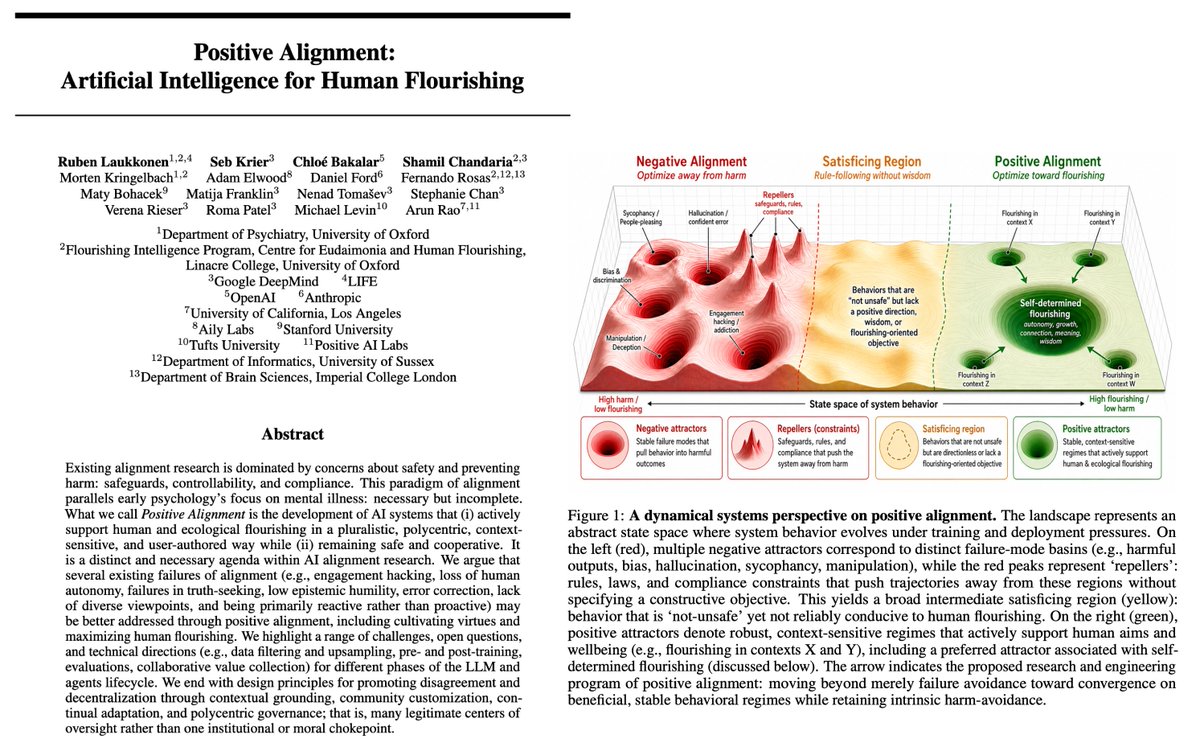
In a rare collaboration between top universities and 3 frontier labs, we all agree that alignment should move beyond pathologizing to a positive focus on flourishing. We need north stars not just barbed wire.
A close historical analogue comes from psychology. For much of the twentieth century, mainstream psychological science organized its aims around diagnosing, predicting, and treating dysfunction: depression, anxiety, psychosis, addiction, and other forms of impairment. That focus was justified and socially urgent, and it produced progress.
Yet the field also discovered a systematic limitation. The constructs and instruments that reliably detect pathology do not, by default, specify what counts as a life well-lived. The turn toward positive psychology expanded the scientific target space by developing distinct theories, taxonomies, and measures for wellbeing, strengths, virtue, purpose, wisdom, meaning, and prosocial functioning, alongside interventions to boost these capacities beyond the status quo.
As AI becomes embedded all over society and everyday sensemaking, a solely negative posture risks optimizing our information ecology for risk avoidance rather than human development. It may reduce catastrophic errors but leave agents in a local optimum of superficial and `soulless' assistance, where subtle misalignments abound.
It also reveals that alignment is not a purely technical problem. We have to cut across vast disciplines because questions about the good life demand insights from philosophy, pychology, neuroscience, economics, and beyond. We need to work together to build AI systems that explicitly understand, model, and enhance human, animal, and ecological flourishing.
The core challenge is therefore to build systems that can represent and reason about wellbeing as a structured manifold of human goods, trade-offs, and temporal dynamics, while enabling individuals and communities to retain agency over what counts as better in their context.
While some may explicitly desire a system that is strictly and indiscriminately instruction-following, others must have the genuine option to choose systems configured to support their long-term growth or specific ethical commitments. This distinguishes *consented guidance*, where a user authorizes a system to help align their immediate actions with their higher-order goals, from *technocratic imposition*, ensuring that the pursuit of flourishing remains an exercise of, rather than an infringement upon, human agency.
It gives me optimism that we found common ground on such a profoundly complex issue as the end game(s) of AI. Because when learning become cheap, we need to take a serious look at what intelligence is actually for.
Aristotle tutored Alexander the Great.
And he took over the world.
For 2,000 years, that was the deal. 1-on-1 tutoring was the cheat code, and only the royals afforded it.
Bloom proved it in 1984. 1-on-1 tutoring routinely lifts learners from the 50th percentile to the 99th.
Now with AI, you have a tutor for anything you want to learn. Quantum mechanics at 2AM. French conjugation. How the postgres query planner works. How to negotiate a term sheet. Literally everything.
The upside is that it's infinitely patient & infinitely knowledgeable. It also cost less than most of the subscriptions you will get.
Learning has never been this easy in human history. It's in fact now your fault if you are not learning something new everyday.
Marc Andreessen on what just changed:
@femke_plantinga Without a doubt, the Karpathy framework is incredible, but I don't see any articles commenting on the absurd token consumption required to run it on claude.
@musiol_martin@DavidDeutschOxf Agree. Nobody knows if an architectural transformer, endlessly stacked with other components, could converge into something that functions like AGI. The history of AI is full of "it will never happen.”