None of this is surprising once you look at the countries closely. India in 1984 was poor and then grew fast, so to rebuild that path you need donors that start poor and then move quickly. Ethiopia is the only country in the pool that starts poorer than India, Bangladesh is the only one that starts level, and everything else begins richer, some of them many times over.
That is what creates a dependecy on these two countries. China grew far too fast to pass for India on its own, so the blend needs something poor and slow to hold the average down, and Ethiopia and Bangladesh are the only candidates available. Take them out and the best blend the method can build starts 1984 at $1,831 against India's $1,317 and widens over the next decades. So without these two, a counterfactual Synthetic India is not meanigful anymore.
tl;dr - The $1,000 figure is not robust enough to be taken seriously. (7/7)
This paper doing the rounds is claiming that real per-capita income of India is roughly $1,000 less than what would have been without Modi government. After replicating the results, and extending the analysis, here are some serious issues I find with the work:
1. The gap between India and the counterfactual synthetic India is overwhelmingly explained by growth in Bangladesh and Ethiopia. But Bangladesh and Ethiopia both have questionable GDP numbers and without them the remaining pool cannot produce a credible counterfactual. Bangladesh's own government concluded that its growth figures had been overstated, worsening after FY2012-13, which is roughly when this study's treatment period begins. Meanwhile Ethiopia went through a civil war, inflation above 20 percent for several years, severe foreign exchange stress and a sovereign default.
While the authors spend time worrying about whether Indian economic data can be trusted, they raise no such concerns about the countries they are comparing India to. (1/7)
https://t.co/nb5ikZ60Hi
Anyway, I dropped Bangladesh from the pool and their estimated gap falls to around $550, so removing a single country takes more than 40 percent off the headline number. When Ethiopia is dropped instead, Bangladesh's weight jumps from 25% to 76%. This makes the dependence on questionable Bangladesh data even starker.
So does the model still work without both of them? No, and not by a small margin.
Before 2014 the published model tracks India's actual income closely, with a typical yearly miss of about $60. Take those two countries out and the best the remaining twelve can manage is a miss of $684, more than ten times worse. I checked every possible weighting and there is no better answer available. (6/7)
'A mental health crisis is brewing among Indian youth. Religion can be a lifeline'
Kishen Shastry @kskishen, PhD scholar, University of Cambridge writes
#ThePrintOpinion
https://t.co/lwU1EOWDZA
That matters because India may not be able to grow around weak states forever.
If the next phase of growth depends on power, land, cities and farms, then state capacity is no longer a side issue. It is the main issue.
My fuller argument in ThePrint:
https://t.co/jiAeWDfEFu
Why don’t we see big state-level reforms in India anymore?
E.g: Power, land, cities, and farm markets. Many subjects that would shape the next stage of growth are state subjects. Yet very few CMs seem eager to spend political capital on them.
Everything is now optimised for welfare transfers, and the state machinery follows. It gets better at lists and payments. But where do new reform ideas come from?
A US president gets thousands of political appointees. An Indian PM/CM mostly inherits a permanent bureaucracy.
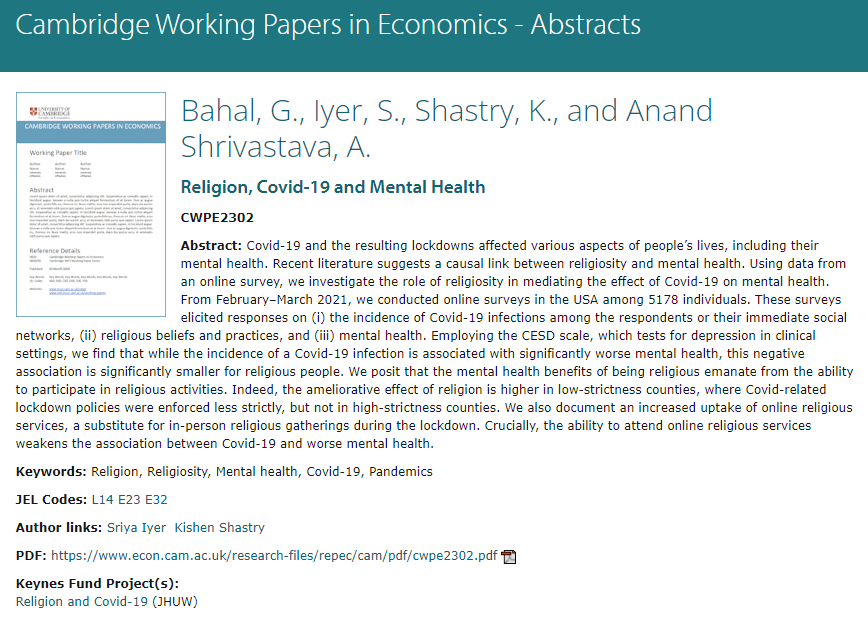
New working paper: Religion, Covid-19 and Mental health, with @GirishBahal@kskishen and Sriya Iyer
https://t.co/SRoP1gluL9
We ask if and how religiosity mediates the effect of Covid-19 on mental health in the US, using online survey data from Feb-Mar 2021
Details in 🧵..
.@SriyaIyer, Kishen Shastry @kskishen et al. have published new #KeynesFundResearch which explores the role of religiosity in mediating the effect of Covid-19 on mental health. You'll find the WP @CamEcon here:
https://t.co/FTwJkAn9L7