@markmk1961 You are beginning a different journey— a new chapter in life no one wants nor expects. I pray you have the daily strength to fight the daily challenges and emerge victorious over this illness.
Rochester NY is a small to medium size city and over the last week there have been twenty people shot, including a 12 year child.
I have not seen one statement from any of our DEMOCRAT representatives that created the laws that empower the criminals to terrorize our streets. Not one.
The silence is deafening.
@RepJoeMorelle@DemondLMeeks@SenatorCooney@HarryBBronson
@ArlineL0 DELIBERATE NEGLIGENCE. When I saw this calendar of events I knew there'd be violence. So did every normal citizen w zero law enforcement background. It's a war zone. Any politician backpedaling is 💯 gaslighting Rochesterians. See below for dates of future shootings😓👇
"I am thankful the RPD was prepared with staffing..."
At least 12 officers who worked last night were mandated to.
Mandated on a holiday, for a Special Event no less, because we are understaffed by 125+ officers.
It's time for the City to take the staffing crisis seriously.
The American flag existed long before Donald Trump, and it’ll still be here long after him.
If your patriotism rises and falls based on who’s in the White House, maybe your allegiance is to politics—not the country.
The flag represents the nation and its people, not whichever administration happens to be in power.
God bless America. 🇺🇸
This might be President Trump's finest moment of all time.
"We must never forget there is no American freedom without American culture and there is no American founding without the American people.
"A constitution is only as strong as the people and the culture responsible for upholding it."
"the United States of America will forever be the land of free men and women, and we will never, ever fail."
"Above all, Americans love freedom. We cherish independence, and we know that we are the heirs to the most beautiful land"
"In America, we do not need anyone's permission to say what we think and to live as we please, to worship as we choose, or to keep and bear arms."
@unreMARKLEble And her interactions with the girl child are performative. The child is dressed like a waif and pulls away from her mother who mugs for the camera. Lili is an accessory like a purse.
In September of 1814, America was once again in trouble.
The young republic was only thirty-eight years old. The War of 1812 had gone badly. British troops had marched into Washington, burned the Capitol, set the White House ablaze, and now turned their sights toward Baltimore. If Fort McHenry fell, the harbor would be open, the city would likely follow, and another devastating blow would be dealt to the fragile nation.
Amid this uncertainty, a young American lawyer named Francis Scott Key sailed under a flag of truce to the British fleet. He had come to negotiate the release of a friend, a physician the British had captured.
He succeeded.
The British agreed to free the doctor.
But there was a catch.
Because Key and his companions had seen too much of the British fleet and learned too much about its plans, they were not allowed to return to shore. Instead, they were detained aboard a ship in the harbor and forced to watch the coming battle from behind enemy lines.
On the morning of September 13, the bombardment began.
For the next twenty-five hours, British warships unleashed somewhere between 1,500 and 1,800 bombs and rockets upon Fort McHenry. These were the “bombs bursting in air” and the “rockets’ red glare” of the song—not poetic embellishments, but terrible realities.
Key stood on the deck through the endless day and the long, terrifying night. Every explosion lit the darkness for a fleeting instant before the smoke swallowed everything again. Somewhere beyond that wall of fire stood the fort. Somewhere beyond it flew an American flag if it still flew at all.
He could not see.
He could only listen.
As long as the guns continued firing, there was reason to hope. The British would not waste ammunition on a fort that had already surrendered.
Then, just before dawn…
The guns fell silent.
For the first time all night, there was only stillness.
It was the most frightening sound of all.
Had the fort finally fallen? Had the defenders surrendered? Had the flag been torn down in the darkness while no one could see?
There was nothing to do but wait.
As the first light of September 14 slowly pushed back the smoke, Francis Scott Key strained his eyes toward the distant fort.
Then he saw it. Not a British flag.
The American flag. Still there. Still flying.
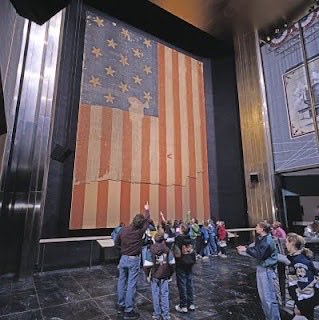
That flag was no ordinary banner. Months earlier, the fort’s commander had commissioned a Baltimore flagmaker, Mary Pickersgill, to sew a flag so enormous “that the British would have no difficulty seeing it from a distance.” It measured roughly thirty by forty-two feet, carried fifteen stars and fifteen stripes, and was so large it had to be assembled on the floor of a brewery because no ordinary room could contain it.
That was the Star-Spangled Banner.
The very flag Key saw through the morning mist.
The very flag that still survives today in the Smithsonian.
Overcome by what he had witnessed, Key reached into his pocket, pulled out an envelope, and began writing. The words came from a heart that had spent an entire night fearing his country might disappear with the dawn.
He first titled the poem Defence of Fort M’Henry.
Within days it was printed and circulating throughout the country. Before long, people began singing it to a melody they already knew—an old British tune called “To Anacreon in Heaven,” originally written for a London social club. There is something beautifully ironic in that: America’s most beloved patriotic song borrowed the melody of the very nation it had just survived. It also explains why the anthem is so notoriously difficult to sing. It was never written for ordinary voices gathered in stadiums or school assemblies.
The song spread quickly and became one of America’s favorite patriotic hymns, but it would wait more than a century before receiving official recognition. Not until 1931 did Congress declare “The Star-Spangled Banner” the national anthem of the United States.
America is a place, merged with an idea. Americans are those here who agree to this idea. The idea is that anything is possible and that you can live your life the way you want, so long as that way does not impinge on others’ ability to live the way they want.
As the current custodians of America, we will keep this idea sacred, so that it is healthy and alive for those who come after us. Just like those of the past 250 years did for us. Happy 4th of July.