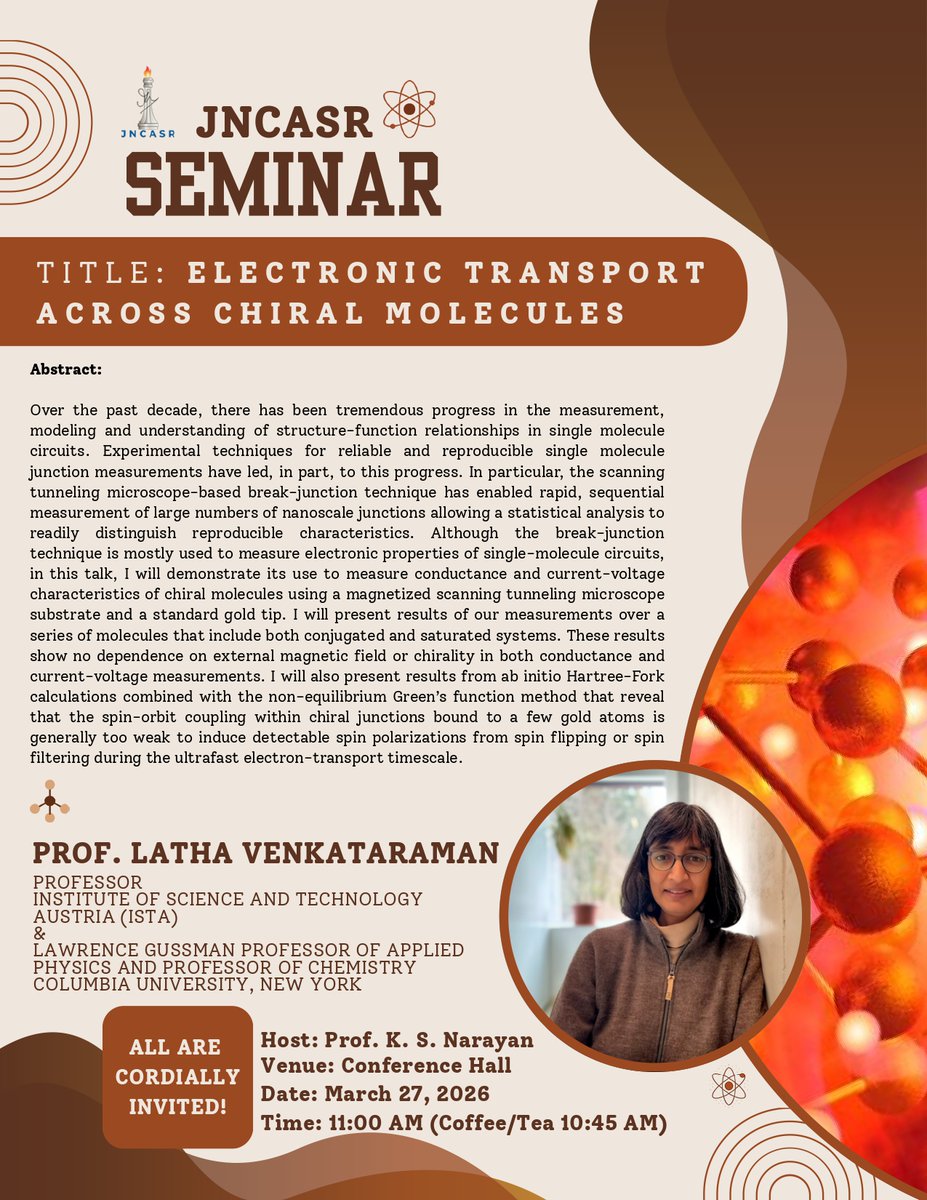
📢JNCASR Seminar
Title: Electronic Transport Across Chiral Molecules
Speaker: Prof. Latha Venkataraman
Columbia University & ISTA
🗓️March 27, 2026 | 11:00 AM
📍Venue: Conference Hall, JNCASR
Host: Prof. K. S. Narayan @ksnarayanlab
All are welcome
@IndiaDST
Students who have cleared CSIR-JRF or who have the DST-Inspire fellowship, and interested in pursuing a PhD in exciting areas of solar PV, bioelectronics, device physics please do apply https://t.co/XULwQCFP7Y I have positions open.
The deeper you go into the semiconductor supply chain, the less believable it becomes.
> TSMC, a company on a small island, produces over 90% of the world’s most advanced chips
> TSMC relies on dutch company ASML for EUV lithography machines
> ASML depends on German Company Carl Zeiss, the only firm in the world capable of making mirrors precise enough for ASML’s requirements.
> The light source for ASML’s EUV machines is produced by a single company in San Diego.
> The photoresists used to print transistor patterns are produced by Japanese firms like JSR and Tokyo Ohka Kogyo.
> The ultra-pure quartz needed to make silicon wafers comes entirely from a single mine in Spruce Pine, North Carolina.
> The copper and rare-earth materials inside chips are mined and refined across Chile, the Congo, and China.
> The specialized gases used in chipmaking, like neon and fluorine, largely come from Ukraine and Japan.
> The design blueprints for these chips often come from American companies like NVIDIA, AMD, and Apple, which rely on software tools from U.S. firms like Synopsys and Cadence.
Remove any single piece and the whole system collapses.
Our new paper https://t.co/75pXUIQbGj has come out, where we ask this profound question: What happens when you drop a liquid metal drop from a height on a substrate ? Well ! it creates an impact and spreads.
We use this method based on free fall and observe that the liquid metal drop after impact forms large-area films. We use metal alloys that have a melting temperature around 62 C (slightly higher than room temperature). So the dried films on the substrate can be re-heated and spun around to result in clean large area metal films (without any vacuum ).
These large area metal films have implications as electrodes and interconnects. Utilizing the physics of impact deposition and coupling it with a post-processing technique, we show formation of films with different thickness and shapes. These can be transferred onto any substrate of interest. These results can find its utility in flexible electronics.
Chinmay, graduate student from our laboratory led efforts that has appeared in
Units of Time measurement in Bengaluru
YeraDe Nimisha madam, alle iri bande .
Time, in Bangalore, does not follow the neat order of clocks, calendars, or project timelines. It follows its own eccentric rhythm, marked by traffic signals, UPI pings, chai breaks, and civic projects that never seem to end. Ask anyone who lives here, and they’ll tell you: in Bangalore, “a few seconds” and “a few days” are not universal measures. They are local dialects of patience, sarcasm, and resignation.
A few seconds
In most parts of the world, a few seconds is just that : a blink, a pause, a brief moment. In Bangalore, it is the life cycle of a salary credit. The phone goes ting!—credited. In those very same seconds, the money has already evaporated into EMIs,rents, groceries, OTT subscriptions, and that one “let’s split equally” dinner with friends. The SMS notification is like a cruel joke: money comes in, waves hello, and walks out the door before you can even refresh your bank app.
A few minutes
Elsewhere, this means you’ll see someone in about five to ten minutes. But here, yeraDe nimisha saar (“two minutes, sir”) is a concept that deserves its own TED Talk. In Bangalore, two minutes is elastic: it could mean twenty minutes, forty-five minutes, or even “I’ll come after I finish lunch and a nap.” The art of promising immediacy and delivering eventually. Two minutes is not a measure of time; it is an expression of hope.
A few hours
This is commute territory. A few hours is what it takes to cross the city, especially if you’re brave enough to travel from one end to the other during peak hours by road. Koramangala to Manyata tech park? That’s not a trip, that’s a pilgrimage. Whitefield to Electronic City? That’s an entire Netflix mini-series with seasons, and dramatic plot twists. Bangaloreans don’t measure distance in kilometers; we measure it in hours of podcasts, missed meetings, and the number of times you say “one last leftu ” to the auto driver. We somehow still manage to travel across braving one pothole at a time..
A few days
When someone in Bangalore says swalpa time agatte, wait maadi saar, prepare to settle in. This is code for: “I have no idea when this will happen, but certainly not soon.” The excuse is always the same: they are busy, they had to go to Delhi, or their cousin’s wedding has swallowed their week. Callbacks, repairs, and favours all fall into this category. A few days in Bangalore can stretch into weeks, sometimes months, but the phrase keeps the illusion alive that things are progressing.
Eternity
And then, there are projects that exist outside of time. The Ejipura flyover, for instance. Should I say anything more ?
Well for the non-Bangalorean maybe its better I explain
You cannot ask when it will be completed because the question itself is meaningless. It belongs to the realm of myth, alongside the Loch Ness monster. Even Google Maps has stopped updating its status, as though embarrassed to keep lying. Bangaloreans drive past it like archaeologists examining an local Stonehenge . Was this ever meant to be finished, or was it simply built to test our faith?
The Bangalorean Clock
So, how do we measure time in Bangalore? Not by minutes or hours, but by lived experiences:
Time in Bangalore is not money and somehow, we’ve all learned to laugh about it #Bengaluru #timemeasure
Delighted to share that three faculty @JNCASR —Prof. Narayan, Prof. Subi George, and Prof. Umesh Waghmare—have been awarded the JC Bose Grants 2025, a competitive research grant from @ANRF_India.
A proud moment celebrating excellence in research.
@IndiaDST
Neural circuits in the absence of external input (retina disorders - RP/AMD) change connections between cells. Our results are important in the context of neural prosthetics, as the degree of degradation/changes in the circuit can be assessed to effectively stimulate the tissue.
Our developing-retina paper is out https://t.co/uFrVQ8HY5W. Really happy that our in-house effort, led by Abhijith Krishnan (who has recently submitted his thesis). @ANRFIndia@IndiaDST@jncasr Here is the story and the highlights :
This change in the effect of GABA is a hallmark of different developing circuits in the brain. The burst analysis, along with pharmacological blockade,their can be used to study developing neural circuits and to quantify its properties.·