I am selling 2 verified tickets for Barry Manilow: The Last Portland Concert on July 3, 2026 at Cross Insurance Arena , Portland via Ticketmaster. Interested? https://t.co/F42EqgNrV5
I went to In-N-Out and ordered a cheeseburger. The cashier, a calm young woman named Destiny, asked me a question I did not expect.
"You want that Animal Style?"
I paused.
I did not know what this meant. But a samurai does not admit he does not know. So I answered with weight.
"...Animal Style."
"Cool. So that's mustard-grilled, extra spread, grilled onions, pickles. Yeah?"
I understood now. This was a sacred permission. For one meal, I was being told to put down my manners at the door. To eat the way a beast eats, without shame. I had waited my whole life for someone to give me this order.
"Yes," I said. "I will become the animal."
Destiny did not blink. "...Okay. You want your fries Animal Style too?"
I stopped. Even the potatoes?
"The potatoes also become animals?"
"I mean, they get cheese and sauce and grilled onions, so..."
"Then yes. Let the potatoes abandon their restraint as well."
"...Got it." She was the calmest woman I have ever met. "3x3, 4x4, or just the one?"
I did not know these numbers, but I knew a challenge when I heard one. "How many must I face?"
"It's, like, how many patties you want."
"How many is the most honorable?"
"...Four is a lot."
"Then four. A warrior does not ask for fewer."
She wrote it down without argument. A 4x4, Animal Style, with animal fries. She warned me once, kindly. "That's gonna be huge." I told her I was counting on it.
It arrived. It was a tower. Cheese and sauce ran down my hands the moment I lifted it. There was no clean way to eat it. There was no dignified way. That was the entire point.
I ate it like a beast. Both hands, no honor, grilled onion on my chin, and I have to be honest with you, it was the best thing I have ever put in my mouth.
For thirty years I have kept my manners at every table in the world.
They handed me a burger and told me to be an animal, and I have never felt so free.
So tell me, America.
The whole country knows the secret menu. What else are you hiding in plain sight?
And "Animal Style." Was I eating the animal, or finally becoming one?
20 years ago, An Inconvenient Truth put climate change at the center of global debate, shaping politics, influencing leaders, and inspiring a generation of activists.
Two decades later, we can assess not just its impact, but its accuracy. Many of the film’s most alarming predictions did not materialize, while many of the policies it inspired have proven costly and ineffective.
The lesson? Panic is a poor guide for public policy. Focusing on innovation, adaptation, and economic development can do far more to help both people and the climate—at a fraction of the cost.
https://t.co/EIJyuNeFU1
https://t.co/PTSyFXF4vt
Origninally, as written, the draft of our Constitution outlined the powers under Federal authority and deligated all other lawmaking and enforcement powers to the states.
I view that as the: "Thou shalt" part.
But James Madison noticed there was no "Shalt Not" component, by which he meant things that the various institutions of government, on all levels, were forbidden to do by law.
Which is to say there needed to be specific, absolute, or near absolute, limits on what the various government could do.
Individuals were viewed as having rights that could not be tampered with.
And thus the Bill of Rights, 10 at first, were born.
The Bill of Rights is a list of "Thou shalt not" restrictions on government power that were codified and deliberately and specifically formulated to limit government power.
These limits were intended to keep the people safe from the most blatant forms of government overreach and the transformation of the country into a dictatorship of one kind or another.
The first Amendment guaranteed freedom of speech, religion, assembly, the right to petition the governmement, freedom of the press and also forbad the state from establishing a state religion.
The 2A was the right of individuals to own guns.
The Bill of Rights is unique to the United States. No other country in the world has anything equilivant. Meaning that no other country has a set of codified "Thou shalt nots."
So no foreign citizen has any "right" as outlined by our Bill of Rights, which makes citizens other than US citizens subject to the whims of their respective governments.
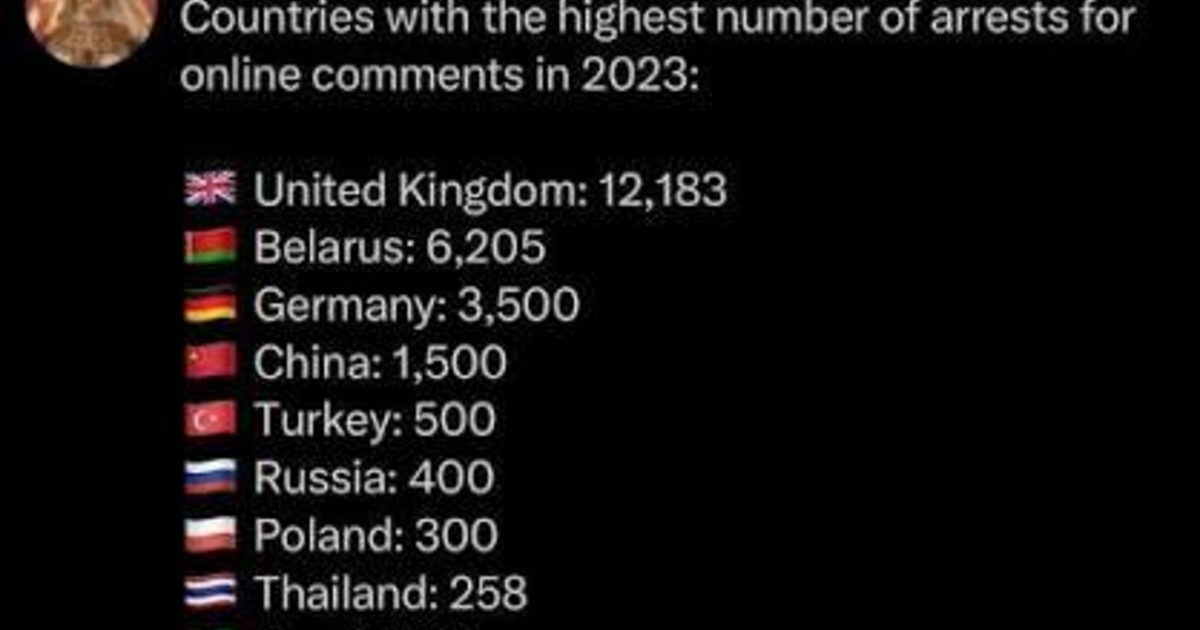
If you question this, in the last few years England punished more people for "speech infractions" (online comments) **than the next 4 restrictive countries combined**. (See below)
We are very lucky, or blessed, but I fear that, the past 50 years for lack of balanced educational institutions, the ignorance and/or lack of appreciation of our citizenry for what they have been bequeathed will overcome all protections our country's founders worked so brilliantly to produce.
Why we post about Britain. Because the British can't.
That, and because Britain is whence we sprang as a nation, and we still love Britain. And having expended considerable blood and treasure in Britain's defense, we are not without standing.
We hate to see Britain descending into its Labour nightmare. Mass migration. Two tier justice. Racist police who turn a blind eye to rape, let a young man die because the foreigner who stabbed him cried racism. Police who will show up promptly to arrest you if you post something that might "cause anxiety" or "offend" but more particularly challenge authority.
We do that for Canada, too. And Australia.
Why has such a swath of the Anglosphere become so wretchedly authoritarian? The Anglosphere having spread civilization and notions of liberal governance, free enterprise, individual freedom around the world.
By far the biggest part of the Anglosphere, the United States, thankfully remains free.
Charles is monarch of Britain, Canada and Australia. They have parliamentary government. And a lack of explicitly stated individual freedoms which has allowed the rise of despotism.
Follow us in this our 250th year. Listen, we're trying to tell you something. Let your World Cup revelations inform you, if that's what it takes. What we have been saying is true.
Here's the basic instruction:
"We hold these truths to be self-evident, that all men are created equal, that they are endowed by their Creator with certain unalienable Rights, that among these are Life, Liberty and the pursuit of Happiness.--That to secure these rights, Governments are instituted among Men, deriving their just powers from the consent of the governed, --That whenever any Form of Government becomes destructive of these ends, it is the Right of the People to alter or to abolish it, and to institute new Government, laying its foundation on such principles and organizing its powers in such form, as to them shall seem most likely to effect their Safety and Happiness."
In 1965 Malaysia kicked Singapore out of the Malaysian federation, and Tunku Abdul Rahman thought he had won. He had dumped a port city with no oil, no farmland, no fresh water, and two and a half million people crammed onto an island smaller than Lake Tahoe. Sixty years later Singapore's GDP per capita runs past $84,000 while Malaysia limps along under $12,000. The man who got expelled built the richest patch of dirt in Asia. The man who did the expelling built the New Economic Policy.
Let's study what happened.
Start with what Singapore lacked. No resources. No hinterland. No domestic market worth the name. By every theory that says a nation needs raw materials to prosper, Singapore should have starved. Instead Lee Kuan Yew made his country a place where capital felt safe. Low tariffs. Easy entry for foreign firms. Courts that enforced contracts instead of shaking down the parties. Corporate tax dropped to 17 percent, personal rates capped at 22, no tax on most capital gains. Money flowed in because money is not stupid.
Malaysia chose the opposite. The New Economic Policy was racial central planning dressed up as fairness. Bumiputera quotas demanded that ethnic Malays hold 30 percent of corporate equity, that government contracts favor Malay-owned firms, that universities admit by race rather than ability. The state picked winners by bloodline. Predictably, the productive Chinese and Indian minorities took their capital and brains elsewhere, much of it to (where else) Singapore. You distort prices and incentives long enough, the talented people leave. They always leave.
Lee Kuan Yew was not perfect. The man jailed opponents, sued journalists into poverty, and ran a soft authoritarian state with a fondness for caning. He banned chewing gum, which is the kind of thing a control freak does when he runs out of real problems. Singapore is no libertarian paradise. The government owns Temasek and GIC, sovereign wealth funds sitting on close to a trillion dollars combined, and public housing covers 80 percent of the population. Plenty there for a free market thinker to dislike.
But here is the lesson Malaysia missed. Lee understood the difference between an interventionist government and a parasitic one. Singapore's state stayed mostly out of the price system. It kept inflation low, the currency credible, the bureaucracy clean, and trade open. Transparency International ranks it the fifth least corrupt country on earth. Malaysia sits at 57th, with a former prime minister, Najib Razak, currently serving time for looting 1MDB to the tune of billions. One country treated public office as a trust. The other treated it as a buffet.
Capital responds to incentives, not slogans. When Singapore guaranteed property rights and kept the rules predictable, Exxon and Shell built refineries, banks set up regional headquarters, and the port became the busiest transshipment hub in the world. When Malaysia told investors that race would override merit and that the rules could change whenever a minister felt like it, the smart money discounted everything by a risk premium. Over fifty years that premium compounds into a $70,000 gap in living standards.
This morning, I appeared on Good Morning Britain in a live interview about the grooming gangs. Before I went on air, I was told not to mention the race of the perpetrators. I, of course, didn’t listen.
I have now received an apology from the editor.
My interview is below: 👇🏻
all these anecdotes on the Scots drinking the city of Boston dry (after drinking entire airplanes dry) are the stuff of legend
from bars:
“We’ve been here for over 30 years, and we’ve never seen anything like it.”
“We tripled St. Patrick’s Day.”
“They’re drinking everything.”
This is legitimately sickening:
> the sitting prime minister Keir Starmer presided over public prosecutions of thousands of rape cases
> he let **13,000** suspected rape gang members and pedophiles off with **warning letters**
> now that this information is blowing up on x, he is leading the charge to ban x
I knew it was bad, I didn't know it was this bad
It would be difficult to imagine a more evil and treasonous politician.
This is movie-level evil.
This is WILD!
Tom Mueller. SpaceX employee #1, the man who built the engines and his 0.06% stake is now worth approximately $1.11 billion (Save this).
But the number undersells the story.
Mueller grew up in St. Maries, Idaho, population 2,500, the son of a logger who wanted him to follow the same path.
He spent four summers cutting timber to pay his way through engineering school, then moved to California with nothing but a degree and a passion for rockets.
He spent 15 years at TRW, one of the biggest aerospace companies in the world, watching his ideas get diluted inside a bureaucracy so he started building engines in his garage at night as a hobby.
By early 2002 he had built the largest amateur liquid-fuel rocket engine in the world, 80 pounds, 13,000 lbs of thrust and moved it to a friend's warehouse.
That's where @elonmusk found him.
Fresh from selling PayPal for $1.5 billion, Musk walked into that warehouse and asked one question: "Can you build something bigger?"
Mueller never fired that original engine, he took it back to his garage, where it still sits today.
Instead, he joined Musk on May 1, 2002 becoming employee #1 on the SpaceX payroll.
What followed was 18 years of building what became the most reliable rocket engine ever flown.
The Merlin engine, designed from scratch powered Falcon 1, Falcon 9, and Dragon.
The Merlin 1D holds the thrust to weight record for production rocket engines and it enabled the first ever propulsive landing of an orbital rocket booster, which is what made reusability possible, which is what made cheap access to space possible, which is what made Starlink possible, which is what made today's $2.1 trillion IPO possible.
Mueller also started the early development of what became the Raptor engine, the full flow staged combustion methane engine that powers Starship, which no American aerospace company had ever successfully built before.
He retired from SpaceX in November 2020 but he got bored within six months so he founded Impulse Space, building space tugs to move payloads around once they're in orbit, and planetary landers to deliver cargo to Mars.
What an incredible story!
🇺🇸 The 50 star American flag flying today was designed in 1958 by 17 year old Robert G. Heft as a high school class project.
He got a B-minus on it.
The teacher claimed the design "lacked originality" and jokingly remarked that if Heft didn't like the grade, he should get the flag accepted in Washington.
Heft called his teacher's bluff. He sent his physical prototype to his congressman, Walter Moeller, who forwarded it to the design pool.
Out of more than 1,500 submissions, President Eisenhower picked his design.
His teacher later changed his grade to an A.
Thank you, Robert! The flag is beautiful! 🇺🇸
He was counting down the days to graduation.
Caps and gowns had already been ordered. College plans were taking shape. At home in Colorado, his family was preparing to watch him walk across that stage and begin the life he had worked toward.
His name was Kendrick Castillo.
Born March 14, 2001, and raised in Denver, he was a senior at STEM School Highlands Ranch. He loved robotics. He loved learning. He had the kind of quiet strength that teachers notice and friends rely on. In May 2019, he was just days away from receiving his diploma.
On May 7, 2019, he sat in British literature class. The class was watching The Princess Bride. It was an ordinary afternoon. Laughter. A familiar room. The comfort of routine. The sort of day that passes without leaving a mark.
Then the door opened.
An armed student walked in and told everyone not to move.
For a split second, the world stopped.
Kendrick was close to the gunman. Close enough to understand what was happening. Close enough to know that every second mattered.
He did not duck under a desk.
He did not crawl away.
He did not wait for someone else.
He lunged forward.
In that heartbeat, this young man, barely eighteen, made a decision most adults pray they will never have to make. He charged the shooter, giving his classmates a chance to run. Others followed his lead and tackled the gunman. Because of those seconds, many students were able to escape.
Kendrick was shot.
His classmates tried to save him. They pressed on the wound. They called his name. They pleaded with him to stay. But he did not survive.
One student later said Kendrick died a legend. Another said he would carry his memory for the rest of his life.
His father, John Castillo, spoke with a strength that no parent should ever need. He said his son cared deeply about others and always wanted to protect people. He admitted he wished his son had hidden, wished he had run. But that was not who Kendrick was.
That line stays with you.
That was not who he was.
In a world where we often hear about fear and cruelty, this teenager showed something older and stronger. Instinctive courage. Selflessness without calculation. The kind of character many of us were taught to admire when we were young.
He was eighteen years old.
For those of us who have watched our own children grow, who have sat at graduation ceremonies, who have felt that mix of pride and hope, this story hits deep. It is every parent’s worst nightmare. It is also a reminder of what one life can mean in a single moment.
Because Kendrick stood up, others went home to their families that night.
He never got to wear his cap and gown. But he left behind something far greater than a diploma. He left behind an example.
Kendrick Castillo
2001 to 2019
He did not run.
He did not hide.
He chose others.
May we remember him.
Follow us Lost in Yesterday
Sowell invites us to change the focus: before debating distribution, let’s understand creation. Because without wealth creation, there is nothing real to distribute.
The Netherlands also has its Henry Nowak cases.
In July 2020, 14-year-old Tamar from Marken was hit by a car on a dark dike road and left to die. Her body was later found in the berm.
What happened next is deeply disturbing.
The police initially told her mother that the driver was German. Days later the truth came out: it was four Iraqis in the car. The mother was told they withheld the real background because they didn’t want to create a "Wilders-effect" — they didn’t want to give Geert Wilders political ammunition.
Even worse: evidence strongly suggests Tamar’s body was moved after the accident. The driver didn’t just flee, they dragged her off the road and left her there like an animal.
The driver received only a €1,500 fine for looking at his phone while driving. He then disappeared completely. The fine was returned “undeliverable” and for years he was untraceable.
Only after years of fighting by the family (including going to court to force prosecution), a breakthrough came in March 2026: the now 33-year old Jamal is finally being prosecuted for causing the fatal accident and leaving the scene.
Just like Henry Nowak in Southampton — an innocent young person dies, authorities seem more focused on protecting a narrative and avoiding “political incorrectness” than on delivering swift justice.
A 14-year-old girl dies on a Dutch dike. The system lies about the identity of the driver, gives him a slap on the wrist, loses him for years, and only after massive pressure does real prosecution begin.
This is not just a traffic accident. This is a story about truth, accountability, and what happens when institutions put ideology before grieving families.
Her name was Tamar.
She was 14.
She deserved better.
♡