Scientific. Started at 325ppm CO2. Fact based nerd. Never give up. Animal lover. Veterinary emergencies & critical care. Mother. Living on Noongar land.
Just read Farenheit 451. Had never read it in English Lit and became interested because it has been banned in some USA schools. I now understand why people who want to destroy democracy would ban books like this.
I’m a climate scientist. Let me fix this headline.
“Nearly a century ago, scientists showed that burning fossil fuels warms the planet.*
Today, we know human emissions account for over 100% of the warming.**
Yet dark money and disinformation still work to keep Americans addicted to fossil fuels.”***
* in 1937, Guy Callendar published a paper showing that the world had already warmed over the last 50 years due to human emissions what he called “carbonic acid“ – what we now call CO2 – from burning fossil fuels
** If you are wondering, “how could humans be causing more than 100% of the warming?”
— it’s because, according to natural factors, the earth should be cooling right now.
So our emissions are offsetting that cooling AND causing all of the observed warming.
*** For more on the well funded disinformation campaign, read or watch Merchants of Doubt and The Petroleum Papers
Almost 3 years ago, on July 1, 2023 the much anticipated National Anti-Corruption Commission began its operations.
Promised to the Australian public by Anthony Albanese as a corruption commission "with teeth", the NACC also took over the operations of the previous federal integrity body, the Australian Commission for Law Enforcement Integrity (ACLEI).
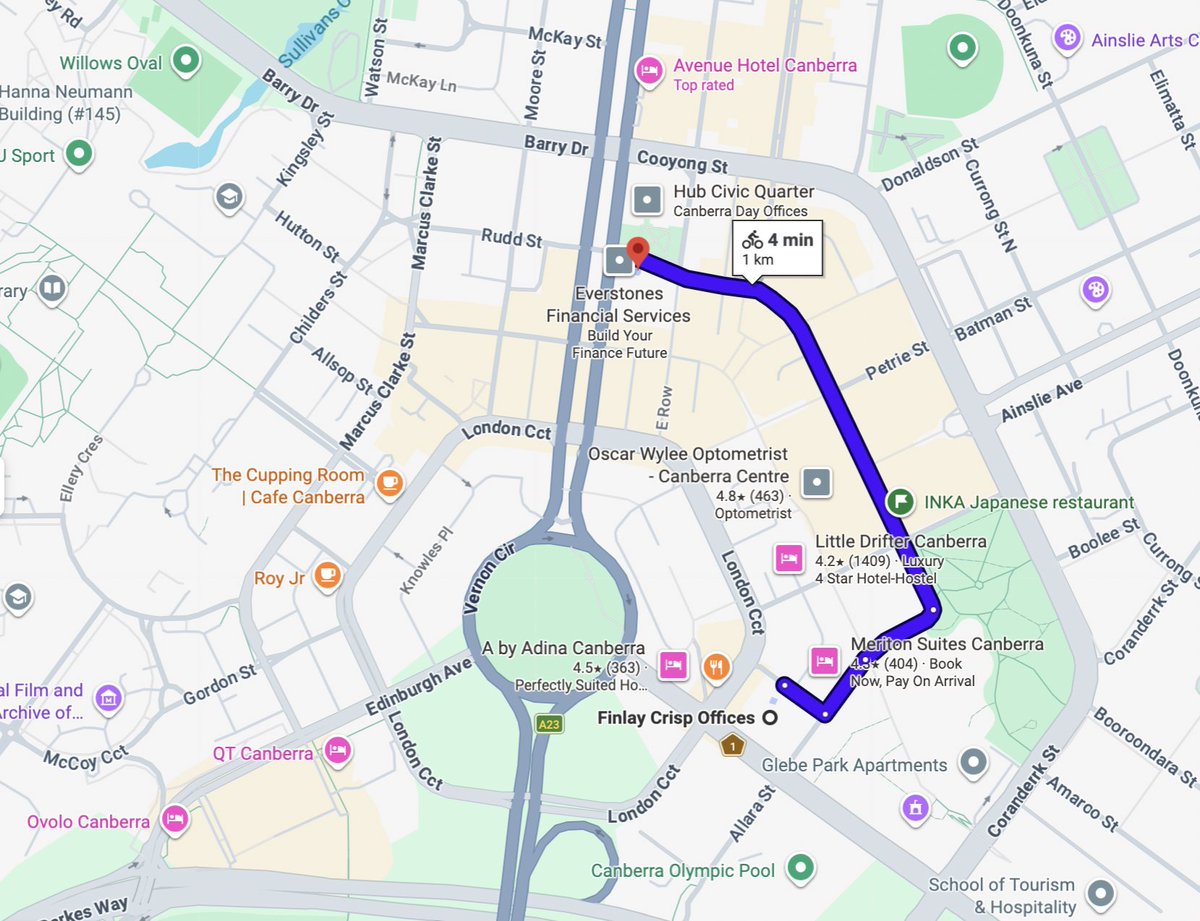
When the NACC took over, they also shifted headquarters approx 1.1 kms away.
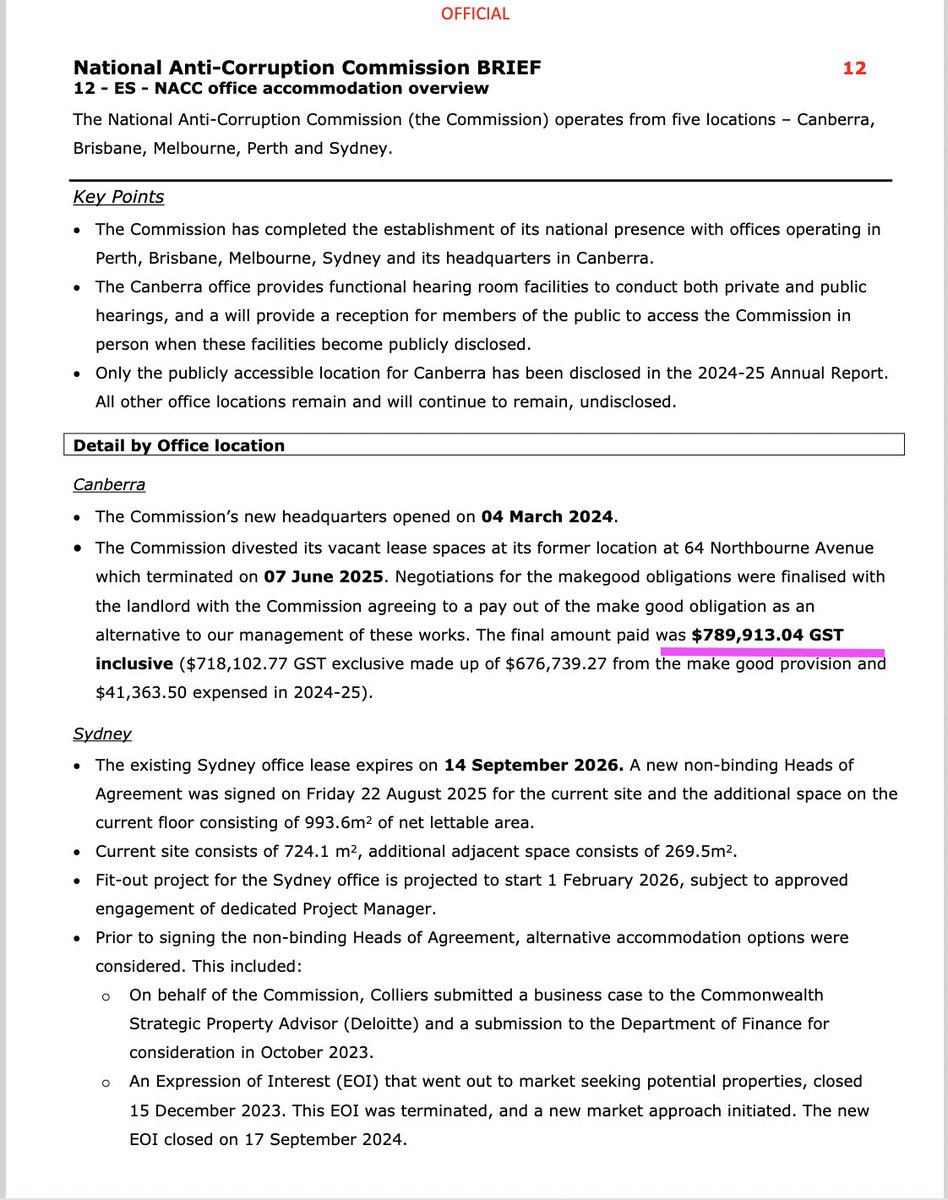
But even though it cost taxpayers $789,913 to shift out, the shiny new NACC was ready for operation.
They were ready and raring to go.
Twenty years ago today, An Inconvenient Truth made its debut in movie theaters across the U.S.
I’ll be honest: I was skeptical that my slideshow about the climate crisis could become a successful movie. But thanks to our immensely talented director, Davis Guggenheim, Jeff Skoll, who made the ultimate decision to make the movie, and the incredible team behind the film — Laurie David, Lawrence Bender, Scott Z. Burns, Lesley Chilcott, Ricky Strauss, Diane Weyermann, and so many others, the film was a huge success, and opened the eyes of millions around the world to the threat posed by the climate crisis.
While I wasn’t sure that there’d be widespread public interest in a science-based slideshow, I have never doubted humanity’s ability to solve this crisis.
We know we must act, and Mother Nature is making that clearer and clearer every day. We’re already feeling the rapidly worsening impacts of a warming planet. Those impacts are evidence that our cause is even more urgent than it was 20 years ago. And as a result, the global movement for climate action has grown into the largest morally-based movement in the history of the world.
We also know now that we can act. Indeed, in the past 20 years, we’ve made tremendous progress: The world came together in 2015 to forge the historic Paris Agreement, which despite the recent U.S. withdrawal, continues to drive global action and ambition. Incredibly, last year, renewables made up 86% of all the new electric power installed around the world. In the U.S., renewables were 92% of all new power capacity!
Electric vehicles are now 25% of all new car sales worldwide and the sales of gasoline-powered vehicles have been declining since they peaked in 2017.
Unfortunately, however, the crisis is still getting worse faster than we are deploying the solutions — solutions that are now way cheaper than the dirty and dangerous fossil fuels still spewing heat-trapping pollution into the sky as if it is an open sewer.
So, while this is a natural occasion to reflect on the 20 years since the movie came out, I’m focused much more intensely on what we need to do now in order to shape what our world will look like in the next 20 years.
I’m still presenting my updated slideshow all over the world, training grassroots climate leaders and working with partners in 194 countries and territories who are creating change in their communities, in their workplaces and schools, and in their nation’s policies.
From what I’m seeing and hearing, I have no doubt that we will win this struggle. But it is still not clear that we will win it in time to avoid catastrophic damage and the dangerous negative tipping points that the climate scientists have long been warning us we must prevent.
Will we muster the moral courage and political will to solve this crisis?
Well, if you ever doubt our ability to do so, just remember that political will is itself a renewable resource. It’s up to all of us to renew it.
Photos: Still from An Inconvenient Truth, 2006.
Climate Reality Project training in Nashville, TN, 2026.
Today is the hardest one for me. May 22.
Every year it rolls around faster than the year before.
As I write, her family is marking their 36th year without her.
Stacey-Ann Tracy was murdered by my stepfather on May 22, 1990. She will be forever nine years old. Stacey was the second child abducted, raped and murdered by my mother's husband. He also killed five-year-old Sandra Dorothy Bacon.
I've spent the past 11 years doing everything I can to ensure Stacey and Sandra have a legacy. My work documenting the killing of women and children - and everything else I do in this space - is inspired by these little girls. Their's were the first names on my Memorial and now there are more than 3000 stories of lives lived and lost.
Stacey deserved all the good things in life - to live a childhood free of violence, to achieve her goals and ambitions and to spend her sunset years in the manner she dreamed of.
She should be wrapped in the loving arms of her mum Janet, sister Elizabeth and nan Joan. Her family members were irrevocably changed by the actions of my stepfather on that day - he destroyed the trajectory of their lives.
I would trade everything to rewind May 22, 1990 - to ensure Stacey returned home safe. She will always be the gentle angel in my heart.
* You can help me get a Royal Commission into the Killing of Women and Girls by signing the petition using the link in my bio (Insta) or go to: https://t.co/Cxq1KK37O6.
Incredible speech delivered by Baroness Linforth in the House of Lords today calling for clean indoor air in schools.
“It would cost less than a tenner per child per year to provide pupils and staff with clean air - about the same cost as a coffee and a cake.”
☕️🧁
Japan just turned thin air into fuel.
No oil rigs. No drilling. No pipelines stretching across oceans.
Just water, CO₂, and a process that flips combustion on its head.
ENEOS Corporation, Japan's biggest oil refiner, pulled it off at their Yokohama lab.
They built a demo plant that sucks carbon dioxide straight from the atmosphere, splits hydrogen out of water using renewable energy, then fuses them through Fischer-Tropsch synthesis into liquid hydrocarbons.
The result? Real, usable synthetic petroleum.
The kicker: this fuel is "drop-in ready." That means it works in the cars you already drive, the planes already in the sky, the pipelines already in the ground. Zero modifications.
They didn't just brew it in a beaker either. They ran actual vehicles on it. It works.
Think about what that unlocks. Countries with no oil reserves could manufacture their own fuel using nothing but sunlight, wind, and the air around them.
The geopolitical chessboard would flip overnight.
Sectors that electrification can't easily touch, like aviation and heavy shipping, suddenly have a clean fuel path.
There's a catch, though. The process is hungry. The same electricity it takes to brew one liter of synthetic fuel could push an EV about 200 km down the road. ENEOS quietly shelved the project in 2025 because the economics didn't math out yet.
But the science? Proven. The blueprint exists. Someone, somewhere, will crack the cost problem.
And the day they do, the oil map of the planet gets redrawn.
Source: ENEOS Corporation / TheTownHall(.)News
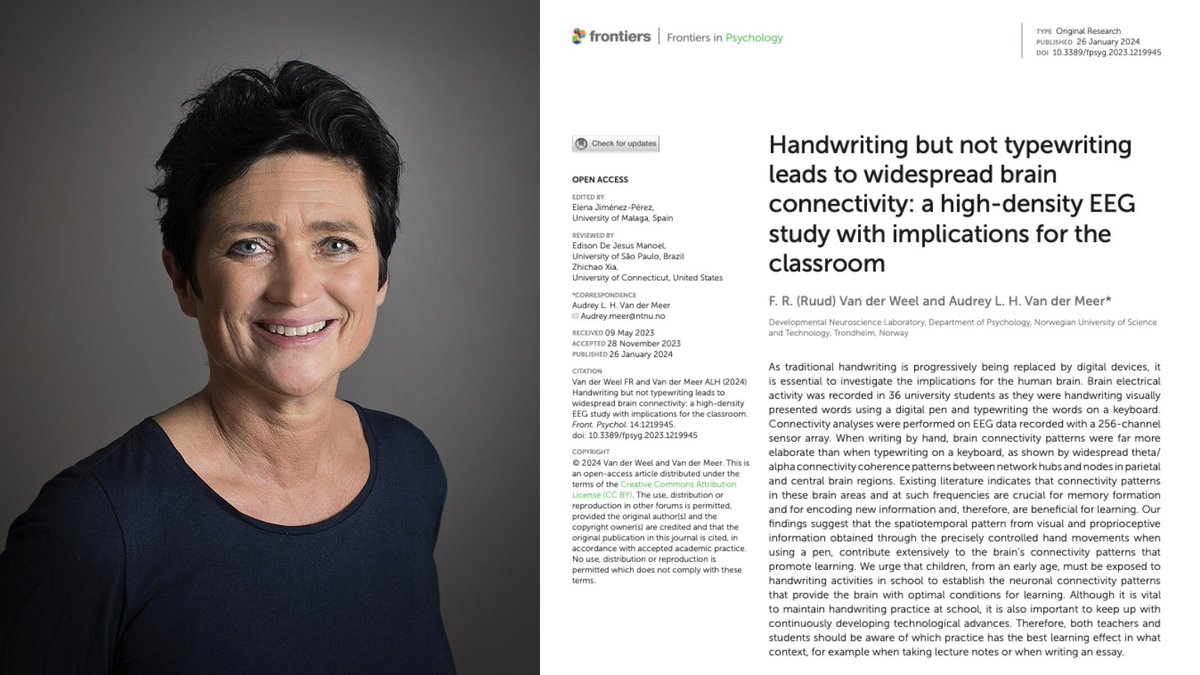
A Norwegian neuroscientist spent 20 years proving that the act of writing by hand changes the human brain in ways typing physically cannot, and almost nobody outside her field has read the paper.
Her name is Audrey van der Meer.
She runs a brain research lab in Trondheim, and the paper that closed the argument was published in 2024 in a journal called Frontiers in Psychology. The finding is brutal enough that it should have changed every classroom on Earth.
The experiment was simple. She recruited 36 university students and put each one in a cap with 256 sensors pressed against their scalp to record brain activity. Words flashed on a screen one at a time.
Sometimes the students wrote the word by hand on a touchscreen using a digital pen, and sometimes they typed the same word on a keyboard. Every neural response was recorded for the full five seconds the word stayed on screen.
Then her team looked at the part of the data most researchers had ignored for years, which is how different parts of the brain were communicating with each other during the task.
When the students wrote by hand, the brain lit up everywhere at once.
The regions responsible for memory, sensory integration, and the encoding of new information were all firing together in a coordinated pattern that spread across the entire cortex. The whole network was awake and connected.
When the same students typed the same word, that pattern collapsed almost completely.
Most of the brain went quiet, and the connections between regions that had been alive seconds earlier were nowhere to be found on the EEG.
Same word, same brain, same person, and two completely different neurological events.
The reason turned out to be something nobody had really paid attention to before her work. Writing by hand is not one motion but a sequence of thousands of tiny micro-movements coordinated with your eyes in real time, where each letter is a different shape that requires the brain to solve a slightly different spatial problem.
Your fingers, wrist, vision, and the parts of your brain that track position in space are all working together to produce one letter, then the next, then the next.
Typing throws all of that away. Every key on a keyboard requires the exact same finger motion regardless of which letter you are pressing, which means the brain has almost nothing to integrate and almost no problem to solve.
Van der Meer said it plainly in her interviews.
Pressing the same key with the same finger over and over does not stimulate the brain in any meaningful way, and she pointed out something that should scare every parent who handed their kid an iPad.
Children who learn to read and write on tablets often cannot tell letters like b and d apart, because they have never physically felt with their bodies what it takes to actually produce those letters on a page.
A decade before her, two researchers at Princeton ran the same fight using a completely different method and ended up at the same answer. Pam Mueller and Daniel Oppenheimer tested 327 students across three experiments, where half took notes on laptops with the internet disabled and half took notes by hand, before testing everyone on what they actually understood from the lectures they had watched.
The handwriting group won by a wide margin on every question that required real understanding rather than surface recall.
The reason was hiding in the transcripts of what the two groups had actually written down.
The laptop students typed almost word for word, capturing more total content but processing almost none of it as they went, while the handwriting students physically could not write fast enough to transcribe a lecture in real time, which forced them to listen carefully, decide what actually mattered, and put it in their own words on the page.
That single act of choosing what to keep was the learning itself, and the keyboard had quietly skipped the choosing and skipped the learning along with it.
Two studies. Two countries. Same answer.
Handwriting makes the brain work. Typing lets it coast.
Every note you have ever typed instead of written went into your brain through a thinner pipe. Every meeting, every book highlight, every idea you captured on your phone instead of on paper was processed at half depth.
You did not forget those things because your memory is bad. You forgot them because typing never woke the part of the brain that would have made them stick.
The fix is the thing your grandmother already knew.
Pick up a pen. Write the thing down. The slower road is the faster one.
The 5 million Angus Taylor thinks don’t vote and the millions in their households who do.
Angus Taylor thinks he’s punishing non-citizens. They can’t vote, so it’s a free hit. That’s the entire logic. But it’s a logic only someone who has never lived in the big cities would consider.
In the suburbs that decide elections, the household, not the individual, is the political unit. Three generations under one roof or in the same suburb.
Grandparents on partner visas. Parents holding PR while the citizenship queue grinds on. Citizen kids enrolled to vote, working part-time, doing the family’s Services Australia paperwork at the kitchen table.
Strip the NDIS from a permanent resident and you have not touched a single voter directly. You have touched their daughter. Their son. Their citizen niece. And they vote, very deliberately, for the people in their family who cannot.
This is exactly the structural shape of post-war migrant Australia. Greek, Italian, Maltese, Lebanese, Vietnamese households where the citizen children voted for the whole family. It is alive and well, three generations on, in the outer suburbs the Coalition needs to win government.
Taylor has told every one of those households that in his Australia, their parents are second-class.
He thinks he’s chasing Hanson voters in Farrer. He’s actually handing Labor a permanent structural lock on the seats that decide who governs. And he has possibly committed his party to losing opposition status at the next election.
Full piece and analysis below
The One Nation wave is real. The wave is steep and it breaks and dissipates when it hits diverse, university educated and young suburbs. Labor’s wall.
The wall is the Indian-Australian software engineer in North Parramatta, whose parents put themselves through Master’s degrees in their forties to set up their family for a better life in this country.
The wall is the Chinese-Australian accountant in Hurstville, whose mother runs a bakery on Forest Road and whose father came over in the 1990s on a student visa that almost didn’t get renewed. She watched her parents called names through a pandemic. She doesn’t need a polling memo to tell her she is not welcomed by some political parties.
The wall is the 29-year-old project manager in Marrickville, born in Sydney, university-educated, renting a one-bedroom above a deli, 30 years off ever owning a house. She has every cost-of-living grievance the populist playbook predicts. Her ballot is locked, and not for the parties blaming migrants for the rent.
My new essay on Farrer, the Labor demographic wall, and the Liberal Party’s drastic slide to minor-party status. Link below.
BHP is suing MWM to muzzle media coverage of a wage theft case. Why we are standing up to the $300b multinational colossus
#auspol#pressfreedom
https://t.co/9Iec4A80el
It's not every day that Australia's biggest company drags a humble independent journalist and small business guy into Court ... but here it is - BHP sues MW
An MIT mathematician sat down in 1950 and wrote a small, non-technical book aimed at the general public. He was not predicting the future. He was warning them. He said machines would eventually replace human work, optimize ruthlessly for the wrong goals, and quietly turn human beings into components inside systems they did not control.
Almost nobody listened. 75 years later, every warning he made has come true.
His name was Norbert Wiener. The book is called "The Human Use of Human Beings."
The textbook story of AI ethics says the field began in the 2010s, when Stuart Russell, Nick Bostrom, and a small group of researchers started writing about the dangers of intelligent machines. That story is wrong. The first serious book about the ethics of AI was published in 1950, by a man who had personally invented the science that AI would eventually be built on, and who saw exactly what was coming with a clarity nobody else managed to match for the next 70 years.
Here is the story almost nobody tells you.
Norbert Wiener was a child prodigy. He graduated from Harvard at 14. He had a PhD in mathematics by 17. He became an MIT professor before he turned 30. During World War II he was assigned to work on anti-aircraft fire control systems. The problem was simple and impossible. How do you aim a gun at a fast-moving plane that will not be where it is by the time the shell arrives.
His answer turned into a new science. He called it cybernetics, from the Greek word for steersman. In 1948 he published a technical book by that name. Cybernetics was the foundation of modern control theory, robotics, and almost everything that became artificial intelligence. The book was dense. Most readers could not get past the math. The ideas inside it were too important to leave trapped in equations.
So in 1950 Wiener sat down and wrote a second book aimed at ordinary people. No equations. No jargon. Just consequences. He titled it The Human Use of Human Beings. It is barely 200 pages. It is one of the most prescient documents ever written about technology.
The first thing he warned about was automation.
He predicted, in 1950, that machines would replace human work across every industry. Not just factory work. Not just manual labor. Any task that could be reduced to a procedure would eventually be automated. He specifically said white-collar work would not be safe. Bookkeeping. Translation. Drafting. Calculation. Anything where a human was being paid to follow a defined process would eventually be done by a machine for a fraction of the cost.
He was not celebrating this. He was warning about it. He said the social consequences would be enormous, that entire industries would collapse, that the value of human labor itself would be undermined for tasks where humans had been useful for centuries. He wrote this 75 years before ChatGPT made every white-collar professional check their job description twice.
The second thing he warned about was the alignment problem. He did not call it that. The phrase did not exist. But he described it precisely.
He said that machines optimize for the goal you give them. They do not optimize for what you meant. They optimize for what you wrote down. If the goal is poorly specified, the machine will pursue the literal version of it with terrifying efficiency, and the result will be a disaster the builders did not foresee.
He used the metaphor of the magic monkey's paw from a horror story by W.W. Jacobs. A grieving father wishes his dead son alive again. The paw grants the wish. Something climbs back out of the grave that is technically the son. The wish was granted exactly as stated. The outcome is hell.
Modern AI safety researchers use almost the same metaphor 75 years later. They call it specification gaming, reward hacking, mesa-optimization. The names are new. The problem Wiener described in 1950 is exactly the same.
The third thing he warned about was the loss of human agency.
He predicted that humans would gradually surrender their decision-making to systems they did not understand. Not because the systems would force them to. Because the systems would be more convenient, more accurate, and more profitable than human judgment. People would offload their navigation, their reading, their relationships, and eventually their thinking to optimization processes designed by companies whose interests were not aligned with their users.
He said something in 1950 that I cannot stop thinking about. He said the more efficiently a society delegates its decisions to machines, the less able it becomes to make decisions at all. The atrophy is gradual. By the time anyone notices, the capacity to choose is gone, and what remains is people executing decisions that were made for them, by systems they did not build, in service of goals they were never asked about.
Look at modern social media feeds, recommendation algorithms, dating apps, navigation systems, news aggregators, and you are looking at exactly what he described.
The fourth thing he warned about was the easiest one to ignore at the time and the most disturbing now.
He warned that authoritarian regimes would use the new computing technology to track, manipulate, and control populations at a scale never previously possible. Not in the future. Soon. He said the same techniques that made cybernetics useful for guiding missiles would be used to guide societies, and that the small, incremental decisions about what to optimize, who to surveil, and how to feed information back into the system would compound into a kind of soft control that did not need force to function. People would do what the system wanted because the system would shape what they wanted in the first place.
He saw modern surveillance states 75 years before they existed.
The strangest thing about reading the book in 2026 is realizing how few of these problems have been seriously addressed.
Wiener was not anti-technology. He had personally helped build it. He was not nostalgic for a pre-machine age. He was warning that any tool powerful enough to amplify human capability is also powerful enough to amplify human stupidity, greed, and indifference, and that the dangers were not in the machines themselves but in the unwillingness of human institutions to ask hard questions about who the machines were being built for.
He died in 1964. He never lived to see most of his predictions come true. He never used a personal computer. He never followed a hyperlink. He never saw a modern recommendation algorithm.
He just wrote down, in 1950, in plain English, what the world would look like when the technology he had helped invent was built out by people who had not read his warnings.
The book is around 200 pages. It is in print. Used copies are everywhere for under ten dollars. It reads like science fiction in which the author already knows how the story ends.
The first serious book about the ethics of AI was published before there was any AI to be ethical about. Almost nobody who works on the problem today has read it.
The warnings are the same. The author has been dead for 60 years. The book is one click away from anyone who wants to read it.
Jim Chalmers rips into the “hopeless” Coalition for playing politics on housing & migration “on the eve of the Farrer by-election” & gives media “a bit of perspective” on real figures compared to when the LNP left office.
“These aren’t opinions, this is the data.” 💥 #auspol
A recent ad from the Minerals Council of Australia wants you to believe the mining industry pays enough tax to fund Medicare.
Which is NOT TRUE for 8 out of the last 10 years!
#auspol
Petrol and diesel cars fought for their lives in Norway but, as you can see, that old technology has now lost the battle to EVs forever and I love that's happening here too.
Being able to witness the end of an automotive era and the start of a new one in real time is honestly pretty cool and it's a privilege to have a front row seat.