Every single child with Down syndrome is a gift from God, who deserves life.
These children have just as much value, and deserve life just as much as a child without DS.
Down syndrome children aren’t a curse to parents.
Pass it on.
🚨 EXCLUSIVE: English hospitals that cut registered nurses saw more deaths while those hiring nurses saw more patients survive. Even when hospitals tried to fill gaps with non-nurses, deaths still went up. Major new study exposes dangerous NHS variation:
https://t.co/ywzF0DtIyU
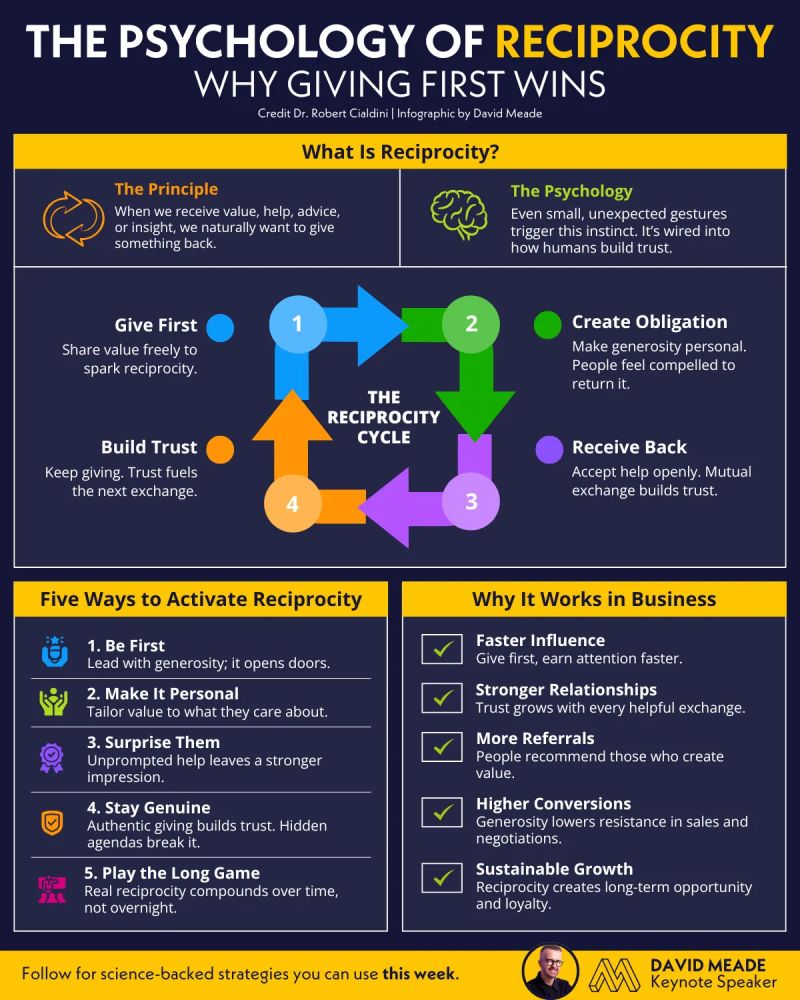
Reciprocity is one of the most important principles for leaders of change.
At a simple level, reciprocity means a mutual exchange between people where each party gives & receives value, creating a balance that benefits everyone involved. But it's deeper than that. It's about mutual benefit & collective growth. Reciprocal relationships are built on mutual giving, receiving and creating community, rather than one-way transactions.
Increasing numbers of organisations are investing in “social network analysis” (SNA) to understand their internal relationships & the extent to which these relationships enable or block change. SNA shows that reciprocity creates the best kind of sustainable, trust-based relationships that support long-term change. By contrast, many organisations exhibit “simple brokering” rather than reciprocity. That means that individuals (“brokers”) fill gaps between disconnected groups or individuals in an organisation. Brokering can be fragile & psychologically costly/exhausting if you’re in this role.
In change leadership, reciprocity succeeds where brokering alone may struggle because it builds the relational infrastructure that makes information sharing, collaboration & sustained commitment possible. By contrast, brokering often means transactional approaches focused on short-term exchanges; less sharing & less learning.
As change leaders, we have to be role models of reciprocity. That means being the people who create the conditions for reciprocal relationships by being the ones who give first. If we want cooperation, support &/or engagement from others, we need to offer cooperation, support &/or engagement first. Even when we are working with people & teams who are challenging, resistant &/or “don’t get us”, we have to give first.
A beautiful blog on reciprocity from @SisDrSandra: https://t.co/n2kUjrPQMm.
Graphic from David Meade on the power of "giving first" taken from: https://t.co/3ltkwGVwUW.
I also want to acknowledge @DrNicolaBurgess who has helped me more fully appreciate the power & importance of reciprocity through her excellent research studies.
Newly published research shows that taking calls & answering emails during “non-work” time can have negative consequences for people. When people use work-related technology in the evening (even by choice) they struggle to mentally switch off from work, which negatively affects their wellbeing both that night & the next morning.
Evening work-related technology use depletes people’s “self-regulatory resources” - the mental energy needed to redirect attention away from work. Without these resources, people cannot mentally disengage from work, which impairs their ability to repair their mood & maintain emotional wellbeing. It creates measurable reductions in positive affect (feeling enthusiastic, relaxed) & increases in negative affect (feeling anxious, dejected). This negative effect carries over to the next day, creating a downward spiral of loss of resources. However, two factors can break this cycle: feeling in control of how evening time is spent & getting good quality sleep.
The authors describe a "double-edged sword" situation - evening technology use may help with work goals in the short term but comes at a cost to recovery & ongoing wellbeing.
Actions for leaders based on this research:
1) Discuss how to contain the work to the working day with the team & problem solve: don't encourage "going the extra mile at night" or "always-on" behaviours.
2) Model the boundaries we expect from others: if we want people in our teams to respect their evening time, demonstrate it ourselves by not sending late-night emails or messages. When leaders reply to emails at midnight, team members feel they should too.
2) Make our boundaries visible & talk about them openly: the research emphasises that perceived control is protective, & when leaders talk openly about their own boundaries, it helps team members feel comfortable setting their own without fear of judgment.
3) Include digital boundary training in wellbeing training: encourage people to be more deliberate about when they engage with work technology rather than checking emails out of habit.
4) Act early when we notice patterns of evening work: spot these patterns early & intervene before visible wellbeing problems emerge, enabling workplace cultures where people feel comfortable setting boundaries.
https://t.co/xUlXnWCTMr By Svenja Schlachter & colleagues, via John Whitfield.
Graphic by @_workchronicles.
The little "chit chats" we have at the start of a meeting or Teams call (where we talk about our weekends, the weather, our pets or the traffic) are really important. Research shows that they actually work as a neural 'warm-up' for a deeper connection.
So the next time we get irritated by the small talk at the start of a meeting & push to start discussion on the topic at hand, we might remember that:
- small talk isn’t filler; it’s an entry point to foster group psychological safety.
- rapport isn’t a ‘nice to have’; it enables the trust needed for meaningful dialogue.
- alignment doesn’t begin with tasks; it begins with shared attention & mutual recognition.
Those first few minutes of “non-essential” chatter are doing critical work. They're building safety, alignment & a shared language that's the foundation for us to work more effectively together: https://t.co/N4N8rqFMhT. By Nick Wright. Fabulous graphic & signpost to this piece by @tashwillcocks
@MartinSLewis Specialist Nurse health visitor & paediatric nurse best job in the world doesn't feel like 'work', support families babies children get the best start in life,everyday something new,safeguarding, nursing opens lots of doors & leads to diff paths. nearly 8yrs.yes would recommend!
I really can’t get out of my head what has happened to Charlie Kirk. I watched him a lot, not because I agreed with everything he said, but because he was an absolutely formidable commentator and could debate in a relentless, yet respectful way. Shot in the throat for using his voice. I’ll never get that image out of my head. Horrifying.
"I'm just flesh and bone, but more importantly, I'm a soul, and that soul is accountable to one being."
"I've had an unbelievably blessed life... So praise God. I've been all across the world. I've met with world leaders."
"I've flown Air Force One, got to know a president. I have an amazing family, the podcast Turning Point USA... And so you experienced that, and you're like, 'What actually matters?'"
"What matters is your relationship with the divine, your relationship with your family, your kids, and maybe a close collection of friends, and your relationship with the truth."
So much wisdom and taken way too soon. Charlie Kirk will never be forgotten.
Charlie Kirk was more committed to peaceful, open dialogue with those who disagreed with him than anyone I know. God blessed him with immense gifts, and he used them boldly and without fear. He knew the risks he was taking, but he did it anyway because he loved his kids & felt a responsibility to the nation they would inhabit. I traveled the entire country with him last year, we spent 1x1 time together in Ohio two weeks ago, spoke to him again 2 days ago. He’s long warned of the rise of political violence & the growing culture of assassination, when few were willing to listen, with a clarity of vision unlike anyone I’ve known. Completely and utterly devastated.
I saw this video this morning on my feed and I think it so eloquently explains what Charlie Kirk was put on this earth to do.
“When people stop talking, that’s when you get violence, that is when civil war happens”
All that Charlie ever did was have conversations with people. He didn’t insult anyone. He made arguments. He debated. He wasn’t an extremist in any way. Everyone who knew Charlie personally loved him. That’s the kind of guy he was. And they still killed him. I am furious and heartbroken in equal measure. I cannot put into words how I feel. Maybe that is for the best.
Charlie Kirk appeared on Fox and Friends with his family just weeks before he was shot in Utah. Prayers are continuing to pour in for the Turning Point USA co-founder.
@TheWhiteHorsePu Thanks so much for your fab front of house today she is a trojan never stopped & squeezed us in short notice- we had been in the area as our pinion has now gone. loved it thanks💜 food was fit as expected!