Come and work at Concord 👏
0.8 FTE staff specialist medical oncologist in upper & lower GI & gynae cancer available 👏
Staff Specialist Medical Oncology Crgh Apply Via Ecredential
https://t.co/ffAXxK3r6t
Calling bioethicists! The MOGA Medical Ethics Sub-Committee seeks EOIs from bioethicists interested in volunteering to contribute expertise and thinking to our clinician-oriented committee. We meet online every 3 months. More info: https://t.co/TbehcxOaSd @CancerEthicsDoc
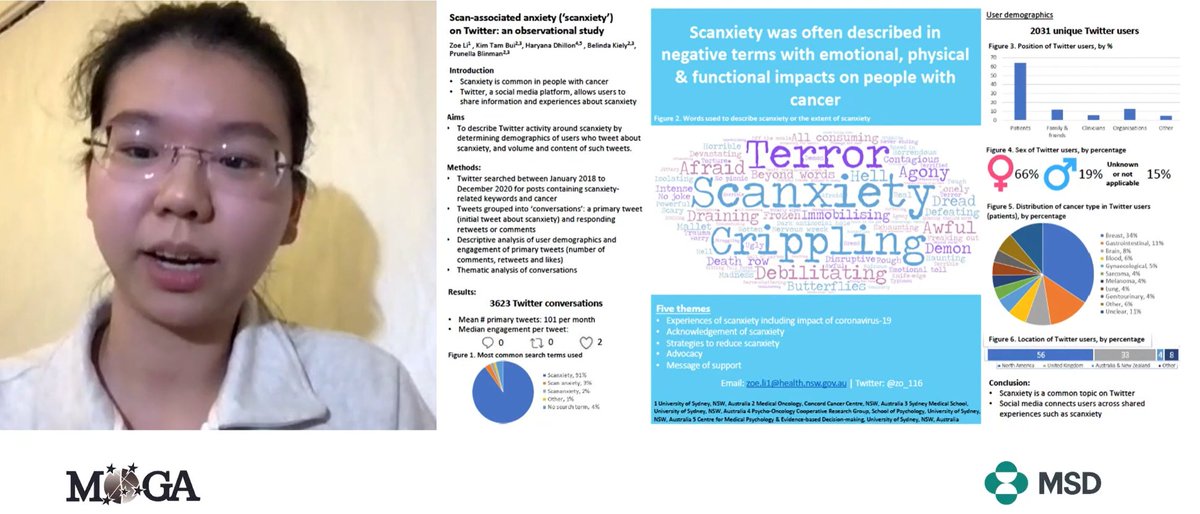
Stoked to be sharing our #Twitter research on #scanxiety!
>2000 users want you to know scanxiety is real. Does that scan really need to happen on your birthday? We can do more to reduce scanxiety 🙏
@drprunellab@BelindaKiely@hagsie@zo_116 https://t.co/7KyIlnMjJP
@DrCraigGedye @Nzeps @NicStraiton In the process of developing a SOP at our site to help our clinician researchers & trials staff navigate their roles & responsibilities
Thanks to this amazing team, I am probably one of the few people who enjoyed doing my PhD in the midst of COVID! Excited to complete the first step of many towards reducing #scanxiety in people with #cancer
@DrScanxiety @hagsie@drprunellab@BelindaKiely@CStatsAU Great idea! Scanxiety is universal across cancer types & around the world - single institution solutions can only help a few. I will send you a DM!
@DrScanxiety Our survey found 55% of people with advanced cancer reported scanxiety. We need many voices speaking about scanxiety to make sure people with cancer feel supported & clinicians think about it when ordering scans. Next steps: when & how can we step in to help reduce scanxiety?
Excited to post on Twitter about @zo_116's Twitter #MOGAASM21 poster- showing that #scanxiety is talked about in negative terms & more needs to be done in this space. A novel way of understanding important issues to the cancer community. Amazing work, Zoe!
Scanxiety is not a new concept, and now we have data to show it. 55% of people with w/ advanced cancer (n=222) experience scanxiety around a CT scan. For anyone out there having scans: Scanxiety is real. You are not alone.
https://t.co/9n2cGNHIsD
Proud of @ktambui 's 1st #scanxiety project that kick-started her PhD now in Supportive Care in Cancer👏
55% of people w/ adv cancer (n=222) experienced scanxiety around a CT scan w/ ⬆️prevalence in younger & more remote
@hagsie@BelindaKiely
https://t.co/eJAwlT6fiQ
@drjenlim @hagsie The preferred way to receive results probably varies & is a Q in our longitudinal study on #scanxiety. For patients to have automated results, we need a system that supports it - from radiology staffing & jargon-free reports. Another solution- docs relaying results faster!
Negative experiences around a scan were not always recognised as #scanxiety & coping strategies were not recognised as coping strategies for scanxiety.
Thank you to our participants who have helped us understand this problem - so relevant to many with cancer
First PhD paper showing scanxiety is measured all over the shop with different tools & at different times. More consistency is needed so we can understand scanxiety better & talk about it clearly with our patients.
Many thanks to @drprunellab@BelindaKiely@hagsie@CStatsAU
V pleased to share this labour of love for @ktambui 's PhD: #Scanxiety: a scoping review about scan-associated anxiety
Main findings = lack of standard definition & specific measure gives @tambui much more work to do!
@BMJ_Open@BelindaKiely@hagsie
https://t.co/CDgbWmAEkx
@hagsie@drprunellab@BelindaKiely#scanxiety is real for patients & for doctors. How much of our scan practices (eg frequency and type of scan) is evidence-based, leads to changes in management & provides better outcomes for our patients? Not always easy to decide for individual patients based on population data