the problem is at some point crypto people started selling the vision of crypto as a get rich quick tech because there was a cohort which came in and that is all they cared about
and completely stopped talking about it as being credibly neutral and censorship-resistant money and infrastructure
you are wrong if you think the natural market does not exist for the latter (it will only grow from here given the state of the world), but “selling” this requires education and consistent messaging
we used to have that. we don’t anymore. now, we have memecoins
on that, the entire crypto industry has catastrophically failed
The Ethereum not ETH stuff is the mental fallacy that triggered me into writing and podcasting in the first place.
There is no strong Ethereum without an ETH worth trillions. Without ETH as a global store of value, Ethereum is a failed project. Full stop.
ETH is economic bandwidth for DeFi. It is the only asset maximized for CROPs, fail at high value ETH, fail at CROPs, fail at Ethereum.
Saying you’re bullish Ethereum not ETH is like saying you’re bullish America not the American economy. They are one and the same - economic engines.
Better to admit Ethereum is a failed project than “Ethereum not ETH”.
So spew that weak blockchain not crypto stuff out of your mouth, it doesn’t make sense for BTC, ZEC, ETH, or any truly crypto native project.
@SoulBound was a huge rug!! 🚨🗑️
After years of promise by @WebbEmotional that was never fulfilled (he deleted all of his previous tweets). I lost tens of thousands of dollars and countless hours supporting this project.
The sad thing is that this is just the tip of the iceberg
@chooserich Hi Nick, this will be a tough journey both physically and mentally but you can be healed with the grace of God. Spend time with your loved ones and keep up the positive attitude. I’ll keep you in my prayers. Fuck cancer
The latest @thedailygwei Refuel is ready for your consumption! ⛽
Today's topics:
- Personal updates ❤️
- Core protocol news 🤓
- ETH stake shuffle 🥩
- and much more ➕
Watch 👇
https://t.co/k0Ze1DYXu7
Glamsterdam coming with more transparency on each transaction; preview of each tx action and its result. Potential 6x transaction throughput through parallelization to the EVM.
Ethereum is about to fundamentally change how blocks are executed. With the upcoming Glamsterdam hardfork, it's shipping EIP-7928: Block-level Access Lists, a proposal that brings parallelization to the EVM.
Here's a short explainer of what it is, how it works, and why it's a big deal for scaling.
Let's start from the top. Alongside EIP-7732 (ePBS), EIP-7928 is the execution-layer (EL) headliner for Glamsterdam. Like ePBS, the main focus has been scaling Ethereum, though both proposals come with a bunch of other, equally important properties on the side e.g. removing trust requirements from the PBS pipeline or improving sync.
EIP-7928 adds a Block Access List (BAL) to every Ethereum block. A BAL is a list of accounts and storage slots that the block touches, but that's not all: it also contains post-transaction state diffs (this part is critical!).
Post-transaction state diffs tell you what the state looks like after each transaction. Quick example: user A swaps 1 ETH for DAI on DEX B. The BAL tells you that user A's ETH balance decreased by 1 ETH + tx fees and their nonce went up by 1; that DEX B's ETH balance went up by 1 ETH; and that inside the DAI contract, user A's DAI balance increased while DEX B's decreased.
In other words, all of that info becomes statically available, something that previously required tracing the transaction.
Client software (Geth, Nethermind, Besu, Erigon, Reth, Ethrex, Nimbus) can use this to do a few very powerful things:
1. Parallelize transaction execution. Knowing the post-state of each tx resolves the dependencies between them. No transaction has to wait on the previous one anymore, so execution can be perfectly parallelized. Instead of large parts of block validation sitting idle waiting on sequential execution, clients can finally make much better use of modern hardware.
2. Batch prefetch. One of the most cumbersome jobs for a node has been fetching the state needed for execution from disk. Because state locations (e.g. the exact storage slot in the DAI contract where user A's balance lives) are only discovered along the way, while executing, state-fetching has been a real drag on scaling: it blocks execution, takes time, and eventually slows everything down. With BALs, everything a node needs for execution is known upfront and can be loaded into cache in one go, in parallel. This speeds things up even further.
3. Parallelize post-state root calculation. Another expensive task is walking the updated state tree to compute the post-state root, which is needed so that everyone agrees on what's on disk after executing the block. With the post-tx state already in the BAL, nodes can do this in parallel while executing. A heavy task that used to wait until all transactions had finished can now run alongside prefetching and execution.
4. Snap sync (v2). An often overlooked, less sexy aspect of blockchains is syncing. Nodes need to catch up with the chain, and they need to catch up faster than the chain progresses. Today, most nodes do snap sync: downloading blocks, headers, and state in parallel while chasing the tip, and then "healing" the database once they're close to the head. Healing means asking peers for trie nodes, receiving them, validating them, and updating the local DB. It's iterative, networking-heavy, can take a while, and especially higher throughput pushes that phase to its limits. BALs help here too: with snap v2, nodes can catch up to the tip and skip the healing phase entirely. Syncing at higher throughput becomes more robust and reliable.
So, to summarize, a BAL contains two things:
-> The state locations the block accesses
-> The state changes after each tx (incl. the new values)
We're already seeing big performance gains today: on 6-core machines, EL clients validate blocks up to 5x faster, making block gas limits of 300M a very realistic outcome. ePBS will add to that by decoupling the block from the payload, giving validators 2-4x more time for execution.
To not overshoot (security stays priority #1), the fork will likely ship with a 200M gas limit, but we shouldn't be stuck there for long before pushing to 300M and beyond. That's a 10x in scaling since we started taking the topic seriously, without touching hardware requirements.
None of this would have happened without people going all-in, heads down, shipping: so many hours spent in calls debating the right design, so many iterations refining the specs, and tons of test cases written (and still being worked on). The road from whiteboard to production-ready code has been a journey, and we're not at the finish line yet, but from what I can tell, things look super bullish for Ethereum.
Glamsterdam will be a fork that shows what's possible when a distributed, decentralized community works on a shared goal, laser-focused on providing enough block space to onboard the next wave of users.
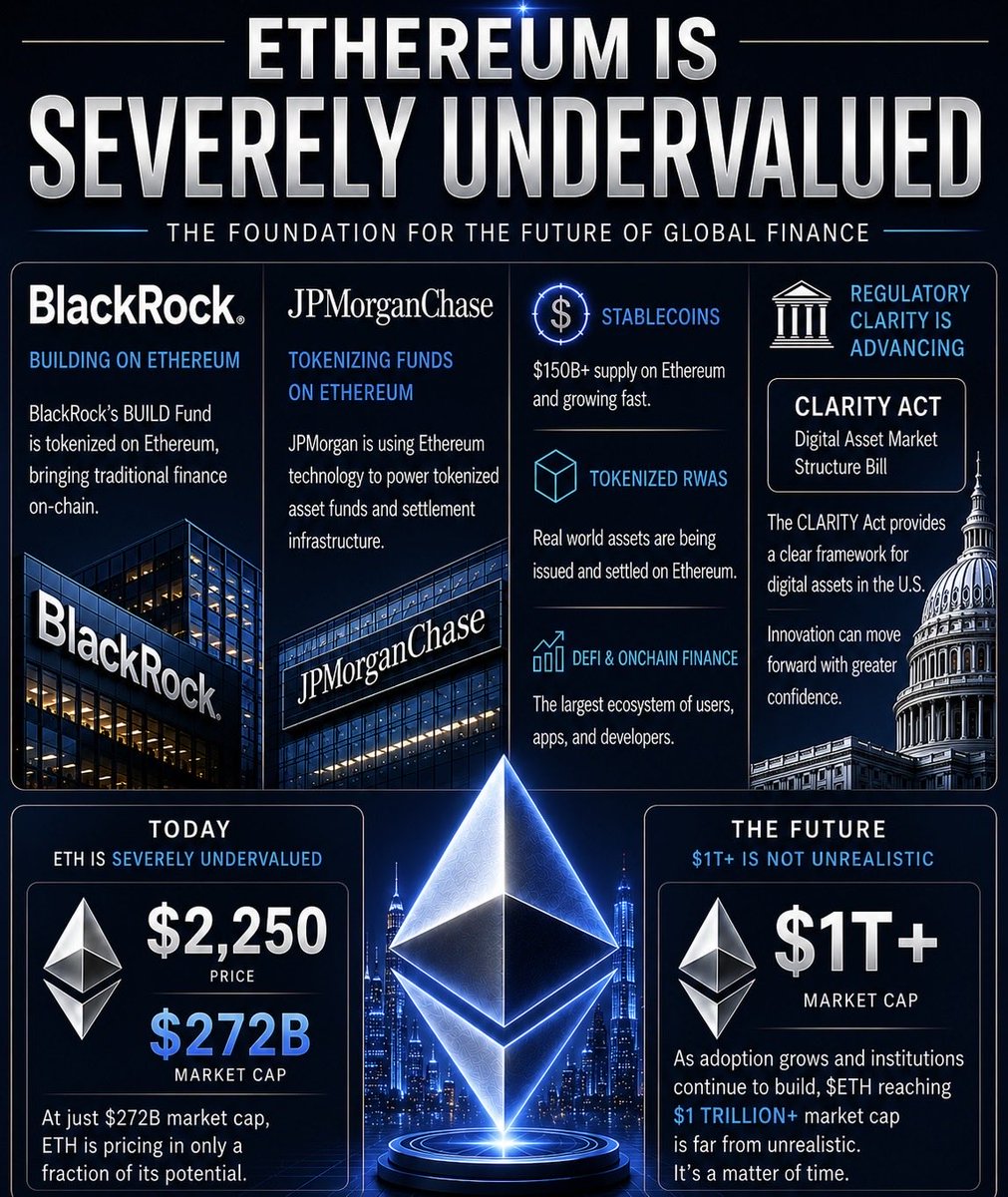
I think we can all agree that $ETH is severely undervalued here at $2,250.
@ethereum is currently sitting at around a $270B market cap, yet it’s becoming the foundation for tokenized finance, stablecoins, RWAs, and on-chain settlement.
• BlackRock is building on Ethereum
• JPMorgan is tokenizing funds on Ethereum
• Stablecoin adoption keeps accelerating
• Regulatory clarity is advancing in the U.S.
And I think most of us can agree that a $1T+ market cap for $ETH is far from unrealistic.
The market still hasn’t fully priced in Ethereum’s role in the future of finance.
Ronin. Is. Home.
Migration to Ethereum complete ⚔
Five years ago, Ronin was a new Ethereum sidechain with a single game aboard: Axie Infinity.
Over the years, Ronin emerged as THE gaming chain, onboarding millions of players through more games like Pixels, Cambria, Angry Dynomites, and many others.
Today, we plugged our engine into the mothership: Ethereum.
Here’s what that means 🧵👇
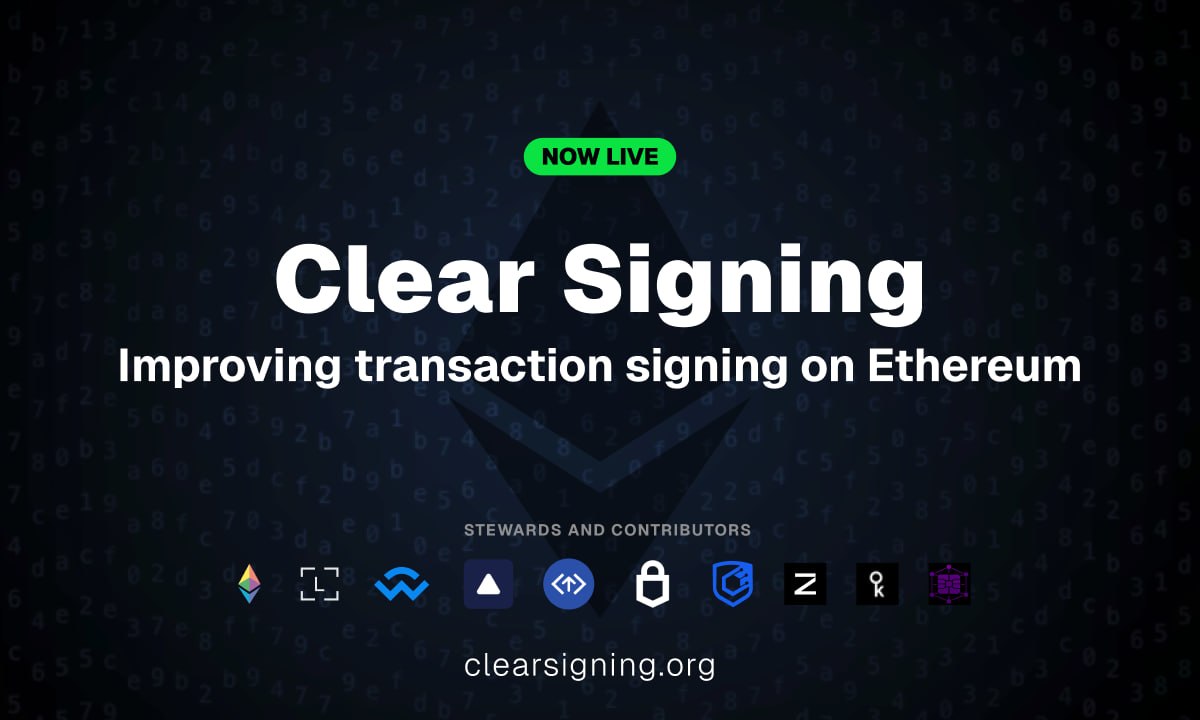
0/ Clear signing is now live.
An open standard to end blind signing, making human-readable transactions default.
This effort brings a major UX and Security upgrade to transaction signing on Ethereum.
🐋 WHALE WATCH: $Aave just got the green light to move $71M in frozen $ETH.
A U.S. judge cleared the way for the recovery after the rsETH exploit.
This allows an on-chain vote to move the funds from Arbitrum back to an Aave wallet.
It is a huge win for the recovery plan and victims claims.
Is this the regulatory clarity we need for DeFi ?
@LayerZero_Core Luckily other people stepped up to stop the contagion from the layerzero bridge hack.
It’s far too late for an apology, especially when they put all the blame on Kelp for using 1/1 DN (it’s their default set up) and also failed to contribute to the fund recovery.
gg