On Tranquillity of Mind
De Tranquillitate Animi, also translated as On Peace of Mind, is addressed to Seneca’s younger friend Annaeus Serenus. Serenus was not wholly committed to Stoicism and seems to have been passing through a period of moral uncertainty.
The work has a striking structure:
Serenus describes his condition at length.
He asks Seneca to diagnose it as a physician would diagnose an illness.
Seneca identifies its causes.
He prescribes a practical way of life.
It is therefore part dialogue, part letter and part ancient psychological consultation.
https://t.co/Bq0wQ8W9iA
Hit the Books
Test scores are not the measure of a person. They are an uncomfortably good measure of the people who run the schools.
https://t.co/5vyN8ncTQL
The practical question is not whether AGI will arrive, but whether we are ready for it. Are we prepared for a world where AI can think, learn and solve problems at a level approaching—or even exceeding—human experts? Will our education systems, workplaces, laws, institutions and values adapt quickly enough, or will we struggle to keep pace with technologies created elsewhere?
Aristophanes: ‘Whirl is King, having driven out Zeus’. The job of the centre is to bring back Zeus and tame the Whirl.
Wooldridge, Adrian. Centrists of the World Unite!: The Lost Genius of Liberalism (p. xxv). (Function). Kindle Edition.
“Happiness is a choice that requires effort at times.” - Aeschylus
The deeper message is: happiness is partly a discipline. It requires mental effort, emotional control, and sometimes the courage to see meaning even in hardship.
A simple way to say it:
Happiness is not always given by life; sometimes it must be built by the mind.
Ethan Mollick’s article makes a simple but urgent point: AI is not the enemy. But using AI without thinking can make us weaker thinkers, weaker writers, and weaker learners. Use AI as a coach, not as a substitute brain.
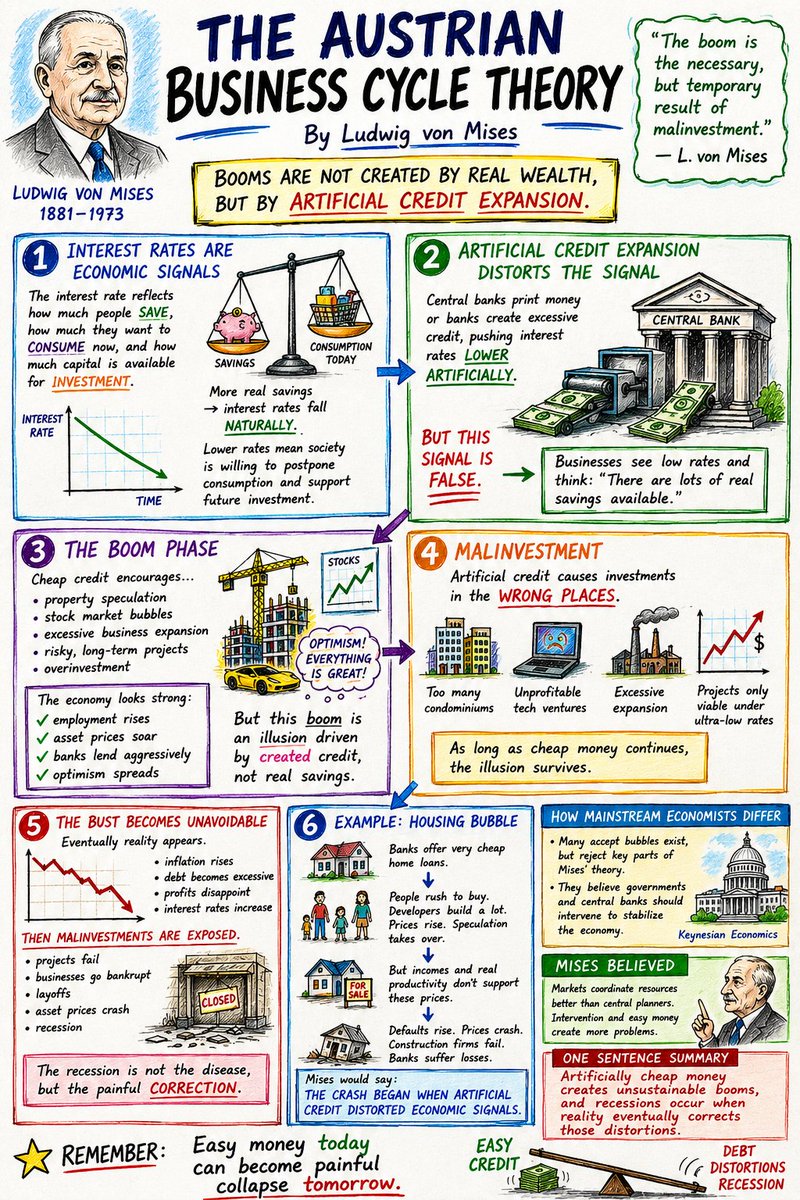
“Not every skyscraper, startup, or market rally is a sign of real wealth. Sometimes it is merely credit wearing the mask of prosperity.”
The word “malinvestment” was popularised by Austrian economist Ludwig von Mises, combining the Latin root mal-(“bad” or “wrong”) with “investment.” But Mises was not merely referring to failed businesses or poor financial decisions. He used the term to describe investments distorted by artificially cheap credit and easy money policies that create the illusion of sustainable growth. In his view, when interest rates are pushed unnaturally low, businesses and investors are encouraged into projects that appear profitable in the short term but lack real economic foundations.
The result is often a cycle of boom, speculation, debt expansion, and eventual collapse. More than a century later, the term “malinvestment” still echoes in debates surrounding housing bubbles, tech speculation, excessive leverage, and modern financial crises — a reminder that not every boom is built on real wealth.
Discover the infinite nature of reality with the Isa Upanishad: 'All this is full. All that is full. From fullness, fullness arises. When fullness is taken from fullness, fullness remains.'" #Upanishad#Spirituality#InfiniteReality