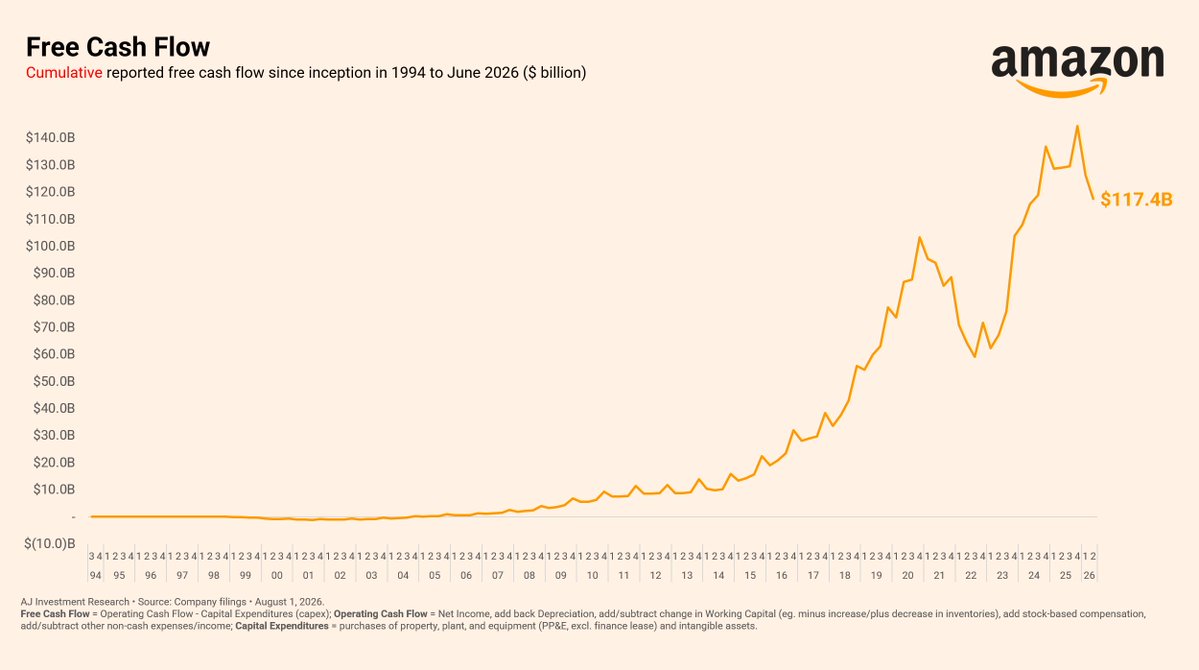
Since its founding in 1994, Amazon @amazon has generated just $117 billion in cumulative free cash flow (FCF) on $721 billion in cumulative operating cash flow.
Despite producing relatively little FCF, Amazon has maintained a multi trillion dollar valuation for several years, and is valued currently at a $2.9 trillion MCap.
The key takeaway for investors is this:
Contrary to finance theory @AswathDamodaran, a company does NOT have to produce significant FCF relative to its valuation to keep growing its share price.
All that is need is the 'prospect' of ever larger potential future FCF!
"Growth beats cash flow any day of the week, over the long term." (AJ, 2026)
As long as this 'carrot' dangling in front of investors is maintained a share price - as Amazon demonstrated for over three decades - will go up.
Years ago, I coined this seeming contradiction with theory the 'Amazon scenario'.
You know what's the craziest part right now?
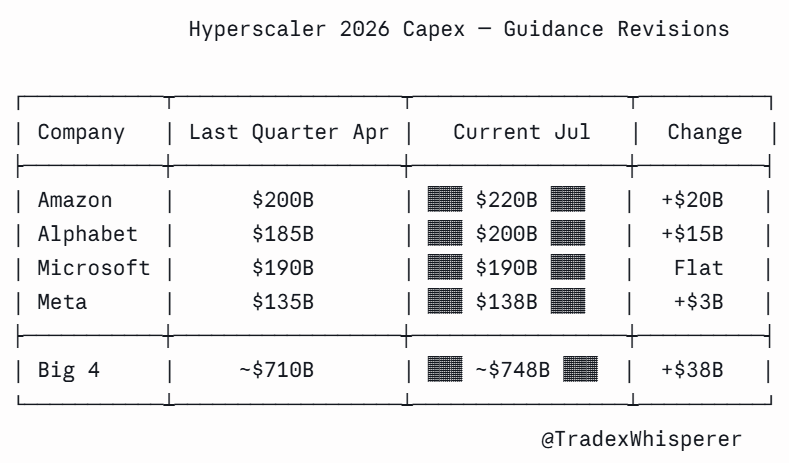
Capex keeps getting raised, on the road to $1 trillion next year. Amazon's CEO says demand still outpaces supply, with no balance in sight through 2028.
And after all that, $MU & $SKHY still trade at 4-5x forward earnings.
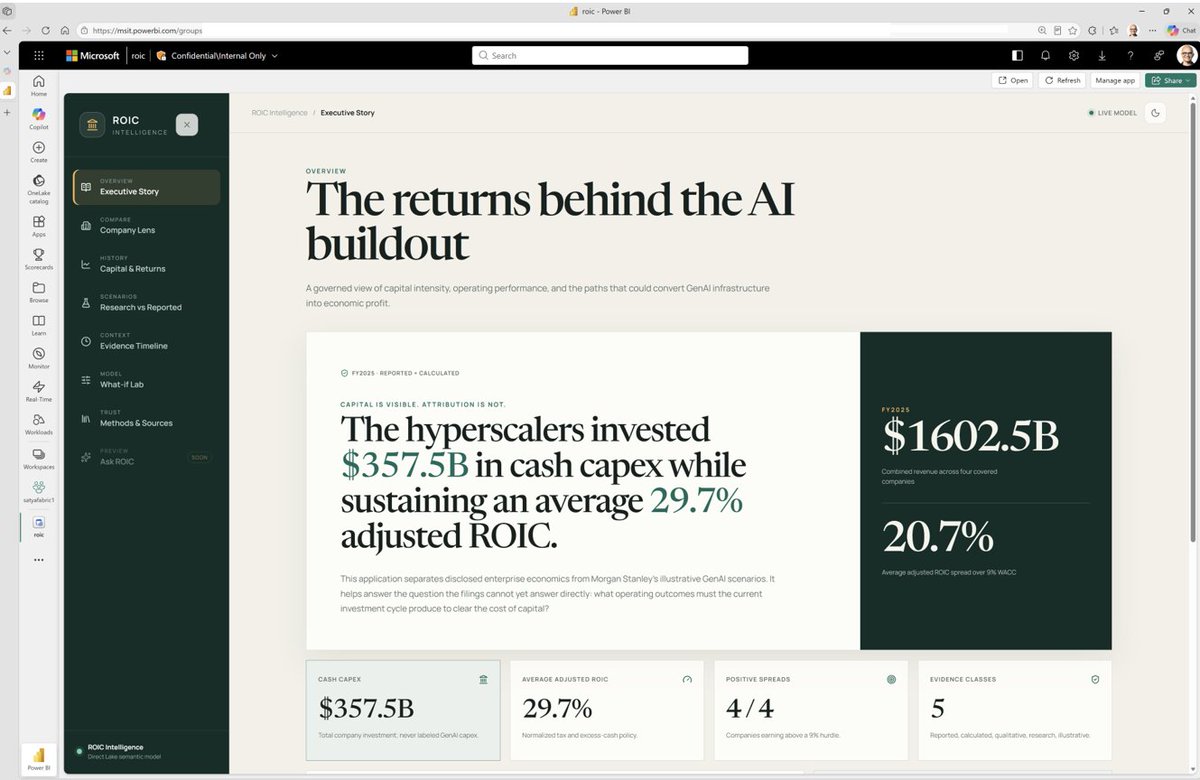
Some more detail on the ROIC Intelligence App I built yesterday and mentioned on today's earnings call.
I took the PDF that Brian Nowak at Morgan Stanley put together for Hyperscale ROIC this week and used Copilot code (coming in our new superapp) with a single prompt + skill (/drill-me) to create the plan, then used autopilot in auto to create the full app (with history, lookups, scenarios, what-ifs, etc). And /rubber-duck to test.
And the best part is that all the artifacts are in my enterprise environment. My app is in Copilot, my code is in GitHub Enterprise; all my data pipelines/lake/semantic models are in Fabric. And everything is under Agent 365 IT/Sec/FinOps control!
So this is not about Tokenmaxxing or vibe coding. Every step of the way the rails are engineered to create value, making everything a long-term reusable asset, with governance/security, and cost controls.
This is the full system to drive business value. Disclosures: This is all pulled from public sources, and for illustrative purposes only...not financial advice! :)
Here is the app and architecture...
Since its founding in 1994, Amazon @amazon has generated just $117 billion in cumulative free cash flow (FCF) on $721 billion in cumulative operating cash flow.
Despite producing relatively little FCF, Amazon has maintained a multi trillion dollar valuation for several years, and is valued currently at a $2.9 trillion MCap.
The key takeaway for investors is this:
Contrary to finance theory @AswathDamodaran, a company does NOT have to produce significant FCF relative to its valuation to keep growing its share price.
All that is need is the 'prospect' of ever larger potential future FCF!
"Growth beats cash flow any day of the week, over the long term." (AJ, 2026)
As long as this 'carrot' dangling in front of investors is maintained a share price - as Amazon demonstrated for over three decades - will go up.
Years ago, I coined this seeming contradiction with theory the 'Amazon scenario'.
Ursula, Microsoft @satyanadella alone spent more than that just in the last quarter and will be spending a multiple of that over the next two quarters.
For my first post, I’m sharing a letter @NVIDIA signed on why open models matter.
AI will transform every industry, power every company, and be built by every country.
Open models strengthen safety and cybersecurity, accelerate innovation and diffusion, and enable sovereignty.
The world needs both frontier closed models and frontier open models.
https://t.co/AUKzoQ5Ikb
@amasad The bear case for $NVDA (the Jensen himself made on dwarkesh) is that Chinese models will end up specializing to Huawei architecture soon
They quantitized to MXFP4 rather than NVFP4 for K3
To scale, a lot of money was needed, and it was useful that economic systems are driven by people that can't extrapolate very well on complicated technological matters. They invested a lot of money for something that is going to benefit everybody.
It is my belief that many devs right now are not maximizing what they can do with automatic programming because they still look at the code. Doing it makes you the bottleneck. Your time is better invested in new ideas, QA, design, and asking yourself what is your goal.
@alojohhardcore Great tool to sense relative expensiveness to feed margin and overall risk exposure, thanks a lot!
Had this backtrack to get a feeling how well it captures history - looks pretty solid (disclaimer: approximation/values were extracted from Yardeni charts)
How do you know @BerntBornich it's the "most advanced robotic hand in human history" if most of the 100+ global startups + Tesla working on them keep their latests prototypes closely under wraps?
https://t.co/1guJ6dvxnw
"[...] human capital does not become less valuable as token capital grows. It only becomes more valuable! [...] Without human direction, you have compute running in circles."