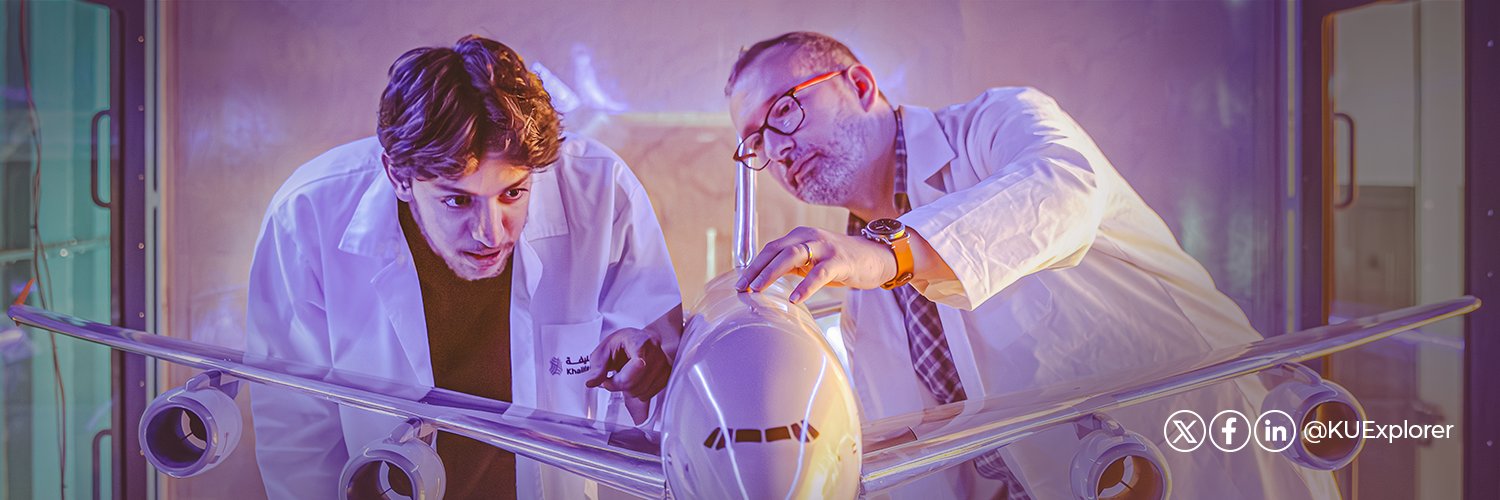
This year’s issue of #KUExplorer is here!
Discover how VR therapy helps patients face their deepest fears, ways AI can predict cyberattacks, how science and heritage come together to secure the UAE’s food future, and much more: https://t.co/pCdtk2YAQH
@KhalifaUni
⚙️ Extreme temperatures force oil operators in the Middle East to rely on expensive alloys. But a combination of corrosion inhibitors and a physics-informed artificial neural network allowing the safe use of more affordable materials.
https://t.co/9wbMEW4oFl
♻️ Capturing carbon limits damage, turning it into something useful drives sustainability.
♻️Scientists are developing solar-powered catalysts to convert carbon dioxide into valuable industrial products like fertilizers and plastics.
👇Read more.
https://t.co/CmGegPUm33
⚡Frequency fluctuations in microgrids can cause blackouts. A new approach building on virtual synchronous generators addresses this by learning from past errors and anticipating future changes, keeping microgrids stable even under demanding conditions.
https://t.co/egAk4InJ55
👩🏻🍼 The Maternal and Infant Health Monitoring System for Abu Dhabi has launched to bridge the gap between research and healthcare by tracking key outcomes and giving physicians much needed data to build a healthier future for mothers and babies.
https://t.co/rbiYJcQpGW
🌍 A brain-inspired tool outperforms several deep learning models in renewable energy forecasting, while consuming less energy, making AI itself more sustainable.
Read the full article: https://t.co/eQAKhizun3
💡What happens inside a nuclear plant when something goes wrong?
Researchers from Khalifa University and EPRI are using AI simulations to map risk points in reactor cooling systems and ensure safer nuclear energy.
https://t.co/zgIHU3cv7p
#KUExplorer
🌐 By precisely controlling how antennas talk to each other, engineers can dramatically boost wireless network performance.
⬇️Read more on #KUExplorer:
https://t.co/KPNkr3GAPv
As industries face growing pressure to go beyond profit and account for people and the planet, Khalifa University researchers have developed a decision-making tool for project managers that weighs economic, social, and environmental factors.
https://t.co/92PafK7SGh
#KUExplorer
Researchers are developing catalysts to convert captured CO₂ into plastics, fuels, and other essentials to fight climate change while meeting global demands.
https://t.co/yQmkJkN1a4
#KUexplorer
🌊 Doping a catalyst with cerium, a rare-earth metal, enhances corrosion resistance, unlocking the vast potential of seawater as a source of green energy.
Find out more: https://t.co/tbvO5z5ZPN
#KUExplorer
Recognized as one of 2025's Highly Cited Researchers, Prof. Khaled Salah shares with #KUExplorer how his blockchain research delivers real-world impact, from healthcare data privacy to tracking agricultural products and securing unmanned aerial vehicles.
https://t.co/EWvEGz71QO
✈️ For three decades, Prof. Wesley Cantwell has been advancing how aircrafts are built, pioneering lightweight, resilient, and even “self-aware” materials capable of detecting structural damage.
Read more about his work: https://t.co/YgenCzElAW
#KUExplorer
🍏Where does our food really come from?
A digital food passport combines Internet of Things field sensors and blockchain to track products from farm to fork, restoring trust in food labels, and supporting sustainable farming.
https://t.co/NUw07HzbUO
#KUExplorer
🆕 A space–time based algorithm enables computer vision to spot movement more accurately, even in videos with busy or changing backgrounds by modeling movement as coherent shapes.
Read more.
https://t.co/HKAxmyguwG
#KUExplorer
💡 What if wasted heat from industry and power plants could be converted into electricity?
Thermoelectric generators under development at Khalifa University’s Advanced Power and Energy Center aim to do just that.
👇Learn more.
https://t.co/8p0tnrG3jP
#KUExplorer
Can wastewater treatment materials be repurposed?
Mxene enhanced with tms-EDTAcan remove nickel and other pollutants from water while retaining over 80% efficiency even after five reuse cycles.
https://t.co/0WCgTd9U7Z
#KUExplorer
💧Inspired by mangroves, scientists at Khalifa University have developed a low-cost, solar-powered desalination device. Producing up to 2.2 liters of freshwater per square meter, it could meet an individual's daily drinking needs.
Find out more: https://t.co/DXCsRKx0wR
💡From high-tech lenses to smart contacts with night vision, Khalifa University researchers can 3D print custom optical filters to meet any need.
Learn more.
https://t.co/SWlXBfjkCQ
#KUExplorer
⚡ Widespread power outages in Spain and Portugal in April 2025 reminded us that, even with interconnected power grids, power supply cannot be taken for granted.
⚡ Could the solution lie in decentralised energy systems?
https://t.co/Qn3Rbxal1t
#KUExplorer
💎A new property for tiny diamonds has been uncovered!
💎By attaching nanodiamonds to chemical groups, scientists demonstrated their potential to boost immunity against viruses and cancer cells, opening the door to new medical applications for these gems.
https://t.co/CnupDmhMi0