Thank you to all the young scholars who applied to “Rethinking Development in Latin America” 2026! We received 116 applications from 20 countries across Latin America, Europe, Africa and Asia.🌍
Selected participants will be announced soon. See you in Buenos Aires!
👉 https://t.co/fPvb9zeeMc
@MarioCimoli@KulfasM@f_nastasi@lalicatelen@manuelv18
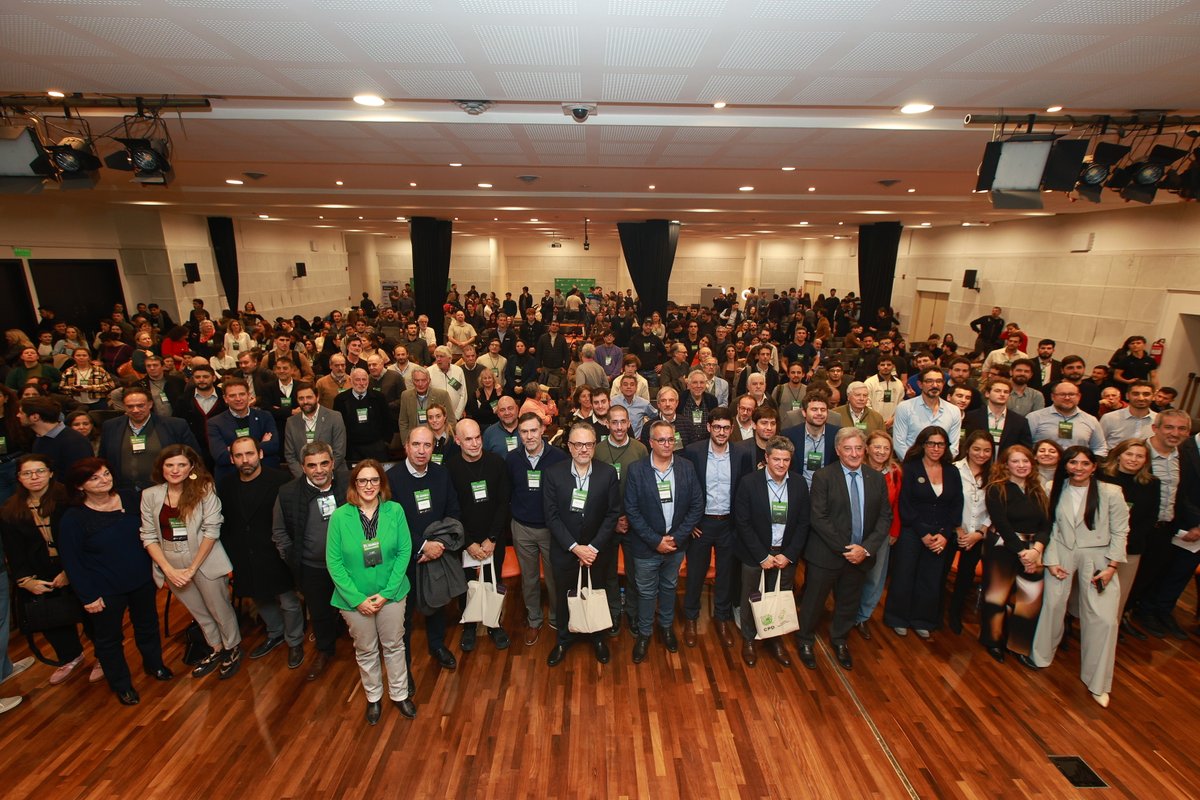
Ayer se realizó el 2° Congreso Productivo para el Desarrollo de @MisionRevista en la FCE-UBA, con más de 900 participantes y un debate poco habitual en Argentina: @KulfasM, @horaciorlarreta, @LaspinaL,
@mara_ruiz_malec, @danyscht, @luciacirmi_, Daniel Herrero, @SergioGKaufman y referentes empresariales, sindicales y académicos discutiendo con respeto y profunidad cómo volver a crecer, generar empleo y desarrollar capacidades productivas.
Más allá de las diferencias, hubo consensos fuertes: Argentina necesita una estrategia productiva, más inversión, infraestructura, innovación, formación y un Estado que acompañe el desarrollo en sectores estratégicos. Seguiremos construyendo desde Misión junto a todos los que creen que ese camino es necesario.
Gracias @MisionRevista por haber organizado este importante y plural congreso y haberme invitado. Fue un debate muy enriquecedor y poco habitual: gente de diferentes trayectorias e ideas debatiendo con altura y respeto. Debería ser algo normal pero hoy en Argentina lamentablemente no lo es. El proyecto productivo del país necesita mucho más diálogos cómo este.
¿Quiénes son los ganadores y perdedores del nuevo régimen comercial (lease más apertura)? Combinando precios mayoristas (IPIM), empleo formal, salarios y datos de importaciones, se puede hacer una radiografía sectorial bastante clara del shock 2024-2025. Hilo 👇
📢 Deadline extended until May 30!
Due to the high number of inquiries and registration requests, we have extended the application deadline for the Summer School: Rethinking Development III (Buenos Aires, Oct. 5–23).
Coordinated by: Mario Cimoli & @KulfasM
🔗 https://t.co/mkgDzZ0hJM
Smartphones are not the explanation for the recent decline in fertility. Instead, they are an accelerator of deeper forces already at work.
Let’s start with the facts. Fertility is falling almost everywhere: in rich, middle-income, and poor countries; in secular and religious countries; and in countries with high and low levels of gender equality.
The decline accelerated around 2014. So, no country-specific explanation will work unless you are willing to believe that 200 distinct country-specific explanations arrived at roughly the same time.
Smartphones look like the obvious candidate: the first iPhone was released in 2007, and global adoption has been astonishingly fast.
Economists understand the first major decline in fertility in advanced economies, from 6 or 7 children per woman throughout most of human history to about 1.8, that occurred between the early 1800s and roughly 1970, well before smartphones. The main drivers were a sharp fall in child mortality (effective fertility was rarely above 3 and often close to 2) and the shift from a low-skill, rural agrarian economy to a high-skill, urban industrial one. We have quantitative models that fit these facts well.
Country-specific factors mattered too, of course. Proximity to low-fertility neighbors accelerated Hungary’s decline, while fragmented landowning structures accelerated France’s. But these were second-order mechanisms.
This is also why most economists long considered Paul Ehrlich’s doom scenarios implausible. We forecast that fertility in middle- and low-income economies would follow the same path as in the rich, probably faster, because reductions in child mortality reached India or Africa at lower income levels (medical technology is nearly universal, and most gains come from handwashing and cheap antibiotics, not Mayo Clinic-level care). Much of what we see in Africa or parts of Latin America today is still that old story.
But in the 1980s, a new pattern appeared. Japan and Italy fell below 1.8, the level we had thought was the new floor. By 1990, Japan was at 1.54 and Italy at 1.36.
This second fertility decline began in Japan and Italy earlier than elsewhere, driven by country-specific factors, but the underlying dynamics were widespread: secularization, an education arms race, expensive housing, the dissolution of old social networks, and the shift to a service economy in which women’s bargaining power within the household is higher. The U.S. lagged because secularization came later, suburban housing remained relatively cheap, and African American fertility was still high. U.S. demographic patterns are exceptional and skew how academics (most of whom are in the U.S.) and the New York Times see the world.
My best guess is that, without smartphones, Italy’s 2025 fertility rate would be about 1.24 rather than 1.14. I doubt anyone will document an effect larger than 0.1-0.2. Italy was at 1.19 in 1995, not far from today’s 1.14. The TFR is cyclical due to tempo effects, so I do not read too much into the rise between 1995 and 2007 or the decline from 1.27 in 2019 to 1.14 today. The direct effect of smartphones is not zero, but it is not, by itself, that large.
Where social media, in general, and smartphones, in particular, matter is in the diffusion of social norms. What would have taken 25 years now happens in 10. Social media are not the cause of fertility decline; modernity is. But they are a very fast accelerator.
That is why social media are a major part of the story behind Guatemala (yes, Guatemala) going from 3.8 children per woman in 2005 to 1.9 in 2025. Without them, Guatemala would also have reached 1.9, just 20 years later.
Modernity, in its current form, is incompatible with replacement-level fertility. By modernity, I do not mean capitalism: fertility fell earlier and faster in socialist economies than in market economies. Socialist Hungary fell below replacement in 1960, and socialist Czechoslovakia in 1966 (both experienced small, short-lived baby booms in the mid-1970s). By modernity, I mean a society organized around rational, large-scale systems and formalized knowledge.
Countries will not converge to the same fertility rate. East Asia is likely stuck near 1, possibly below, given its unbalanced gender norms and toxic education systems. Latin America faces the same gender problem plus weak growth prospects, so I expect something around 1.2. Northern Europe has more egalitarian family structures and might hold near 1.5. The very religious societies are probably the only ones that will sustain 1.8.
All of this could change with AI or changes in population composition. We will see. But on the current evidence, deep sub-replacement fertility is the “new new normal.” Unless we reorganize our societies, better learn to handle it as best we can.
One of great virtues of football as a sport was that it mimicked life: it is a game with few points (goals), they are often scored by a worse or simply luckier team, and injustice is rampant. And because injustice is rampant everyone can complain to be a victim of something and not feel inferior when losing a game.
Escribí sobre el mito del dropout universitario que se hace trillonario con una startup en el espacio del gran @sebacampanario https://t.co/hKT1aRxMZs Va un breve hilo
Está de moda impugnar a la educación superior. "Dejá la universidad, que no enseña nada importante, y armá tu propia start up, que te va a ir mucho mejor". La evidencia, como sostiene acá @anlopez1962, no confirma este prejuicio.
https://t.co/GtaIqIIwIk
Ya entedí:
- Lo que sale bien es porque son el mejor equipo economico del universo, y el Presidente se merece el Premio Nobel de Economía.
- Lo que sale mal es por el Riesgo Kuka.
El Financial Times saca una nota hoy para educar a Javi: la natalidad se desploma en todo el mundo, y la ley del aborto en Argentina no tienen nada que ver. Milei habla de lo que no entiende porque es un bufón y charlatán. https://t.co/7ffSydrv4N
📢 ¡Prórroga hasta el 30 de mayo!
Ante la gran cantidad de consultas y demanda de inscripciones, extendimos el plazo para la Escuela de Verano: Repensar el Desarrollo III (https://t.co/WbwFWKWWqZ, 5–23 oct.).
Coordinan: Mario Cimoli & @KulfasM