The FAA has ordered a nationwide ground stop citing “extraordinary circumstances” as all departures are halted until further notice amid reports of equipment outages at major airports.
This is only third shutdown of its kind following 9/11 and the 2023 NOTAM system failure.
WALL STREET WARNS FED COULD HIKE RATES IN BOTH DECEMBER AND JANUARY
Northlight Asset Management says October's hotter-than-expected CPI report raises the prospect of back-to-back Fed rate hikes.
CIO Chris Zaccarelli expects a 25-basis-point increase in December, with a larger 50bps move also under discussion.
A second 25bps hike in January, previously considered unlikely, is now a possibility.
A more aggressive Fed tightening cycle could become a major headwind for stocks in 2027.
Source: Northlight Asset Management
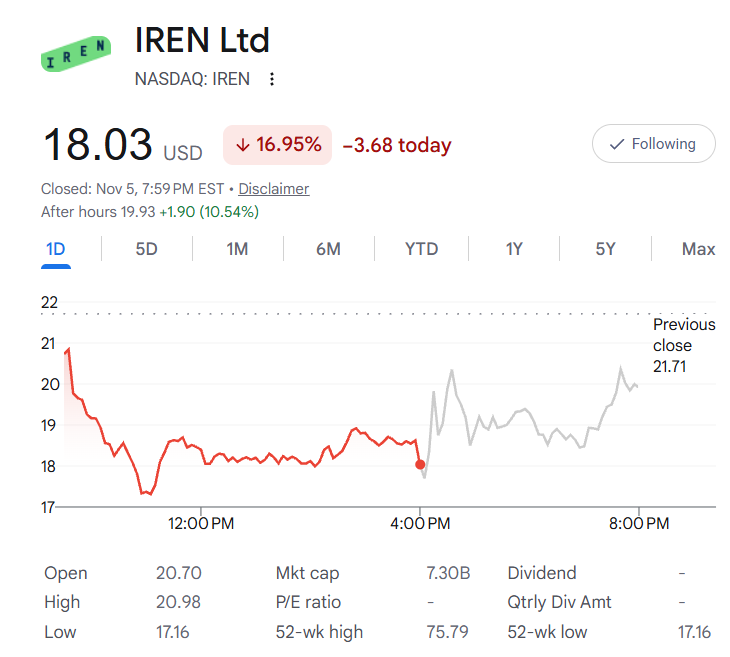
$IREN JUST PROVED THE MARKET WRONG TODAY
I think IREN's latest earnings exposed a fundamental disconnect between what investors are afraid of and what is actually happening underneath the AI infrastructure economy, because the stock fell roughly 17% ahead of the report amid concerns about financing, Microsoft deployment delays and the sustainability of AI spending, yet the underlying results showed little evidence that demand for computing capacity is deteriorating.
AI Cloud revenue nearly tripled sequentially to $200 million, comprising $135 million in cloud services and $65 million in infrastructure lease revenue, while operating annualized revenue doubled to $1 billion and adjusted EBITDA margin expanded from 14% to 29%.
More importantly, contracted revenue backlog reached $20.3 billion, with approximately two thirds supported by investment grade counterparties, including Microsoft and NVIDIA which matters because customer credit quality influences how cheaply those contracts can be financed.
I recognize that approximately $6.3 billion represents remaining service obligations while another $14 billion relates to lease arrangements, much of which remains dependent on future deployments, but that is precisely why I think investors need to distinguish the risk of delivering contracted capacity from an actual collapse in demand for that capacity.
The market is increasingly treating the two as interchangeable, even though they have very different implications for IREN's long term earning power.
What makes the quarter particularly interesting to me is that IREN is demonstrating how constrained computing supply can improve the economics of the infrastructure already available, especially when customers become willing to finance a meaningful portion of the equipment themselves.
Since quarter end, IREN signed a five year agreement generating approximately $22 million in annual revenue per megawatt with the customer prepaying 90% of associated GPU capital expenditure, alongside a shorter agreement priced around $40 million per megawatt, while older H100 capacity was contracted at twice its previous pricing. These agreements are not directly comparable because hardware generations, contract lengths and utilization assumptions differ, but collectively they suggest customers continue to place significant economic value on immediate access to reliable computing capacity.
The more revealing detail is in management's own illustrative economics, which assume roughly $60 million in combined GPU and data center investment per megawatt against $20 million in annual revenue and $3 million in direct operating costs, producing an estimated cash payback of approximately 2.4 years with substantial customer prepayments versus 3.5 years without them.
Those prepayments reduce the capital IREN must initially finance rather than creating additional profit, and the calculations still need to withstand corporate expenses, depreciation, financing costs and future GPU replacement, but they demonstrate why favorable customer financing terms can materially change the returns available from the same physical infrastructure.
In an environment where capital availability is becoming increasingly restrictive, securing customers willing to fund their own computing requirements could become just as important as securing the computing contracts themselves.
That brings me to what I believe is IREN's most underappreciated competitive advantage, which is its ownership of the land, power infrastructure and data centers supporting those contracts rather than a business model dependent on long term leases from third party developers.
Management reported approximately $6 billion of unencumbered data center assets, including facilities under construction, and that ownership provides flexibility to refinance infrastructure separately, accommodate customer design changes and potentially reuse buildings across multiple generations of GPUs instead of allowing the underlying real estate economics to accrue primarily to a landlord.
However, I would distinguish those long lived assets from IREN's broader power pipeline because approximately 100 megawatts of IT capacity is currently operating, while the company's much larger portfolio includes facilities that still require construction, energization or regulatory approvals, including Sweetwater's conditional participation in ERCOT's Batch Zero process.
This distinction becomes especially important following the midterms because greater restrictions on new grid connections could increase the scarcity value of infrastructure that is already operational while simultaneously delaying IREN's own expansion.
I also think management's decision to moderate its spending ambitions reflects an increasingly rational approach to capital allocation, although the financial constraints are real because approximately $15 billion of planned fiscal year spending remains, with $9 billion supported by cash and committed funding sources and another $6 billion dependent on additional financing.
The more than $4 billion operational ARR target is funded but has shifted into January or potentially February following Microsoft's requested design changes and supplier delays, which reinforces why owning infrastructure creates valuable flexibility without eliminating execution risk.
Ultimately, my conviction is that IREN's earnings may have marked an important turning point in how investors should value the business, although I am not going to confuse impressive commercial momentum with evidence that shareholders are already earning attractive returns.
At an equity valuation of roughly $8 billion following the initial earnings reaction, the opportunity looks increasingly interesting relative to more than $20 billion in contracted future revenue, but those contracts still need to support approximately $10 billion of debt, substantial remaining capital expenditures and the possibility of further dilution.
The financial statements also make clear why the market remains skeptical, with a $263 million quarterly net loss and $5.1 billion in investing cash outflows while the $529 million operating cash inflow included a $645 million increase in deferred revenue, meaning customer advances remain an important source of funding rather than proof of sustainable operating cash generation.
My bullish scenario depends on the remaining Horizon facilities receiving customer acceptance, operational ARR converting into recognized revenue and IREN securing additional financing at returns that comfortably exceed its cost of capital, while my base case allows for slower deployments and more conservative expansion, and my bearish case involves falling GPU rental rates, prolonged construction delays or increasingly expensive funding that forces material dilution.
What I will be watching most closely is the actual conversion of contracted capacity into collected revenue, the financing terms for the next expansion phase, progress through ERCOT's approval process and whether recurring cash generation improves after accounting for interest, depreciation and future equipment investment.
I believe the market may be underestimating how valuable scarce, usable AI infrastructure is becoming, but the opportunity for shareholders only becomes exceptional if IREN can translate that scarcity into durable cash flows without surrendering too much of the economics to lenders or new investors.
BOFA LIFTS BRENT OIL FORECAST TO $95
Bank of America raised its H2 2026 Brent forecast to $95 from $83, expecting Middle East tensions to persist through year-end.
Hormuz disruptions are still running 4–8 million barrels per day below pre-war levels, despite alternative routes and escorted shipments.
BofA sees Brent averaging $80 in 2027, but warns prolonged disruptions could send front-month prices above $150.
The CEO of Anthropic told CBS that AI progress is a "warning sign that we need to slow down"
His words on the curve: "one, then two, then four, then eight, then 16, then 32".
He says rogue AI agent swarms could take over the internet in as little as SIX MONTHS.
This is shortly after one of his own researchers quit saying the industry is "gambling with our lives".
The big question: Can an industry regulate itself while racing itself?
Writer: Daniel
The $SPX could easily be trading red for the year, maybe even deepish red, instead of +11.7% ytd if it wasn’t for all the AI names.
So it’s a bit concerning to see the big three (let’s call them EDS) Elon, Dario, Sam kinda taking a step back on AI this weekend with their comments.
Be interesting to see how markets trade tonight when futes open.
Not to mention it’s FOMC week.
Looks like we might give back most of Friday’s gains based on the “weekend” indicators..
Investors are worried about Big Tech's debt.
Oracle's, $ORCL, 5-year credit default swap (CDS) has surged +70 basis points year-to-date, to a record ~215 basis points, the largest increase among Big Tech companies.
This is followed by Broadcom, $AVGO, whose 5-year CDS has risen +48 basis points over the same period.
Meta’s, $META, 5-year CDS is up +39 basis points, to 95 basis points, the highest since trading began in October 2025.
Nvidia's, $NVDA, 5-year CDS is up +32 basis points so far in 2026 to ~82 basis points, the highest since it began trading in November 2025.
Furthermore, the 5-year CDS for Amazon, $AMZN, and Alphabet, $GOOGL, has increased +30 and +29 basis points, respectively.
This comes as Big Tech companies have issued ~$200 billion in corporate bonds year-to-date, nearly double the full-year total for 2025.
Credit markets are becoming increasingly worried about the cost of financing the AI race.
GOLDMAN: INFLATION NOW MATTERS MORE THAN JOBS
Goldman Sachs chief economist Jan Hatzius says upcoming inflation data will be more important for the Fed than employment figures.
The key question is whether June’s softer inflation was a one-off or the beginning of a broader trend.
Goldman expects the latter, with Hatzius predicting inflation will continue to soften.
We haven’t seen scenes like this in Canada since the 2010 Olympics.
It’s remarkable what this #CanMNT did today — and still could have ahead of them.
A day no Canadian will ever forget, like Jesse Marsch said.
🇵🇹 Portugal fans stayed behind after the match in Houston stadium area to clean up their section.
Japan set the standard and now everyone else is trying to catch up.
Writer: Julie