For @YLReview, I take a look at King Sunny Ade’s understanding and use of spirituality in his music. KSA, perhaps more than anyone in Nigerian music history, exemplifies the famed syncretism of the Yoruba people, which in turn largely defines their music. At 80 years old today, Sunny Ade’s layered spiritual imagination is fascinating because it has yielded no less than six decades of public life, more than a hundred albums, ten thousand live performances, and one of the most complex bodies of thought in African music.
https://t.co/tNBM6eJ23W
Saint Janet is dead. This shocking and sad news was announced yesterday, and a corner of Nigeria’s internet has been grappling with the sparse information around her demise.
Every blog carried the same news item, hardly furnished with any detail—not quite an obituary. Little wonder, there are speculations that diabetes contributed to her ill-health and death, speculations that have been squashed.
Saint Janet was the stage name of Janet Iyun Ajilore, a juju musician renowned for repurposing gospel songs with lewd lyrics. She called herself the General Overseer of the St Bottles Cathedral. Her performative sainthood was predicated on her “inability to sin.” These subversive descriptions, when stacked, are hilarious, close to panegyric praise poetry, and wholly representative of her standing in nightlife circuits in southwest Nigeria.
I was introduced to her music around 2012, in Ilesa, during my pre-registration housemanship. Her music spewed out of a phone in an operating theatre during an emergency Caesarean section. The lead surgeon, a registrar, was Igbo, he could not comprehend the music in his operating room. The phone owner was his assistant, a house officer and socialite nicknamed Leninger.
Leninger identified as a St Janet devotee. His phone was filled with her live plays. Sung mostly in Yoruba, St Janet’s juju music drew heavily from hymns and folk songs. The twist: gospel music derailed into the outrageous terrain of sexcapades.
If the prerogative of juju music was to insert sexual innuendoes for the sake of propriety occasionally, St Janet’s mission was to dispel every notion of propriety.
She held court telling stories that approached sex simply as what it was: a human act. Sex was neither a taboo nor a taboo subject. Body parts were not off limits. Sexual dalliances were examined with both journalistic curiosity and fraternal humour.
In a St Janet set, the Christian and carnal, the sacred and secular, piety and pornography were mere suggestions, without any clear divisions. Sordid details in hallowed bedrooms became fodder for barroom banter. Part of her performance was that she appeared unassuming, self-effacing. She presented unembellished, her appearance quite plain. In fact, her stage name, ‘Saint ’, is a nod to her unassuming appearance, which sharply contrasts with what she does to and with the microphone.
St Janet’s music was frowned upon by society, seen as vulgar and poisonous. I must say it takes a bit of courage to power through her set if you are uninitiated. Dutch courage always helps. Little wonder her devotees are not teetotallers. In a sense, she came ahead of her time. She was seen as a figure corrupting the youth when, in fact, what corrupted our youth and society is more insidious. But trust a society that does reflect, St Janet’s success as a juju musician hardly scaled into mainstream success within the juju spheres in southwest Nigeria. Brand and value alignments be damned, St Janet knew her bag was playing live music, and she held on to it steadfastly. Her music is eternal, evidence of her courage and innovation.
Rest in power, Saint Janet.
The wait is over.
We have 2 golds: Chimdiebube Onwubiko and Don Anele Munachimso.
We are the best in the world!
Egejurum Onyedikachi’s name was omitted. He should have a gold.
“What has happened over the years is that what we call Afrobeats—really, popular Nigerian music—finds a new trend to sit on. What has happened since around 2019, pre-Covid, is that we began to experiment with South Africa and amapiano, and a lot of our producers, who are really the engine room of Afrobeats—the guys who do the heavy lifting—sat in that space and carved out something that was not quite Afrobeats, not quite amapiano. Some people have suggested calling it Afro-piano, or whatever, to express what was going on at the time. That sound was popular and did quite well. But since then, I don’t think we’ve had any new sound that has emerged and caught everyone’s attention. The creativity feels stuck.”
I sat recently with @africasacountry ‘s @Mege01 & Sa’eed Husaini to discuss Nigerian popular music over the years, particularly Afrobeats.
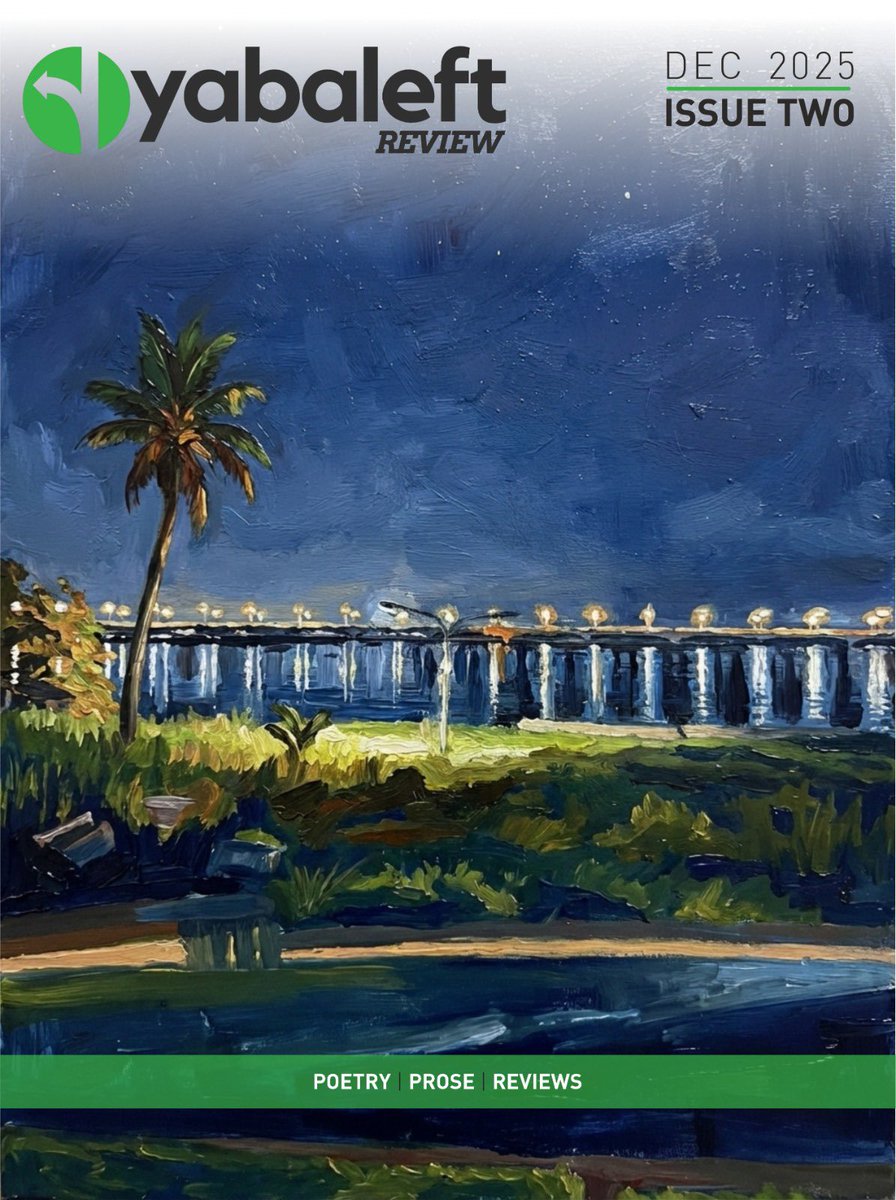
“Literary magazines chart precarious courses. Many die early; very few survive. Some die and are resurrected, with or without institutional support. Without institutional support, YLR chose a long beauty sleep.”
Tunji Olalere & Dami Ajayi, Editorial YLR Issue Two https://t.co/Ruz9CnoPCi
Graceland International School, PortHarcourt just informed me that Agbo Adoga qualified to represent Nigeria in international Maths Olympiad in China.
Nigerian Ministry of Education said they don’t have money to sponsor anybody.
So he will not attend.
Nigeria lost again!
@theunbald And there is a silent graveyard of stocks and ETFs driven by retail investors: SPACS that never flew, ARKs that capsised, and 'the-next-whatever. For every PLTR, there are ten CLOV.
My point is the bull market hasn't been green for most retail investors. The OGs still win.
https://t.co/qvRrTT3Wx4
“Buhari’s first nine months in government cleared our delusion. His I-am -for-everybody-and-I-am-for-nobody inaugural speech reminded me of Lapite’s reign in Tunde Kelani’s classic film, Saworoide.Buhari ruled by the grain of that rhetoric, without the full complement of a cabinet in the first instance. There was no clear fiscal policy and global oil prices began a slow and steady moon-walk.
The naira became 360 to the dollar.”
A point comes when you decide an album is good enough for you. On No Signs of Weakness, it happens for me mid-way through the album on the summery Lovers Rock cut, Sweet Love. Oluwaburna is the greatest Nigerian ever to do it.
That Adekunle Gold Afropop Vol 1. Put a classic stamp on it. What a record! And his sleek transformation from folksy to urbane, call it a Cinderella moment. Talk about a fine Afrobeats moment.