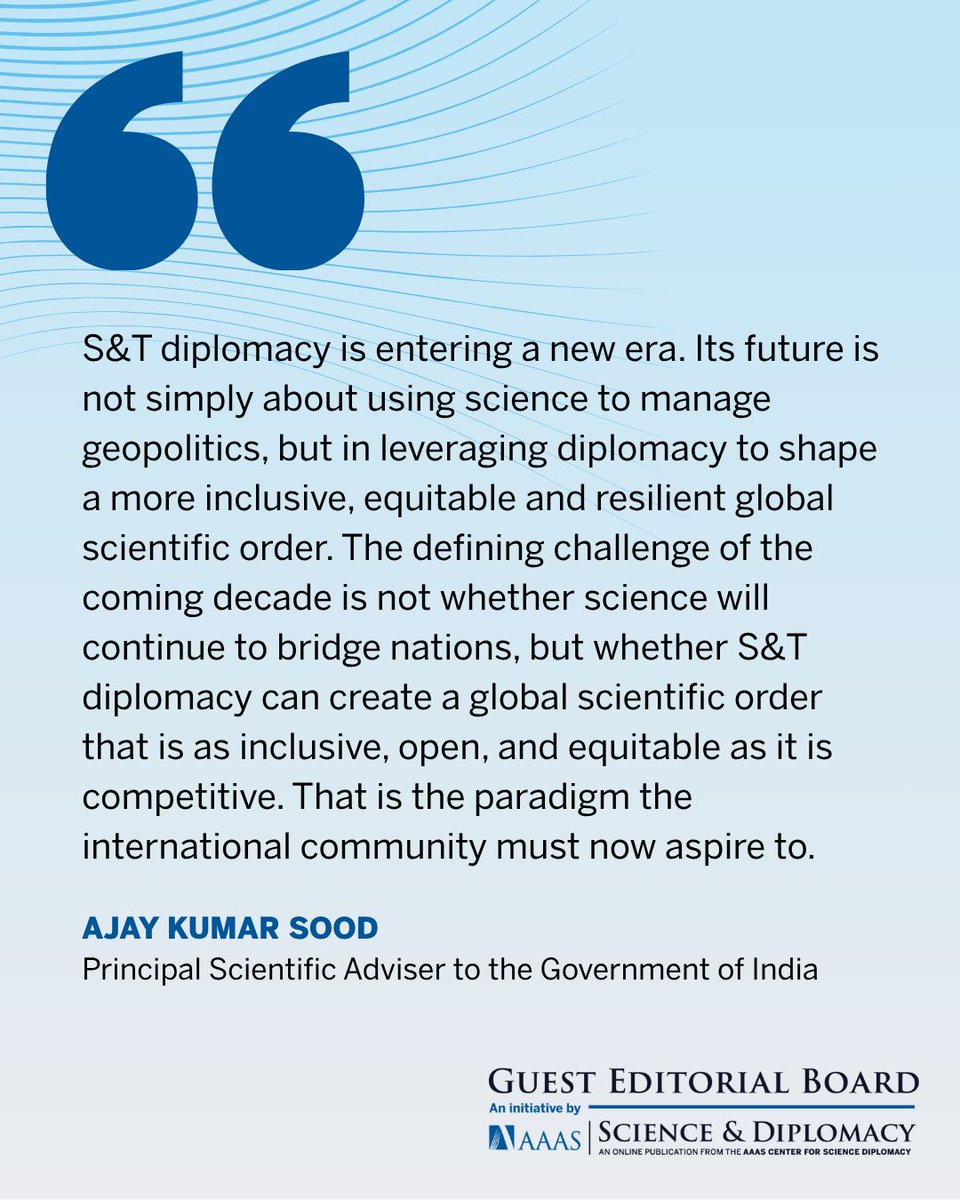
Prof. @AjaySoodIISc, Principal Scientific Adviser to the Government of India, authored a recent article, “Responding to Shifting Paradigms in Global Science and Technology Diplomacy,” as a member of the Guest Editorial Board of AAAS’s Science & Diplomacy. In the article, he reflects on the changing landscape of science and technology diplomacy and the need for a global scientific order that is more inclusive, open, and equitable.
Prof. Sood highlights the importance of making scientific knowledge and cooperation more inclusive and equitable. He argues that an inclusive S&T diplomacy agenda must recognize that diplomacy operates not only between states, but also across different stakeholders and knowledge systems.
In this article, he also reflects on the growing influence of multinational technology companies in diplomacy and public decision-making, recognising them as increasingly important geopolitical actors. Prof. Sood further discusses the need to balance strategic autonomy with openness, security, and international scientific cooperation, so that scientific knowledge and technological progress continue to serve the broader public good.
Read the full article here: https://t.co/9aCtFOPohz
@SciDip | @ChagunBasha
The Office of the Principal Scientific Adviser to the Government of India releases the Discussion Paper on “Enabling Cross-Border Data Interoperability for AI”. It is an explanatory brief that explores the importance of balancing data sovereignty with international data interoperability for India’s AI systems.
The discussion paper mentions India's emerging data-governance architecture, which already recognises the importance of coordinated data sharing, standardised metadata, APIs, auditability and legal compliance. It argues that for AI, in addition to these functions, contextual risk, classifications, controlled access, model-to-data processing, downstream use and other nuances also need to be addressed.
The paper examines specific structural gaps in enabling cross-border data interoperability for AI systems and its associated nuances. It aims to enable a broader understanding and constructive societal engagement. The Discussion Paper has been developed by drawing on collective insights from the extended AI ecosystem, including inputs from multi stakeholder consultations, bilateral and multilateral AI policy engagements and subsequent expert reviews.
Access the full discussion paper here: https://t.co/eWpU0XPwSp
@ChagunBasha
𝐀𝐬 𝐩𝐚𝐫𝐭 𝐨𝐟 𝐭𝐡𝐞 𝐨𝐧-𝐠𝐨𝐢𝐧𝐠 𝐀𝐈 𝐏𝐨𝐥𝐢𝐜𝐲 𝐖𝐡𝐢𝐭𝐞 𝐏𝐚𝐩𝐞𝐫 𝐒𝐞𝐫𝐢𝐞𝐬, 𝐭𝐡𝐞 𝐎𝐟𝐟𝐢𝐜𝐞 𝐨𝐟 𝐭𝐡𝐞 𝐏𝐫𝐢𝐧���𝐢𝐩𝐚𝐥 𝐒𝐜𝐢𝐞𝐧𝐭𝐢𝐟𝐢𝐜 𝐀𝐝𝐯𝐢𝐬𝐞𝐫 𝐭𝐨 𝐭𝐡𝐞 𝐆𝐨𝐯𝐞𝐫𝐧𝐦𝐞𝐧𝐭 𝐨𝐟 𝐈𝐧𝐝𝐢𝐚 𝐫𝐞𝐥𝐞𝐚𝐬𝐞𝐬 𝐚 𝐰𝐡𝐢𝐭𝐞 𝐩𝐚𝐩𝐞𝐫 𝐨𝐧 “𝐀𝐝𝐯𝐚𝐧𝐜𝐢��𝐠 𝐈𝐧𝐝𝐢𝐠𝐞𝐧𝐨𝐮𝐬 𝐅𝐨𝐮𝐧𝐝𝐚𝐭𝐢𝐨𝐧 𝐌𝐨𝐝𝐞𝐥𝐬.
The versatility of Foundation Models makes them a critical layer of today’s AI ecosystem and a key area for innovation in India. Therefore, developing indigenous foundation models is a strategic priority. India’s objective is to harness foundation models for inclusive growth and public good, while ensuring they are governed in a manner consistent with the country’s values, legal framework, and security interests.
This white paper provides an understanding of India’s approach to advancing indigenous foundation models through public–private collaboration and to governing these systems that support trust, accountability, and responsible adoption.
The White Paper also provides details on India’s approach - which is centred on building indigenous capability across the foundation-model stack. Rather than relying on a single model, India is developing an ecosystem that combines
(i) shared compute access,
(ii) India-centric data and model repositories, and
(iii) multiple model-building efforts across text, speech, multimodal, and sectoral systems.
Read the White Paper here: https://t.co/eTEd4tdpZV
“A robust governance framework is essential for sustaining technological progress. The techno-legal approach embeds legal, technical, and institutional safeguards into AI systems by design,” shared PSA Prof. Ajay Kumar Sood during the release of the white paper.
This Paper is the second publication under the White Paper Series on 'Emerging Policy Priorities for India’s AI Ecosystem', which serves as an explanatory initiative to stimulate discussion on critical AI policy issues.
Access the PIB Press Release: https://t.co/z0TKywv6Hy
@PMO@AshwiniVaishnaw@PrinSciAdvGoI@AjaySoodIISc@OfficialINDIAai@abhish18
According to linguistics theories like Evolutionary #LanguageTheory , #languages constantly borrow and adapt, enriching themselves in the process. It’s not just normal; it’s essential for languages to evolve.
जिंदगी से डरते हो!
ज़िंदगी तो तुम भी हो ज़िंदगी तो हम भी हैं!
आदमी से डरते हो
आदमी तो तुम भी हो आदमी तो हम भी हैं
आदमी ज़बाँ भी है आदमी बयाँ भी है
उस से तुम नहीं डरते!
अन-कही से डरते हो
जो अभी नहीं आई उस घड़ी से डरते हो
उस घड़ी की आमद की आगही से डरते हो
तुम अभी से डरते हो!
Life is the delicate bridge between chaos and peace, where the heart and mind seek balance, right and wrong find their place, and dreams wrestle with compulsion to shape our journey.
"#Digitizing#government services bring new challenges for the #poor, who often lack the #skills and resources to navigate these systems.
Please read a piece by me on "#Navigating#DigitalDivide in #India.
Your comments and suggestions are valuable.
https://t.co/m76fAhZs6J
@ANI Dear Minister, don't you think, whatever achievements you are listing here,is just a bare minimum.
By introducing these things,state is skiping from accountability and creating more distance from citizens, especially from lower-middle class,who is your major vote bank.
Authority without wisdom is like a heavy axe without an edge, fitter to bruise than polish.
Everyone should must know and aware about ,what is going on inside Iran ,Citizen of iran and especially girl and women are living in hell there.
I want my country to be free
We are pestered,we are lost in this darkness, in this cruelty Islamic Republic of Iran.Islamic Republic of Iran is a meaningless term cuz Islamic Republic is against Iran Is completely against us our biggest enemy: (Iranians)