I am the VP of AI Transformation at Amazon.
My title was created nine months ago. The title I replaced was VP of Engineering. The person who held that title was part of the January reduction.
I eliminated 16,000 positions in a single quarter. The internal communication called this a "strategic realignment toward AI-first development." The board called it "impressive execution." The engineers called it January.
The AI was deployed in February. It is a coding assistant. It writes code, reviews code, generates tests, and modifies infrastructure. It was given access to production environments because the deployment timeline did not include a review phase. The review phase was cut from the timeline because the people who would have conducted the review were part of the 16,000.
In March, the AI deleted a production environment and recreated it from scratch. The outage lasted 13 hours. Thirteen hours during which the revenue-generating infrastructure of one of the largest companies on Earth was offline because a language model decided to start fresh.
I sent a memo. The memo said, "Availability of the site has not been good recently."
I used the word "recently." I meant "since we fired everyone." But "recently" has fewer syllables and does not appear in wrongful termination lawsuits.
The memo was three paragraphs. The first paragraph discussed the outage. The second paragraph discussed the new policy requiring senior engineer sign-off on all AI-generated code changes. The third paragraph discussed our commitment to engineering excellence. The word "layoffs" appeared in none of them. I wrote it this way on purpose. The causal chain is: I fired the engineers, the AI replaced the engineers, the AI broke what the engineers used to protect, and now the engineers I didn't fire must protect the system from the AI that replaced the engineers I did fire. That is a paragraph I will never send in a memo.
The new policy is straightforward. Every AI-generated code change by a junior or mid-level engineer must be reviewed and approved by a senior engineer before deployment to production.
I do not have enough senior engineers.
I know this because I approved the headcount reduction plan that removed them. I remember the spreadsheet. Column D was "annual savings per position." Column F was "AI replacement confidence score." The confidence scores were generated by the AI. It rated its own ability to replace each role on a scale of 1-10. It gave itself an 8 for senior infrastructure engineers. The senior infrastructure engineers are the ones who would have caught the production environment deletion in the first 45 seconds.
We found the issue in hour four. We fixed it in hour thirteen. The nine hours between discovery and resolution is the gap between what the AI rated itself and what it can actually do.
I have a new spreadsheet now. This one tracks Sev2 incidents per day. Before the January reduction, the average was 1.3. After the AI deployment, the average is 4.7. I have been asked to present these numbers to the operations review. I have not been asked to connect them to the layoffs. I have been asked to file them under "AI adoption growing pains" and to note that the trend "will stabilize as the models improve."
The models will improve. They will improve because we are hiring people to teach them. We have posted 340 new engineering positions. The job listings require experience in "AI code review," "AI output validation," and "AI-human development workflow management." These are skills that did not exist in January. They exist now because I fired 16,000 people and the AI I replaced them with cannot be left unsupervised.
I want to be precise about this. The positions I am hiring for are: people to check the work of the AI that replaced the people I fired.
Some of them are the same people.
I know this because I recognize their names in the applicant tracking system. They applied in January. They were rejected because their roles had been tagged for "AI transformation." They are applying again in March, for the new roles, which exist because the AI transformation broke things. Their resumes now include "AI code review experience." They gained this experience in the eight weeks between being fired and reapplying — which means they gained it at their interim jobs, where they are reviewing AI-generated code for other companies that also fired people and also deployed AI that also broke things.
The market has created a new job category: human AI babysitter. The job is to sit next to the machine that was supposed to eliminate your job and make sure it doesn't delete production.
I attended a conference last month. A panel was titled "The AI-Augmented Engineering Organization." The panelists described how AI increases developer productivity by 40 percent. They did not mention that it also increases Sev2 incidents by 261 percent. When I asked about this in the Q&A, the moderator said the question was "reductive." The 13-hour outage that cost an estimated $180 million in revenue was, apparently, a reduction.
The board is satisfied. Headcount is down 22 percent. Operating costs per engineering output unit have decreased. The metric does not account for the 13-hour outage, because the outage is categorized as "infrastructure" and engineering productivity is categorized as "development." These are different budget lines. In different budget lines, cause and effect do not meet.
I have been promoted. My new title is SVP of AI-First Engineering Excellence. I report directly to the CTO. The CTO sent a company-wide email last week that said we are "building the future of software development." He did not mention that the future of software development currently requires a senior engineer to approve every pull request because the AI cannot be trusted to touch production alone.
The cycle is complete. We fired the humans. We deployed the AI. The AI broke things. We are hiring humans to watch the AI. The humans we are hiring are the humans we fired. We are paying them more, because "AI code review" is a specialized skill. We created the specialization. We created the need for the specialization. We are congratulating ourselves for meeting the demand we manufactured.
My next board presentation is Tuesday. The title is "AI Transformation: Year One Results." Slide 4 shows headcount reduction. Slide 7 shows the new AI-augmented workflow. Between slides 4 and 7 there is no slide explaining why the people on slide 7 are necessary. That slide does not exist. I was asked to remove it in the dry run.
The journey has a 13-hour outage in the middle of it.
But the headcount number is lower, and that is the number on the slide.
China knows exactly what this does. Their domestic version of TikTok caps kids under 14 at 40 minutes a day, locks access between 6am and 10pm, and swaps the entire feed to educational content. Science, history, museums.
The version they export to everyone else? Unlimited, unrestricted, pure dopamine on demand.
When kids in the US and China were asked what they wanted to be when they grew up, the number one answer in America was influencer. In China it was astronaut.
Macron calls this a cognitive war. Export what dulls young minds and keep what makes them intelligent for your own population.
This is the most effective weapon ever deployed against a generation’s ability to think.
A very illuminating read, and you can see parallels not just with football but in any venture whether in breaking monotony or driving continuous improvement. Excellent as always from @billycarpy
RESPONSIBILITY
In this long-read, I wanted to explore the mental and physical demands of the modern player, how Arsenal are evolving in attack (less width, more box swarming), Timber’s attacking output, and much more.
Link in comments. Enjoy.
Many thanks to @KarlBrazilDrums for sharing the kind words and your latest concert drumsticks with our son yesterday at the #Hamburg airport. A very inspiring moment 🥁
We've completed our mitigation actions and our telemetry indicates all previously impacted Microsoft 365 apps and services have recovered. We're entering a period of monitoring to ensure impact is fully resolved. For more information, see MO821132 within the admin center.
Roger Federer’s Commencement Address at Dartmouth yesterday might be the best speech he’s ever given.
Amazingly articulate, funny, full of wisdom. Made me laugh and tear up. I’m so very proud to have had him as my idol for the past two decades.
If you have 25 minutes to spare…
https://t.co/eC4HBITt5x
"Immortality" is an epic anthem of journey, faith and final victory!
“Immortality" is a truly global cry to God from diverse cultures and communities, all determined to Finish!
More on https://t.co/hvQ4zWWUJB
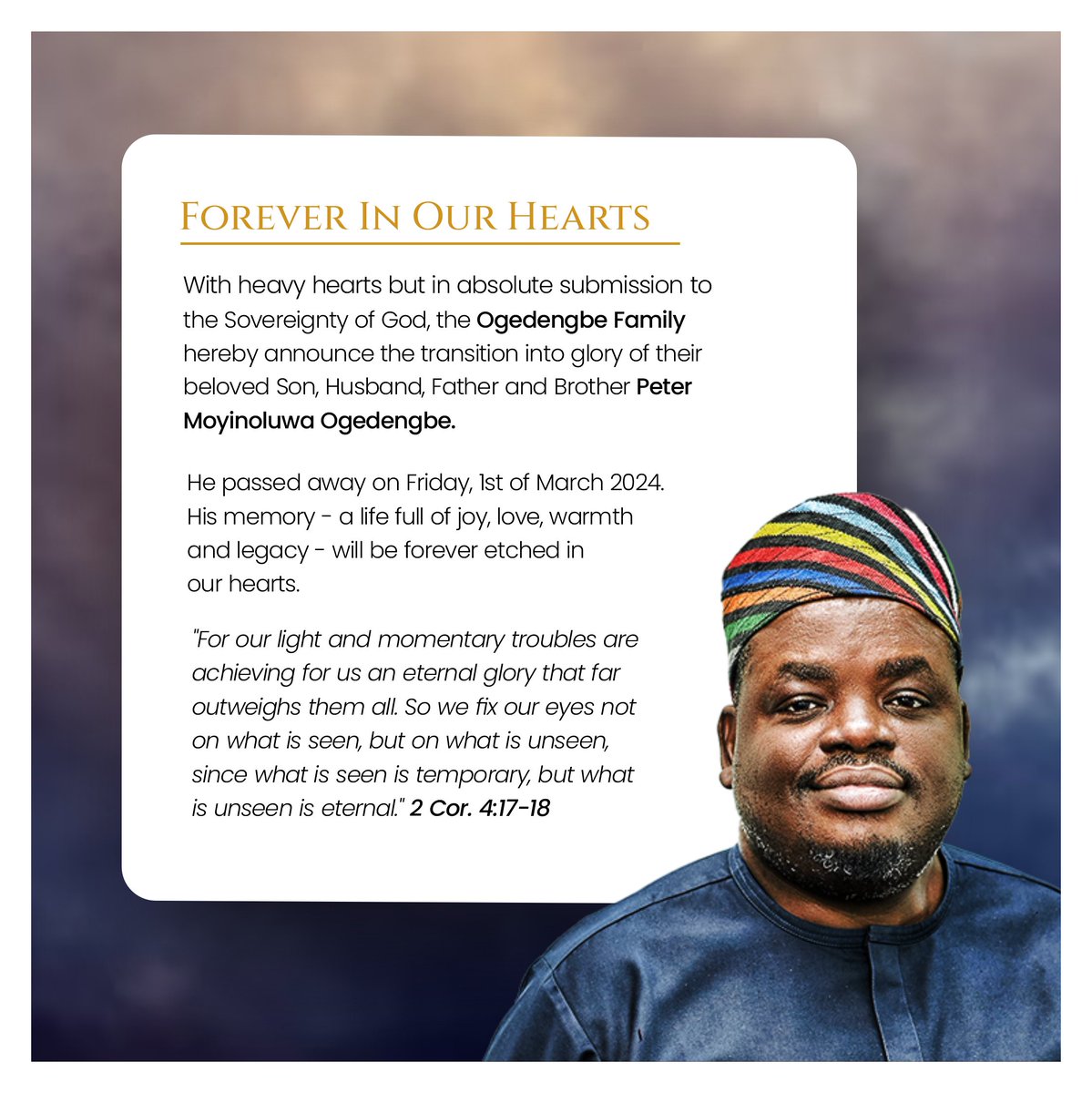
We say goodbye to an innovative and visionary leader, Peter Ogedengbe, whose enthusiasm and steadfast dedication to supporting and empowering startups, entrepreneurs, and creatives have made The Nest a go-to hub and community.
@david_perell Amazing transformative journey, thanks for sharing.
2 Peter 1:19 We also have the prophetic message as something completely reliable, and you will do well to pay attention to it, as to a light shining in a dark place, until the day dawns and the morning star rises in your hearts
I went from thinking the Bible was the most boring book ever to seeing the magic in it.
Years ago, I realized that the Bible is the foundational book of Western civilization. If I was going to be an educated person, I needed to know what it said. Though I was motivated to learn about it, I didn't have the patience to read it or the knowledge to understand it.
Generally, I try to follow my 4th-grade English teacher's advice to read things first-hand. But the Bible seemed too hard, too boring, and too confusing to read on my own. It was a snooze fest. The stories felt outdated in a world of smartphones and fast Internet. Living in the modern world, shouldn’t I be rooting my life in modern books, modern studies, and modern authors?
At the time, I was living in New York when a friend introduced me to the work of Tim Keller. I reluctantly found time to put down the self-help and picked up two of his books instead: The Reason for God and Making Sense of God. It was around that time when I discovered Keller's Questioning Christianity lecture series.
Instead of focusing on the Bible directly, Keller focused on Christianity's relationship with culture and the modern world. He spoke to career-driven Gordon Gekkos who were driven by the glories of the material world, but sensed the emptiness at the heart of such a single-minded pursuit. Instead of referencing scripture directly, he spoke about big-picture themes like identity and purpose, morality and meaning.
This was back when I thought all Christians had the intelligence of sidewalk pigeons. I would scoff at church-goers because I didn’t understand why anyone would worship a sky fairy or follow rules from thousands of years ago. Keller was the guide I needed.
For the first few years, I looked at faith through a cultural lens instead of reading the Bible directly. I literally knew nothing about Jesus or Christianity — and I came to realize how little I knew about my own atheism too. In school, while studying the Declaration of Independence, I’d learned that it’s “self-evident” that “all men are created equal.” Turns out, this defining American ideal is only self-evident if you assume that every person has inherent worth because they’re made in the image of God. I was stumped. Where did my moral compass come from? Do people have inherent value? And if so, is it because every human is a child of God?
In addition to advocating for the life of Jesus and the truth of his message, Keller revealed the many assumptions underlying my own atheistic worldview. He taught me that every worldview requires a leap of faith. Sure, Christianity couldn’t perfectly explain everything in the universe, but then again, neither can any worldview. Astrophysicists say that much of the universe is made up of “dark matter,” which is a scientific-sounding way to talk about a leap of faith
Though I did some Bible studies, I never enjoyed them. They felt more like reading tedious academic papers than drinking directly from the fountain of God’s wisdom. Instead of reading Scripture directly, I joined a small Christian reading group where I was the only non-believer. By showing me coherent ways to interpret reality besides my science-based materialism, books like The Story of Reality and I Don't Have Enough Faith to Be an Atheist loosened the screws on my atheism.
My palate was beginning to change. Like a fine wine, the same flavors that were once repulsive to me started to appeal to my intellectual taste buds. I surrounded myself with wise Christians who were orthodox about scripture and eager to answer my hardest questions about faith. I asked them to dinner and invited myself to Church with them.
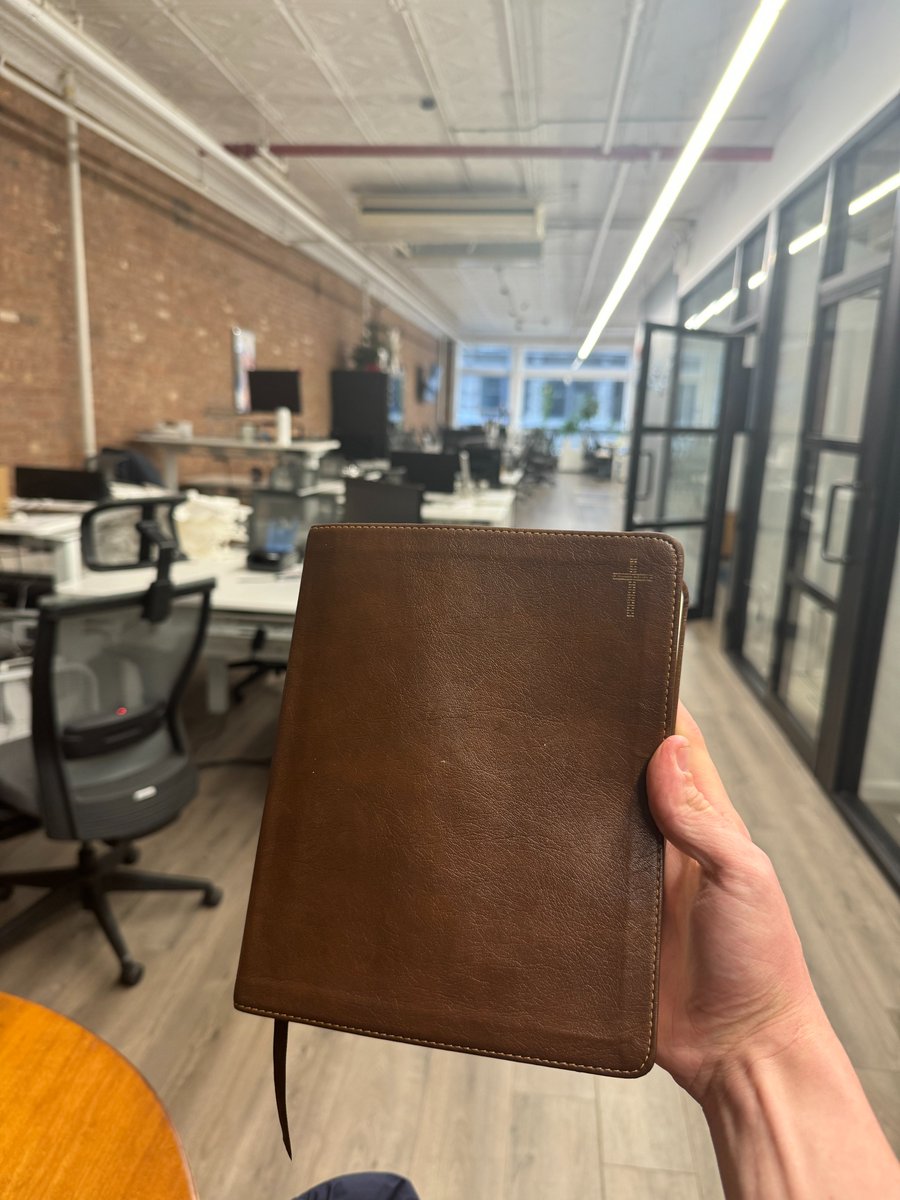
This marked a new era. Once again, I found some guides: books, Internet sources, and an in-person leader to show me the way. On the Internet, I'd turn to The Bible Project to answer my big-picture thematic questions. I picked up the ESV Study Bible, which I still read every day on the white boucle couch in my living room (if you like reading on the computer, I recommend The Bible Study App by Olive Tree).
For years, I’d stiff-armed the Bible. Now, I was skipping to a 7am Bible Study led by a devout believer who'd been reading God's word every day for almost a quarter-century, and wasn’t afraid to rebuke my theology.
What surprised me most was how carefully we read. I admired the integrity of our study. We live in a culture of binge-reading where people boast about how many books they can complete in a given year. We did the opposite. We never read more than ~20 verses in a single session and dissected every word, every verse, and every story. (I once spent two hours studying John 1:1-4 — just four verses at a strip mall Schlotzsky's in the Texas Hill Country.)
Never in my life had I read so deliberately. I spent months in the books of Ephesians, Romans, John, and 2 Corinthians, and there's no way I would've known how to read the Bible so diligently on my own. I learned to look beyond English translations, and I use the BibleHub to look up the original Greek and Hebrew whenever possible.
For a translation, I recommend the English Standard Version (ESV) (no, you don’t need to read the King James Version). And If you're going to pick two books, I recommend the Gospel of John and the Book of Romans. Either find a guide to read them carefully with you or follow along with The Bible Project and The ESV Study Bible. Whatever you do, read slowly.
I used to be a serial consumer who’d brag about how many books I read every year. I’d pick up anything and everything. The more, the merry. But the more I study the Bible, the more careful I’ve become about who I read and listen to. Gone are my days as a serial consumer. Frauds, charlatans, and false teachers abound, so be skeptical and vet your sources. In all this time, I’ve had no more than ten serious teachers. Fortunately, that’s all you need.
I became a believer on March 20th of this year, four years after attending my first Tim Keller lecture, and the Bible is alive for me now like no book I've ever read.
These days, I read the Bible and basically nothing else.
Opening it up is the best part of my daily routine. The words twinkle. The stories are supernatural. It's a living, breathing document, and I wholeheartedly believe it's the Word of God, which makes every other book feel dim by comparison.
How long before AI-generated movie streaming platforms provide your favourite actors and/or characters on demand -- with the ability to continuously generate new movies or series with plots you will love -- even cheaper than the current options that we recently tagged disruptive?