Iraq’s oil minister has indirectly outlined the federal government’s plans for oilfields currently under KRG control, accusing the KRG of taking over fields belonging to the federally owned North Oil Company.
Speaking to the Iraqi News Agency, Khudair said an investigation into “oil smuggling in northern Iraq had been conducted and a report prepared”, with recommendations expected to follow. He pointed to violations involving oilfields that he claimed belong to the North Oil Company but had been taken over by the KRG, alongside smuggling operations in other areas. He added that the quantities of oil allegedly smuggled could only be determined once the investigative committee completed its findings.
Khudair stated that “the Ministry of Oil believes these fields should be administered federally, under the ministry’s authority, just as oilfields in central and southern Iraq are.”
He also said the prime minister intends to resolve outstanding disputes and strengthen federal control over border crossings by placing the Iraqi army in charge of securing them across the country, from north to south.
Notable: Iraq's Oil Ministry has suspended subsidised fuel supplies to factories and commercial businesses in the Kurdistan Region, particularly diesel and heavy fuel oil used in industrial operations.
The move comes amid growing reports that Baghdad is pushing for greater control over KRG-held oilfields as it cracks down on alleged smuggling elsewhere in Iraq.
According to the published official document, the suspension is temporary. Some reports suggest, that follows documented allegations that industrial fuel allocations, especially subsidised heavy fuel oil, were being diverted from factories and smuggled, including along routes through the Kurdistan Region. Baghdad wants to trace the sources of smuggling from the region into Iran, Turkey and Syria.
@mountain772 Such social fault lines exist among all nations and ethnic groups, but that does not make them any less interesting. Anthropologists, sociologists, political scientists and anyone trying to understand the social dimension of political disputes will still want to know about them.
A football match between Erbil and Duhok in Duhok ended in a 1–1 draw and was followed by clashes between supporters of the two clubs. What has happened since reveals much more about the Kurdistan Region's social fault lines.
Each side blames the other for starting the violence. Duhok supporters say Erbil fans ripped out seats, while the Erbil side says its fans used the seats to shield themselves from stones. Duhok supporters also say they were responding to insults. Which account is accurate is hard to establish, but videos circulating after the match show Erbil supporters, heavily outnumbered as the away side, being attacked, and according to the Erbil side, even by Duhok security forces. Some Erbil club officials told press conferences they would never "forgive" what happened.
The more revealing part is how quickly the dispute spread beyond the two fan bases. In a live video after the game, the head of Duhok's supporters called "all Soranis" sellouts and traitors (video attached). He meant Sorani speakers who live in most of Erbil, Sulaimani and Kirkuk, since people in Duhok speak Bahdini, a variety of Kurmanji. Erbil supporters answered in kind in the comments. They attacked Bahdinis as insufficiently Kurdish and mocked a Duhok fan who said "Erbil" in an interview instead of the Kurdish "Hewler".
Similar tensions have surfaced in previous confrontations involving Duhok and Zakho, as well as Duhok and Newroz football clubs. But the Erbil–Duhok incident is particularly revealing because of Erbil's position within the Kurdistan Region's political and social geography.
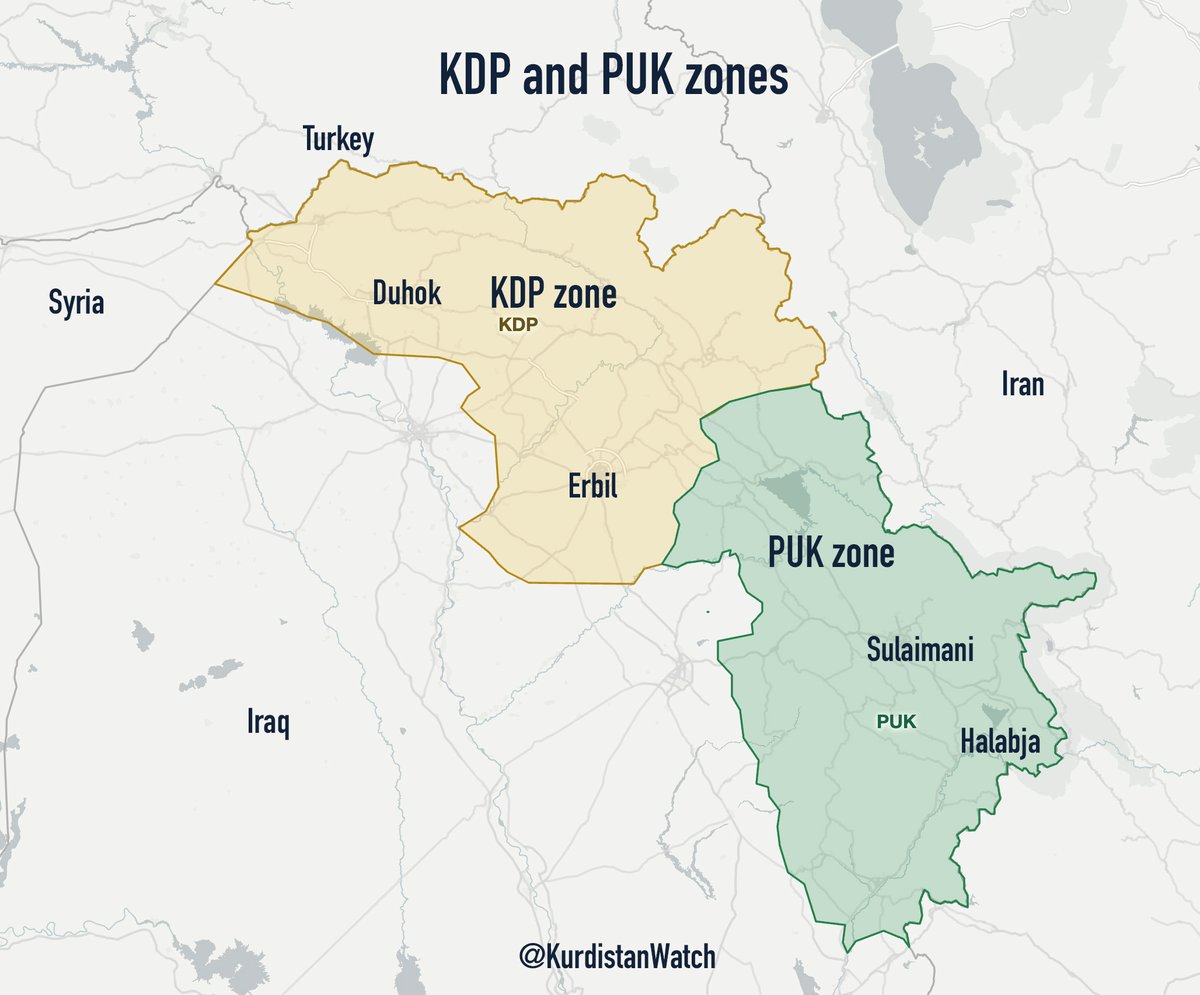
Duhok is the centre of Bahdinan, and the KDP is largely a Bahdini party, with the Barzanis and most of its senior leadership from Bahdini-speaking areas. The PUK is rooted in Sulaimani, the heart of the Sorani-speaking zone. Erbil falls between the two. Some on social media have said its residents are "cowards" if they stay silent, which reflects a perception that the city is leaderless, has no one to defend it and is used as a surrogate by others.
Whether these perceptions are justified is another question. What matters is that they exist and can quickly resurface during incidents that might otherwise have remained ordinary football disputes.
It also points to a wider failure of nation-building, since divisions this deep run across just three governorates, and they extend well beyond football. Many Bahdini families still refuse marriage proposals from Sorani men. In one case witnessed by the author, a father in Duhok said he would rather his daughter marry an Arab from Mosul than a Sorani.
The divide has longstanding roots but deepened further during the civil war of the 1990s, when the KDP in Duhok framed the fighting as a Sorani attack on Bahdinan when they approached the area to mobilise the people, and the opposing PUK camp used the mirror image when the KDP was advancing on Sulaimani. Those narratives faded from public discourse for a time. They are now resurfacing as tribalism is promoted and the economic squeeze pushes people back toward regional and tribal loyalties, a shift that is getting little attention.
Notable: Iraq's Oil Ministry has suspended subsidised fuel supplies to factories and commercial businesses in the Kurdistan Region, particularly diesel and heavy fuel oil used in industrial operations.
The move comes amid growing reports that Baghdad is pushing for greater control over KRG-held oilfields as it cracks down on alleged smuggling elsewhere in Iraq.
According to the published official document, the suspension is temporary. Some reports suggest, that follows documented allegations that industrial fuel allocations, especially subsidised heavy fuel oil, were being diverted from factories and smuggled, including along routes through the Kurdistan Region. Baghdad wants to trace the sources of smuggling from the region into Iran, Turkey and Syria.
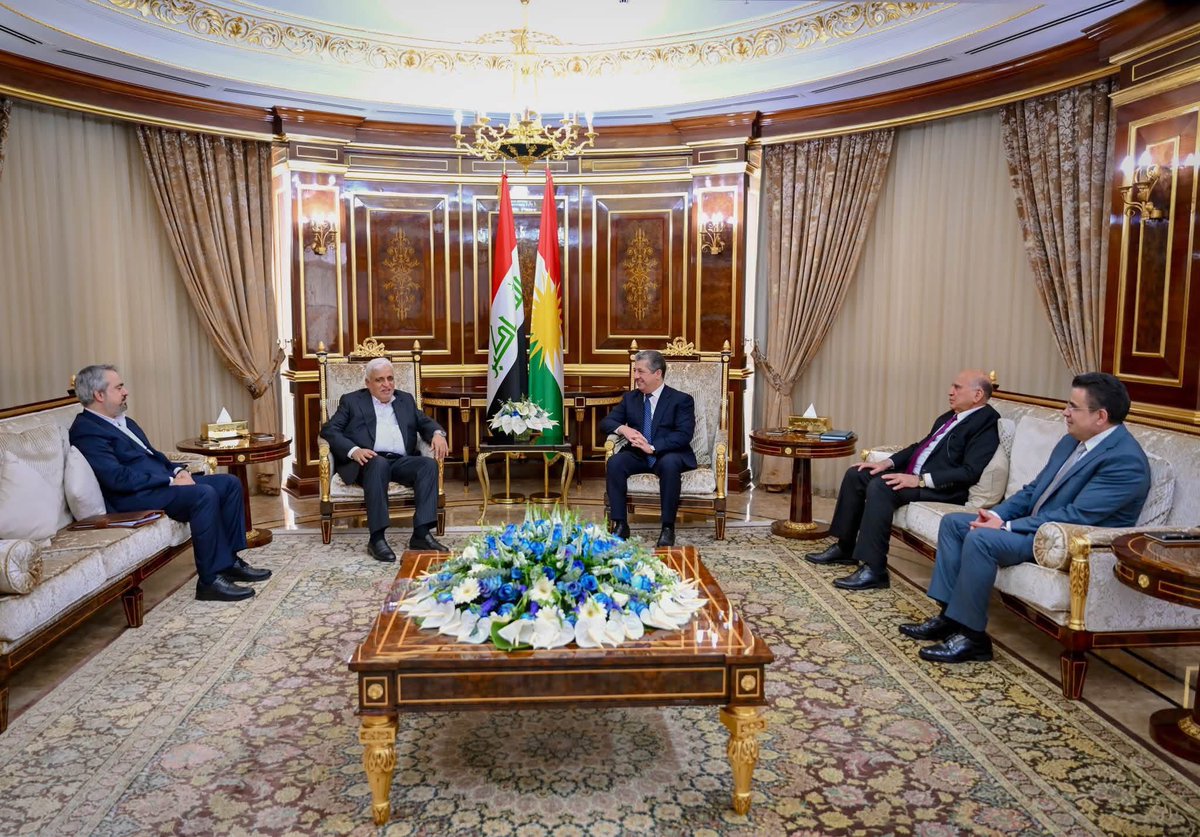
The PMF chief, Falih al-Fayadh, met the three Barzanis, including Masoud Barzani, in Erbil. The next morning he met Iraqi PM Ali al-Zaidi alone in Baghdad, and an hour or two later he attended al-Zaidi's meeting with President Nizar Amedi and the Iraqi justice minister, both of whom represent the PUK.
The sequence of meetings suggests al-Fayadh carried a message from al-Zaidi to the Barzanis, which was then discussed with the PUK's officials in Baghdad.
Reliable sources say al-Zaidi wants a more radical renegotiation of the KRG budget, one that settles the issue permanently instead of reopening it every year. He has made several demands:
The first concerns border crossings, which he wants run jointly by the Iraqi army and the KRG, as the constitution already requires. Iraq has reportedly put all of its border crossings out to tender, to be run by five private companies with Iraqi forces present. The companies are not yet known, but if some are American, Washington may be backing al-Zaidi's push to extend federal control to the KRG's borders.
The second concerns the energy sector. Al-Zaidi has said that oil fields in the disputed territories must return to direct federal control. As we reported earlier, these include Khurmala, Sufaya and, to a lesser extent, Khor Mor.
The third concerns border security. Al-Zaidi wants regular Iraqi army units deployed along the Iranian, Turkish and Syrian borders. Iraqi border police already operate on the KRG's borders and nominally belong to the federal interior ministry, but in practice they are manned by KDP or PUK fighters, depending on the zone. Together with the demand on non-oil revenues, this goes directly to who controls customs and border police in the Region.
The KDP has reportedly rejected the demands so far, and it is unclear what comes next. The KRG is in a far weaker position than it appears, because the KDP-PUK divisions are hollowing out its bargaining power. KDP - has thus far - refused to compromise with the PUK while trying to hold a hard line against Baghdad. Meanwhile, the US, Turkey and Iran all appear to be on board with some degree of the Iraqi state’s control over the Region.
The KRG has long exercised more authority than the constitution grants because it was strong while Baghdad was weak, and that balance has now shifted. For instance, there are also rumours that Baghdad will soon force the KRG to close its foreign representations and keep only offices inside Iraqi embassies, since the constitution does not allow the Region separate representation. The KRG's separate visa policy could be next.
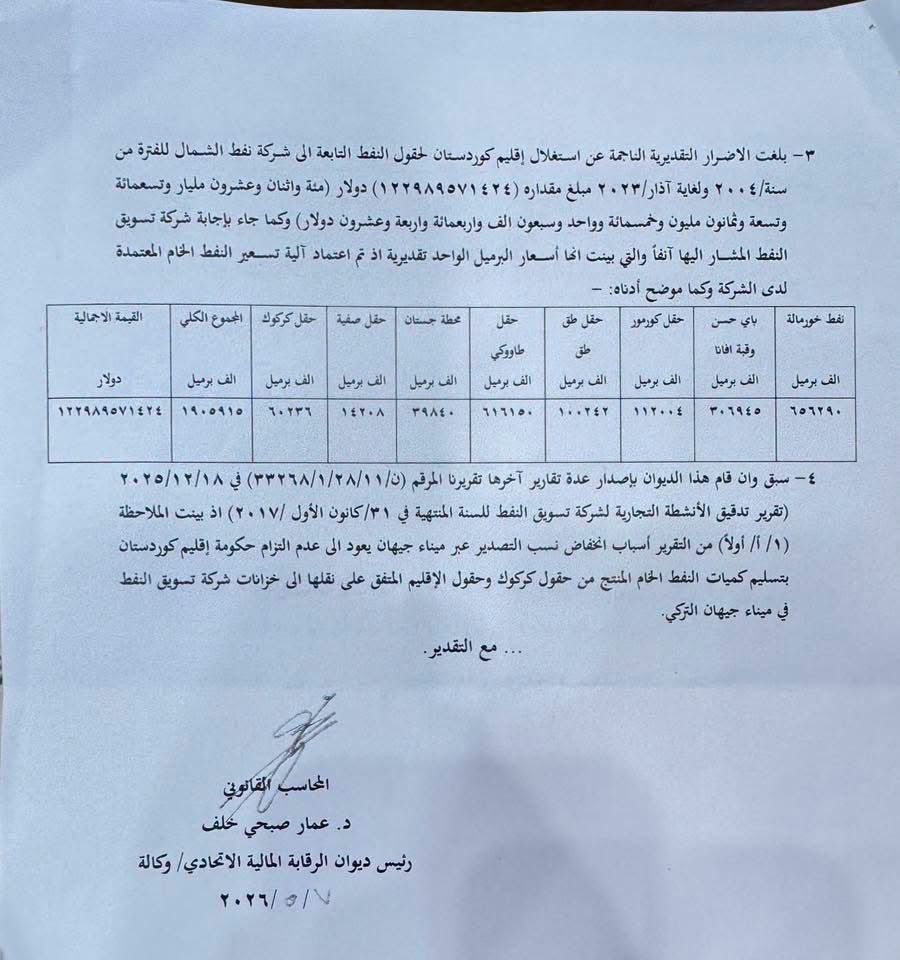
A document from Iraq's Federal Board of Supreme Audit, written in May and published today by Kurdistan Parliament member Ali Hama Salih, claims that several oil fields run by the KRG belong to Iraq's North Oil Company and have been exploited by the Kurdistan Region. It puts the value of the oil taken at up to $123 billion.
Yesterday we reported that Baghdad is eyeing Khor Mor, Khurmala and Sufaya. The document goes further and also lists Taq Taq, in the PUK zone, and Tawke, in the KDP zone. By assigning all of these fields to the North Oil Company, it treats them as federal fields that should go back to Baghdad.
Tawke is the Kurdistan Region's second-largest oil field after Khurmala. If these fields were transferred, the KRG would be left with almost no oil of its own, which would push the region into severe economic decline.
According to Salih, the audit was followed by complaints filed in the federal courts. He says these cases are still on file and can be used whenever Baghdad chooses. That matters because Prime Minister Ali al-Zaidi has strong backing from Faiq Zaidan, head of Iraq's Supreme Judicial Council.
The document adds to growing talk that Baghdad intends to take over these fields, or at least run them directly as federal assets.
Having taken control of Jurf al-Sakhar and steadily tightened its grip on oil smuggling routes in central and southern Iraq, Baghdad is now reportedly weighing moves to assert control over KRG-held oil and gas fields.
The focus is on fields that lie within the disputed territories but are still under KRG control. Three fields are said to be in its sights.
The first is Sufaya, near Ain Zalah in the Mosul area, and it is the one Baghdad may try to take militarily - though some say even part of Ain Zalah is still under KDP control. They are under control of armed groups affiliated with Mansour Barzani, Masoud Barzani's second son, and it is said to produce around 6,000 to 8,000 barrels per day. The crude goes either to the Lanaz refinery, owned by Mansour Barzani, or to Syria, since Sufaya lies a short distance from the Al-Walid border crossing.
The area came under KDP control after 2003. When the Kurdistan Region was established in 1991, it lay outside KRG control, as did the areas shaded differently on the map around Khurmala and Khor Mor. Reliable sources in Iraq say Sufaya which has about 29 oil wells is the most likely immediate target.
Sufaya matters for more than its oil revenue. If Baghdad took it militarily, the KDP would lose much of the short stretch of the Syrian border it controls, and Iraqi forces would end up close to the Turkish border. Direct access to the Turkish border has long been an Iraqi ambition, so the field is as much about territory and border control as it is about oil.
Baghdad is reportedly seeking the other two fields, Khurmala and Khor Mor, through an arrangement. Khurmala, the KRG's largest oil field, is regarded as an extension of the Kirkuk field. Baghdad treats it as part of the North Oil Company rather than the KRG, because the area was under Iraqi government control before 2003 and geographically, it is the continuation of the Kirkuk oilfields. Khor Mor, a gas field, was undeveloped before 2003, but its territory was also under Baghdad's control at the time.
According to opposition MP Ali Hama Salih, Baghdad has prepared a legal challenge at the Federal Supreme Court arguing that Khurmala and Khor Mor belong to the North Oil Company and should be operated by federal authorities. He expects these two cases to play out differently from Sufaya. Sufaya is less disputed as part of Nineveh, so Baghdad may try to take it more assertively. For Khurmala and Khor Mor, he expects Baghdad to use legal channels instead of force.
That leaves two separate approaches. Sufaya's legal status is unclear even within the KRG: its output appears in no production reports, because the oil goes directly to Mansour Barzani. Khurmala and Khor Mor are a different case, and the political stakes are higher. Khurmala produces around 40% of the KRG's oil, and losing it to Baghdad would sharply reduce the oil under KRG control and seriously weaken the KRG economy. Khor Mor, the largest gas field in Iraq, supplies around 80% of the Kurdistan Region's electricity.
KRG Prime Minister Masrour Barzani gave an interview to Shams TV, a channel owned by his father, Masoud Barzani. The interview was conducted by the channel's manager, Lebanese presenter Elie Nakouzi, and Masrour made several notable remarks.
On the KDP-PUK power struggle and the KDP's unilateral move to reconvene parliament on November 4, he was openly combative and showed little willingness to compromise. He stressed that the KDP had won the most seats and defended the MPs who broke ranks with their parties to attend the session, saying they had acted freely. He justified the session by claiming that the PUK and its partner, the opposition New Generation movement, had held parliament hostage for two years. According to him, the KDP had to act because the legitimacy of the Kurdistan Region's institutions was at stake.
What stood out most was his tone. The dispute appears to have become deeply personal for Masrour. This was clearest when he was asked about 50-50 power-sharing between the KDP and PUK. The question itself was misleading and historically inaccurate, since there has been no genuine 50-50 arrangement for more than a decade and the KDP has long held significantly more government posts.
Masrour's answer was revealing, particularly its opening, which can be heard in English before the translation. His tone was egotistical and dismissive, suggesting he is personally invested in the confrontation and unwilling to accommodate the PUK's demands.
The same personal edge is visible on the PUK side. After the November 4 session, PUK President Bafel Talabani struck an equally defiant note, effectively telling Masrour: "You started it, and I will finish it."
The interview also turned to Iraqi Prime Minister Ali al-Zaidi. After Nakouzi showered al-Zaidi with praise, Masrour responded cautiously, saying the KRG's problems lay with the system as a whole, whoever leads it. He declined to predict what might happen next, saying only that he hoped things would go well.
This was telling because Masrour had met al-Zaidi in Baghdad just days earlier and afterwards claimed their outstanding issues had been resolved.
His latest remarks suggest the situation is far less positive than he first presented, and that relations with Baghdad may be back to square one.
Finally, a word on the interviewer. Nakouzi has increasingly acting as a propagandist, and this interview was no exception. His flattery was so excessive that at times even Masrour appeared uncomfortable
Media outlets affiliated with the KDP’s Masrour Barzani and the PUK’s Bafel Talabani have reported that today’s meeting between the two parties ended without an agreement.
The tone of the coverage suggests the gap between them has, if anything, widened.
According to KDP media, the PUK demanded that the November 4 Kurdistan Parliament session be annulled and that its three MPs who attended be expelled from parliament. The KDP rejected both demands.
PUK media reported that the KDP criticised the signature campaign for a separate region in Suleimani. The PUK replied that it is not behind the campaign but cannot stop people from taking part, and that it has not yet decided to push for a separate region. If it had, it would not need a signature campaign, since it could easily gather the required 121,000 signatures on its own. PUK media also said the PUK demanded the expulsion of all MPs who attended without their faction's approval, not only its own. There are eight such MPs. The PUK said it will not recognise the session and that the KDP's actions have split parliament in two.
Both sides' media agreed that the meeting produced no agreement or breakthrough, and that it is unclear when, or whether, another meeting will take place.
Interesting report by the Middle East eye on what appeared like possible KDP PUK involvement in the Iran war back in February:
“A former US intelligence official told MEE that the PUK was actually seen by members of the Trump administration as more receptive to plans to support Kurdish opposition groups in Iran because it was lobbying for greater attention in Washington. The PUK's territory in the KRG also shares a longer border with Iran.
The PUK was courting the Trump administration in part over frustration that its rival, the KDP, had greater access in Washington as a result of controlling the Kurdistan region’s presidency.”
Also says: “Among American officials, Bafel Talabani is known to enjoy hanging out with former American Joint Special Operations Command fighters, better known as “JSOC guys”. His brother, Qubad, the deputy prime minister of Iraqi Kurdistan, is married to a former State Department official.”
Media outlets affiliated with the KDP’s Masrour Barzani and the PUK’s Bafel Talabani have reported that today’s meeting between the two parties ended without an agreement.
The tone of the coverage suggests the gap between them has, if anything, widened.
According to KDP media, the PUK demanded that the November 4 Kurdistan Parliament session be annulled and that its three MPs who attended be expelled from parliament. The KDP rejected both demands.
PUK media reported that the KDP criticised the signature campaign for a separate region in Suleimani. The PUK replied that it is not behind the campaign but cannot stop people from taking part, and that it has not yet decided to push for a separate region. If it had, it would not need a signature campaign, since it could easily gather the required 121,000 signatures on its own. PUK media also said the PUK demanded the expulsion of all MPs who attended without their faction's approval, not only its own. There are eight such MPs. The PUK said it will not recognise the session and that the KDP's actions have split parliament in two.
Both sides' media agreed that the meeting produced no agreement or breakthrough, and that it is unclear when, or whether, another meeting will take place.
The KDP and PUK met today at politburo level for the first time since the contested November 4 session of the Kurdistan Parliament. The meeting was mainly a chance for each side to test the other's position on the dispute between them.
The meeting reportedly came at the initiative of KDP President Masoud Barzani. It followed a remark by PUK President Bafel Talabani that Barzani's earlier statement was for media consumption, and that if the KDP was serious, it should approach the PUK formally.
According to reports, the meeting produced no breakthrough. The two sides could not agree even on the issues that have come up since the session. The PUK insists that the November 4 session must be annulled. It also wants three of its MPs, whom it accuses the KDP of drawing away, to give up their seats. One of the three has already resigned voluntarily. The KDP rejected these demands outright. It is standing by its moves and plans to take further steps.
What happens next is unclear. The PUK's rhetoric has shifted over the past few days. It now says it has never sought to separate Suleimani from the Kurdistan Region and is calling for decentralisation. In practice, though, the PUK has already cut most of its administrative and financial ties with Erbil.
What is now emerging in the Kurdistan Region? Two administrations within one nominally unified federal region.
Despite media campaigns suggesting otherwise, the administrative split between the KDP and PUK zones is now complete, and KDP-PUK negotiations have reached a deadlock.
As of today, the PUK’s team in the KRG, down to general managers, has begun working from Suleimani. Ministers and deputy ministers are based in the building that formerly housed the Suleimani provincial council, general managers are in a nearby building, and Qubad Talabani, the KRG deputy prime minister, also has an office in the area. Lower-ranking PUK employees will continue working from their current posts, including in Erbil.
Meanwhile, PUK leader Bafel Talabani has reportedly reached a tentative understanding with Baghdad for direct payment of civil servants’ salaries in the PUK-controlled zone, along with separate investment allocations. The PUK appears to be relying partly on a February 2024 Federal Supreme Court ruling that explicitly permits government institutions and their directorates in the Kurdistan Region to deal directly with Iraq’s Finance Ministry over salary payments. The ruling also recognises the Region’s governorates’ investment entitlements under federal budget law, though whether these allocations can legally be transferred directly to Suleimani, bypassing Erbil, would depend on the applicable budgetary framework.
Since the KDP-initiated parliament session on 4 November, the KDP appears to have backed away from further parliamentary moves. The other main parties have refused to attend under current conditions, and the PUK has vowed to escalate in response to any further unilateral KDP action.
For now, parliament may be left dormant while the KDP uses the session as leverage. The PUK, meanwhile, is collecting signatures from 10 percent of Suleimani’s voters as a backup plan for forming a separate federal region. It does not yet appear serious about pursuing this, and wants the option available if relations with the KDP reach a point of no return.
On the ground, however, two completely separate administrations are taking shape. In the near future, the PUK plans to change electricity tariffs and taxes, introduce other populist measures and launch a slew of projects to show that a separate administration is already delivering tangible benefits. One of the PUK’s central arguments is now that KRG Prime Minister Masrour Barzani deliberately withheld projects from the PUK zone.
The financial separation is also advancing. The PUK has severed financial ties with Erbil, while the Sulaimani branch of the Kurdistan Region's central bank and several major public banks are reportedly already functioning as the financial apparatus of the emerging PUK administration.
So what we will have is no active parliament, and with the newly consolidated administrations, elections, which are due in less than two years, also look highly unlikely, given that the differences are now so deep that the parties are unlikely to agree on even how the elections should be held and under what laws and regulations.
Having taken control of Jurf al-Sakhar and steadily tightened its grip on oil smuggling routes in central and southern Iraq, Baghdad is now reportedly weighing moves to assert control over KRG-held oil and gas fields.
The focus is on fields that lie within the disputed territories but are still under KRG control. Three fields are said to be in its sights.
The first is Sufaya, near Ain Zalah in the Mosul area, and it is the one Baghdad may try to take militarily - though some say even part of Ain Zalah is still under KDP control. They are under control of armed groups affiliated with Mansour Barzani, Masoud Barzani's second son, and it is said to produce around 6,000 to 8,000 barrels per day. The crude goes either to the Lanaz refinery, owned by Mansour Barzani, or to Syria, since Sufaya lies a short distance from the Al-Walid border crossing.
The area came under KDP control after 2003. When the Kurdistan Region was established in 1991, it lay outside KRG control, as did the areas shaded differently on the map around Khurmala and Khor Mor. Reliable sources in Iraq say Sufaya which has about 29 oil wells is the most likely immediate target.
Sufaya matters for more than its oil revenue. If Baghdad took it militarily, the KDP would lose much of the short stretch of the Syrian border it controls, and Iraqi forces would end up close to the Turkish border. Direct access to the Turkish border has long been an Iraqi ambition, so the field is as much about territory and border control as it is about oil.
Baghdad is reportedly seeking the other two fields, Khurmala and Khor Mor, through an arrangement. Khurmala, the KRG's largest oil field, is regarded as an extension of the Kirkuk field. Baghdad treats it as part of the North Oil Company rather than the KRG, because the area was under Iraqi government control before 2003 and geographically, it is the continuation of the Kirkuk oilfields. Khor Mor, a gas field, was undeveloped before 2003, but its territory was also under Baghdad's control at the time.
According to opposition MP Ali Hama Salih, Baghdad has prepared a legal challenge at the Federal Supreme Court arguing that Khurmala and Khor Mor belong to the North Oil Company and should be operated by federal authorities. He expects these two cases to play out differently from Sufaya. Sufaya is less disputed as part of Nineveh, so Baghdad may try to take it more assertively. For Khurmala and Khor Mor, he expects Baghdad to use legal channels instead of force.
That leaves two separate approaches. Sufaya's legal status is unclear even within the KRG: its output appears in no production reports, because the oil goes directly to Mansour Barzani. Khurmala and Khor Mor are a different case, and the political stakes are higher. Khurmala produces around 40% of the KRG's oil, and losing it to Baghdad would sharply reduce the oil under KRG control and seriously weaken the KRG economy. Khor Mor, the largest gas field in Iraq, supplies around 80% of the Kurdistan Region's electricity.
A presenter on Ava News, a channel owned by Masrour Barzani's son, asked the spokesman for the Commander-in-Chief of the Iraqi Armed Forces whether Baghdad intended to repeat in the Kurdistan Region what it had done in Jurf al-Sakhar. The spokesman did not answer, and the call ended in what appeared to be him hanging up.
The exchange comes amid growing speculation about Baghdad's intentions, after Prime Minister Ali al-Zaidi said he wants federal authority extended to every part of Iraq, particularly its oilfields and borders.
The question overlooked a basic legal distinction. The Kurdistan Region is a constitutionally recognised federal region, and Baghdad cannot impose military decisions on it unilaterally.
Article 10, Paragraph 10, of the amended Kurdistan Region Presidency Law No. 1 of 2005 provides for "allowing federal armed forces to enter the Region when necessary, subject to the approval of the Region's National Assembly." The law makes the approval of the Kurdistan Parliament a clear condition for any entry of federal forces, so any comparison with Jurf al-Sakhar has to account for that difference.
Media outlets across the Kurdistan Region, including those affiliated with the KDP, are increasingly competing for attention with short viral clips, to the point of asking questions that run directly against the Region's own interests. The question has stirred controversy for exactly this reason, as it blurred the constitutional distinction between the two cases.
The drama surrounding the Iraqi PM’s moves against Kataib Hezbollah in Jurf al-Sakhar is overhyped, and little will come of it. Iraqi forces will likely enter the area without clashes, but the episode will be used to demonstrate Baghdad’s consolidation of authority and amplify calls for tougher action against the KRG, particularly through a much stricter energy policy and border control.
There is already discussion about key KRG energy fields near the line of contact with federal Iraqi forces, particularly Khurmala and Khor Mor, both just a short drive from federal-controlled territory.
Baghdad insists that Khurmala is part of Kirkuk and should therefore fall under federal control. While military action cannot be ruled out, Baghdad is more likely to push for a new legal and administrative arrangement that strengthens federal authority over Khurmala, particularly given that the field already operates under a unique arrangement that differs from other KRG oilfields.
The jailed former PUK co-leader Lahur Sheikh Jangi has confirmed in this interview what we already knew: he has cultivated close ties with Masrour Barzani. We wrote about this back in 2024.
What makes Lahur’s explicit admission particularly revealing is that it further confirms the emergence of factions within the KDP. Much like the PUK, the KDP no longer functions as an influential, unified party. Instead, power is concentrated around Masrour and his team, Nechirvan and his team, and Masoud, whose team is increasingly handpicked by his son Masrour.
While Nechirvan maintains good relations with Qubad and Bafel Talabani, Lahur has developed a close personal relationship with Masrour Barzani. The same applies to Azhi Amin, the expelled former PUK intelligence chief, who now maintains a military outpost in Erbil and works closely with Masrour on matters concerning the PUK-controlled zone.
𝐇𝐨𝐰 𝐡𝐚𝐯𝐞 𝐌𝐚𝐬𝐫𝐨𝐮𝐫 𝐁𝐚𝐫𝐳𝐚𝐧𝐢 𝐚𝐧𝐝 𝐋𝐚𝐡𝐮𝐫 𝐒𝐡𝐞𝐢𝐤𝐡 𝐉𝐚𝐧𝐠𝐢 𝐜𝐫𝐞𝐚𝐭𝐞𝐝 𝐚 𝐜𝐨𝐨𝐫𝐝𝐢𝐧𝐚𝐭𝐞𝐝 𝐦𝐞𝐝𝐢𝐚 𝐞𝐜𝐨𝐬𝐲𝐬𝐭𝐞𝐦?
A revealing example is this coverage by AVA Media and other outlets owned by Masrour Barzani of a rumor claiming that Maher Assad, the brother of Bashar Assad, may have fled to Sulaimani. While the story is patently absurd and untrue, its circulation serves a deliberate purpose: to subtly frame Sulaimani as a hub of Iranian activity.
The story's dissemination pattern is revealing: AVA Media presented the story as an effort to "fact-check a widespread social media rumor." However, the origins of the rumor are telling. The initial posts came from unreliable accounts affiliated with Lahur Sheikh Jangi. These were then amplified by other similarly unreliable accounts linked to Masrour Barzani.
The choice to cover such a baseless rumor might seem puzzling, but the underlying strategy is clear: to reinforce the narrative that Bafel Talabani, PUK leader is an Iranian proxy. By doing so, Masrour and Lahur’s media outlets aim to undermine Bafel’s standing, especially as they perceive Iran to be politically weakened amid speculation of impending changes in Iraq.
It is important to note that while Bafel Talabani maintains close ties with Iran, labeling him a proxy is a clear mischaracterization. His relationship with Tehran is fundamentally different from that of Iranian-backed Shia militias or Bashar Assad’s regime. Moreover, while the PUK’s ties to Iran are often scrutinized, it is the KDP’s relationship with Tehran that is notably more opaque. For instance, during the last three instances in which a Kurdish leader met with Iran's Supreme Leader, it was always a Barzani.
A further example illustrating the complexity of Bafel Talabani’s position is his public and explicit support for the continued presence of U.S. troops in Iraq. Speaking at a conference in Baghdad in March, which was attended by senior Shia leaders during a period of peak Iranian influence, Bafel openly advocated for U.S. forces to remain in the country—a stance rarely expressed so explicitly by others in the country.
The significance in such stories lies not in their veracity (as they are often fabricated) but in the interplay between Masrour and Lahur's media networks: their media platforms appear to operate in coordination, recycling and amplifying each other’s messaging to target the Talabani brothers. Over the past few months, numerous examples have emerged of Masrour’s media leveraging Lahur’s talking points—and vice versa—illustrating the symbiotic relationship within their media ecosystem.
The drama surrounding the Iraqi PM’s moves against Kataib Hezbollah in Jurf al-Sakhar is overhyped, and little will come of it. Iraqi forces will likely enter the area without clashes, but the episode will be used to demonstrate Baghdad’s consolidation of authority and amplify calls for tougher action against the KRG, particularly through a much stricter energy policy and border control.
There is already discussion about key KRG energy fields near the line of contact with federal Iraqi forces, particularly Khurmala and Khor Mor, both just a short drive from federal-controlled territory.
Baghdad insists that Khurmala is part of Kirkuk and should therefore fall under federal control. While military action cannot be ruled out, Baghdad is more likely to push for a new legal and administrative arrangement that strengthens federal authority over Khurmala, particularly given that the field already operates under a unique arrangement that differs from other KRG oilfields.
Iraq’s Deputy Oil Minister - a PUK member - says he secured direct kerosene deliveries for Suleimani and Halabja: Another Step Towards a Separate Administration?
Izzat Ismail, Iraq's Deputy Oil Minister and a PUK member, announced that he had secured the oil minister's approval to deliver kerosene directly to households in Suleimani and Halabja governorates, with distribution starting tomorrow.
The announcement comes amid escalating tensions between KDP and PUK and growing discussion of a separate administration for Suleimani. It raises the question of whether the arrangement is simply a service measure or a further sign of an administrative structure taking shape outside the KRG in Erbil since the same process in Erbil was announced via the KDP-led natural resources minister.
By dealing directly with PUK-affiliated officials and institutions, and by setting up separate service delivery for Suleimani and Halabja, Baghdad appears to be deepening the divide between the KDP and the PUK.
Such arrangements are likely further entrench the administrative split between Erbil and Suleimani and weaken the unity of the region's institutions.
What is now emerging in the Kurdistan Region? Two administrations within one nominally unified federal region.
Despite media campaigns suggesting otherwise, the administrative split between the KDP and PUK zones is now complete, and KDP-PUK negotiations have reached a deadlock.
As of today, the PUK’s team in the KRG, down to general managers, has begun working from Suleimani. Ministers and deputy ministers are based in the building that formerly housed the Suleimani provincial council, general managers are in a nearby building, and Qubad Talabani, the KRG deputy prime minister, also has an office in the area. Lower-ranking PUK employees will continue working from their current posts, including in Erbil.
Meanwhile, PUK leader Bafel Talabani has reportedly reached a tentative understanding with Baghdad for direct payment of civil servants’ salaries in the PUK-controlled zone, along with separate investment allocations. The PUK appears to be relying partly on a February 2024 Federal Supreme Court ruling that explicitly permits government institutions and their directorates in the Kurdistan Region to deal directly with Iraq’s Finance Ministry over salary payments. The ruling also recognises the Region’s governorates’ investment entitlements under federal budget law, though whether these allocations can legally be transferred directly to Suleimani, bypassing Erbil, would depend on the applicable budgetary framework.
Since the KDP-initiated parliament session on 4 November, the KDP appears to have backed away from further parliamentary moves. The other main parties have refused to attend under current conditions, and the PUK has vowed to escalate in response to any further unilateral KDP action.
For now, parliament may be left dormant while the KDP uses the session as leverage. The PUK, meanwhile, is collecting signatures from 10 percent of Suleimani’s voters as a backup plan for forming a separate federal region. It does not yet appear serious about pursuing this, and wants the option available if relations with the KDP reach a point of no return.
On the ground, however, two completely separate administrations are taking shape. In the near future, the PUK plans to change electricity tariffs and taxes, introduce other populist measures and launch a slew of projects to show that a separate administration is already delivering tangible benefits. One of the PUK’s central arguments is now that KRG Prime Minister Masrour Barzani deliberately withheld projects from the PUK zone.
The financial separation is also advancing. The PUK has severed financial ties with Erbil, while the Sulaimani branch of the Kurdistan Region's central bank and several major public banks are reportedly already functioning as the financial apparatus of the emerging PUK administration.
So what we will have is no active parliament, and with the newly consolidated administrations, elections, which are due in less than two years, also look highly unlikely, given that the differences are now so deep that the parties are unlikely to agree on even how the elections should be held and under what laws and regulations.
US envoy Tom Barrack today in Istanbul met with influential Bradosti tribal chief Ghalib Karim Khan, accompanied by his nephew Muhammad.
Until recently, the Bradosti family was aligned with the PUK, but it withdrew from the party a few months ago. Muhammad, whose father Faisal Karim Khan was a member of the PUK leadership, attended the disputed November 4 Kurdistan parliamentary session initiated by the KDP. However, the family subsequently issued a statement distancing itself from his participation, saying he had acted without its knowledge or approval. Muhammad has since submitted his resignation from parliament.
According to some sources, Muhammad attended the session out of frustration after the PUK allegedly failed to honour a promise to give his father a prominent position in the Iraqi government. Whatever his motivation, the family’s subsequent distancing suggests it does not intend to align itself with the KDP either.
Another interesting dimension is the family’s historical relationship with the PKK. The Bradost region occupies a strategically important mountainous area near the Iraq-Turkey-Iran border, where the tribe has considerable influence. The family has historically been associated with logistical support for the PKK, and one of its members was even arrested by KDP security forces several years ago over alleged cooperation with the group. Much of this territory has since come under substantial Turkish military control. This makes the location of today’s meeting in Istanbul particularly noteworthy.
The broader question is whether the Bradosti family is now positioning itself as an independent power centre between the KDP and PUK, potentially giving it greater political relevance. Its influence extends beyond tribal politics. The family has longstanding commercial ties with the US military, including contracts to provide logistical support for American operations in Iraq - at least before their recent departure.
There is also an Iranian dimension. The Bradosti tribal network extends across the border into Iran’s Urmia region, where it maintains local connections. At least one Bradosti figure on the Iranian side is said to have been in contact with the Americans about possible cooperation on the ground. There is no evidence that today’s meeting concerned these contacts, but they illustrate the family’s wider regional reach.
It remains unclear whether this signals a broader American effort to cultivate independent Kurdish power centres amid the KDP-PUK dispute or relates to wider regional calculations. But the timing, location and participants make the meeting worth watching.
We now have two competing rhetorical campaigns from the KDP and the rival PUK–New Generation camp:
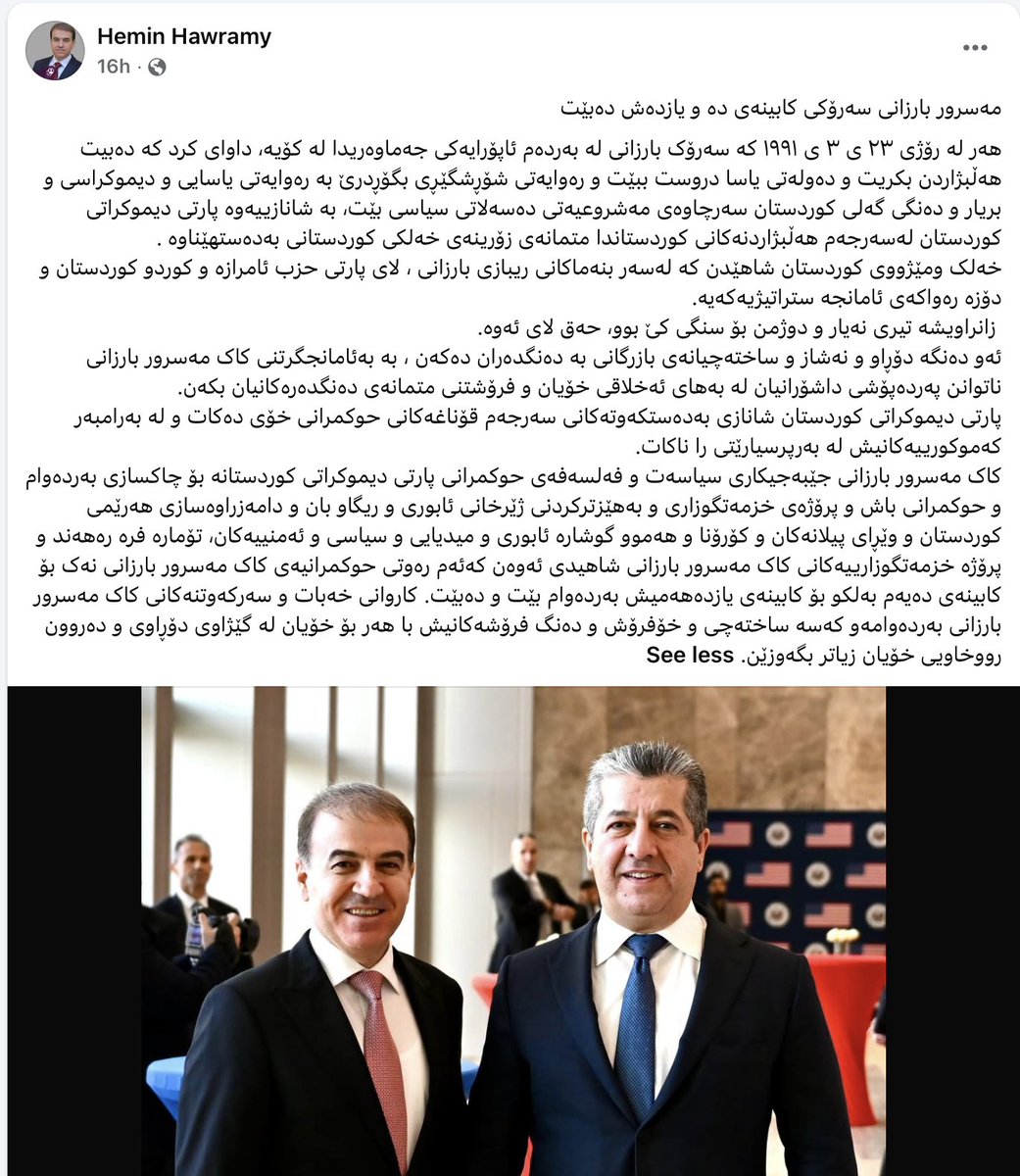
Last night, Hemin Hawrami, one of the KDP officials closest to Masrour Barzani, said that Masrour would lead not only the 10th KRG cabinet but also the 11th. The current ninth cabinet is approaching its eighth year in office. His remarks were a response to growing calls for the KDP to replace Masrour as its candidate for prime minister.
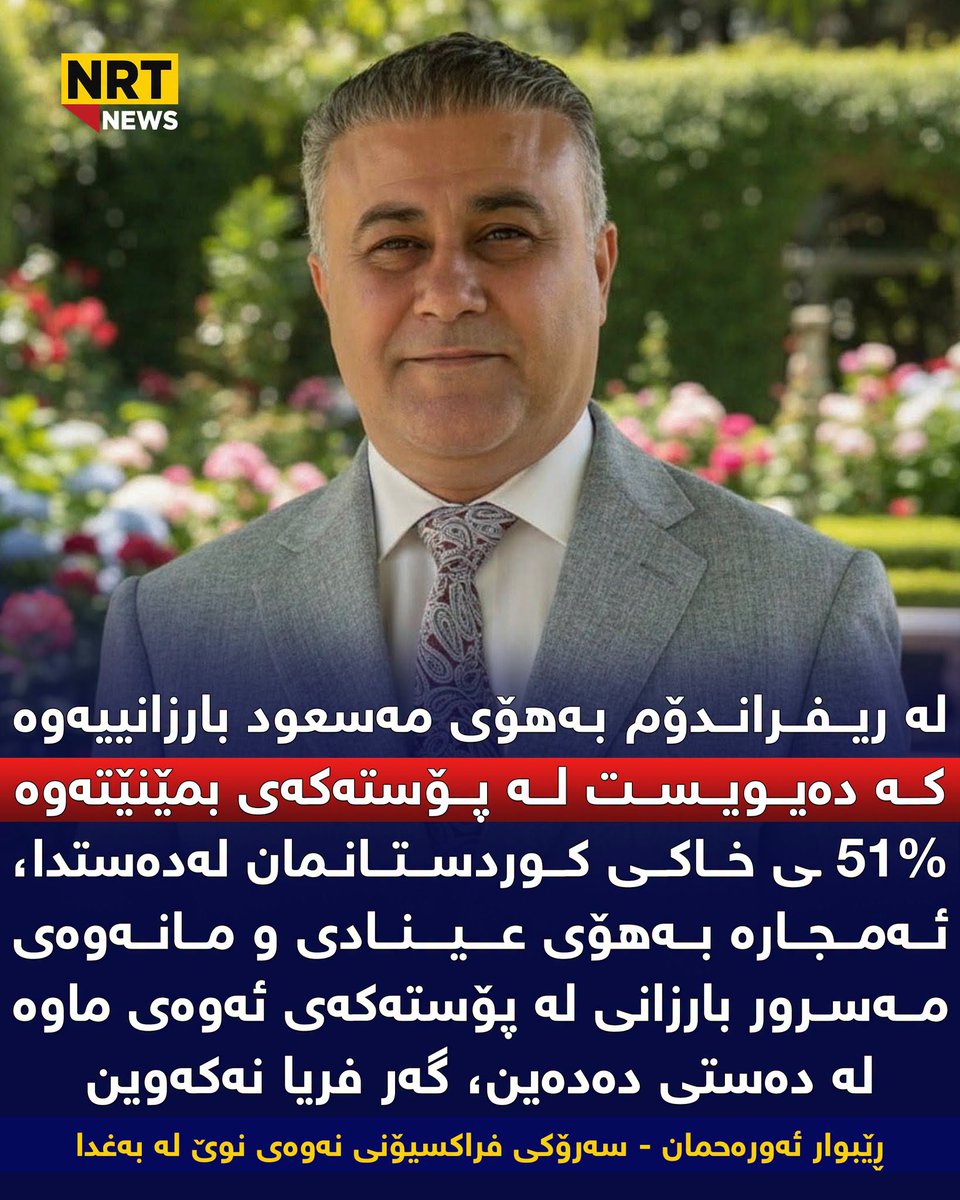
Today, New Generation official Rebwar Abdulrahman responded by arguing that Masoud Barzani's determination to remain in power led him to hold the 2017 independence referendum, resulting in the Kurdistan Region losing 51% of its territory when Iraqi forces retook most disputed areas from Khanaqin to Sinjar. He warned that Masrour Barzani's insistence on clinging to power could now cost the region what remains of its territory unless the issue is resolved.
New Generation leader Shaswar Abdulwahid, now a key ally of the PUK's Bafel Talabani, says their motto is "Yes to Kurdistan, no to Masrour Barzani."
He distanced his camp from the signature campaign for a separate region in Suleimani and dismissed it as a non-issue, saying that those who focus on it are trying to divert attention from the real problem. According to him, nobody is trying to separate Suleimani from the Kurdistan Region; the aim is to strengthen its institutions and, through them, the region as a whole. He says the problem is Masrour Barzani, who he claims has “illegitimately” clung to power more than three years after his term ended.
Shaswar’s remarks are revealing because he speaks with less of a filter than Talabani, which makes their strategy easier to read. They appear to want to frame the dispute as Masrour sacrificing the region to keep his post. This marks a shift in their messaging. Until a few days ago, the perception was that Suleimani wanted to separate, and yesterday Masrour presented himself as the leader who wants to keep the region united. Shaswar’s message today counters this: they support a strong Kurdistan, but that cannot happen while Masrour imposes himself and clings to power.
@guul09 It wasn’t the PUK directly, but some so-called NGOs. The PUK never claimed responsibility for it or publicly supported it. They use this as a pressure tactic; otherwise, if they were serious, they could collect the signatures through their patronage networks.
New Generation leader Shaswar Abdulwahid, now a key ally of the PUK's Bafel Talabani, says their motto is "Yes to Kurdistan, no to Masrour Barzani."
He distanced his camp from the signature campaign for a separate region in Suleimani and dismissed it as a non-issue, saying that those who focus on it are trying to divert attention from the real problem. According to him, nobody is trying to separate Suleimani from the Kurdistan Region; the aim is to strengthen its institutions and, through them, the region as a whole. He says the problem is Masrour Barzani, who he claims has “illegitimately” clung to power more than three years after his term ended.
Shaswar’s remarks are revealing because he speaks with less of a filter than Talabani, which makes their strategy easier to read. They appear to want to frame the dispute as Masrour sacrificing the region to keep his post. This marks a shift in their messaging. Until a few days ago, the perception was that Suleimani wanted to separate, and yesterday Masrour presented himself as the leader who wants to keep the region united. Shaswar’s message today counters this: they support a strong Kurdistan, but that cannot happen while Masrour imposes himself and clings to power.
KRG Prime Minister Masrour Barzani adopted an openly combative tone today, showing no indication that he intends to back down in the ongoing dispute with the PUK.
He portrayed the PUK as a minority seeking to impose its will on the majority, arguing that the KDP represents the majority and that, in a democracy, the majority should determine the outcome. He also dismissed the PUK’s position as the rhetoric of “losers”.
Barzani went further, claiming credit for the KRG’s major projects and accusing the PUK of repeatedly attempting to obstruct them. He argued that, despite these obstacles, he had managed to push the projects forward with the support of the people of Kurdistan.
His remarks suggest that he views the dispute from a fundamentally different perspective and remains in a confrontational rather than conciliatory mood. This became even clearer when, asked about negotiations, he insisted that any agreement must reflect each party’s individual political weight. In effect, he rejected treating the PUK and New Generation as a single parliamentary bloc and showed no willingness to accommodate their demands for real power-sharing.
With Barzani showing little appetite for compromise and the PUK apparently having lost confidence in the prospects of a negotiated settlement, the Kurdistan Region appears increasingly headed towards the further consolidation of two separate administrations - as we have explained below. The PUK has already begun taking concrete steps to establish its administrative operations in Sulaimani.
This is the queue for household gas cylinders at a distribution station in Sulaimani. Such scenes have become common since the attack on Khor Mor, which forced operations to halt, disrupting household gas supplies and electricity generation.
Meanwhile, petrol prices in Erbil rose by as much as 200 Iraqi dinars per litre today, amid growing fears of fuel shortages. These concerns are driven by the possibility of renewed war involving Iran and threats of Iraqi military action against Kataib Hezbollah, which many fear could trigger a wider fuel crisis.
As a precaution, people are rushing to fill their tanks, while others are stocking up on fuel to ensure they have sufficient supplies.
Dana Gas says the Khor Mor gas field suffered significant damage in the November 8 attack and remains incapable of producing any gas. The company has provided no timetable for resuming production.
This is significant because, following all previous attacks on Khor Mor that disrupted operations, production resumed, at least partially, within less than five days. This time, however, six days have passed, and Dana Gas is still emphasising the extent of the damage and the facility’s inability to produce gas.
This suggests that the damage is likely more extensive than in previous attacks and that production is unlikely to resume as quickly as it did before, raising the prospect of a prolonged shutdown.
While Baghdad is now supplying household LPG to the Kurdistan Region to meet its needs until Khor Mor resumes production, electricity blackouts will continue. Households currently receive only around five hours of public electricity per day, as the region relies on Khor Mor gas for approximately 80% of its electricity generation.