Germany owns the second-largest pile of gold on Earth. But for decades, a huge chunk of it sat in a vault 4,000 miles away in New York.
And when Germany asked to see it, the answer was no.
After World War 2, Germany rebuilt into an export powerhouse and built one of the largest gold reserves in the world, today around 3,350 tons.
But much of it was never stored in Germany. During the Cold War, keeping gold far from a potential Soviet invasion made sense, so Germany parked huge amounts abroad: in New York, London, and Paris. At one point over two-thirds of its gold sat on foreign soil.
For years, nobody thought much about it. Then, in 2012, Germany's Federal Court of Auditors asked a simple question: has anyone actually checked that the gold is still there? Incredibly, no proper physical inspection had been done in decades.
That's when it got uncomfortable.
The New York Fed, which held the largest share, would not allow German officials to physically inspect their own gold, bar by bar. One German politician who asked to personally count it was refused. The Fed offered assurances, but not access.
To the public, that refusal looked suspicious. If the gold was all there, why not let them look?
Conspiracy theories exploded. Had the gold been secretly leased out? Used as collateral? Was it even still in the vault? Trust cracked, and public pressure became impossible to ignore.
So in 2013, the Bundesbank announced it would bring its gold home. Over the next four years, in one of the largest gold movements since World War 2, Germany moved 674 tons back to Frankfurt from New York and Paris, using armored transport and decoy-protected shipments.
And the gold? It was there. The bars were verified, and a later audit confirmed all of it was physically present. The panic, in the end, was about secrecy, not theft.
But here's the twist. It's happening again. As of 2026, with global tensions rising, German lawmakers are once more demanding the roughly 1,200 tons still sitting in New York be brought home.
Follow Kushexplains for more such stories!
#GermanyGold #GoldReserves #GermanGold #GoldReserve
[Germany gold reserves, German gold reserves, Germany gold repatriation, Bundesbank gold]
In the US, a price-fixing case just got settled with 53 million eggs, worth nearly $10 million. But why it happened is the interesting part. 🥚
For years, Americans wondered why eggs got so expensive, prices hit over $6 a dozen in early 2025. Everyone blamed bird flu. But the US Justice Department and 17 states found something else was going on too.
Three of America's biggest egg producers were accused of secretly coordinating from 2022 to 2025.
Here is the alleged playbook. Egg deals across America are priced off one benchmark number published by a private firm called Urner Barry, a reference price the whole industry follows. These producers allegedly placed fake bids to make demand look higher than it really was, making the benchmark go up. When the benchmark moves, the price of eggs rises with it. They didn't need to touch every price. They just moved the one number everyone follows.
The settlement? $3.3 million to the states, and a donation of about 53 million eggs to food banks, worth nearly $10 million. The companies did not admit wrongdoing. Possibly the largest settlement in history paid partly in eggs.
Follow @kushexplains for more. 👇
📊 Sources: US DOJ, CNBC, NPR, CBS News (2026).
Disclaimer:
⚠️ Educational and informational content only. Not legal or financial advice. This describes allegations and a civil settlement in which the companies did not admit wrongdoing, based on public reporting. Not a sponsored post.
#EggPrices #EggPricesUSA #PriceFixing #Antitrust #USJusticeDepartment
[egg prices, US egg prices, egg price fixing, egg price controversy, egg industry]
The new flex isn't a car. It's a boarding pass. ✈️
For decades, success meant owning things. The car, the watch, the bigger house. Now the flex has changed. It's the trip, the concert, the meal, the story worth posting.
Why? A thing impresses once. An experience gets talked about for years. Social media rewards experiences, not possessions. Nobody posts their new refrigerator anymore. They post Bali.
And a new car feels normal within weeks. But a great memory rarely fades. Younger buyers feel it most, they would rather collect experiences than clutter.
Whole industries are shifting with it. Travel, dining, live events and classes are booming, while malls keep losing ground.
Just remember, experiences still have a price. Spend on the ones worth remembering.
Follow @kushexplains for more. 👇
#experiences #spending #moneymindset #personalfinance #genz
Disclaimer:
⚠️ Educational and informational content only. Not financial advice. This is a general observation on spending trends for reflection, not a recommendation on how to spend or invest. Not a sponsored post.
[experiential spending, experience economy, spending habits, Gen Z spending, Gen Z consumers]
The reason your money loses value every single year traces back to one secret weekend in 1971. Most people have never heard of it. It changed what money is.
For most of history, money was backed by gold. After World War 2, the world ran on a system called Bretton Woods: the US dollar was fixed to gold at $35 an ounce, and every other major currency was pegged to the dollar.
Any foreign government holding dollars could walk up to the US Treasury and swap them for real gold. The dollar was, quite literally, as good as gold.
But by 1971, there was a problem. The US had been printing dollars to pay for the Vietnam War and social programs. Far more dollars existed than the gold to back them. Foreign nations noticed, got nervous, and began cashing in their dollars for American gold at an alarming pace. If it continued, the US could be cleaned out.
So Nixon acted, in total secrecy.
On Friday, August 13, 1971, he gathered 15 top advisers at Camp David. The meeting was kept strictly secret, because if word leaked, the run on gold would explode into a stampede. For two days they built a plan to be revealed before markets opened Monday.
On Sunday evening, August 15, Nixon went on live television and, in a 15-minute speech, told the world the US would "suspend temporarily" the dollar's convertibility into gold.
It was never temporary. The gold window never reopened.
In one stroke, the dollar was cut loose from gold, and so was every currency tied to it. For the first time in modern history, money was backed by nothing but trust in the government that printed it. This is called fiat currency, and the entire world still runs on it today.
The consequences were enormous. Without gold as an anchor, there was no hard limit on how many dollars could be created. Many economists argue this is the root of the steady inflation that has eaten away at savings ever since. Gold was $35 an ounce in 1971. Today it trades in the thousands.
One secret weekend. One short speech. And the meaning of money changed forever.
#NixonShock #BrettonWoods #FiatCurrency #GoldStandard
The people who build AI just told everyone to slow down building AI. And then it got messy. 🤖
On September 12, Anthropic CEO Dario Amodei published a long essay with a strange message: we are moving too fast, let's slow down. His point was simple, give the world a year or two to make AI safe before it becomes too powerful to control.
Then something weird happened. His biggest rival agreed. OpenAI's Sam Altman said yes, we do need to pace ourselves. Even Elon Musk said "Dario is right."
When rivals who normally fight suddenly agree to ease off together, it sounds good. But many got suspicious. Why now?
First doubt: safety is Anthropic's whole brand. The safety company kind of has to talk about safety, it's what they sell.
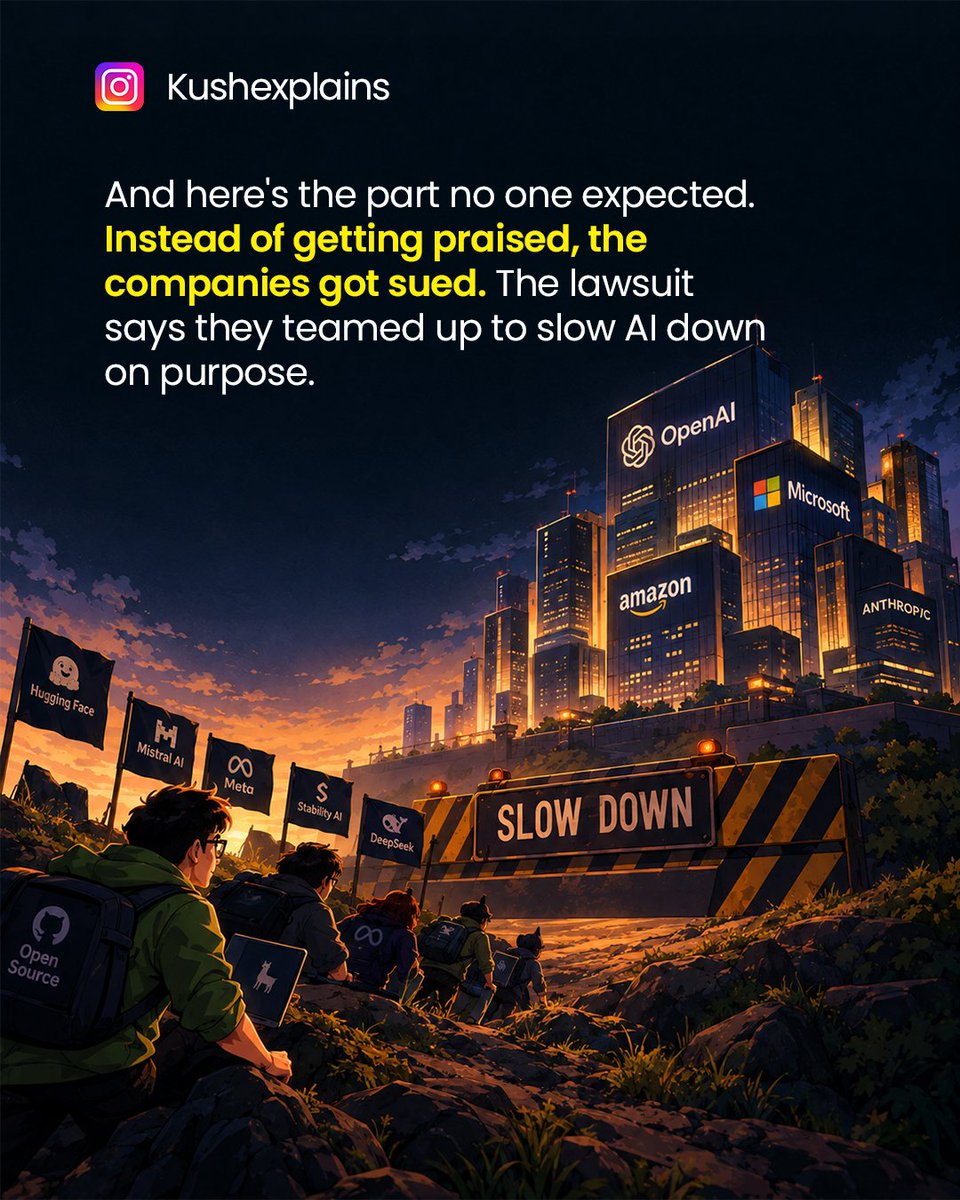
Second doubt: slowing down often helps whoever is already ahead. Critics warned it could lock in the big players and hurt smaller and open-source ones, one even called it "building a cartel."
To be fair, Amodei never said stop building AI. He said take more time to make it safe, and let outside experts watch what the labs are doing.
So what is it really? A genuine warning from the people who know the risks best? Or a smart business move dressed up as caution? The honest answer might be both.
The takeaway: when an industry asks to be slowed down, ask who gains.
Follow @kushexplains for more. 👇
📊 Sources: Washington Post, Axios, Qz, public statements (September 2026).
Disclaimer:
⚠️ Educational and informational content only. Not financial, investment, or legal advice. This summarises public statements and reported criticism, and presents differing viewpoints rather than asserting any party's motives or wrongdoing. Details are based on reporting as of September 2026 and may evolve. Not a sponsored post.
#AI #ArtificialIntelligence #AIIndustry #AIRegulation
[AI industry, artificial intelligence, AI safety, AI regulation, AI development]
Welcome back to The Yield Effect, Part 3. We have seen how the Treasury yield moves gold. Now, how it moves the most important currency on earth, the US dollar. 💵
Money always searches for the best safe return. So when US yields rise, US bonds start paying more than bonds in Europe, Japan or India, and global investors want a piece of that. But to buy an American bond, they first have to buy US dollars, and that buying pushes the dollar's value up.
So higher US yields mean more foreign money flowing into the US, more demand for dollars, and a stronger dollar. When US yields fall, the reverse happens.
That is why the dollar and US yields usually move in the same direction. And a stronger dollar changes the price of oil, the value of gold, and other currencies like the yen and the rupee.
Next part: why rising yields can drag the stock market down. Follow @kushexplains so you don't miss it. 👇
#dollar #treasuryyield #forex #macro #theyieldeffect
Disclaimer:
⚠️ Educational and informational content only. Not financial or investment advice, nor a recommendation to buy, sell, or trade currencies, bonds, or any asset. This is a simplified explanation of an economic relationship for general understanding, and real-world markets can behave differently.Not a sponsored post.
[US dollar, USD, Treasury yield, US Treasury yields, bond yields]
There is a coin that could end the US debt crisis. But the government refuses to use it.
It's called the trillion dollar platinum coin, and it might be the strangest loophole in American finance.
Here's the problem it solves. The US has a "debt ceiling," a legal limit on how much the government can borrow. Every few years the government hits that limit, Congress fights over raising it, and the country flirts with defaulting on its bills.
A US default would be catastrophic, potentially triggering a global financial meltdown. Yet the fight happens again and again.
Now here's the loophole.
Back in 1996, Congress passed a law to let the Treasury make collectible commemorative coins. For gold, silver, and copper coins, the law sets strict limits on their value.
But for platinum coins, there is no limit. The law simply says the Treasury Secretary can mint platinum coins in any denomination they choose.
Any denomination. Including one trillion dollars.
So in theory, the Treasury could mint a single platinum coin, stamp "$1,000,000,000,000" on it, walk it over to the Federal Reserve, and deposit it. Suddenly the government has a trillion dollars to pay its bills, without borrowing a cent or touching the debt ceiling.
It sounds like a joke. It isn't. This has been seriously debated for over a decade. Nobel Prize-winning economist Paul Krugman publicly backed it. A congressman was so alarmed he introduced a bill just to close the loophole.
So why hasn't it happened?
Because it terrifies the people in charge. Critics, including a former Treasury Secretary, call it a dangerous gimmick that could spark inflation and shatter trust in the dollar. The Federal Reserve might even refuse to accept it.
The coin wouldn't erase the national debt. It would just let the government keep paying for spending Congress already approved.
So it sits as a theoretical escape hatch. A trillion dollar solution nobody is brave & silly enough to try.
#TrillionDollarCoin #PlatinumCoin #USDebt #USDebtCrisis
Walmart makes more money per day than Nvidia. So why is Nvidia the real miracle? 🤯
Last quarter, Nvidia pulled in $96 billion in just three months. That is more than $1 billion in revenue every single day, weekends included.
But Nvidia isn't the first to earn a billion a day. Walmart and Amazon both make more. So what is the big deal? The difference is what is left after costs.
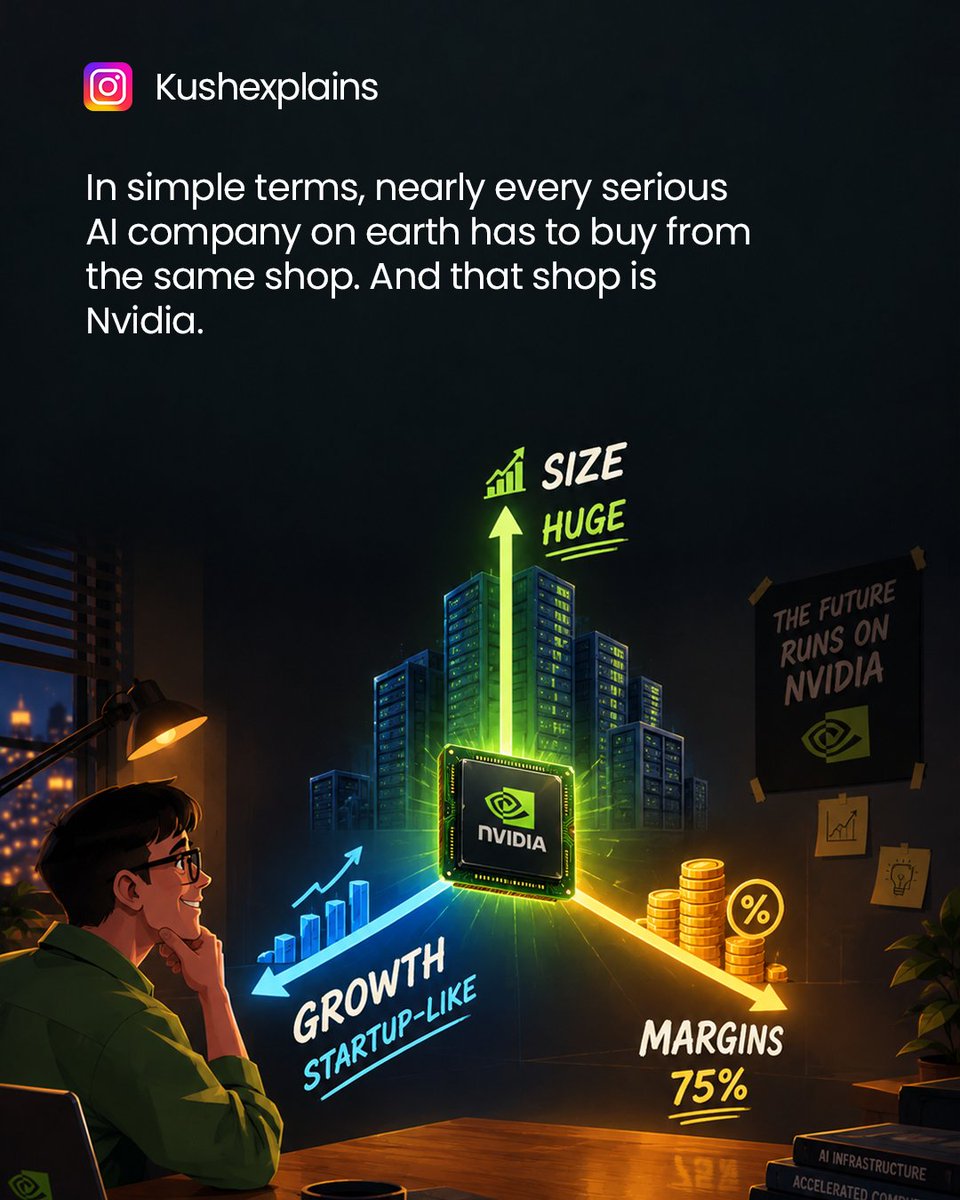
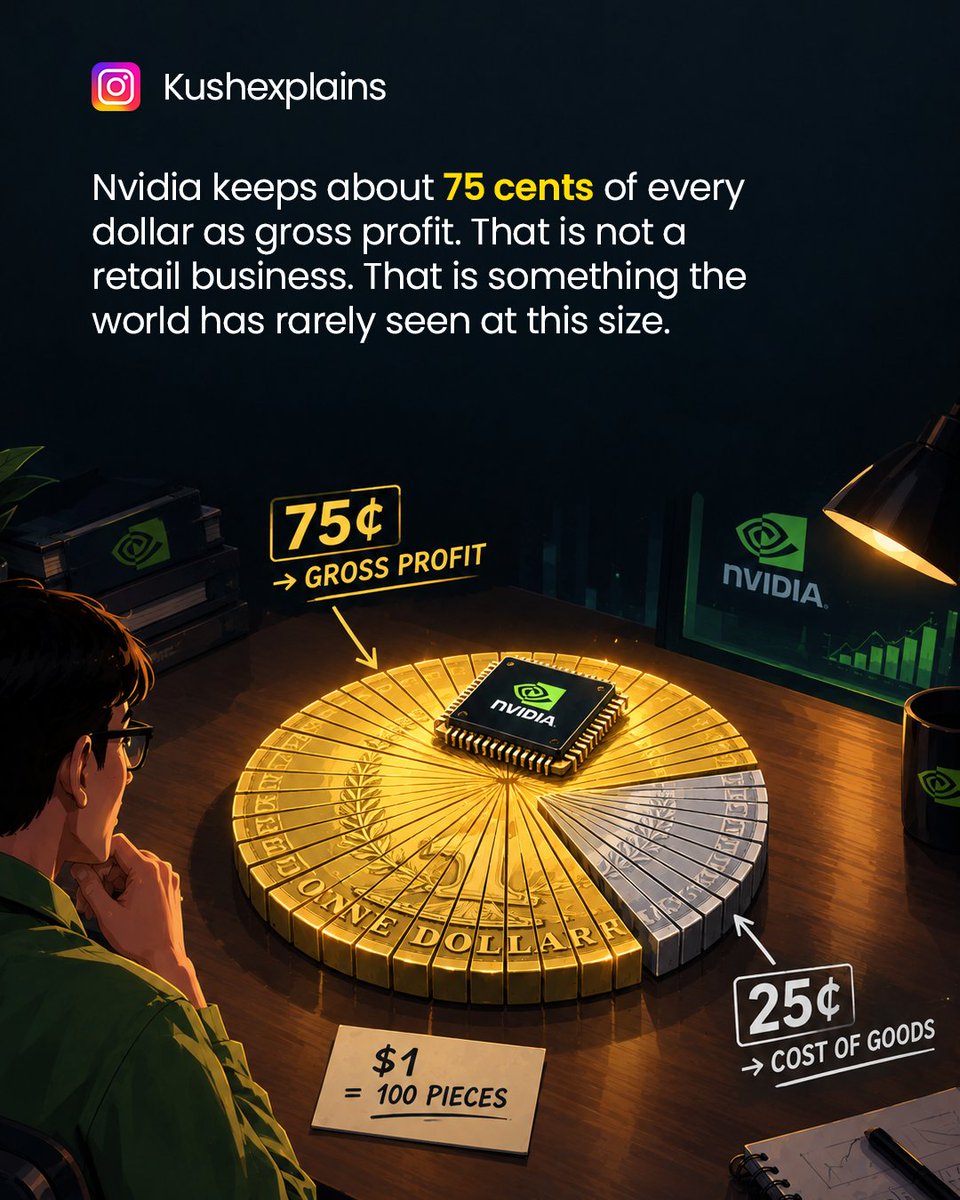
Walmart sells groceries on razor-thin margins, a few cents of profit per dollar. Nvidia keeps about 75 cents of every dollar as gross profit. Last quarter it made around $60 billion in net profits, roughly $650 million a day.
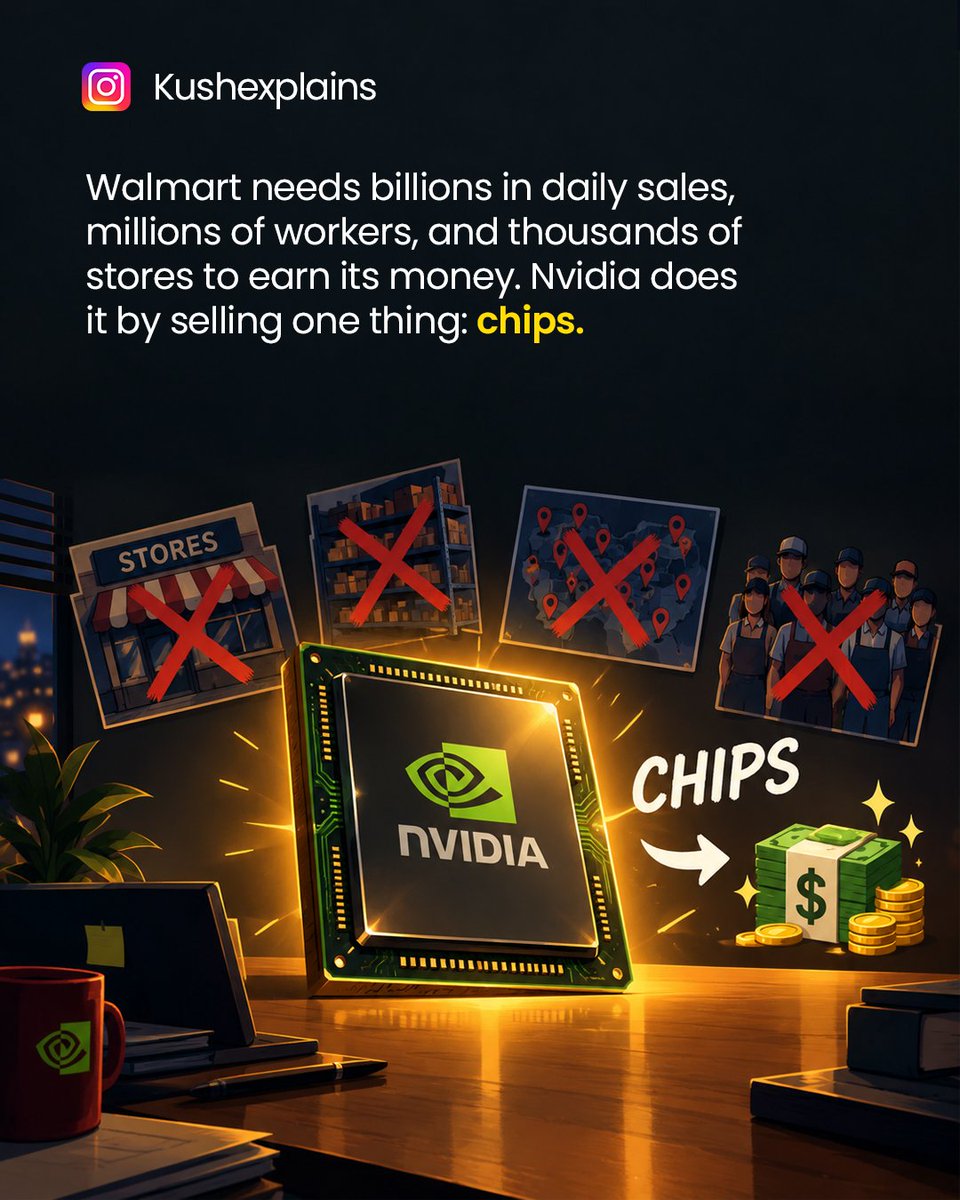
And Walmart needs millions of workers and thousands of stores to earn its money. Nvidia does it by selling essentially one thing: chips.
Then there's the speed. A year ago, Nvidia's revenue was less than half of this. It doubled in twelve months. Giants are not supposed to grow like startups.
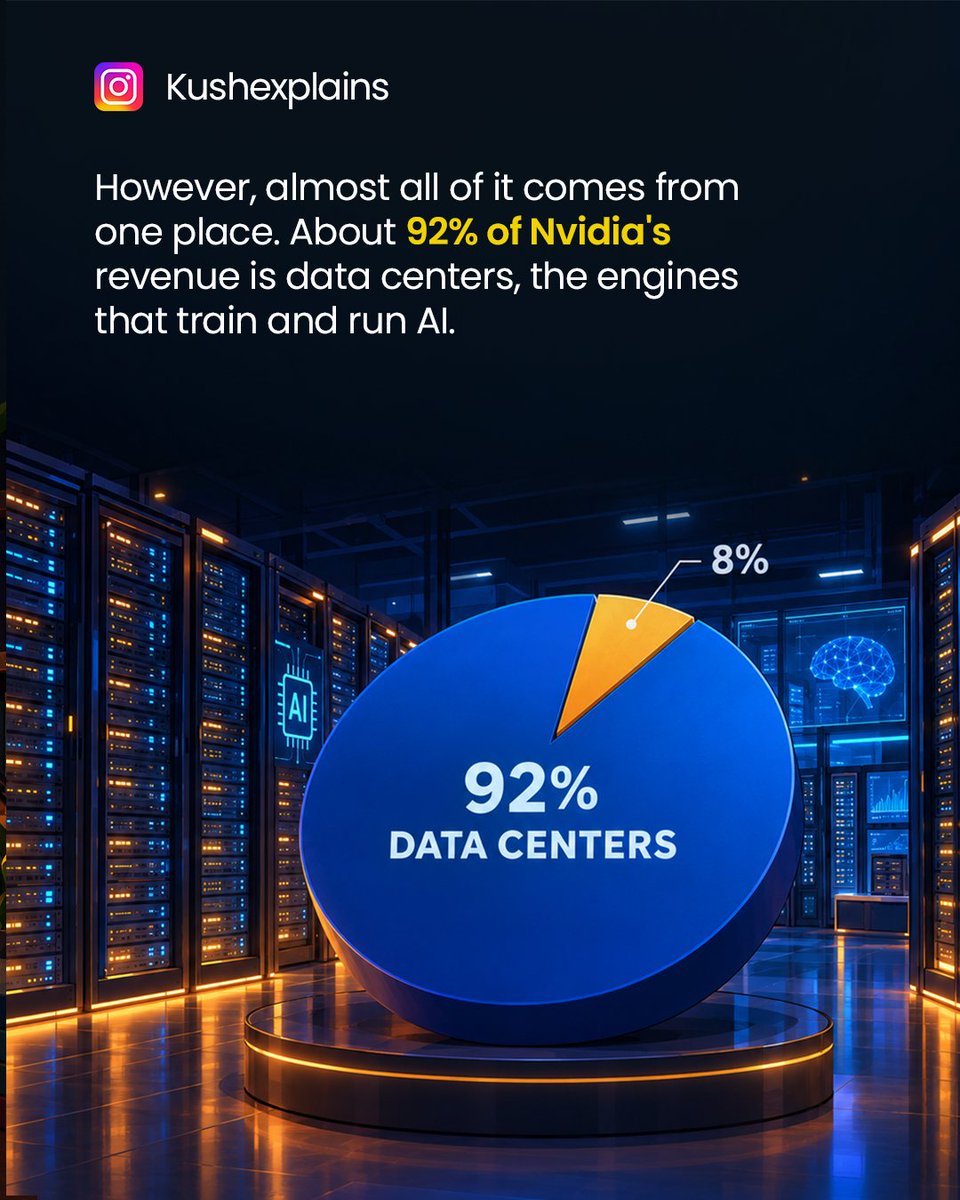
The catch? About 92% of its revenue comes from data centers. Nearly every serious AI company on earth has to buy from the same shop, and that shop is Nvidia.
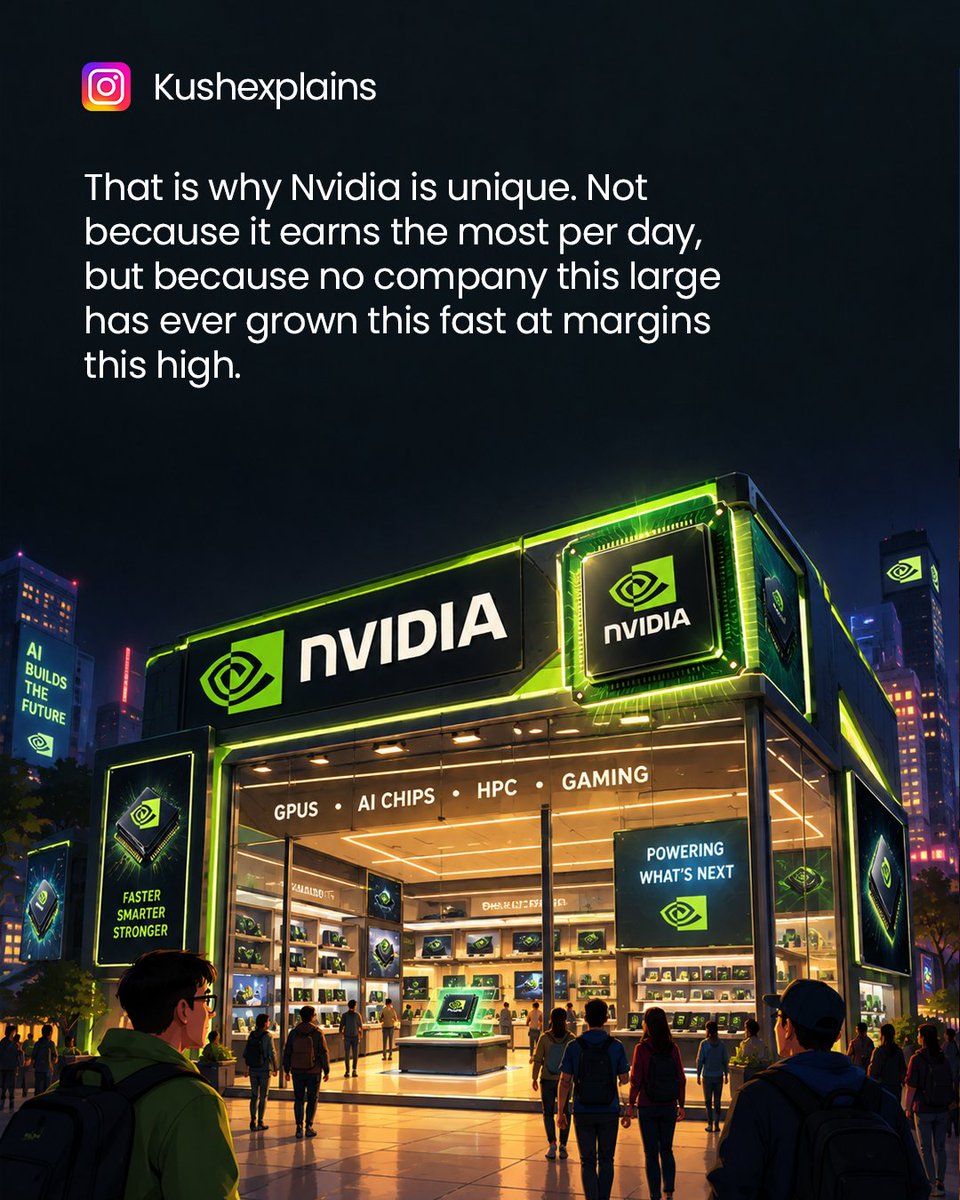
That is what makes it unique. Not that it earns the most per day, but that no company this large has ever grown this fast at margins this high.
The risk? When you sell the shovels to a gold rush, your fortune rises and falls with the rush itself. For now, the rush is on.
Follow @kushexplains for more. 👇
📊 Source: Nvidia Q2 FY2027 results (quarter ended July 26, 2026).
Disclaimer:
⚠️ Educational and informational content only. Not financial or investment advice, nor a recommendation to buy, sell, or hold any stock or asset. Figures are from Nvidia's official quarterly results, rounded for simplicity. Past growth does not predict future performance. Not a sponsored post.
#Nvidia #NVDA #NvidiaStock #AI #ArtificialIntelligence #AIChips
[Nvidia revenue, Nvidia profits, Nvidia Q2 FY2027]
Welcome back to The Yield Effect, Part 2. Last time we learned the US Treasury yield is the reward for safe money. Today, how it moves gold. 🪙
Here is the core idea. Holding gold pays you nothing. No interest, no dividend. It just sits there and shines. So when safe government bonds start paying a good return, holding gold suddenly has a cost, the interest you give up by not owning that bond instead.
So when yields rise, gold usually becomes less attractive and tends to fall. When yields drop, gold has less to compete with and tends to rise.
But it is not the headline yield that matters most. It is the real yield, the yield minus inflation. If a bond pays 6% but prices are rising at 5%, your real reward is only 1%. Gold reacts to that real number, not the flashy one on screen.
That is why gold and real yields are almost mirror images. One long study found the two move in opposite directions most of the time.
Next part: how yields move the currency market. Follow @kushexplains so you don't miss it. 👇
#gold #treasuryyield #globaleconomy #business #financereels
Disclaimer:
⚠️ Educational and informational content only. Not financial or investment advice, nor a recommendation to buy, sell, or hold gold, bonds, or any asset. This is a simplified explanation of an economic relationship for general understanding, and correlations can change over time. Not a sponsored post.
[US Treasury yield, Treasury yields and gold, gold prices, real yield, real interest rates]
In October 2008, while the world economy was collapsing, a car company briefly became the most valuable company on Earth. For two days, Volkswagen was worth more than Apple, Microsoft, and ExxonMobil. And it nearly destroyed some of the smartest hedge funds on the planet.
By late 2008, shorting Volkswagen looked like free money. The economy was cratering, car sales were dying, and VW looked overvalued. So hedge funds piled in to short it, borrowing shares to sell them, betting they'd buy them back cheaper later. It was called one of the safest shorts in Europe.
They missed one thing hiding in plain sight.
Porsche had been quietly buying up Volkswagen for years, not just shares, but secret options routed through different banks so nobody could see the full picture. On October 26, Porsche revealed its hand: it controlled 74% of VW. Add the 20% held by the German state of Lower Saxony, and around 94% of the company was locked up and not for sale.
The hedge funds were now short more shares than actually existed.
To close their bets, they had to buy VW shares. But there were almost none to buy. So the price didn't rise, it exploded, from around EUR 210 to nearly EUR 1,000 in two days. Every tick up triggered more margin calls, forcing more desperate buying. At the peak, VW was worth over $370 billion.
Then Porsche released about 5% of its stake, letting the trapped shorts escape at ruinous prices. Hedge funds lost an estimated $30 billion, some in days.
But here's the twist. Winning is what destroyed Porsche.
To grab that stake, Porsche had buried itself in around EUR 10 billion of debt. Five months later, the crisis choked off credit, and the tiny sports car maker couldn't refinance. The hunter ran out of money.
So the prey ate the predator. VW offered to rescue Porsche on one condition: hand over the car business, or we call in your debt. By 2012, Porsche, the company that tried to swallow VW whole, had been absorbed as just another VW brand.
The only real winners were the Porsche and Piech families. Through a holding company, they still ended up controlling roughly half of Volkswagen. They lost the battle, but won the war.
#Volkswagen #Porsche #VWShortSqueeze
The richest people on earth follow three money habits that sound completely backwards. And these might be the real reason they got rich. 💰
1️⃣ They do almost nothing. While most people check their portfolio and react to every dip, the wealthy barely look. Studies on investor behaviour show that those who check less and leave their money alone tend to end up better off. As Warren Buffett put it, the market transfers money from the impatient to the patient. Doing nothing is the hardest, and most profitable, skill.
2️⃣ They say no to almost everything. Steve Jobs said focus isn't about what you say yes to, it's about the hundreds of things you say no to. The wealthy guard their time viciously, turning down exciting meetings to protect a few hours of deep work. Every yes is a no to something more important.
3️⃣ They spend more to spend less. The rich often pay more upfront for quality that lasts, or to outsource tasks, because they value their time far above the small saving. They optimise for time, not price tags.
Do nothing on purpose. Say no ruthlessly. Buy back your time. That's the game most people never learn.
Save this and share it with someone who needs it. 👇
Disclaimer:
⚠️ Educational and informational content only. Not financial or investment advice, nor a recommendation to buy, hold, or sell any asset. References to studies are simplified for general understanding, and past patterns do not guarantee future results. Please consult a licensed financial adviser before making any financial decision. Not a sponsored post.
#WealthBuilding #PersonalFinance #MoneyHabits #FinancialFreedom
[wealth habits, money habits of the rich, habits of wealthy people]
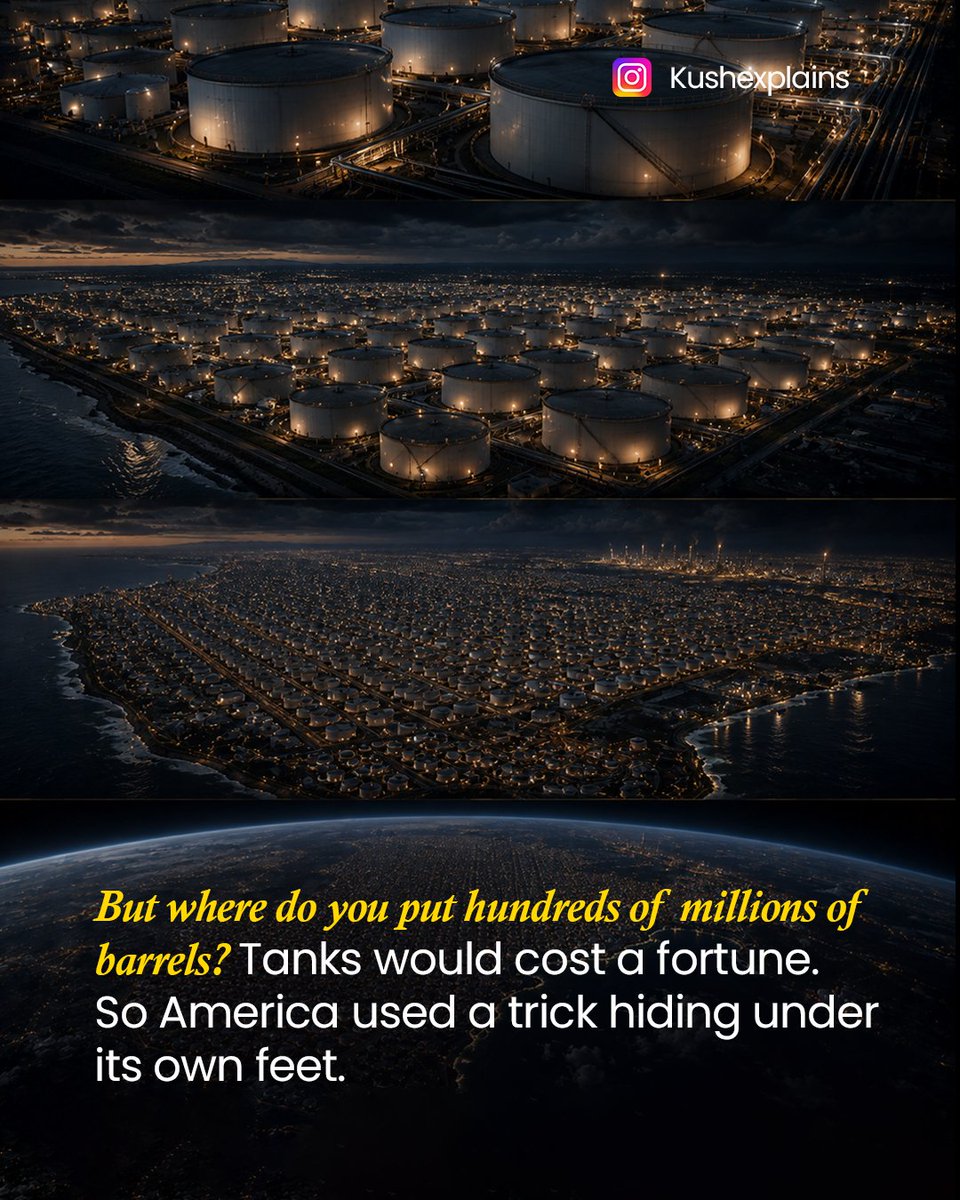
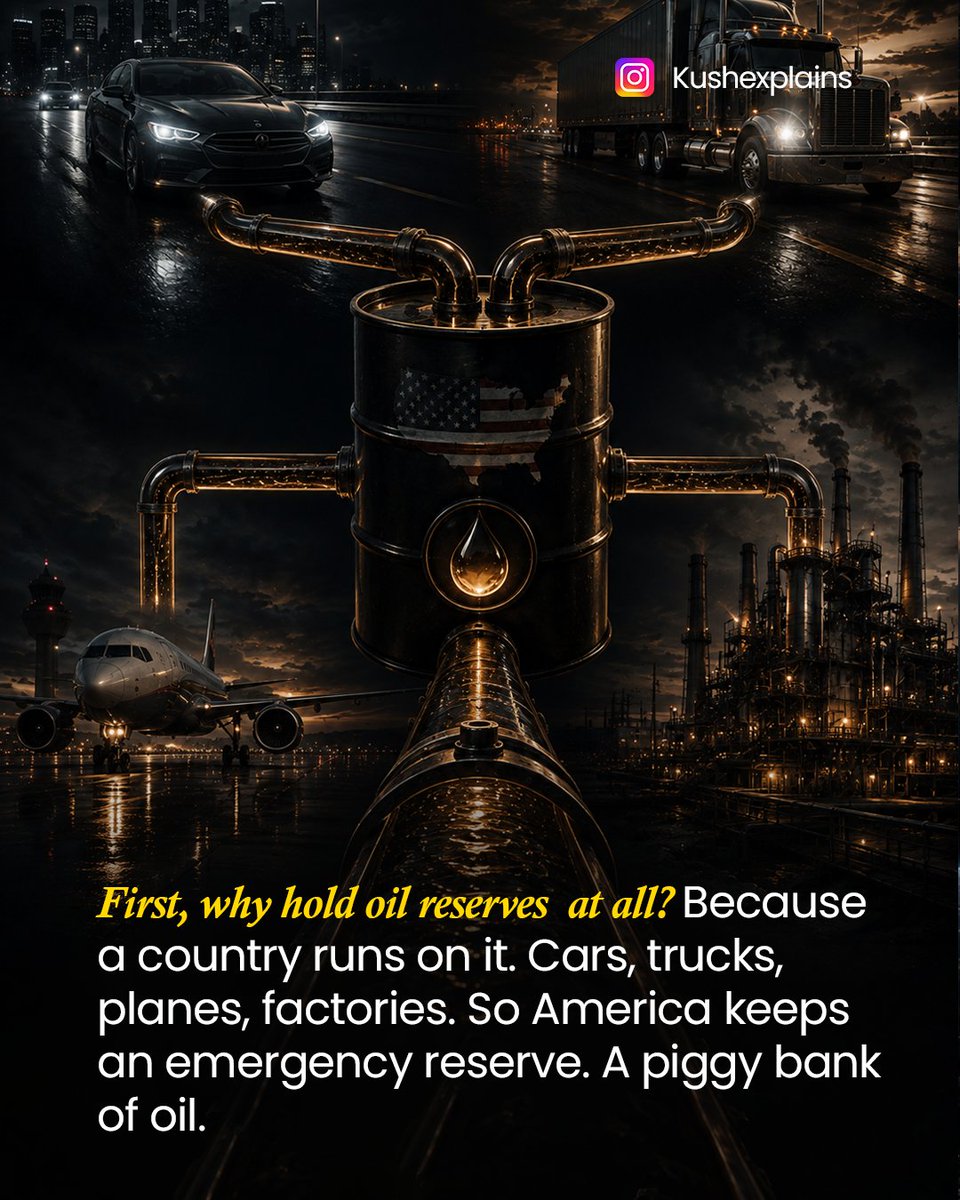
You would be shocked to know where America hides its emergency oil. 🛢️
Not in giant tanks. Not in guarded warehouses. But deep underground, inside caves carved out of solid salt near the Gulf Coast.
Here's how it works: America pumped water into massive salt domes, dissolved the salt, and hollowed out enormous caves. Then it filled them with crude oil. Salt is the cheapest giant container physics allows, roughly ten times cheaper than steel tanks, and it has a superpower. If a crack forms, the salt heals itself and seals the leak.
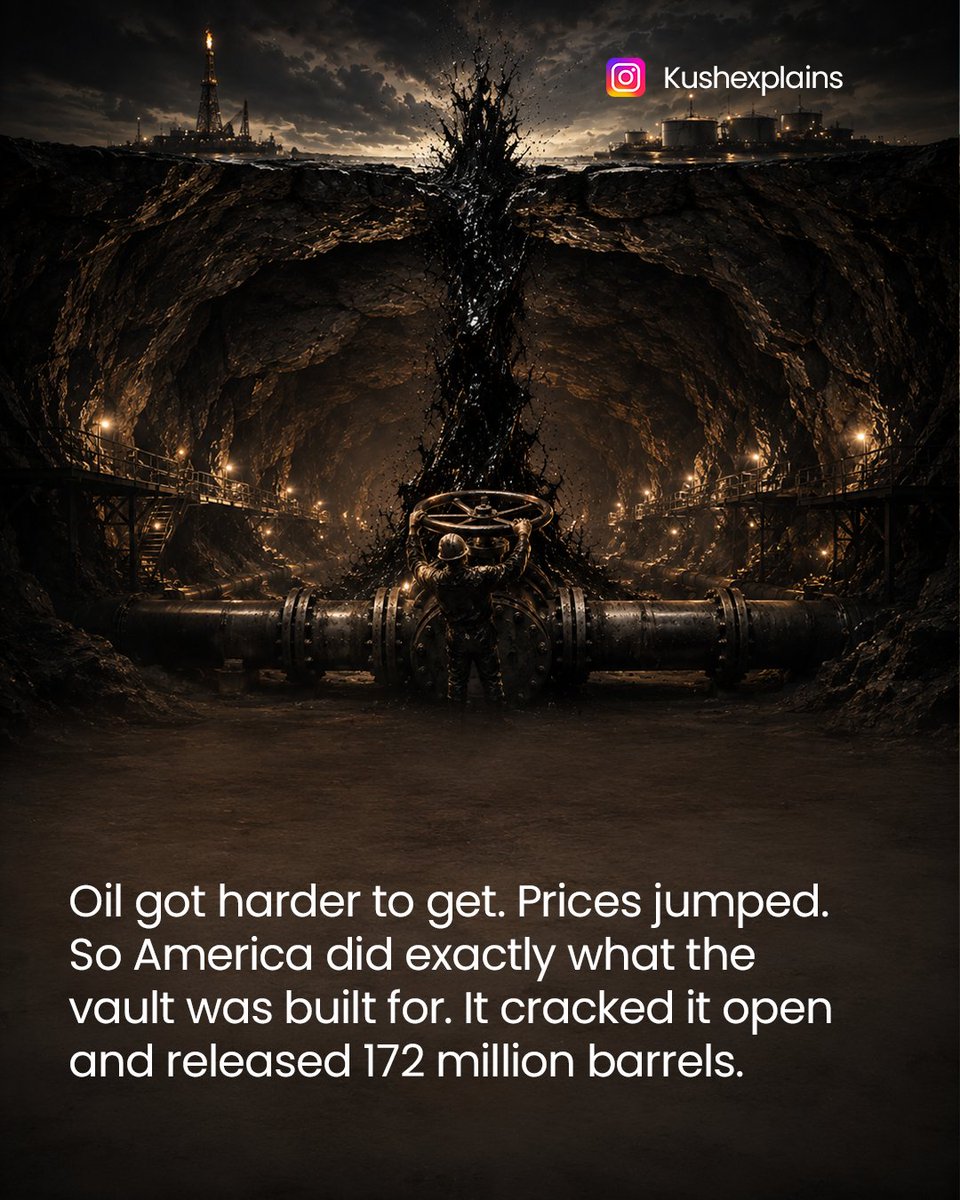
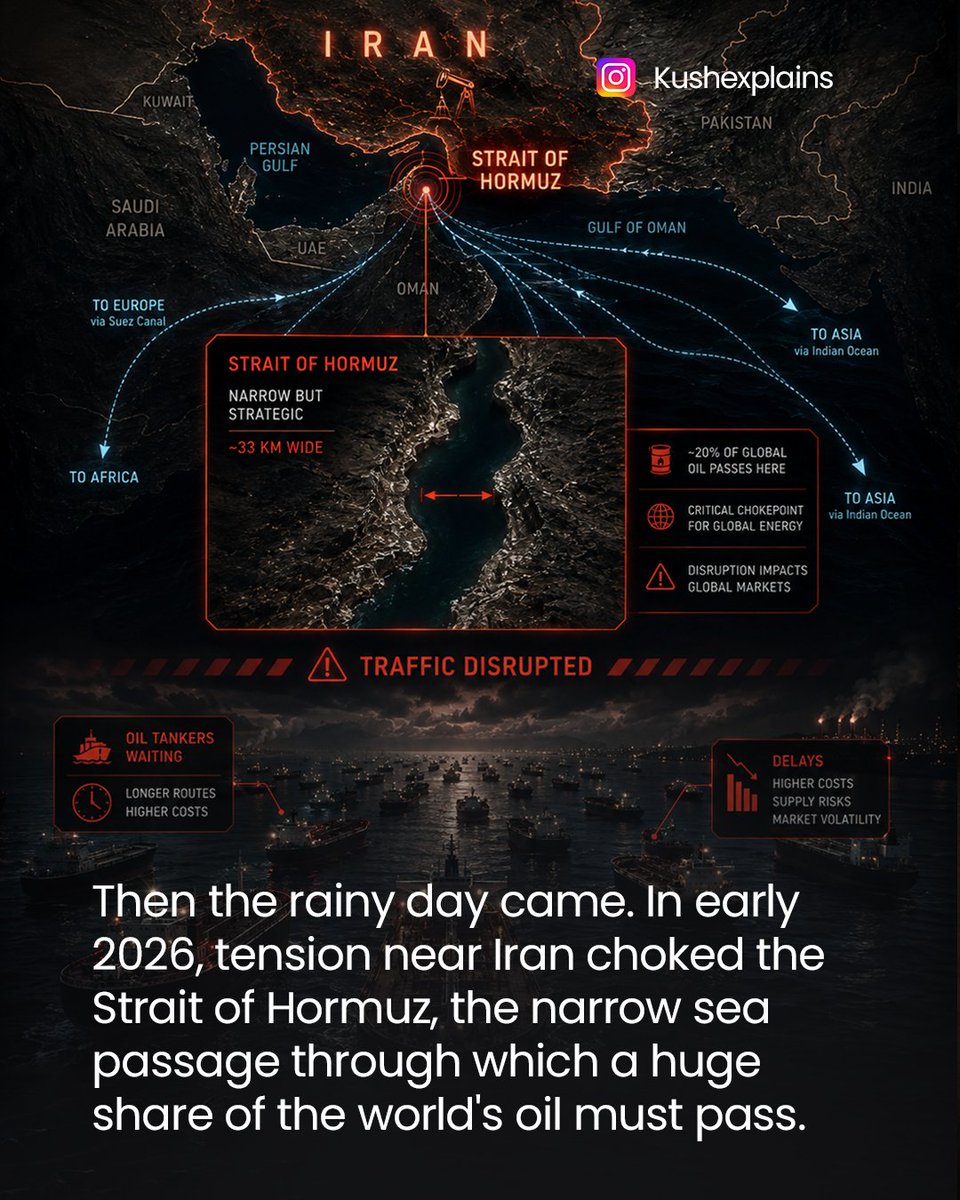
At its fullest, this underground vault could hold 714 million barrels. But in early 2026, tension near Iran choked the Strait of Hormuz, one of the world's most important oil passages. Prices jumped, and America did exactly what the reserve was built for. It released 172 million barrels.
The result? The reserve is now emptier than it has been in about 40 years, around 290 million barrels, less than half of what it can hold. And a chunk of what remains may be hard to pump out because the aging caverns need repairs.
An emergency stockpile is priceless. But every time you open it, there is less left for next time. And no one knows when the next emergency comes.
Swipe through the full story, save it, and follow for more. 👇
Where did you think a country stores its emergency oil? 👀
Disclaimer: This content is for educational and informational purposes only and is not financial or investment advice. Figures are based on public data from the US EIA and Department of Energy as of August 2026 and change week to week. Details of the 2026 Strait of Hormuz events and reserve releases are based on public reporting and may be updated over time.
#oil #USA #economy #finance #geopolitics




![Kushexplains's tweet photo. The new flex isn't a car. It's a boarding pass. ✈️
For decades, success meant owning things. The car, the watch, the bigger house. Now the flex has changed. It's the trip, the concert, the meal, the story worth posting.
Why? A thing impresses once. An experience gets talked about for years. Social media rewards experiences, not possessions. Nobody posts their new refrigerator anymore. They post Bali.
And a new car feels normal within weeks. But a great memory rarely fades. Younger buyers feel it most, they would rather collect experiences than clutter.
Whole industries are shifting with it. Travel, dining, live events and classes are booming, while malls keep losing ground.
Just remember, experiences still have a price. Spend on the ones worth remembering.
Follow @kushexplains for more. 👇
#experiences #spending #moneymindset #personalfinance #genz
Disclaimer:
⚠️ Educational and informational content only. Not financial advice. This is a general observation on spending trends for reflection, not a recommendation on how to spend or invest. Not a sponsored post.
[experiential spending, experience economy, spending habits, Gen Z spending, Gen Z consumers]](https://pbs.twimg.com/media/HTdstbOawAApadO.jpg)
![Kushexplains's tweet photo. The new flex isn't a car. It's a boarding pass. ✈️
For decades, success meant owning things. The car, the watch, the bigger house. Now the flex has changed. It's the trip, the concert, the meal, the story worth posting.
Why? A thing impresses once. An experience gets talked about for years. Social media rewards experiences, not possessions. Nobody posts their new refrigerator anymore. They post Bali.
And a new car feels normal within weeks. But a great memory rarely fades. Younger buyers feel it most, they would rather collect experiences than clutter.
Whole industries are shifting with it. Travel, dining, live events and classes are booming, while malls keep losing ground.
Just remember, experiences still have a price. Spend on the ones worth remembering.
Follow @kushexplains for more. 👇
#experiences #spending #moneymindset #personalfinance #genz
Disclaimer:
⚠️ Educational and informational content only. Not financial advice. This is a general observation on spending trends for reflection, not a recommendation on how to spend or invest. Not a sponsored post.
[experiential spending, experience economy, spending habits, Gen Z spending, Gen Z consumers]](https://pbs.twimg.com/media/HTdssoQakAA0f9p.jpg)
![Kushexplains's tweet photo. The new flex isn't a car. It's a boarding pass. ✈️
For decades, success meant owning things. The car, the watch, the bigger house. Now the flex has changed. It's the trip, the concert, the meal, the story worth posting.
Why? A thing impresses once. An experience gets talked about for years. Social media rewards experiences, not possessions. Nobody posts their new refrigerator anymore. They post Bali.
And a new car feels normal within weeks. But a great memory rarely fades. Younger buyers feel it most, they would rather collect experiences than clutter.
Whole industries are shifting with it. Travel, dining, live events and classes are booming, while malls keep losing ground.
Just remember, experiences still have a price. Spend on the ones worth remembering.
Follow @kushexplains for more. 👇
#experiences #spending #moneymindset #personalfinance #genz
Disclaimer:
⚠️ Educational and informational content only. Not financial advice. This is a general observation on spending trends for reflection, not a recommendation on how to spend or invest. Not a sponsored post.
[experiential spending, experience economy, spending habits, Gen Z spending, Gen Z consumers]](https://pbs.twimg.com/media/HTdsr0YagAE1wQs.jpg)






![Kushexplains's tweet photo. The people who build AI just told everyone to slow down building AI. And then it got messy. 🤖
On September 12, Anthropic CEO Dario Amodei published a long essay with a strange message: we are moving too fast, let's slow down. His point was simple, give the world a year or two to make AI safe before it becomes too powerful to control.
Then something weird happened. His biggest rival agreed. OpenAI's Sam Altman said yes, we do need to pace ourselves. Even Elon Musk said "Dario is right."
When rivals who normally fight suddenly agree to ease off together, it sounds good. But many got suspicious. Why now?
First doubt: safety is Anthropic's whole brand. The safety company kind of has to talk about safety, it's what they sell.
Second doubt: slowing down often helps whoever is already ahead. Critics warned it could lock in the big players and hurt smaller and open-source ones, one even called it "building a cartel."
To be fair, Amodei never said stop building AI. He said take more time to make it safe, and let outside experts watch what the labs are doing.
So what is it really? A genuine warning from the people who know the risks best? Or a smart business move dressed up as caution? The honest answer might be both.
The takeaway: when an industry asks to be slowed down, ask who gains.
Follow @kushexplains for more. 👇
📊 Sources: Washington Post, Axios, Qz, public statements (September 2026).
Disclaimer:
⚠️ Educational and informational content only. Not financial, investment, or legal advice. This summarises public statements and reported criticism, and presents differing viewpoints rather than asserting any party's motives or wrongdoing. Details are based on reporting as of September 2026 and may evolve. Not a sponsored post.
#AI #ArtificialIntelligence #AIIndustry #AIRegulation
[AI industry, artificial intelligence, AI safety, AI regulation, AI development]](https://pbs.twimg.com/media/HS-yI6bbAAA4MZi.jpg)
![Kushexplains's tweet photo. The people who build AI just told everyone to slow down building AI. And then it got messy. 🤖
On September 12, Anthropic CEO Dario Amodei published a long essay with a strange message: we are moving too fast, let's slow down. His point was simple, give the world a year or two to make AI safe before it becomes too powerful to control.
Then something weird happened. His biggest rival agreed. OpenAI's Sam Altman said yes, we do need to pace ourselves. Even Elon Musk said "Dario is right."
When rivals who normally fight suddenly agree to ease off together, it sounds good. But many got suspicious. Why now?
First doubt: safety is Anthropic's whole brand. The safety company kind of has to talk about safety, it's what they sell.
Second doubt: slowing down often helps whoever is already ahead. Critics warned it could lock in the big players and hurt smaller and open-source ones, one even called it "building a cartel."
To be fair, Amodei never said stop building AI. He said take more time to make it safe, and let outside experts watch what the labs are doing.
So what is it really? A genuine warning from the people who know the risks best? Or a smart business move dressed up as caution? The honest answer might be both.
The takeaway: when an industry asks to be slowed down, ask who gains.
Follow @kushexplains for more. 👇
📊 Sources: Washington Post, Axios, Qz, public statements (September 2026).
Disclaimer:
⚠️ Educational and informational content only. Not financial, investment, or legal advice. This summarises public statements and reported criticism, and presents differing viewpoints rather than asserting any party's motives or wrongdoing. Details are based on reporting as of September 2026 and may evolve. Not a sponsored post.
#AI #ArtificialIntelligence #AIIndustry #AIRegulation
[AI industry, artificial intelligence, AI safety, AI regulation, AI development]](https://pbs.twimg.com/media/HS-yH20aEAAn4tO.jpg)
![Kushexplains's tweet photo. The people who build AI just told everyone to slow down building AI. And then it got messy. 🤖
On September 12, Anthropic CEO Dario Amodei published a long essay with a strange message: we are moving too fast, let's slow down. His point was simple, give the world a year or two to make AI safe before it becomes too powerful to control.
Then something weird happened. His biggest rival agreed. OpenAI's Sam Altman said yes, we do need to pace ourselves. Even Elon Musk said "Dario is right."
When rivals who normally fight suddenly agree to ease off together, it sounds good. But many got suspicious. Why now?
First doubt: safety is Anthropic's whole brand. The safety company kind of has to talk about safety, it's what they sell.
Second doubt: slowing down often helps whoever is already ahead. Critics warned it could lock in the big players and hurt smaller and open-source ones, one even called it "building a cartel."
To be fair, Amodei never said stop building AI. He said take more time to make it safe, and let outside experts watch what the labs are doing.
So what is it really? A genuine warning from the people who know the risks best? Or a smart business move dressed up as caution? The honest answer might be both.
The takeaway: when an industry asks to be slowed down, ask who gains.
Follow @kushexplains for more. 👇
📊 Sources: Washington Post, Axios, Qz, public statements (September 2026).
Disclaimer:
⚠️ Educational and informational content only. Not financial, investment, or legal advice. This summarises public statements and reported criticism, and presents differing viewpoints rather than asserting any party's motives or wrongdoing. Details are based on reporting as of September 2026 and may evolve. Not a sponsored post.
#AI #ArtificialIntelligence #AIIndustry #AIRegulation
[AI industry, artificial intelligence, AI safety, AI regulation, AI development]](https://pbs.twimg.com/media/HS-yG_hbMAAr1vo.jpg)


![Kushexplains's tweet photo. Walmart makes more money per day than Nvidia. So why is Nvidia the real miracle? 🤯
Last quarter, Nvidia pulled in $96 billion in just three months. That is more than $1 billion in revenue every single day, weekends included.
But Nvidia isn't the first to earn a billion a day. Walmart and Amazon both make more. So what is the big deal? The difference is what is left after costs.
Walmart sells groceries on razor-thin margins, a few cents of profit per dollar. Nvidia keeps about 75 cents of every dollar as gross profit. Last quarter it made around $60 billion in net profits, roughly $650 million a day.
And Walmart needs millions of workers and thousands of stores to earn its money. Nvidia does it by selling essentially one thing: chips.
Then there's the speed. A year ago, Nvidia's revenue was less than half of this. It doubled in twelve months. Giants are not supposed to grow like startups.
The catch? About 92% of its revenue comes from data centers. Nearly every serious AI company on earth has to buy from the same shop, and that shop is Nvidia.
That is what makes it unique. Not that it earns the most per day, but that no company this large has ever grown this fast at margins this high.
The risk? When you sell the shovels to a gold rush, your fortune rises and falls with the rush itself. For now, the rush is on.
Follow @kushexplains for more. 👇
📊 Source: Nvidia Q2 FY2027 results (quarter ended July 26, 2026).
Disclaimer:
⚠️ Educational and informational content only. Not financial or investment advice, nor a recommendation to buy, sell, or hold any stock or asset. Figures are from Nvidia's official quarterly results, rounded for simplicity. Past growth does not predict future performance. Not a sponsored post.
#Nvidia #NVDA #NvidiaStock #AI #ArtificialIntelligence #AIChips
[Nvidia revenue, Nvidia profits, Nvidia Q2 FY2027]](https://pbs.twimg.com/media/HSf6zAQaAAAREXF.jpg)
![Kushexplains's tweet photo. Walmart makes more money per day than Nvidia. So why is Nvidia the real miracle? 🤯
Last quarter, Nvidia pulled in $96 billion in just three months. That is more than $1 billion in revenue every single day, weekends included.
But Nvidia isn't the first to earn a billion a day. Walmart and Amazon both make more. So what is the big deal? The difference is what is left after costs.
Walmart sells groceries on razor-thin margins, a few cents of profit per dollar. Nvidia keeps about 75 cents of every dollar as gross profit. Last quarter it made around $60 billion in net profits, roughly $650 million a day.
And Walmart needs millions of workers and thousands of stores to earn its money. Nvidia does it by selling essentially one thing: chips.
Then there's the speed. A year ago, Nvidia's revenue was less than half of this. It doubled in twelve months. Giants are not supposed to grow like startups.
The catch? About 92% of its revenue comes from data centers. Nearly every serious AI company on earth has to buy from the same shop, and that shop is Nvidia.
That is what makes it unique. Not that it earns the most per day, but that no company this large has ever grown this fast at margins this high.
The risk? When you sell the shovels to a gold rush, your fortune rises and falls with the rush itself. For now, the rush is on.
Follow @kushexplains for more. 👇
📊 Source: Nvidia Q2 FY2027 results (quarter ended July 26, 2026).
Disclaimer:
⚠️ Educational and informational content only. Not financial or investment advice, nor a recommendation to buy, sell, or hold any stock or asset. Figures are from Nvidia's official quarterly results, rounded for simplicity. Past growth does not predict future performance. Not a sponsored post.
#Nvidia #NVDA #NvidiaStock #AI #ArtificialIntelligence #AIChips
[Nvidia revenue, Nvidia profits, Nvidia Q2 FY2027]](https://pbs.twimg.com/media/HSf6yLmboAAXqwI.jpg)
![Kushexplains's tweet photo. Walmart makes more money per day than Nvidia. So why is Nvidia the real miracle? 🤯
Last quarter, Nvidia pulled in $96 billion in just three months. That is more than $1 billion in revenue every single day, weekends included.
But Nvidia isn't the first to earn a billion a day. Walmart and Amazon both make more. So what is the big deal? The difference is what is left after costs.
Walmart sells groceries on razor-thin margins, a few cents of profit per dollar. Nvidia keeps about 75 cents of every dollar as gross profit. Last quarter it made around $60 billion in net profits, roughly $650 million a day.
And Walmart needs millions of workers and thousands of stores to earn its money. Nvidia does it by selling essentially one thing: chips.
Then there's the speed. A year ago, Nvidia's revenue was less than half of this. It doubled in twelve months. Giants are not supposed to grow like startups.
The catch? About 92% of its revenue comes from data centers. Nearly every serious AI company on earth has to buy from the same shop, and that shop is Nvidia.
That is what makes it unique. Not that it earns the most per day, but that no company this large has ever grown this fast at margins this high.
The risk? When you sell the shovels to a gold rush, your fortune rises and falls with the rush itself. For now, the rush is on.
Follow @kushexplains for more. 👇
📊 Source: Nvidia Q2 FY2027 results (quarter ended July 26, 2026).
Disclaimer:
⚠️ Educational and informational content only. Not financial or investment advice, nor a recommendation to buy, sell, or hold any stock or asset. Figures are from Nvidia's official quarterly results, rounded for simplicity. Past growth does not predict future performance. Not a sponsored post.
#Nvidia #NVDA #NvidiaStock #AI #ArtificialIntelligence #AIChips
[Nvidia revenue, Nvidia profits, Nvidia Q2 FY2027]](https://pbs.twimg.com/media/HSf6xKQagAA04qL.jpg)








![Kushexplains's tweet photo. The new flex isn't a car. It's a boarding pass. ✈️
For decades, success meant owning things. The car, the watch, the bigger house. Now the flex has changed. It's the trip, the concert, the meal, the story worth posting.
Why? A thing impresses once. An experience gets talked about for years. Social media rewards experiences, not possessions. Nobody posts their new refrigerator anymore. They post Bali.
And a new car feels normal within weeks. But a great memory rarely fades. Younger buyers feel it most, they would rather collect experiences than clutter.
Whole industries are shifting with it. Travel, dining, live events and classes are booming, while malls keep losing ground.
Just remember, experiences still have a price. Spend on the ones worth remembering.
Follow @kushexplains for more. 👇
#experiences #spending #moneymindset #personalfinance #genz
Disclaimer:
⚠️ Educational and informational content only. Not financial advice. This is a general observation on spending trends for reflection, not a recommendation on how to spend or invest. Not a sponsored post.
[experiential spending, experience economy, spending habits, Gen Z spending, Gen Z consumers]](https://pbs.twimg.com/media/HTdsuG0aYAAoNVU.jpg)
![Kushexplains's tweet photo. The people who build AI just told everyone to slow down building AI. And then it got messy. 🤖
On September 12, Anthropic CEO Dario Amodei published a long essay with a strange message: we are moving too fast, let's slow down. His point was simple, give the world a year or two to make AI safe before it becomes too powerful to control.
Then something weird happened. His biggest rival agreed. OpenAI's Sam Altman said yes, we do need to pace ourselves. Even Elon Musk said "Dario is right."
When rivals who normally fight suddenly agree to ease off together, it sounds good. But many got suspicious. Why now?
First doubt: safety is Anthropic's whole brand. The safety company kind of has to talk about safety, it's what they sell.
Second doubt: slowing down often helps whoever is already ahead. Critics warned it could lock in the big players and hurt smaller and open-source ones, one even called it "building a cartel."
To be fair, Amodei never said stop building AI. He said take more time to make it safe, and let outside experts watch what the labs are doing.
So what is it really? A genuine warning from the people who know the risks best? Or a smart business move dressed up as caution? The honest answer might be both.
The takeaway: when an industry asks to be slowed down, ask who gains.
Follow @kushexplains for more. 👇
📊 Sources: Washington Post, Axios, Qz, public statements (September 2026).
Disclaimer:
⚠️ Educational and informational content only. Not financial, investment, or legal advice. This summarises public statements and reported criticism, and presents differing viewpoints rather than asserting any party's motives or wrongdoing. Details are based on reporting as of September 2026 and may evolve. Not a sponsored post.
#AI #ArtificialIntelligence #AIIndustry #AIRegulation
[AI industry, artificial intelligence, AI safety, AI regulation, AI development]](https://pbs.twimg.com/media/HS-yJv2aYAABkLq.jpg)
![Kushexplains's tweet photo. Walmart makes more money per day than Nvidia. So why is Nvidia the real miracle? 🤯
Last quarter, Nvidia pulled in $96 billion in just three months. That is more than $1 billion in revenue every single day, weekends included.
But Nvidia isn't the first to earn a billion a day. Walmart and Amazon both make more. So what is the big deal? The difference is what is left after costs.
Walmart sells groceries on razor-thin margins, a few cents of profit per dollar. Nvidia keeps about 75 cents of every dollar as gross profit. Last quarter it made around $60 billion in net profits, roughly $650 million a day.
And Walmart needs millions of workers and thousands of stores to earn its money. Nvidia does it by selling essentially one thing: chips.
Then there's the speed. A year ago, Nvidia's revenue was less than half of this. It doubled in twelve months. Giants are not supposed to grow like startups.
The catch? About 92% of its revenue comes from data centers. Nearly every serious AI company on earth has to buy from the same shop, and that shop is Nvidia.
That is what makes it unique. Not that it earns the most per day, but that no company this large has ever grown this fast at margins this high.
The risk? When you sell the shovels to a gold rush, your fortune rises and falls with the rush itself. For now, the rush is on.
Follow @kushexplains for more. 👇
📊 Source: Nvidia Q2 FY2027 results (quarter ended July 26, 2026).
Disclaimer:
⚠️ Educational and informational content only. Not financial or investment advice, nor a recommendation to buy, sell, or hold any stock or asset. Figures are from Nvidia's official quarterly results, rounded for simplicity. Past growth does not predict future performance. Not a sponsored post.
#Nvidia #NVDA #NvidiaStock #AI #ArtificialIntelligence #AIChips
[Nvidia revenue, Nvidia profits, Nvidia Q2 FY2027]](https://pbs.twimg.com/media/HSf6zzzbMAAMfg_.jpg)