In markets, confident opinions are everywhere. Evidence is rare. I would rather show you the evidence than sell you the confidence.
If you want to understand markets instead of gambling on them, this account is for you.
I take the things people in finance repeat as fact and test them against real data.
Sometimes they hold up.
Sometimes they fall apart.
Either way, I’ll show you what happened, why I think it happened, and what the evidence still can’t tell us.
No signals. No price predictions. No “trust me.”
And you shouldn’t have to take my word for any of it. That’s the point.
I’m based in Zurich, obsessed with markets and how they actually work. I hold an MSc in Finance & Money, and that curiosity eventually led me to build Helvetic Research so I could test market ideas instead of just arguing about them.
Here you’ll find macro, markets, crypto and quant, tested in public.
I’ll be wrong sometimes. I’ll change my mind when the evidence changes.
I’m not trying to be the loudest person in markets.
I’m trying to build the account I would’ve wanted to follow: curious, evidence-led, and comfortable saying “I don’t know.”
If that sounds like how you want to think about markets too, follow along.
PwC projects global data-center spending could top $30T by 2050, while some AI companies are planning spending far beyond current revenues.
The bet is enormous future productivity. The risk is paying for that future too early.
Source: Reuters.
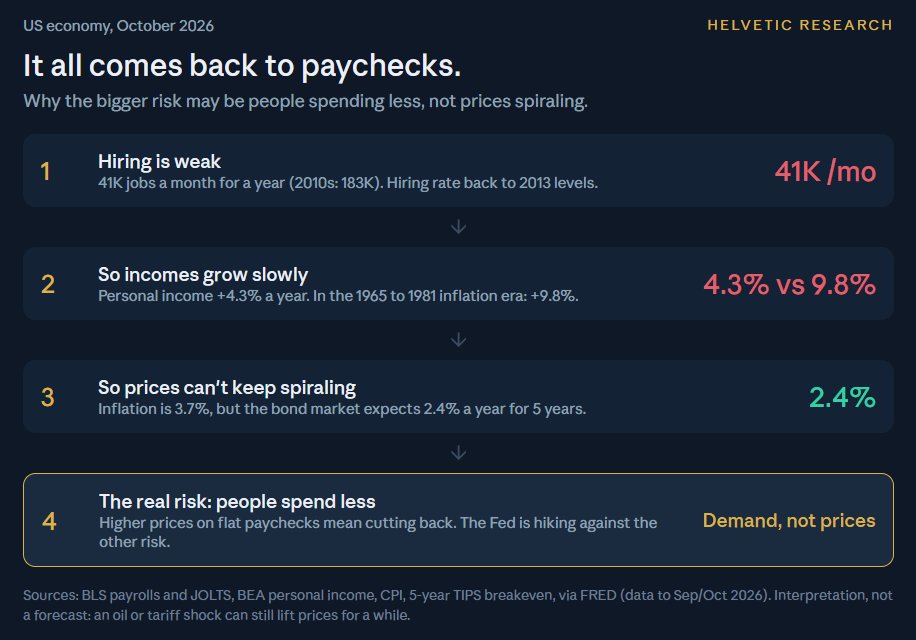
The whole economy comes back to one thing: paychecks.
Hiring has slowed to 41,000 jobs a month.
So incomes grow slowly, 4.3% a year vs almost 10% in the 1970s.
So prices can't keep spiraling. The bond market expects 2.4% inflation, not a repeat of the 1970s.
The Fed is hiking to stop inflation. The bigger risk might be people simply spending less.
Which worries you more: prices going up, or your income not keeping up?
Every jobs report gets judged the same way: positive = good.
But at the 2010s hiring pace, the US would have 9 million more jobs today. In 2023 the gap was 4.7 million. It has grown every year since, even in the "good" months.
Unemployment still says 4.2%.
Which number feels closer to your life: 4.2% or 9 million?
The chain in numbers: payrolls averaged 41K a month over the last year (2010s: 183K), and the hiring rate is back to 2013 levels. Personal income is up 4.3% a year, vs 9.8% on average from 1965 to 1981, when fast-rising pay let prices keep climbing. The 5-year TIPS breakeven is 2.4% while CPI is 3.7%.
The logic: without fast income growth, higher prices can't keep rising for long, because people cut back instead.
Caveat: this is a reading, not a forecast. An oil or tariff shock can still push prices up for a while. And the Fed is watching the low 4.2% unemployment rate, which tells a different story.
Data: BLS, BEA, FRED.
Serious question for anyone paying attention: just 29,000 new jobs, mortgages above 7%, oil near $97, and the Fed still hiking.
On a scale of 1 to 10, how worried are you right now?
September: just 29,000 new jobs.
And last month's "strong" 162,000 just got revised down to 133,000. July flipped from a gain to a loss.
Do you still trust the first jobs number they report: yes or no?