This guy has a collection of Venus fly traps and records them catching bugs and insects.
Here’s one catching a black widow spider.
[📹 carnivosous_plants_journey]
Mobula rays can jump over two meters out of the water and remain airborne for several seconds. The reason for this behavior is still unknown, but hypotheses include attracting mates, removing parasites, long-distance communication, or just to have fun.
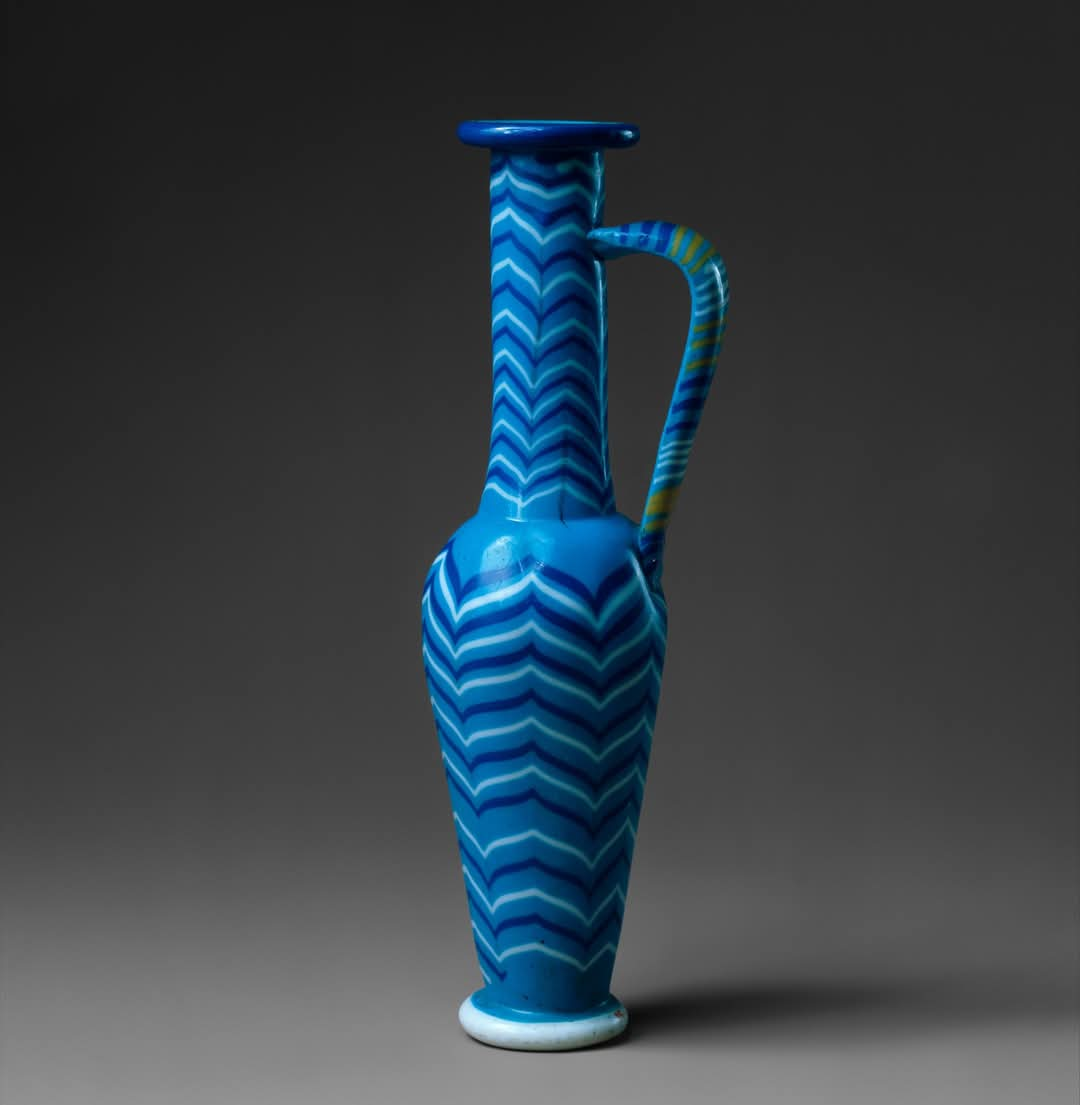
A Spindle bottle with handle...
This object, which is made of glass, dates to the reign of King Akhenaten during the 18th Dynasty.
The flask was core-formed and finished by hand, with the strap handle applied separately. The elongated, ovoid body and slender neck were decorated with finely executed zigzags of blue and white glass.
This "feathered" decoration was achieved by winding thin colored glass rods around the vessel and pressing them onto its surface while it was still soft, and then drawing the rods up or down with a metal instrument.
The handle is embellished with repeating bands of blue, yellow, and white.
This piece (26.7.1176), which is 17.5 centimeters in height, is now in the Metropolitan Museum of Art, New York 🇺🇸
#archaeohistories
The personality of David the Builder (David IV of Georgia) will remain misunderstood unless we take into account the role of one of his Armenian teachers...
The greatest intellectual and pedagogue of the 12th Century Caucasus — a Armenian philosopher, mathematician, geometer, musician/poet, astronomer, and grammarian (a master of every subject taught at the Gelati Academy) — Hovhannes Imastaser, played a crucial role in shaping David’s intellectual policy.
Imastaser was the author of original mathematical and philosophical treatises and a translator of works by Aristotle and Euclid. His philosophical credo is well captured in the following phrase:
"No thought can be considered credible and acceptable without experiment; only experiment brings clarity."
According to Armenian sources, David the Builder loved his Armenian teacher dearly:
"He would bow his noble head before him and receive his blessing. He would sit beside him and embrace his neck. But the old man would say: 'I am worn out, and the scent of my old age clings to me; go away, lest you suffer harm.' Yet the king would kiss him and say: 'Let me never be deprived of this scent, my dear father.' And he granted him a village near the monastery for his service. When the king blessed him, laying his hand upon his head, he would say: 'I have found David, my servant, and anointed him with sacred oil' (and so on, up to the tenth verse). The king rejoiced and praised the excellent translations made by the Armenians. And indeed, we have seen the words of the Psalms fulfilled concerning the king; many of them came true for him."
This extraordinary text stands out in the history of pedagogy worldwide:
David deeply loved his Armenian teacher, embraced and caressed him, praised his Armenian translations. It is evident that David was introduced to Aristotle and Euclid precisely through Hovhannes.
Some superficial or tendentious observers might dismiss the beautiful account of the bond between Hovhannes and David as merely a charming Armenian legend. However, one crucial point allows us to affirm that the depiction presented here reflects full historical truth:
David the Builder’s favorite philosopher and theologian was Gregory of Nyssa, one of the leading figures of rational, argument-driven theology — exactly the type of intellectual approach David valued.
In 12th Century Caucasus, the prime representative of such a method was indeed the Armenian Hovhannes Imastaser. Thus, it is perfectly understandable that he became one of David’s most beloved teachers. The elegance and appeal of Imastaser’s style must also have played a role — his original philosophical poem, "Ban Imastutian" ("The Word of Wisdom"), is structured as a dialogue between the author and a little bird.
David’s acceptance of his Armenian teacher’s critical method, emphasizing the experimental verification of knowledge, is clearly reflected in his skeptical attitude toward the legend of Christ’s Robe kept at Svetitskhoveli Cathedral.
David declared:
"How can I know what is truly inside that vessel? And why should I worship it?"
(The Inquiry into the Robe of Christ and the Living Pillar)
In general, David was characterized by special love and affectionate care toward cultural figures. According to Al-Jawzi, David established special centers for Muslim poets and Sufis and frequently hosted them at grand receptions and gatherings.
Based on the Georgian historian Beka Chichinadze
#drthehistories