Empty Desks: Chronic Absenteeism persists as system-wide problem in New Brunswick. Missing 18 days a year (10 per cent of classes) is a habit for 1 out of 3 students, six years after the pandemic #NBed#NBpoli#cdned
Scientists have identified a reversal of the long-standing Flynn effect—the roughly 200-year trend of rising average intelligence (measured via IQ and cognitive tests) across generations.
For the first time in modern recorded history, Generation Z (born roughly 1997–2012) shows lower performance than previous generations in key cognitive domains, including attention, memory, literacy, numeracy, executive function, problem-solving, and general IQ—despite spending more years in formal education than ever before.
Neuroscientist and educator Dr. Jared Cooney Horvath, PhD, MEd, testified before the U.S. Senate Committee on Commerce, Science, and Transportation on January 15, 2026, highlighting this shift. In his written testimony, he stated that cognitive development in children across much of the developed world has stalled or reversed over the past two decades, with declines evident in international assessments (e.g., PISA, TIMSS) and other large-scale data starting around the mid-2000s and accelerating post-2010.
Horvath attributes the primary driver not to reduced schooling, but to the widespread integration of digital screens and educational technology (EdTech) in classrooms. He argues that human brains evolved for deep, focused learning through face-to-face interaction and sustained attention, not fragmented skimming or constant task-switching encouraged by devices.
Key points from his testimony include:
- Teens now spend over half their waking hours on screens, with significant portions in school involving computers or tablets—often leading to off-task behavior and shallower processing.
- Evidence from meta-analyses and national/international studies shows a consistent pattern: higher classroom screen exposure correlates with weaker outcomes in reading, math, science, and higher-order reasoning.
- Digital tools may aid narrow, repetitive skill practice in controlled settings, but in core academic contexts, they tend to reduce depth of understanding, retention, and critical thinking.
Horvath describes this as a "structural mismatch" between human cognition and how digital platforms are designed (to capture and fragment attention), warning that unchecked EdTech adoption risks long-term harm to workforce skills, innovation, and societal reasoning.
[Horvath, J. C. (2026). Written testimony before the U.S. Senate Committee on Commerce, Science, and Transportation. U.S. Senate]
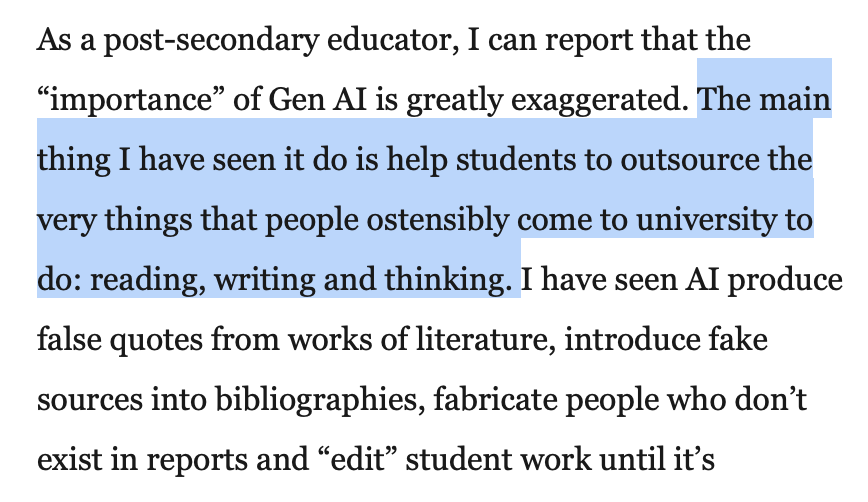
This is an excellent article written by a senior lecturer at Simon Fraser University, urging BC schools not to introduce generative AI in classrooms. https://t.co/9CbQG3eLDv
Only four times in NBA history has a player led the league in scoring, won the MVP, led the playoffs in scoring, won playoff MVP, and was 1st Team All-Defensive.
Career leaderboard:
Michael Jordan, 4
Everyone else who ever lived, 0
Banning social media for kids is necessary to change the culture around it.
Like how we banned smoking in restaurants. It changed our views and habits on smoking.
Culture is everything.
It is how we save our kids.
54% of U.S. adults read below a sixth-grade level. 21% are functionally illiterate, meaning they are “unable to perform basic reading tasks.” We have a literacy crisis in this nation. https://t.co/z9k8AIrJ2Z
If college students can't read/do math/etc., then professors need to fail them. Stop coddling this.
Stop devaluing standards and skills. Make the degrees mean something.
Schools need to put a stop to unlimited extensions on late work.
When students learn that deadlines are optional, they also learn that responsibility is optional.
"Covid kids" are heading for high school. Many "have trouble with basic skills, like manipulating fractions or automatically recalling times tables in math, or reading multisyllabic words in English."
https://t.co/Ofx4tw5Uft
Big Spenders: New Brunswick's Francophone School Districts spent a shocking $468,000 on international PD trips from 2022-2025. Incredible, for Canada's lowest performing districts in math, science & reading (PCAP 2023) #NBed#NBpoli https://t.co/lSwERKoGGy
The world has experienced the effects of addicting, algorithmically-driven social media on childhood. Parents want change, and policymakers in Canada, the UK and beyond are responding.
These governments are building on the successes we've seen around the globe, including Australia which has already protected 30% of its kids in just a few months, despite poor compliance from these companies. They are on round 1 of enforcement (on the companies), so social media use will decline with each round, with the biggest benefits seen for today's 8-12 year olds, who will be less likely to open accounts in the first place.
Just as we don't allow tobacco companies to sell their addicting products to children, we should not allow social media companies to recruit and retain child users. Any proposal that moves us closer to that goal deserves serious consideration.
https://t.co/qh4viuZjBj
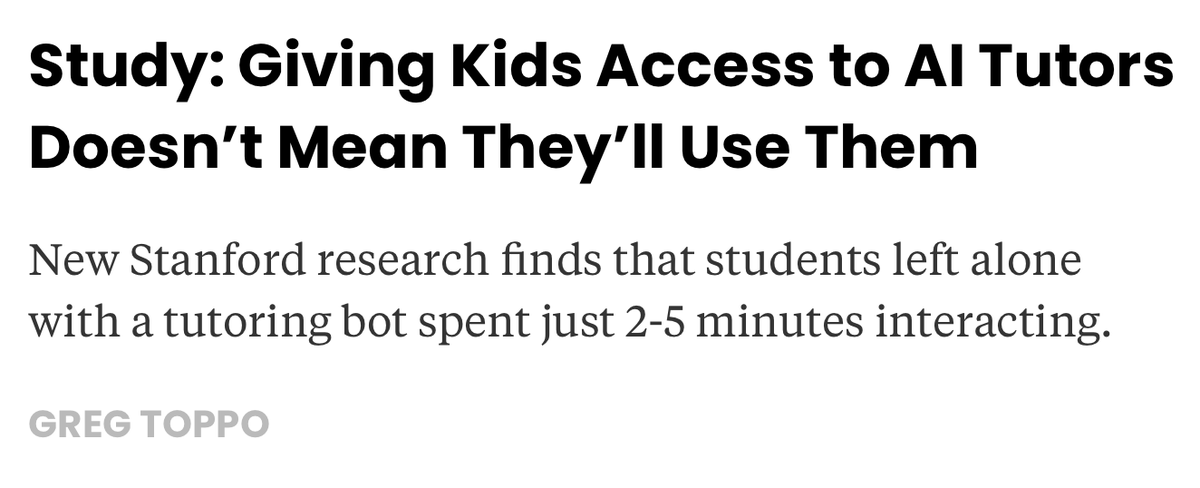
AI in schools is like fire: useful on the gas hob, dangerous in the curtains.
It can help students think harder, practise better and get better feedback. It can also bypass thinking entirely and undermine motivation .
The question isn’t whether AI belongs in education but whether it can be harnessed to support what we value.
https://t.co/QIjqDGZ9sb




![Rainmaker1973's tweet photo. Scientists have identified a reversal of the long-standing Flynn effect—the roughly 200-year trend of rising average intelligence (measured via IQ and cognitive tests) across generations.
For the first time in modern recorded history, Generation Z (born roughly 1997–2012) shows lower performance than previous generations in key cognitive domains, including attention, memory, literacy, numeracy, executive function, problem-solving, and general IQ—despite spending more years in formal education than ever before.
Neuroscientist and educator Dr. Jared Cooney Horvath, PhD, MEd, testified before the U.S. Senate Committee on Commerce, Science, and Transportation on January 15, 2026, highlighting this shift. In his written testimony, he stated that cognitive development in children across much of the developed world has stalled or reversed over the past two decades, with declines evident in international assessments (e.g., PISA, TIMSS) and other large-scale data starting around the mid-2000s and accelerating post-2010.
Horvath attributes the primary driver not to reduced schooling, but to the widespread integration of digital screens and educational technology (EdTech) in classrooms. He argues that human brains evolved for deep, focused learning through face-to-face interaction and sustained attention, not fragmented skimming or constant task-switching encouraged by devices.
Key points from his testimony include:
- Teens now spend over half their waking hours on screens, with significant portions in school involving computers or tablets—often leading to off-task behavior and shallower processing.
- Evidence from meta-analyses and national/international studies shows a consistent pattern: higher classroom screen exposure correlates with weaker outcomes in reading, math, science, and higher-order reasoning.
- Digital tools may aid narrow, repetitive skill practice in controlled settings, but in core academic contexts, they tend to reduce depth of understanding, retention, and critical thinking.
Horvath describes this as a "structural mismatch" between human cognition and how digital platforms are designed (to capture and fragment attention), warning that unchecked EdTech adoption risks long-term harm to workforce skills, innovation, and societal reasoning.
[Horvath, J. C. (2026). Written testimony before the U.S. Senate Committee on Commerce, Science, and Transportation. U.S. Senate]](https://pbs.twimg.com/media/HLLnJasWIAAXKMy.jpg)