𝐓𝐇𝐄 𝐎𝐑𝐆𝐀𝐍𝐈𝐙𝐀𝐓𝐈𝐎𝐍𝐀𝐋 𝐒𝐓𝐑𝐔𝐂𝐓𝐔𝐑𝐄 𝐎𝐅 𝐓𝐇𝐄 𝐒𝐂𝐇𝐔𝐓𝐙𝐒𝐓𝐀𝐅𝐅𝐄𝐋 𝐀𝐍𝐃 𝐓𝐇𝐄 𝐒𝐈𝐂𝐇𝐄𝐑𝐇𝐄𝐈𝐓𝐒𝐃𝐈𝐄𝐍𝐒𝐓
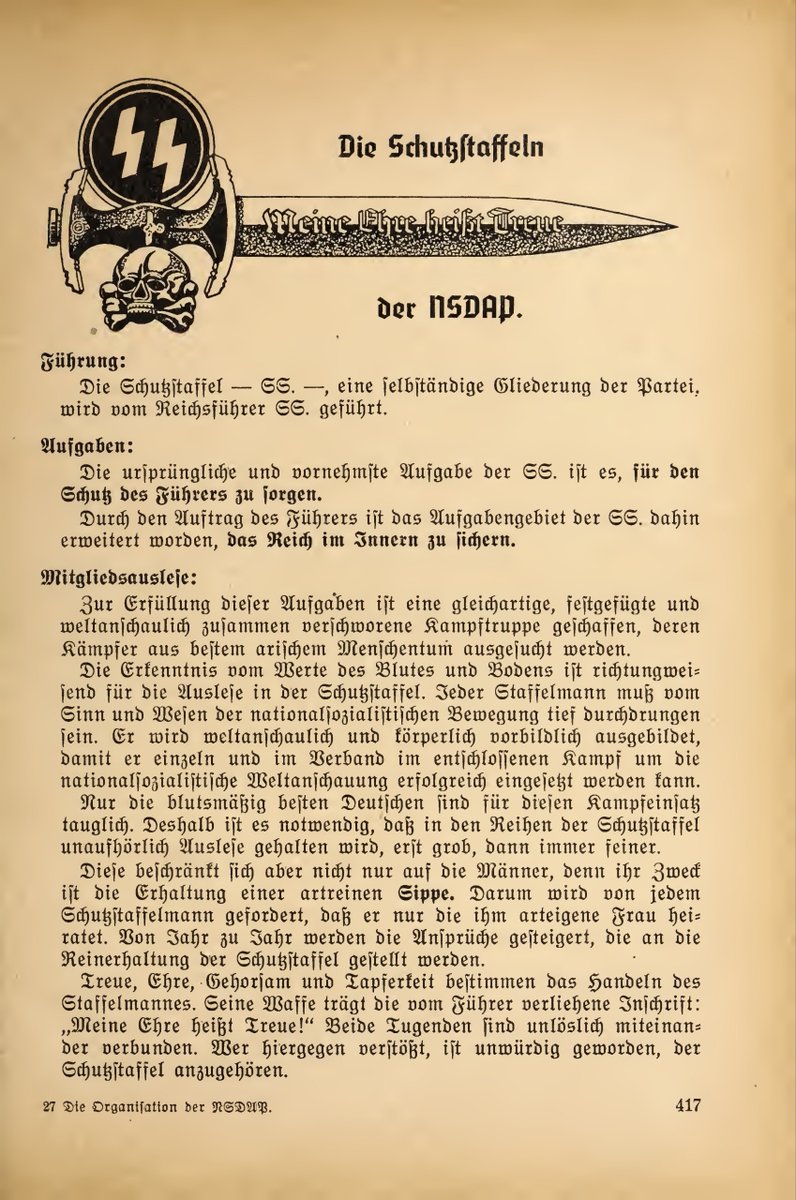
The Schutzstaffel (SS), or Protection Squadron, was one of the principal organizations of National Socialist Germany. Originally established in 1925 as a protective formation within the NSDAP, it developed under 𝙍𝙚𝙞𝙘𝙝𝙨𝙛𝙪𝙝𝙧𝙚𝙧 𝙎𝙎 Heinrich Himmler into a large, centralized organization encompassing military formations, intelligence services, police institutions, racial and settlement offices, economic administrations, and outer party administrations.
Between 1933 and 1945, the SS underwent several reorganizations. Its organizational structure was not entirely uniform: certain departments belonged directly to the SS leadership, others operated as state institutions under SS commanders, and still others were military formations with their own command structures.
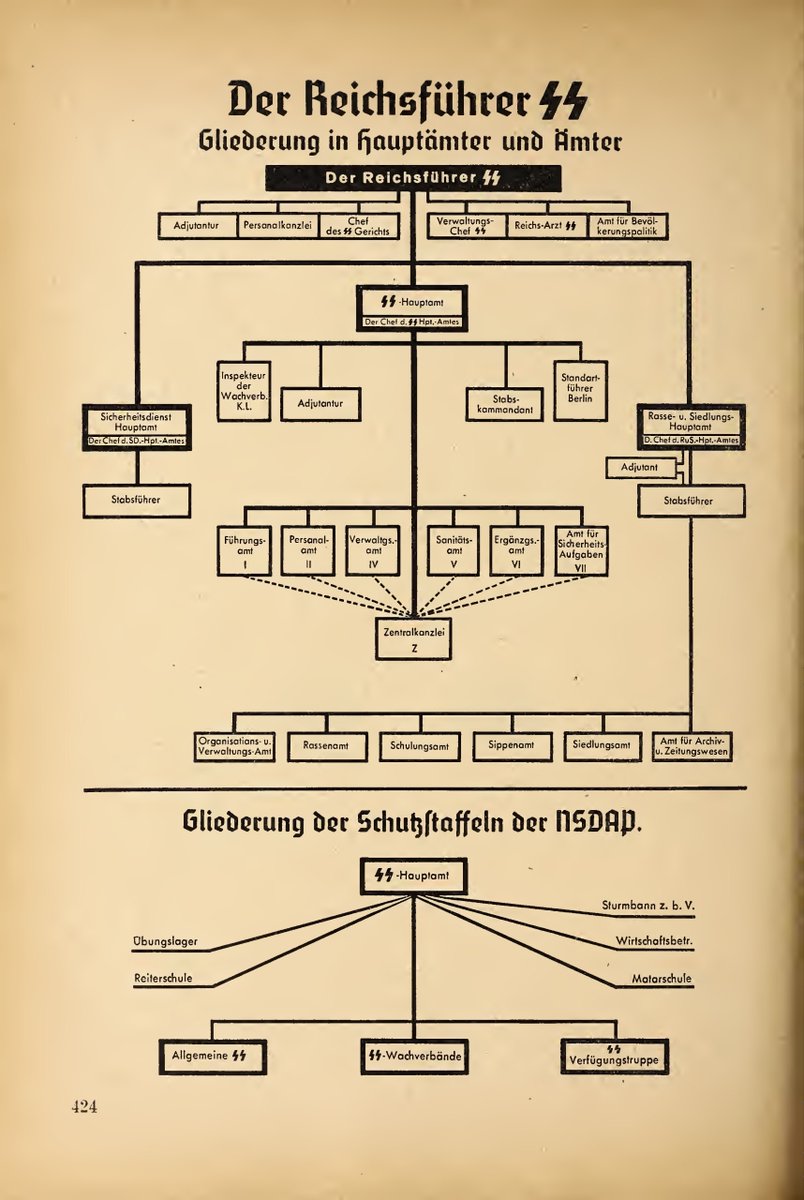
The following article will demonstrate the organizational structure of the Schutzstaffel and the various bodies under the organization.
𝙎𝙐𝙋𝙍𝙀𝙈𝙀 𝙇𝙀𝘼𝘿𝙀𝙍𝙎𝙃𝙄𝙋 & 𝘾𝙀𝙉𝙏𝙍𝘼𝙇 𝘾𝙊𝙈𝙈𝘼𝙉𝘿
--
𝙍𝙚𝙞𝙘𝙝𝙨𝙛ü𝙝𝙧𝙚𝙧-𝙎𝙎 - 𝙍𝙚𝙞𝙘𝙝 𝙇𝙚𝙖𝙙𝙚𝙧 𝙤𝙛 𝙩𝙝𝙚 𝙎𝙎
The Reichsführer-SS was the supreme command position within the Schutzstaffel and exercised authority over its organizational, administrative, ideological, military, and security institutions. The position was held by Heinrich Himmler from January 1929 until the collapse of the German Reich in 1945. Following the NSDAP seizure of power, Himmler progressively expanded his authority, eventually obtaining control over the German police system as well. The Reichsführer-SS supervised the various SS main offices, appointed senior SS officials, issued organizational directives, controlled promotions and personnel matters, and exercised considerable influence over the Waffen-SS administration, intelligence services, and police organizations. Although these institutions possessed their own commanders and administrative chains of command, they ultimately formed part of the extensive system of authority accumulated by Himmler.
𝙋𝙚𝙧𝙨ö𝙣𝙡𝙞𝙘𝙝𝙚𝙧 𝙎𝙩𝙖𝙗 𝙍𝙚𝙞𝙘𝙝𝙨𝙛ü𝙝𝙧𝙚𝙧-𝙎𝙎 - 𝙋𝙚𝙧𝙨𝙤𝙣𝙖𝙡 𝙎𝙩𝙖𝙛𝙛 𝙤𝙛 𝙩𝙝𝙚 𝙍𝙚𝙞𝙘𝙝 𝙇𝙚𝙖𝙙𝙚𝙧 𝙤𝙛 𝙩𝙝𝙚 𝙎𝙎
The Personal Staff of the Reich Leader of the SS served as Himmler's immediate administrative and coordinating headquarters. Headed by SS-Obergruppenführer Karl Wolff for much of its existence, this office handled correspondence, confidential instructions, personal appointments, special assignments, and communications between Himmler and the numerous SS institutions. It also coordinated matters that crossed the jurisdiction of multiple SS main offices and maintained contact with senior officials in the German government, NSDAP, and military establishment.
𝙎𝙎-𝙃𝙖𝙪𝙥𝙩𝙖𝙢𝙩 - 𝙎𝙎 𝙈𝙖𝙞𝙣 𝙊𝙛𝙛𝙞𝙘𝙚
The SS Main Office was one of the principal administrative headquarters of the organization. It was responsible for recruitment, personnel acquisition, membership administration, general organizational development, training, and the expansion of SS formations. It also supervised various recruitment and replacement activities and maintained connections with regional SS commands. Its responsibilities changed as the SS expanded and additional main offices were established. One of its important functions was ensuring that the Allgemeine SS and other SS formations received personnel and organizational support. Its leadership changed during the period, with Gottlob Berger becoming one of its most important chiefs from 1939 onward.
𝙎𝙎-𝙁ü𝙝𝙧𝙪𝙣𝙜𝙨𝙝𝙖𝙪𝙥𝙩𝙖𝙢𝙩 - 𝙎𝙎 𝙇𝙚𝙖𝙙𝙚𝙧𝙨𝙝𝙞𝙥 𝙈𝙖𝙞𝙣 𝙊𝙛𝙛𝙞𝙘𝙚
The SS Leadership Main Office was established in 1940 and became particularly important in the military administration of the SS. Headed by SS-Obergruppenführer Hans Jüttner, it was responsible for the organization, training, operational administration, and logistical coordination of the Waffen-SS. Its subordinate command offices handled the formation of military units, troop administration, military instruction, equipment requirements, and personnel assignments. It also maintained organizational connections with the Allgemeine SS and other armed SS formations. The SS-Führungshauptamt was particularly important because it provided the administrative and military framework through which the Waffen-SS developed into a substantial armed force operating alongside the German Army.
𝙎𝙎-𝙋𝙚𝙧𝙨𝙤𝙣𝙖𝙡𝙝𝙖𝙪𝙥𝙩𝙖𝙢𝙩 - 𝙎𝙎 𝙋𝙚𝙧𝙨𝙤𝙣𝙣𝙚𝙡 𝙈𝙖𝙞𝙣 𝙊𝙛𝙛𝙞𝙘𝙚
The SS Personnel Main Office administered personnel matters throughout the organization. It maintained official service records, oversaw appointments, promotions, transfers, dismissals, and personnel classifications, and administered the careers of SS officers. Its jurisdiction extended across the Allgemeine SS, Waffen-SS, and other SS institutions. The office was particularly important in maintaining the extensive rank structure and determining the official standing of SS personnel. Walter Schmitt and subsequently Maximilian von Herff were among its senior leaders.
𝙃𝙖𝙪𝙥𝙩𝙖𝙢𝙩 𝙎𝙎-𝙂𝙚𝙧𝙞𝙘𝙝𝙩 - 𝙎𝙎 𝘾𝙤𝙪𝙧𝙩 𝙈𝙖𝙞𝙣 𝙊𝙛𝙛𝙞𝙘𝙚
The SS Court Main Office administered the SS judicial and disciplinary system. Headed by SS-Obergruppenführer Franz Breithaupt, it supervised SS courts, investigated disciplinary violations, processed legal complaints, and administered judicial proceedings involving members of the SS and police. The organization maintained its own judicial institutions and disciplinary procedures, separate from many ordinary civilian judicial channels. Its jurisdiction covered matters such as violations of SS regulations, military discipline, internal conduct, and criminal allegations involving SS personnel.
--
𝙎𝙎 𝘽𝙍𝘼𝙉𝘾𝙃𝙀𝙎
--
𝘼𝙡𝙡𝙜𝙚𝙢𝙚𝙞𝙣𝙚 𝙎𝙎 - 𝙂𝙚𝙣𝙚𝙧𝙖𝙡 𝙎𝙎
The Allgemeine SS was the principal non-frontline organizational branch of the Schutzstaffel. It encompassed the general membership and administrative formations of the organization, including its regional, district, local, and specialist units. Its responsibilities included internal administration, recruitment, ideological instruction, political organization, ceremonial activities, and the provision of personnel for various SS institutions. Its organizational structure was based on territorial commands, including Oberabschnitte (Main Districts), Abschnitte (Districts), Standarten (Regiments), Sturmbanne (Battalions), Stürme (Companies), and smaller units. Unlike the Waffen-SS, the Allgemeine SS was not primarily organized as a conventional field army. It maintained the wider organizational framework through which the SS operated throughout Germany and, subsequently, occupied territories. Heinrich Himmler was its supreme leader, with regional SS commanders exercising authority over their respective territories.
𝙒𝙖𝙛𝙛𝙚𝙣-𝙎𝙎 - 𝘼𝙧𝙢𝙚𝙙 𝙎𝙎
The Waffen-SS was the armed military branch of the SS, developing from the earlier SS-Verfügungstruppe (SS Special Purpose Troops) and armed SS formations. It became a major military organization during the Second World War, eventually comprising numerous divisions, brigades, regiments, and specialized combat formations. Its responsibilities included frontline military operations, infantry warfare, armored operations, artillery, reconnaissance, engineering, communications, and military logistics. The Waffen-SS possessed its own recruitment, training, and command institutions, although its formations frequently operated under Wehrmacht operational command. Heinrich Himmler exercised overall authority over the Waffen-SS, while Hans Jüttner's SS-Führungshauptamt administered much of its organizational structure. Important military commanders included Paul Hausser, Felix Steiner, and Sepp Dietrich.
𝙎𝙎-𝙏𝙤𝙩𝙚𝙣𝙠𝙤𝙥𝙛𝙫𝙚𝙧𝙗ä𝙣𝙙𝙚 - 𝙎𝙎 𝘿𝙚𝙖𝙩𝙝'𝙨-𝙃𝙚𝙖𝙙 𝙐𝙣𝙞𝙩𝙨
The SS-Totenkopfverbände constituted the SS formations responsible for guarding and administering the concentration-camp system. They developed from the guard units established at early concentration camps, particularly Dachau. Their organizational leadership was closely associated with Theodor Eicke, who established the standardized camp administration and guard procedures. Eicke subsequently served as Inspector of Concentration Camps before being succeeded by Richard Glücks in 1939. These formations provided armed guards, camp personnel, administrative staff, and supervisory officers. Their responsibilities included perimeter security, prisoner surveillance, labor supervision, and the enforcement of camp regulations. As the concentration-camp system expanded, their personnel and administrative structures became increasingly integrated with the SS Economic-Administrative Main Office.
--
𝙒𝘼𝙁𝙁𝙀𝙉-𝙎𝙎 𝘿𝙄𝙑𝙄𝙎𝙄𝙊𝙉𝙎
--
1. SS-Panzer-Division Leibstandarte SS Adolf Hitler
2. SS-Panzer-Division Das Reich
3. SS-Panzer-Division „Totenkopf
4. SS-Polizei-Panzergrenadier-Division
5. SS-Panzer-Division Wiking
6. SS-Gebirgs-Division Nord
7. SS-Freiwilligen-Gebirgs-Division Prinz Eugen
8. SS-Kavallerie-Division Florian Geyer
9. SS-Panzer-Division Hohenstaufen
10. SS-Panzer-Division Frundsberg
11. SS-Freiwilligen-Panzergrenadier-Division Nordland
12. SS-Panzer-Division Hitlerjugend
13. Waffen-Gebirgs-Division der SS Handschar
14. Waffen-Grenadier-Division der SS (galizische Nr. 1)
(Galician No. 1).
15. Waffen-Grenadier-Division der SS (lettische Nr. 1)
(Latvian No. 1).
16. SS-Panzergrenadier-Division Reichsführer-SS
17. SS-Panzergrenadier-Division Götz von Berlichingen
18. SS-Freiwilligen-Panzergrenadier-Division Horst Wessel
19. Waffen-Grenadier-Division der SS (lettische Nr. 2)
(Latvian No. 2).
20. Waffen-Grenadier-Division der SS (estnische Nr. 1)
(Estonian No. 1).
21. Waffen-Gebirgs-Division der SS Skanderbeg (albanische Nr. 1)
(1st Albanian)
22. SS-Freiwilligen-Kavallerie-Division Maria Theresia
23. Waffen-Gebirgs-Division der SS Kama (kroatische Nr. 2)
(2nd Croatian)
24. Waffen-Gebirgs-(Karstjäger-) Division der SS
25. Waffen-Grenadier-Division der SS Hunyadi (ungarische Nr. 1)
(1st Hungarian).
26. Waffen-Grenadier-Division der SS (ungarische Nr. 2)
(2nd Hungarian)
27. SS-Freiwilligen-Grenadier-Division Langemarck (flämische Nr. 1)
(1st Flemish)
28. SS-Freiwilligen-Grenadier-Division Wallonien
29. Waffen-Grenadier-Division der SS (italienische Nr. 1)
(1st Italian).
30. Waffen-Grenadier-Division der SS (weißruthenische Nr. 1)
(1st Belarusian).
31. SS-Freiwilligen-Grenadier-Division
32. SS-Freiwilligen-Grenadier-Division of 30. Januar
33. Waffen-Grenadier-Division der SS Charlemagne (französische Nr. 1)
(1st French)
34. SS-Freiwilligen-Grenadier-Division Landstorm Nederland
35. SS-und Polizei-Grenadier-Division
36. Waffen-Grenadier-Division der SS
37. SS-Freiwilligen-Kavallerie-Division Lützow
38. SS-Grenadier-Division Nibelungen
(Note)
Not all 38 divisions were fully established. Many of the later formations existed primarily on paper, were incompletely organized, or were disbanded shortly after formation. Some divisional numbers were reused. The 23rd and 29th designations, for example, were assigned to different formations at different times. The 24th Division is commonly associated with the Karstjäger formation, which initially operated as a smaller mountain and specialized unit. The 29th Division initially had a Russian designation before the number was reassigned to the Italian formation. The 33rd designation was also used for a Hungarian Waffen cavalry formation before being assigned to Charlemagne.
--
𝙊𝙍𝙂𝘼𝙉𝙄𝙕𝘼𝙏𝙄𝙊𝙉 𝙊𝙁 𝙏𝙃𝙀 𝙎𝙄𝘾𝙃𝙀𝙍𝙃𝙀𝙄𝙏𝙎𝘿𝙄𝙀𝙉𝙎𝙏
--
The Sicherheitsdienst, commonly abbreviated SD, was the intelligence and political-information service of the SS. Established in 1931 under the leadership of Reinhard Heydrich, it was initially responsible for gathering intelligence concerning political opponents, rival organizations, developments within the NSDAP, and perceived threats to the National Socialist movement. Following the establishment of the German Reich under National Socialist rule, the SD expanded its responsibilities to include domestic and foreign intelligence collection, political assessments, surveillance, and the analysis of social and political developments. It was divided into two principal operational areas: the SD-Inland (Domestic Intelligence) and SD-Ausland (Foreign Intelligence). The organization maintained regional intelligence offices and employed informants and intelligence personnel. Reinhard Heydrich was its principal architect and leader until 1942, followed by Ernst Kaltenbrunner's leadership of the RSHA from 1943 until Germany's defeat
𝙎𝘿-𝙄𝙣𝙡𝙖𝙣𝙙 - 𝘿𝙤𝙢𝙚𝙨𝙩𝙞𝙘 𝙄𝙣𝙩𝙚𝙡𝙡𝙞𝙜𝙚𝙣𝙘𝙚 𝙎𝙚𝙧𝙫𝙞𝙘𝙚
The SD-Inland was responsible for intelligence collection and political assessment within Germany. Its personnel monitored developments in political organizations, public opinion, religious institutions, economic conditions, cultural life, and other areas considered relevant to the security and stability of the National Socialist state. Its regional offices collected reports and forwarded them to the central SD administration in Berlin. The information gathered was consolidated into internal reports, including assessments of public attitudes and political developments. The SD-Inland was subsequently incorporated into RSHA Office III, which continued domestic intelligence operations under the leadership of Otto Ohlendorf.
𝙎𝘿-𝘼𝙪𝙨𝙡𝙖𝙣𝙙 - 𝙁𝙤𝙧𝙚𝙞𝙜𝙣 𝙄𝙣𝙩𝙚𝙡𝙡𝙞𝙜𝙚𝙣𝙘𝙚 𝙎𝙚𝙧𝙫𝙞𝙘𝙚
The SD-Ausland was responsible for intelligence collection and analysis outside Germany. Its responsibilities included monitoring foreign governments, political movements, diplomatic developments, international organizations, and military and economic conditions abroad. It maintained intelligence contacts and operated through personnel and networks in foreign countries, including territories occupied during the war. Its organizational purpose was to provide the SS leadership with information concerning international developments and foreign threats. After the establishment of the RSHA, the SD-Ausland became Office VI, Foreign Intelligence. Walter Schellenberg became its principal wartime leader and directed its intelligence operations during the later years of the Reich.
𝙍𝙚𝙞𝙘𝙝𝙨𝙨𝙞𝙘𝙝𝙚𝙧𝙝𝙚𝙞𝙩𝙨𝙝𝙖𝙪𝙥𝙩𝙖𝙢𝙩 - 𝙍𝙚𝙞𝙘𝙝 𝙎𝙚𝙘𝙪𝙧𝙞𝙩𝙮 𝙈𝙖𝙞𝙣 𝙊𝙛𝙛𝙞𝙘𝙚 (𝙍𝙎𝙃𝘼)
The Reich Security Main Office was established on 27 September 1939 by Heinrich Himmler, bringing together the Security Police (Sicherheitspolizei) and the SS Security Service (SD) under one central administrative institution. It became the principal security and intelligence headquarters of the National Socialist German Reich. The RSHA was initially headed by Reinhard Heydrich, who was succeeded temporarily by Himmler after his death in 1942, and subsequently by Ernst Kaltenbrunner in January 1943. Its responsibilities included political policing, domestic intelligence, foreign intelligence, criminal investigations, ideological research, surveillance, and the coordination of security operations throughout Germany and occupied Europe. It was divided into seven principal offices, each with its own specialized administrative responsibilities, the seven offices were:
(Office 1)
Verwaltung und Recht - Administration and Law
led by Bruno Streckenbach
(Office 2)
Organisation, Verwaltung und Recht - Organization, Administration and Law
led by Werner Best
(Office 3)
SD-Inland - Domestic Intelligence
led by Otto Ohlendorf
(Office 4)
Gestapo - Secret State Police
led by Heinrich Müller
(Office 5)
Kriminalpolizei (Kripo) - Criminal Police
led by Arthur Nebe and later Friedrich Panzinger
(Office 6)
SD-Ausland - Foreign Intelligence
led by Walter Schellenberg
(Office 7)
Weltanschauliche Forschung und Auswertung - Ideological Research and Evaluation
led by Franz Six
𝙂𝙚𝙝𝙚𝙞𝙢𝙚 𝙎𝙩𝙖𝙖𝙩𝙨𝙥𝙤𝙡𝙞𝙯𝙚𝙞 - 𝙎𝙚𝙘𝙧𝙚𝙩 𝙎𝙩𝙖𝙩𝙚 𝙋𝙤𝙡𝙞𝙘𝙚 (𝙂𝙚𝙨𝙩𝙖𝙥𝙤)
The Gestapo was the political police organization of National Socialist Germany. It originated in Prussia in 1933 and was subsequently centralized under Heinrich Himmler and Reinhard Heydrich. Its principal responsibilities included investigating political opposition, conducting surveillance, interrogating suspects, arresting individuals, and enforcing the State's political and racial policies. It operated through central administrative offices and regional Gestapo headquarters, known as Staatspolizeistellen and Staatspolizeileitstellen. The Gestapo was incorporated into the Security Police and subsequently became Amt IV of the RSHA. Heinrich Müller served as its principal chief from 1939 until 1945. Although it was closely integrated with the SS, the Gestapo was formally a state police institution rather than simply another military branch of the SS.
𝙆𝙧𝙞𝙢𝙞𝙣𝙖𝙡𝙥𝙤𝙡𝙞𝙯𝙚𝙞 - 𝘾𝙧𝙞𝙢𝙞𝙣𝙖𝙡 𝙋𝙤𝙡𝙞𝙘𝙚 (𝙆𝙧𝙞𝙥𝙤)
The Kriminalpolizei was the criminal investigation branch of the German police system. It was responsible for investigating offenses classified as ordinary criminal activity, including theft, fraud, homicide, and other criminal offenses. Under the German Reich however, its responsibilities expanded to include policing based on the State's racial and social classifications. It became part of the Security Police in 1936 and was incorporated into the RSHA as Amt V in 1939. Its chief wartime responsibilities included criminal investigations, forensic work, surveillance, and the administration of criminal-police investigations. Arthur Nebe was one of its principal leaders before his dismissal in 1944, after which Friedrich Panzinger assumed leadership.
𝙎𝙞𝙘𝙝𝙚𝙧𝙝𝙚𝙞𝙩𝙨𝙥𝙤𝙡𝙞𝙯𝙚𝙞 - 𝙎𝙚𝙘𝙪𝙧𝙞𝙩𝙮 𝙋𝙤𝙡𝙞𝙘𝙚 (𝙎𝙞𝙋𝙤)
The Sicherheitspolizei was the centralized security police organization established in 1936 under Reinhard Heydrich. It combined two distinct police institutions: the Gestapo and the Kriminalpolizei. Its purpose was to consolidate political and criminal police authority under a single leadership structure. The SiPo was responsible for investigating political offenses, criminal activity, and matters designated as threats to the State. It was not identical to the SS, although its senior leadership was increasingly composed of SS members. In September 1939, its administrative structure was combined with that of the SD within the RSHA.
𝙀𝙞𝙣𝙨𝙖𝙩𝙯𝙜𝙧𝙪𝙥𝙥𝙚𝙣 𝙙𝙚𝙧 𝙎𝙞𝙘𝙝𝙚𝙧𝙝𝙚𝙞𝙩𝙨𝙥𝙤𝙡𝙞𝙯𝙚𝙞 𝙪𝙣𝙙 𝙙𝙚𝙨 𝙎𝘿 - 𝙊𝙥𝙚𝙧𝙖𝙩𝙞𝙤𝙣𝙖𝙡 𝙂𝙧𝙤𝙪𝙥𝙨 𝙤𝙛 𝙩𝙝𝙚 𝙎𝙚𝙘𝙪𝙧𝙞𝙩𝙮 𝙋𝙤𝙡𝙞𝙘𝙚 𝙖𝙣𝙙 𝙎𝘿
The Einsatzgruppen were mobile operational formations organized by the Security Police and SD. They were deployed during the war against Poland in 1939 and subsequently on a much larger scale during the war against the Soviet Union in 1941. Their official security responsibilities included identifying and eliminating threats behind the military front, gathering intelligence, and conducting security operations in occupied territories. Their commanders included Arthur Nebe, Otto Ohlendorf, Franz Walter Stahlecker, and other senior SS and police officers. Their operational activities were coordinated through the RSHA and regional SS and Police Leaders.
𝙊𝙧𝙙𝙣𝙪𝙣𝙜𝙨𝙥𝙤𝙡𝙞𝙯𝙚𝙞 - 𝙊𝙧𝙙𝙚𝙧 𝙋𝙤𝙡𝙞𝙘𝙚 (𝙊𝙧𝙥𝙤)
The Ordnungspolizei was the uniformed state police organization responsible for public-order policing, traffic regulation, municipal policing, and general law enforcement functions. It was established in its centralized form under Heinrich Himmler and was headed for much of its existence by Kurt Daluege, who served as Chief of the Ordnungspolizei. Its principal components included the Schutzpolizei (Protective Police), Gendarmerie (Rural Police), and Gemeindepolizei (Municipal Police). It also contained police battalions deployed in occupied territories and during military operations. Although the Ordnungspolizei was not formally identical to the SS, its senior command was closely integrated with Himmler's SS and police leadership system.
--
𝘼𝘿𝙈𝙄𝙉𝙎𝙏𝙍𝘼𝙏𝙄𝙑𝙀 𝙊𝙁𝙁𝙄𝘾𝙀𝙎 𝙊𝙁 𝙏𝙃𝙀 𝙎𝙎
--
𝙎𝙎-𝙒𝙞𝙧𝙩𝙨𝙘𝙝𝙖𝙛𝙩𝙨-𝙑𝙚𝙧𝙬𝙖𝙡𝙩𝙪𝙣𝙜𝙨𝙝𝙖𝙪𝙥𝙩𝙖𝙢𝙩 - 𝙎𝙎 𝙀𝙘𝙤𝙣𝙤𝙢𝙞𝙘 𝙖𝙣𝙙 𝘼𝙙𝙢𝙞𝙣𝙞𝙨𝙩𝙧𝙖𝙩𝙞𝙫𝙚 𝙈𝙖𝙞𝙣 𝙊𝙛𝙛𝙞𝙘𝙚
The WVHA was established on 1 February 1942 under SS-Obergruppenführer Oswald Pohl. It was responsible for the financial, economic, construction, and administrative management of SS institutions. Its duties included managing SS finances, supplying military formations, supervising construction projects, administering SS-owned commercial enterprises, and overseeing the concentration-camp administration.
𝙍𝙖𝙨𝙨𝙚 𝙪𝙣𝙙 𝙎𝙞𝙚𝙙𝙡𝙪𝙣𝙜𝙨𝙝𝙖𝙪𝙥𝙩𝙖𝙢𝙩 - 𝙍𝙖𝙘𝙚 𝙖𝙣𝙙 𝙎𝙚𝙩𝙩𝙡𝙚𝙢𝙚𝙣𝙩 𝙈𝙖𝙞𝙣 𝙊𝙛𝙛𝙞𝙘𝙚
The RuSHA was responsible for the SS's racial selection, ancestry, marriage approval, and settlement policies. Originally established in 1931 as the Rasse- und Siedlungsamt, it developed into a main office of the SS. It administered ancestry documentation, examined applications for marriage permission from SS personnel, supervised racial selection procedures, and coordinated settlement policies. During the war, its responsibilities expanded to include racial assessments and population classification in occupied territories, as well as participation in Germanization and resettlement programs. Richard Walther Darré was an important early leader, followed by Günther Pancke and Otto Hofmann. Its functions reflected the racial ideology upon which the SS had been organized.
𝙎𝙎 𝙍𝙖𝙨𝙨𝙚 𝙪𝙣𝙙 𝙎𝙞𝙚𝙙𝙡𝙪𝙣𝙜𝙨𝙬𝙚𝙨𝙚𝙣 - 𝙎𝙎 𝙍𝙖𝙘𝙚 𝙖𝙣𝙙 𝙎𝙚𝙩𝙩𝙡𝙚𝙢𝙚𝙣𝙩 𝘼𝙙𝙢𝙞𝙣𝙞𝙨𝙩𝙧𝙖𝙩𝙞𝙤𝙣
The broader race and settlement administration encompassed the specialist offices and subordinate departments responsible for ancestry investigations, genealogical documentation, marriage applications, racial classifications, and settlement assessments. It provided the administrative mechanisms through which SS racial regulations were enforced. It also supplied assessments for personnel decisions and later participated in the classification of populations in occupied territories. Although the RuSHA was its central administrative institution, the wider system included regional offices and specialist personnel who conducted investigations and evaluations.
𝙎𝙎-𝙎𝙖𝙣𝙞𝙩ä𝙩𝙨𝙖𝙢𝙩 - 𝙎𝙎 𝙈𝙚𝙙𝙞𝙘𝙖𝙡 𝙊𝙛𝙛𝙞𝙘𝙚
The SS Medical Office coordinated medical services for SS personnel and maintained the medical administration of the organization. Its responsibilities included military medical services, examinations of recruits, medical personnel administration, health facilities, and coordination of medical support for SS formations. The SS also had a Reichsarzt-SS (Reich Physician of the SS), who held a senior medical supervisory position. Ernst-Robert Grawitz served as Reich Physician of the SS during the war. The medical system was not limited to one office: different SS branches maintained their own medical personnel and facilities.
𝙎𝙎-𝙎𝙘𝙝𝙪𝙡𝙪𝙣𝙜𝙨𝙖𝙢𝙩 - 𝙎𝙎 𝙏𝙧𝙖𝙞𝙣𝙞𝙣𝙜 𝙊𝙛𝙛𝙞𝙘𝙚
The SS Training Office was concerned with ideological, political, and organizational instruction for SS personnel. Its activities included the preparation of instructional materials, the organization of training courses, and the dissemination of SS doctrine and internal regulations. Training was also carried out by specialist schools, regional institutions, and the individual branches of the SS. It therefore functioned within a wider system of political and professional instruction rather than as the sole educational institution of the organization.
𝙎𝙎-𝙂𝙚𝙧𝙞𝙘𝙝𝙩𝙨𝙗𝙖𝙧𝙠𝙚𝙞𝙩 - 𝙎𝙎 𝙅𝙪𝙙𝙞𝙘𝙞𝙖𝙡 𝘼𝙙𝙢𝙞𝙣𝙞𝙨𝙩𝙧𝙖𝙩𝙞𝙤𝙣
The SS judicial system administered disciplinary proceedings, courts, and legal matters involving SS and police personnel. It operated through the Hauptamt SS-Gericht and its subordinate courts, including the Oberstes SS und Polizeigericht (Supreme SS and Police Court). Its responsibilities included military discipline, internal investigations, criminal proceedings, and the enforcement of SS regulations. Franz Breithaupt was the senior leader of the central judicial administration.
--
These were the primary and main acting bodies of the Schutzstaffel and the Sicherheitsdienst of the National Socialist German Worker's Party.
SOURCE:
https://t.co/VKpILZDBNe
Heinrich Ehrler – sein letzter überlieferter Funkspruch an Theodor Weißenberger (4. April 1945):
„Theo, ich habe keine Munition mehr. Ich ramme jetzt. Auf Wiedersehen, wir sehen uns in Walhalla.“
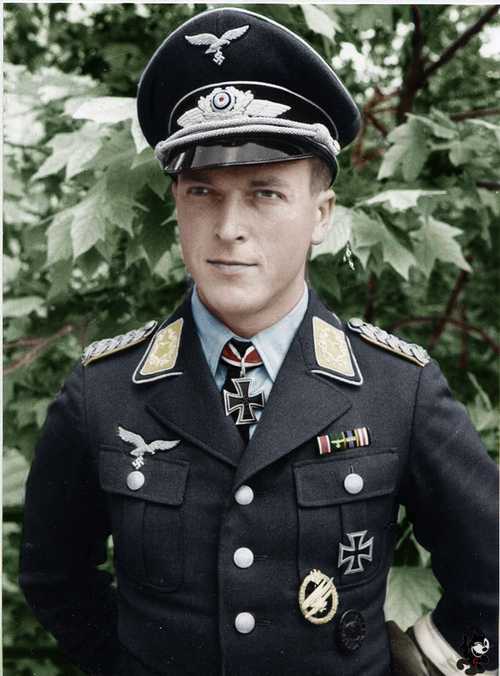
He led the most audacious special operation of the war's opening, landing gliders on the roof of a fortress thought to be impregnable and capturing it in minutes, and he went on fighting as an elite paratrooper from Belgium to Tunisia to the end. Rudolf Witzig wore the Knight's Cross of the Iron Cross, won in one of the most brilliant coups de main in military history.
Witzig was a Fallschirmjäger, a German paratrooper, and an engineer, and in May 1940, at the very start of the great German offensive in the west, he commanded one of the most daring operations ever attempted. The Belgian fortress of Eben-Emael was one of the strongest in the world, a massive modern fort guarding the vital bridges over the Albert Canal, bristling with guns, manned by a large garrison, considered all but impregnable to conventional assault. The Germans could not afford to let it hold up their advance.
The solution was Witzig's glider assault. A small force of German paratroop engineers, Witzig's among them, would land silently by glider directly on top of the fortress, on its great flat roof, achieving total surprise, and then knock out its guns and cupolas from above using a new weapon, the shaped-charge demolition. It was unprecedented, the first use of gliders to land assault troops in history. In the pre-dawn darkness the gliders cast off and swooped down silently onto the roof of Eben-Emael. Witzig's own glider was forced down early and he arrived late, but his men, with extraordinary skill and nerve, set about the fortress, placing their shaped charges on the gun cupolas and blasting them open, destroying the fort's armament and neutralizing the garrison from on top, a tiny force paralyzing a huge fortress. Eben-Emael fell with stunning speed, its guns silenced, its defenders overwhelmed, opening the way for the German advance.
It was a sensation, one of the most celebrated special operations of the war, and Witzig was awarded the Knight's Cross for it. He had proven what a small, elite, boldly led force could do against a position everyone thought unassailable, a lesson studied by special forces ever since.
Witzig went on fighting through the war as a paratrooper. He led his Fallschirmjäger in the hard campaigns that followed, including in Tunisia in 1943, where the German paratroopers fought as elite ground infantry in the mountains, a tough, skilled force that gave the Allies a hard time in the Tunisian hills. He fought on various fronts through to the end of the war, decorated further for his continued service, one of the most capable and renowned of the German airborne officers.
His name is bound above all to Eben-Emael, the glider assault on the fortress roof, one of those feats that passes into the textbooks of war, the small band of paratroop engineers who landed out of the dawn sky on top of the strongest fort in Belgium and took it in a matter of hours. Witzig, who led them, carried the Knight's Cross he won there through the rest of his fighting life.
🚨 Declan Rice: “Hopefully there's a new contract on the horizon soon”.
“I'm extremely lucky to be at a club like Arsenal, where the manager shows me so much trust and my teammates put so much energy and effort into me”.
🚨 Eric Garcia on Anthony Gordon learning Catalan:
“He’s taking Catalan lessons. In the dressing room, we try to make things easier for him and help him out with a few words.”
“He’s settled in really well. He’s a genuinely good guy, very humble and hard-working, and I think he’ll continue to contribute a lot.”