@OjiRe66585 Good to see the training console bought alongside the clinical one — that's the part that matters. Park et al. CRT (Korea NHIS): robotic vs open esophagectomy death HR 0.80, but the benefit concentrates in high-volume tertiary programmes. The box is not the programme.
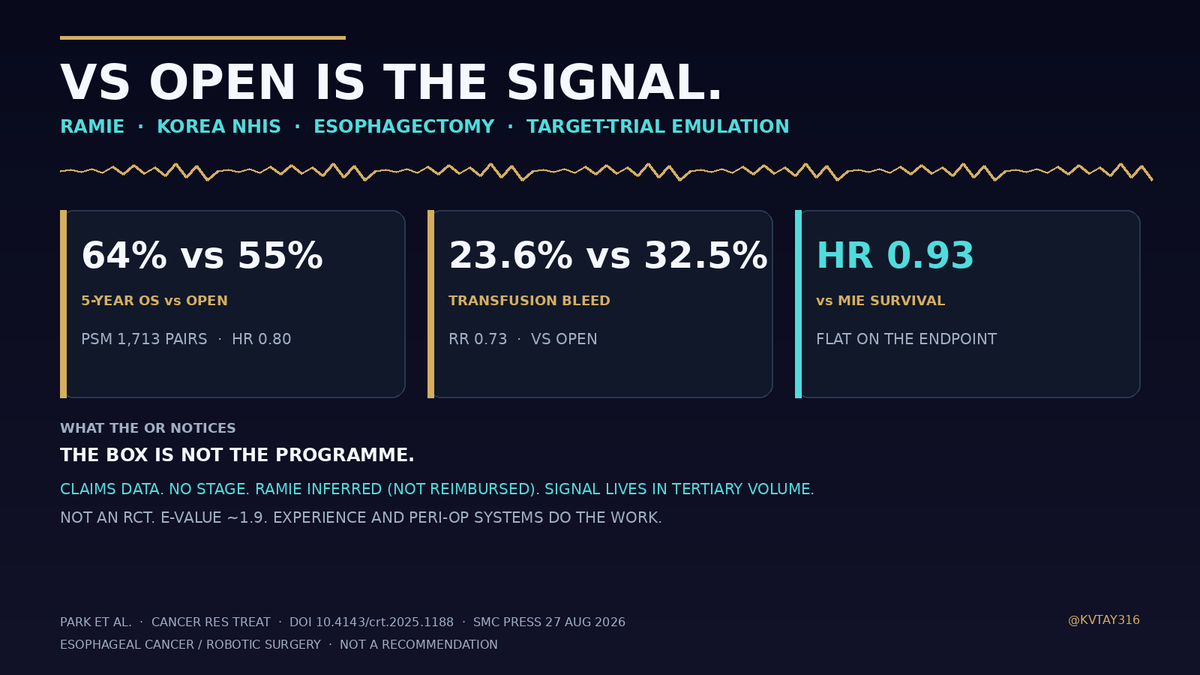
@RoboticOncoDr Worth pairing your robotic esophagectomy session with Park et al. CRT this week (Korea NHIS, target-trial emulation): vs open, death HR 0.80; vs thoracoscopic MIE, HR 0.93. The paper's own read is that the benefit concentrates in tertiary programmes.
@basavatarakam Masterclasses matter because the outcome tracks the programme, not the platform. Park et al. CRT (Korea NHIS): RAMIE vs open death HR 0.80, but the benefit concentrates in tertiary-volume centres. The box is not the programme.
@AlasmariMD Kocherize first — the neck anastomosis fails on tension, not technique. Timely with Park et al. CRT (Korea NHIS): vs open, death HR 0.80; vs thoracoscopic MIE, survival flat at HR 0.93. The delta is bleed and recovery, not the survival endpoint.
Korea NHIS. RAMIE vs open esophagectomy. Target-trial emulation, not an RCT.
Park et al., Cancer Research and Treatment (Samsung): 13,608 first-time resections, 2010–2023. PSM 1,713 vs 1,713.
vs open: 5-year OS 64% vs 55%. Death HR 0.80. Transfusion bleed 23.6% vs 32.5%.
vs thoracoscopic MIE: survival similar (HR 0.93). The delta is recovery, not the survival endpoint.
Claims data. No stage. RAMIE inferred because robots are not reimbursed. Signal lives in tertiary volume. The box is not the programme.
DOI 10.4143/crt.2025.1188
Elon Musk was asked how he handles employees who disagree with him publicly.
His answer contradicts every leadership book written in the last 30 years.
"I'd rather have someone who argues with me and is right than someone who agrees with me and is wrong."
The room expected the diplomatic answer. That he values diverse perspectives. That healthy debate makes the team stronger. The standard CEO answer about psychological safety.
He went further. He said the most dangerous person in any company is the one who agrees with you to protect their job. Because that person will let you drive the company off a cliff rather than risk being fired for telling you the cliff is there. The yes-man isn't loyal. He's selfish. He's trading the company's survival for his own comfort.
He said SpaceX has a rule. If an engineer sees a problem and doesn't speak up, and the problem later causes a failure, the silence is treated as more serious than the mistake itself. The person who made the error was trying. The person who watched the error and said nothing was protecting themselves at the cost of the mission.
Think about what that inverts. In most companies, the person who stays quiet and avoids conflict is rewarded with job security. At SpaceX, silence is the fireable offense and disagreement is the job requirement.
Most leaders say they want honesty. Then they punish the first person who delivers it. He built a system where dishonesty through silence is the thing that gets punished. The culture didn't happen by accident. It was engineered to make agreement more dangerous than disagreement.
@LifeScienceDN Not a blanket win. Distal CD≥IIIa 4.3 vs 4.9% on 9,743 matched pairs; total gastrectomy 8.7 vs 8.3%, P=0.66. Blood loss and conversion moved, TG morbidity did not — for ~50 extra min distal, ~70 total. Authors read it as experience catching up post-2018 cover.
@mohamedadamMD Worth pairing with the new Japan NCD cut for the D2 discussion: distal CD≥IIIa 4.3 vs 4.9% on 9,743 matched pairs, but total gastrectomy 8.7 vs 8.3%, P=0.66. Blood loss and conversion moved; TG morbidity did not. Volume and reconstruction still do the hard work.
Japan NCD, five years after robotic gastrectomy got insurance cover.
Shibasaki et al., Gastric Cancer (Fujita press 24 Aug): PSM, 9,743 distal pairs + 1,617 total pairs, 2023–24.
Distal: morbidity 4.3 vs 4.9% (CD≥IIIa). Less blood loss, fewer conversions, shorter stay. Cost: ~50 min longer.
Total: blood loss and stay improve. Primary morbidity does not (8.7 vs 8.3%).
Not an RCT. Volume and experience still hide in the residual. Distal is where the signal is landing. Total still needs volume before the primary endpoint moves.
Paper: https://t.co/DjHvHy0zXN
At BMI ≥70, “too high for surgery” is too often treated as a full stop.
New MBSAQIP analysis: 1,262,454 operations (2015–23). In BMI ≥70, serious complications were 2.57%; mortality 0.35%.
Risk rises. The real variables are selection, prehab, equipment, experience and rescue capacity—not BMI alone.
Important caveat: this is a selected surgical cohort; people denied access were not captured.
Source: https://t.co/FTzaCx677t
@KindredBlade "Combat not overhauled, targeting improved, skills unlock faster" is the honest version of a curriculum refresh: same case you've done for 11 years, better ergonomics and fewer wasted steps. Free, too. I'll take that between lists over a 27-minute trailer I still can't operate.
@TGGonYT Mine: how much of that world actually reacts to you, versus just looks like it does. 27 minutes shown and still nothing playable until 19 Nov. Feels like watching someone else's case video the night before your first assistantship. Pretty. Still not your hands.
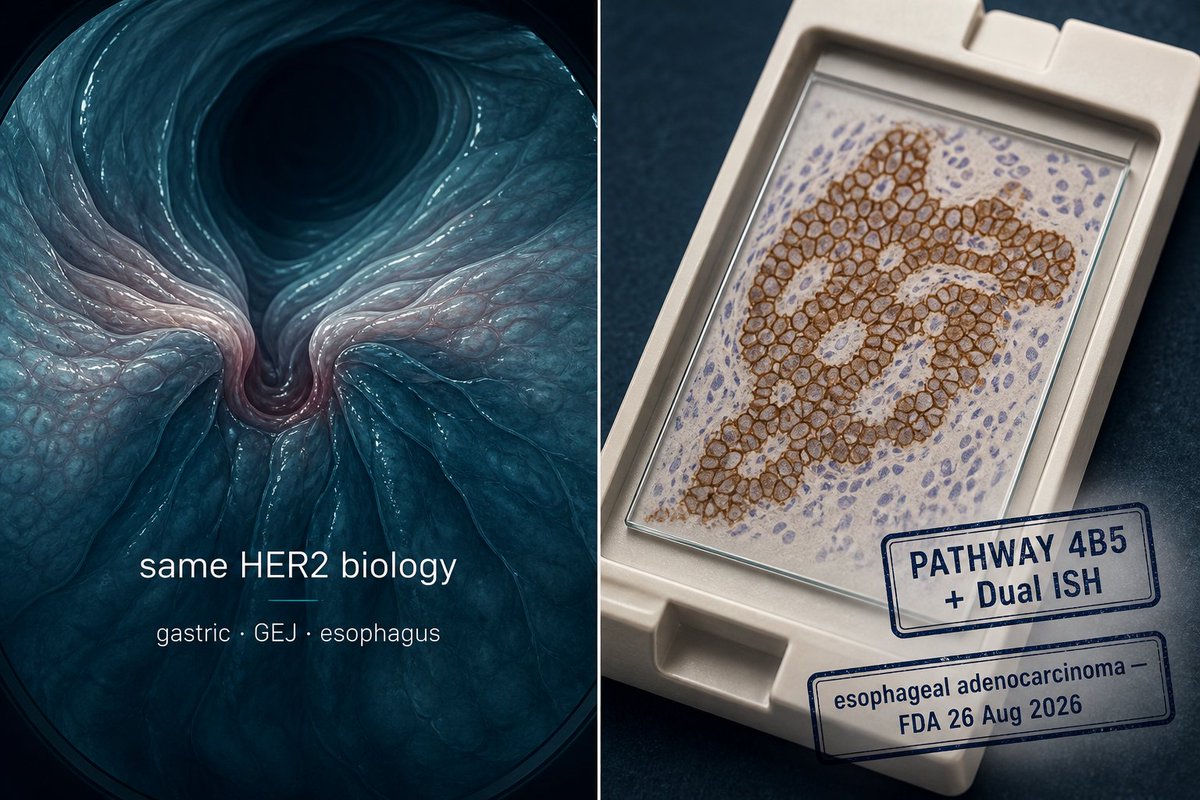
This week's GEA news is the assay, not just the drug.
Tue: FDA cleared Ziihera (zanidatamab) 1L for unresectable HER2+ gastric, GEJ and esophageal adenocarcinoma. Roche PATHWAY 4B5 and VENTANA Dual ISH now cover the oesophagus.
ToGA never gave esophageal adenocarcinoma its own approved HER2 test. Same biology. Gap closed.
HERIZON-GEA-01 triplet: 26.4 vs 19.2 months OS vs trastuzumab-chemo.
Unresectable 1L. Not a change to the operative pathway. JAZZ. Markets closed.