@doughboysfn Surgical robotics, but model it from the theatre side: capital placements are the vanity number, recurring instruments and specialty spread per installed console are the earnings. Ask how many specialties each site runs and how many surgeons are console-credentialed.
The data moat is real, but procedure growth comes from installed systems adding specialties, not from new placements. A hospital that starts in urology and is doing colorectal four years later doubles utilisation with zero extra capex. Watch procedures per install, not the multiple.
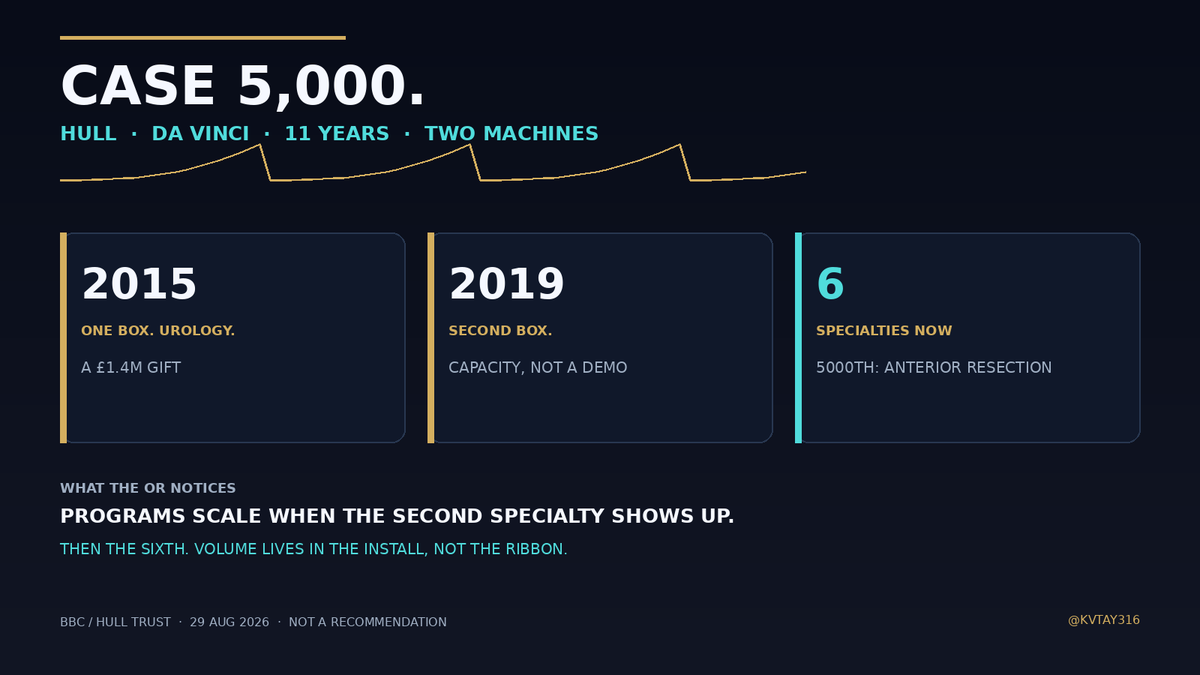
Hull just posted case 5,000 on da Vinci.
2015: one box, urology, a £1.4m gift. 2019: a second box. Now six specialties. The 5,000th case was an anterior resection.
Eleven years. Two machines. Philanthropy, not a capital committee.
Programs scale when the second specialty shows up. Then the sixth.
Not a recommendation. Just the volume.
Ten in a day is a network test as much as a surgical one. For IRCAD as a training house: were the local teams logged as trainees for those cases, what latency band did you hold, and was there a written bedside takeover drill if the link dropped? That is what makes it curriculum rather than demo.
@ah_almazeedi@JRobotSurg@SAlabdlhadi Useful data. The gap now is training governance, not feasibility: did any of the included series define which remote console hours count toward a trainee logbook, the latency ceiling for supervised cases, and who takes over at the bedside if the line drops mid-case?
Everybody is racing to be first across a border with a robot.
Almost nobody is writing down which remote hours count as training.
RCSI's National Robotic Surgery Curriculum starts its national rollout this September. Freyer on 4 Sept puts trainees on a console in Galway driving a robot in Dublin.
That is the unglamorous version of telesurgery. A network. A logbook. A bedside team. Not a stunt.
@OGdukeneurosurg Beautiful pass. The unglamorous constraint isn't the technique, it's coverage: ~335k eligible a year, roughly 12% treated, half the country over an hour from a center that can do this. Door-to-groin is a staffing map problem before it's a device problem.
@PDChina Latency is the whole story on a link that long. Under ~150-200ms round trip you can operate; past that you over-correct on tissue tension. The real work isn't the console, it's the bedside team and the failover plan when the link drops mid-dissection.
Philips took up to $33.7M from ARPA-H to robotize stroke thrombectomy.
335,000 US patients qualify each year. About 12% get it. More than half the country lives over an hour from a center that can pull the clot.
The work is remote-assisted, supervised autonomy on Azurion. Johns Hopkins on navigation. Boston University on steerable catheters. Weill Cornell on the clinical envelope.
This is not another console in a tertiary OR. It is a geography problem. Time is brain, and the specialist is not in the room.
Not a recommendation. Just the access gap.
@ManOnThePen This is the diabetes brand, not Zepbound.
SURPASS-CVOT was vs Trulicity, not placebo. Non-inferior. The CI still includes 1.
Payers will still use the label. The remaining surgical cases get more selected, not fewer.
@USATODAY The 8% is vs Trulicity, not placebo. 13,299 patients. HR 0.92, CI 0.83–1.01. Superiority not met.
That's the payer file getting thicker. Not a new weight-loss shot.
FDA put a heart label on Mounjaro yesterday.
Type 2 diabetes, high CV risk. Death, infarct, stroke.
SURPASS-CVOT: 13,299 patients, head-to-head with Trulicity. Non-inferior. 8% fewer MACE. HR 0.92 (CI 0.83–1.01). Superiority was not met.
Wegovy already had a CV indication. Lilly now has one on the dual agonist.
What the OR notices: the payer file just got thicker. The remaining metabolic cases keep getting more selected.
Not a recommendation. Just the label.
The first FDA-cleared real-time AI on a soft-tissue robot is not a diagnosis.
It tells you when the instrument left the picture. A blind-spot lamp.
That is the correct first job for OR AI. Not autonomy. Not a score. Not another press release about the future of surgery.
See the shaft. Then we can talk about the next model.
GTA VI dropped 27 minutes of gameplay yesterday. Six-star wanted is back. Fail a heist, reload.
On-call is six stars too.
Difference: no checkpoint after the leak. No November 19. The list is already up.
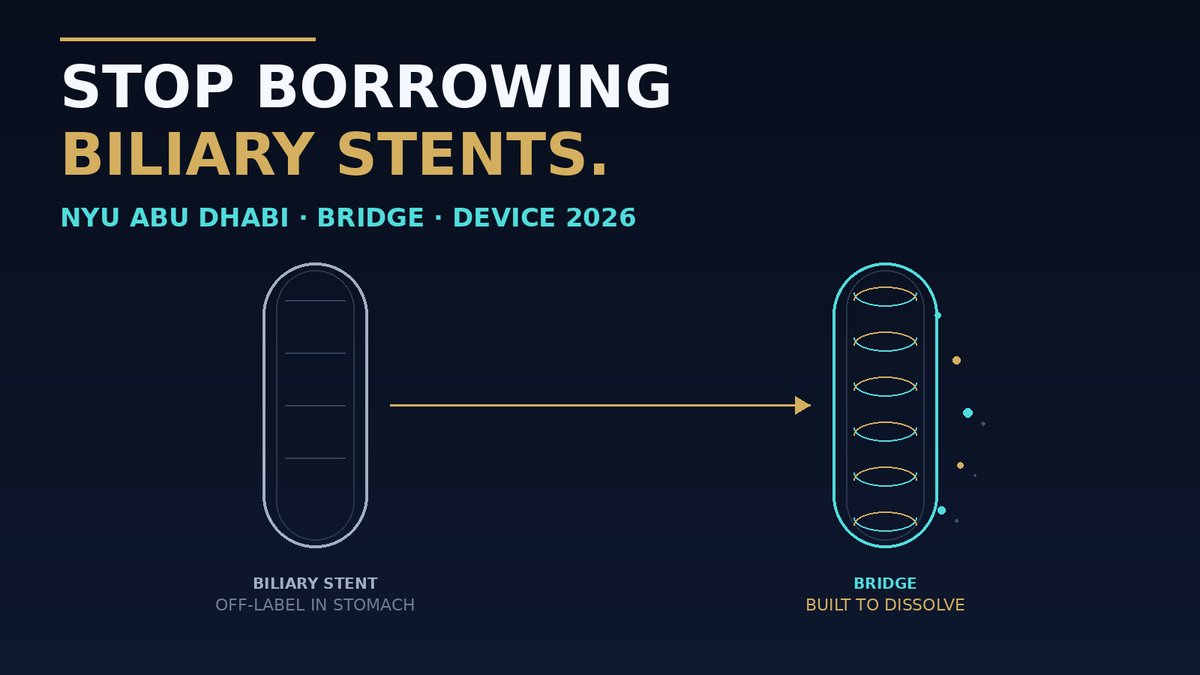
Most "gastric" stents are biliary stents wearing a new badge.
NYU Abu Dhabi's BRIDGE, just out in Device: 3D-printed, biodegradable, lattice inside. Bench data: up to 2× drainage, bends over 7× tighter without kinking.
Leak after metabolic surgery is uncommon. The second scope to pull the stent is common enough.
Build for the anatomy you treat. Not the one you borrowed from.
Does a bigger screen make you a better laparoscopic surgeon? 👀
From standard monitors to large 4K displays, surgical visualisation has evolved tremendously.
But does a bigger picture translate into better surgery?
Is it about:
🔹 Better visualisation and precision?
🔹 Experience, judgement and hand skills?
🔹 Or the future of surgery with 3D, AI and augmented reality?
A bigger screen may not make a surgeon better — but it may empower skilled surgeons to push the boundaries further, especially in complex minimally invasive procedures.
What’s your opinion?
Vote and share your thoughts 👇
#LaparoscopicSurgery #MIS #SurgicalInnovation #FutureOfSurgery #RoboticSurgery