@Sanjil@GoDrift_ai Most simulators have similar physics engines and contact models. Isaac even lets you swap out different contact models, solvers, etc. What exactly are you looking for in new simulators?
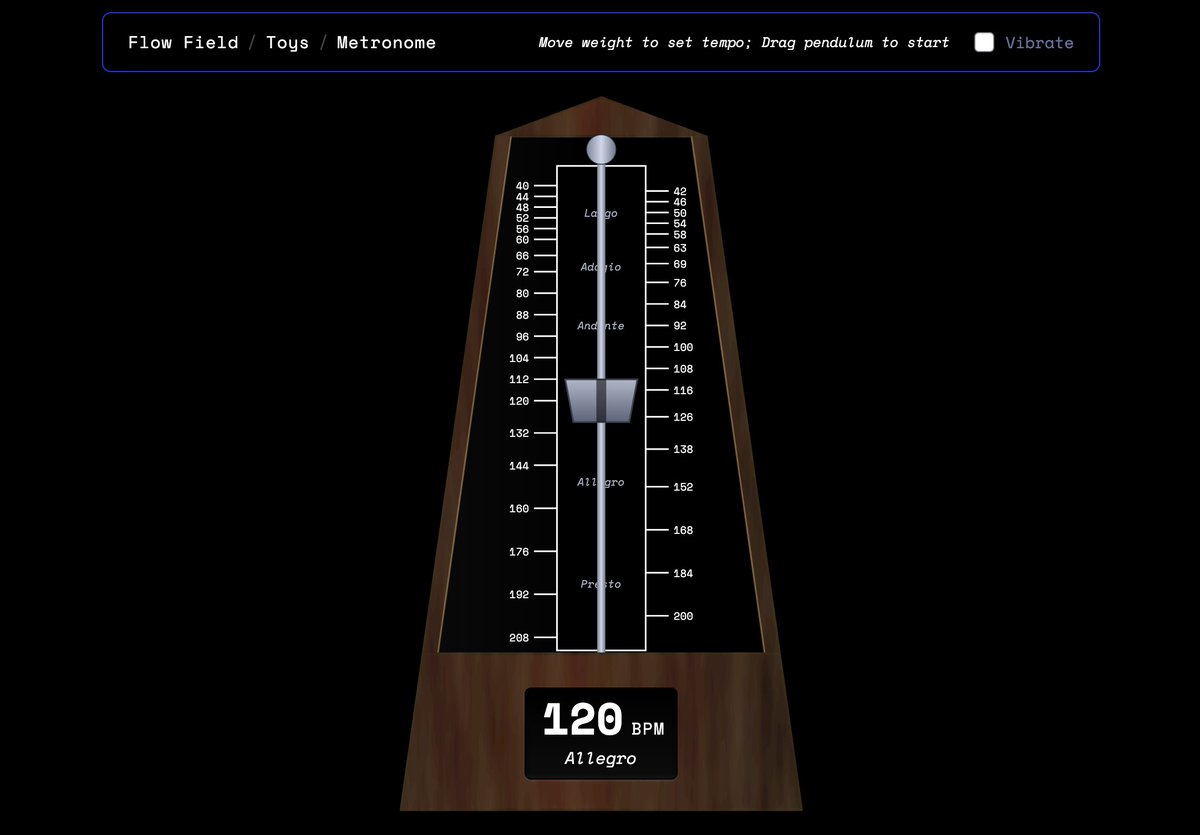
musicians don't need to pay for tuner/metronome apps anymore, you can just vibe code your own. basic YIN pitch detection is easy to implement. you can also make a metronome with whatever features you'd like, i made one that looks like a mechanical one: https://t.co/CGyJNWvgap
i was surprised sim2real worked for legged robots but when compared to grasping, foot contact is simple: brief, few point contacts, mostly normal force. grasping is the opposite. sustained contact over an area where friction and slip decide the grasp holds.
Raw first-person video isn't robot training data. It's blurry, unlabeled and flat: no task steps, no 3D hands.
So we built egokit: clean → scene + steps → 3D hands → LeRobot/MCAP.
95% of bad footage caught, zero false flags (42 hand-checked clips).
https://t.co/qVwWMaiZ5a
@wispem_wantex Increase in developer productivity just doesn't translate directly into economic productivity, and the increase first has to pay for AI before it's visible. For e.g. porting legacy code to rust in a week is amazing but how does it help the bottom line? So you do layoffs.
Crazy times to be in Robotics - never would've thought a generalist robot who was even possible. But yeah, lots of work still left to be done before robots become as useful as general AI/LLMs.
@edwardahn9 hmm i would've assumed that could generalize were impossible but here we are. they could keep getting better, esp if training data for these models is solved cheaply
march 2031 havent had a haircut in
years. salon has 7 chairs and 7 alumninum clankers... trained on a billion hours of indian barber camera rig data
i ask for head massage. it puts a finger in my ear. a single tear down my cheek . god is dead
fun stat from @microagi’s write-up on shipping petabytes of robot data:
they re-uploaded a 239 GB dataset with small changes to Hugging Face. only 2.6 MB went over the network, done in about a minute (!)
and it keeps paying off at scale, because robot recordings are super repetitive (same scenes, same rigs). then @Cloudflare workers fan it all out to any cloud, >1 PB for ~$500
great write-up by the team: https://t.co/O4w4EbnHar
@chris_j_paxton There's gotta be some direct sensor safety loops built into the motor controller, if it's LLMs all the way down then we're going to get prompt injections that can kill people
We trained π0.5 for 8 hours on 4× H100, streaming a 10.7 TB dataset straight from the Hub.
Time spent waiting for data: 0.52% of step time.
No full download first.
Just add --dataset.streaming=true
How it works 👇
https://t.co/nIo1kcO1k8
We are open-sourcing V1.0 of our agentic robotics framework, ASPIRE, with full real robot skill discovery and self improvement capabilities! On the day Astra arrived, our lab switched the backend model and saturated all the benchmarks to ~99% over night.
And the frontier is already on the move:
- Opus 5.5 slightly edges out Astra on our robot simulation bench.
- Sonnet 5.5 hits the Pareto frontier of cost vs. robot capability, $12/task.
We first introduced ASPIRE and /robot skill library in June, way before the big models could reliably do robotics. A rising frontier tide lifts all boats, but Astra was a 0->1 tsunami on many tasks.
Now you can also feel the Physical Bitter Lesson at home like we did on that fateful day ;)
links in thread
A Qwen3 neuron that tracks Colorado stuff was given as an example of a neuron that seems polysemantic but makes sense once you trace it. I had Claude check what else it tracks: Tornado’s Python HTTP client code, just as hard. Can’t wait to learn how Colorado and Tornado connect!