The IMF programme defined what central bank foreign exchange intervention (FXI) was. There’s no ambiguity there.
If there was indeed a cap of $80 million per month, which isn’t in the public programme documents btw, then the $3 billion in interventions in 2024 would have breached that cap. Even the roughly $1 billion in 2023 would have breached the reported cap.
The reality is that the government simply didn’t have the room to intervene aggressively in 2023 or early 2024 because reserves were still being rebuilt. Reserves increased from just 0.6 months of import cover at the end of 2022 to 1.7 months by the end of 2023.
What room would you really have to intervene aggressively when reserves were still well below the minimum threshold?
The “cap” didn’t stop you. You just didn’t have the facilities, big man.
Yet he was part of the government that ran the DGPP from 2021 to 2024 and never publicly disclosed the losses incurred by the programme, not even in the IMF reports 🤦🏿♂️
GHC400
A Pan of Jollof (will come in a box)
8 pieces of chicken
A pack of Salad/coleslaw on the side
It’s highly customizable! First frame decided to add plantain at no extra cost (just replaced one chicken with plantain)
To order, kindly dm, call or WhatsApp 0558415732
GHC1,200
A pan of Jollof
A pan of fried rice
A pan of grilled chicken
A pan of kelewele
A pan of Ghanaian salad
Feeds 10-12 people 🤭
Perfect for parties and hangouts!
Dm, call or WhatsApp 0558415732 to order!
I look at so much Ghanaian data that sometimes I see a number and immediately know it doesn’t add up, even before I dig into the details. Then I find the time to check it, and it turns out the instinct was right.
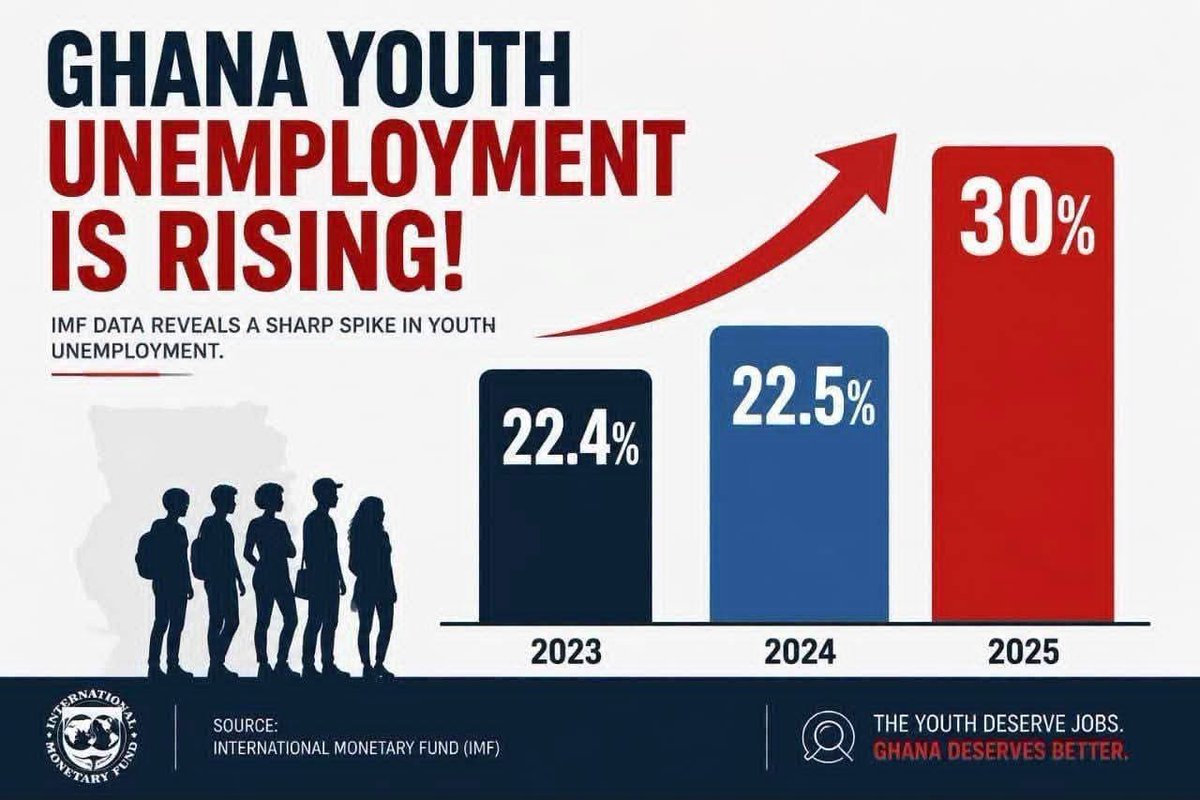
I’ve seen the claim that Ghana’s youth unemployment rate increased by 8 percentage points between 2024 and 2025, with the IMF referenced as the source. See the graph from Dr. Boako below.
The problem is that two different definitions of youth unemployment are being compared.
There is a youth unemployment rate for people aged 15–24 and another for people aged 15–35. The 22.5% reported for 2024 is the rate for ages 15–35, while the 30% reported for 2025 is for ages 15–24. Those two figures cannot be compared.
Using the same definition, the youth unemployment rate for ages 15–24 was about 32% in 2024 and 32.5% in 2025. For ages 15–35, it was about 22.5% in 2024 and 22% in 2025.
So, no, youth unemployment did not jump by 8 percentage points between 2024 and 2025 based on publicly available data. Depending on the definition used, it was essentially unchanged.
Interestingly, the IMF document that was cited actually focuses on the 15–24 age group. Articles from the Ghana News Agency and Daily Graphic were referenced.
Alleged crime boss extradited and charged: Who is Daniel Kinahan?
Sky's @SMurphyTV looks at the events leading to the former boxing promoter's extradition to Ireland, who was charged with directing activities of a criminal organisation.
Find out more ⬇️