the appalachian mountains are older than saturn’s rings. the appalachian mountains are older than dinosaurs. the appalachian mountains are older than trees. the appalachian mountains are literally older than BONES. the appalachian mountains should be regarded with pure terror.
This leads to a necessary and important discussion with internationally recognized scholars and scientific staff to determine: how can genomics benefit and empower human health without harm and without promoting disparity? How can genomic science be just?
After 12+ years in lab research, next week I transition to a different path: I join the @theNASEM Institute for Laboratory Animal Research as an assoc. program officer. Very excited for this new opportunity, and thankful to those whose friendship and mentorship supported me
This coming Friday (March 18th, 1pm EST) I will present my PhD thesis seminar on the epigenetic mechanisms by which the liver senses and responds to elevated lipid levels. DM me for the zoom link if you are interested in watching
Animal research is conducted according to rigorous guidelines as well as review and oversight by animal care and use committees, which include researchers, veterinarians, non-scientists, and community members.
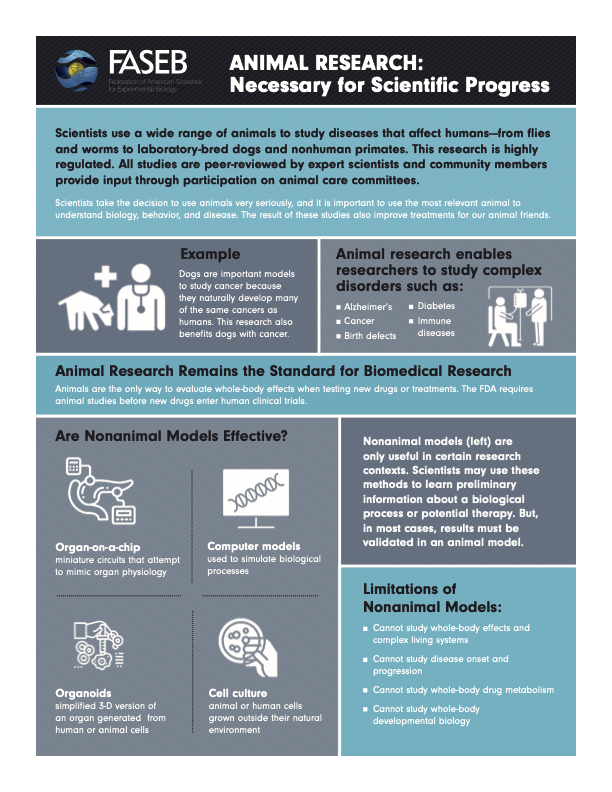
Returning to twitter to share the recently released animal research factsheet I helped make as a science policy fellow for @FASEB
https://t.co/CSR6knaQjx
Non-animal models are useful in certain circumstances to supplement animal research, but these results must typically be validated in an animal. Non-animal models cannot be used to study whole-body effects and complex living systems.
In one week I'm hosting a @FASEBorg webinar on dealing with conflict as a grad student, featuring conversations with Lori Conlan from NIH and Stacey Satchel from Vanderbilt Grad Life Coach Office. I'm excited to see folks there! Info+Registration: https://t.co/UD84RQej9C
Examine strategies to mediate conflicts with fellow graduate students and with faculty mentors, as well as review resources available to trainees for conflict mediation in our free webinar, "Dealing with Conflict as a Graduate Student," on January 13. https://t.co/M7KISoiaI1
On Jan 13 I’m hosting a @FASEB webinar on conflict resolution skills and resources for grad students. Panelists will discuss strategies to prevent and mediate conflict with fellow trainees, mentors, and how to find institutional resources. Register here: https://t.co/4WU7upArtR
The conversation will more explicitly focus on grad students in biological/biomedical research, but the material is still broadly applicable to students or postdocs in other fields.
You want more test at home kits?
You got more test at home kits.
Starting tomorrow, EVERY @prattlibrary location will have kits for you to take home.
The Pratt Library works hard making sure Baltimore has accessible and equitable access to knowledge.
We’re proud to partner.
Looking forward to a fascinating and timely symposium over at @genome_gov. Day 1 discusses history, Day 2 discusses more recent examples of scientific and structural racism
Eugenics and scientific racism are widely misunderstood despite their long, tragic histories. Why do these misconceptions still exist and continue to cause modern-day discrimination and bias? We look to the history of science and medicine to help answer these questions.
@SciPolJournal, in collab w/ @AAAS & @KavliFoundation, has a really exciting new Special Issue out today: Shaping the Future of Science Policy. Starting some great dialogues on ways to increase utility+impact of science to public: https://t.co/ev35N3uuPR #JSPGEndlessFrontier.
This is new and important information for understanding how the liver senses and responds to fluctuations in lipid concentrations at the levels of genome regulation and gene expression, such as we see with metabolic oxidation deficits or periods of nutrient deprivation.
My research from the past few years is now up as a preprint! I used a combination of mouse genetic models with a bunch of -omics platforms to give a granular view on how liver responds to deficits in lipid metabolism at the level of genome regulation. https://t.co/FpI32BXRlW
More changes in histone acetylation happen at enhancers vs promoters. One interpretation is that Ppara target gene transcription levels are more closely tied to changes in enhancer dynamics than at promoters.