So, let's cut to the chase.
You love us and can't bear the thought of us ending up in a state of eternal torment (hell), right?
Okay, then simply make the case for your faith paradigm.
It should be able to stand entirely on its own two feet without needing to contrast itself with Mormonism or any other faith paradigm.
Here is the specific challenge/exercise for you:
Step 1: Forget The Church of Jesus Christ of Latter-day Saints exists. Put it completely out of your mind. Mormonism never was and never will be.
Done? Good.
Okay, next:
Step 2: Make the case for your specific faith paradigm. Do not hide behind any other faith paradigm. Do not hide behind the other 2.5 billion Christians. Sell your exact faith paradigm plainly and clearly.
Pretend that a random person on the street walked up to you and asked about your faith. How would you sell it to them? Let’s see it stand on its own.
Go ahead.
Start by making the best elevator pitch you can think of for your faith paradigm.
I will act as the random person to examine what you are selling to see if it makes sense.
Not really as it’s never God doing the talking, only people claiming to have heard Him (whether thousands of years ago (making it into your favorite edition of scripture) or today).
Logically speaking, if God wants everyone to understand a message completely with zero discrepancies, He could drop the mystery and communicate universally in a way that is unmistakably Him.
I have plagiarized the work of others. This was wrong, and it was sinful. Over the years, I allowed myself to develop justifications for my actions, minimizing their seriousness and, at times, even pushing them so far from my mind that I failed to reckon with what I had done. These patterns have affected far more of my work than I ever wanted to acknowledge.
I do not want to simply move past this or treat it as something to be managed. I deeply regret my initial defensive and dishonest response to the accusations, and my involvement of others in that response. I want to face all of this truthfully, accept the consequences of my actions, and do what I can to make things right.
My heart has always been to tell people about Jesus, to share the gospel, and to help others discover the beauty and richness of the Bible and its history. But having a good desire does not excuse the ways I have fallen short in pursuing it. I have clearly failed to uphold the standards of integrity that I have encouraged others to value. That failure is mine, and I take responsibility for it. One of the things that grieves me most is the reality that, through my own actions, I have undeniably brought reproach upon the very gospel I have spent so much of my life seeking to proclaim. The truth of the gospel is never served by dishonesty in the way we communicate it. I cannot justify my actions by appealing to my intentions.
In my sin and failing, I have wronged those who have trusted me and sought to learn from me, and have wronged those whose work I treated as my own. To those individuals, and to everyone who has trusted me and my work, I am deeply sorry. I ask for your forgiveness, recognizing that forgiveness cannot be demanded and that rebuilding trust, if it is possible, will take time.
As I step back from my ministry and church work, I am submitting myself fully to Apologetics Canada's in-depth review, and to any academic disciplinary process I will be subject to. I will also be under the care and counsel of my church and elders.
Above all, I want to walk through this with genuine repentance before God, and with humility toward those I have wronged. I know that repentance is more than words, and I recognize that it will need to be demonstrated through my actions going forward. My prayer is that God would use this painful season to confront what needs to change in me and to lead me toward genuine repentance.
My soul feels grieved by this situation. My heart is heavy. And my guilt at times has felt like it will swallow me whole. I am grateful for those who can still find it in their hearts to pray for me and my family.
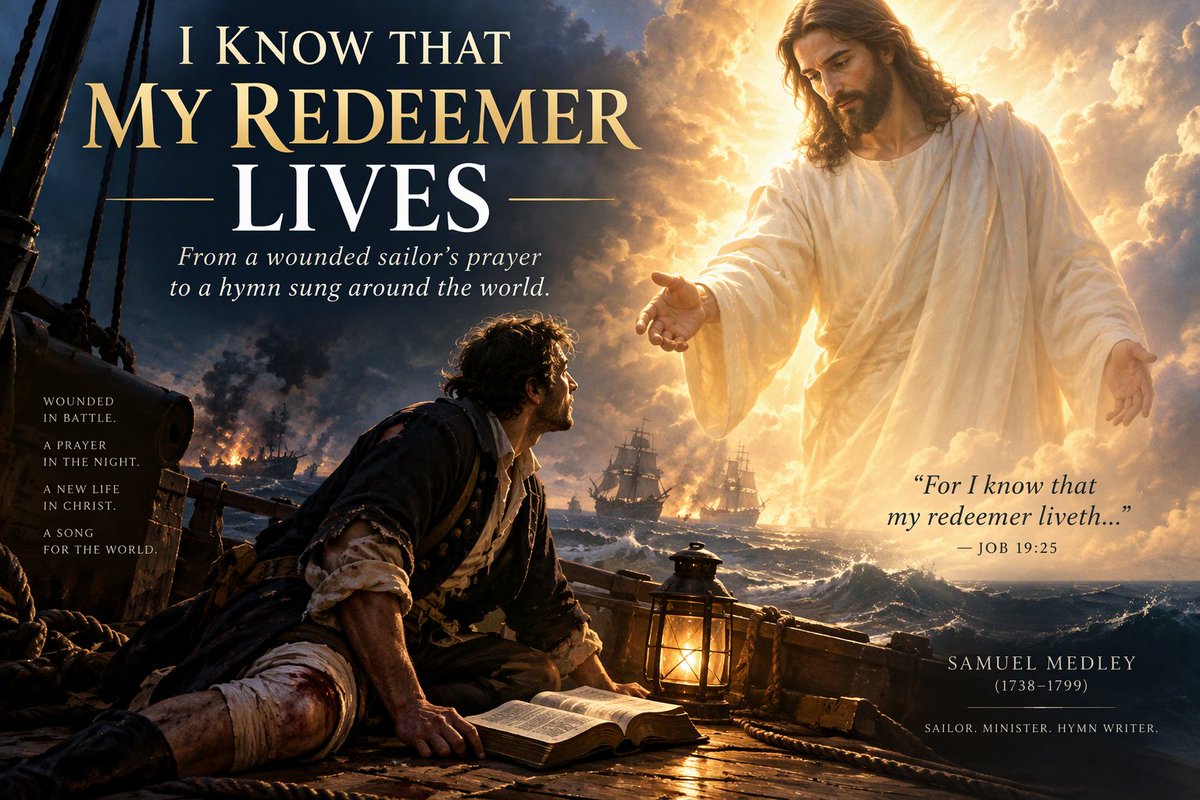
The Story Behind the Hymn “I Know That My Redeemer Lives”
Before Samuel Medley (1738–1799) became a beloved hymn writer and Baptist minister, he lived a very different life. At age fourteen, he was apprenticed to a London oilman, a trade he disliked. When war broke out in 1755, he seized the opportunity to leave his apprenticeship and join the British Royal Navy.
Four years later, on August 18, 1759, Medley was severely wounded in the leg during the Battle of Lagos, a major naval engagement of the Seven Years' War. As the wound worsened, the ship's surgeon warned that amputation might be necessary to save his life. That night, Medley reflected on the Christian instruction he had received from his grandfather and prayed earnestly for mercy. According to later accounts, the surgeon found the wound sufficiently improved the next morning that amputation was no longer required.
His spiritual transformation was not instantaneous. After being discharged from naval service, Medley recovered at the home of his grandfather, William Tonge. There, one evening, his grandfather read to him a sermon by Isaac Watts based on Isaiah 42:6–7. The message deeply affected him and led to his conversion.
Medley eventually entered the Baptist ministry. After serving in Hertfordshire, he became pastor of the Baptist congregation on Byrom Street in Liverpool in 1772, a position he held until his death in 1799. His ministry flourished, especially among Liverpool's sailors, with whom he felt a natural kinship because of his own years at sea. During his lifetime he wrote approximately 230 hymns.
Drawing inspiration from Job 19:25, "For I know that my redeemer liveth," Medley wrote"I Know That My Redeemer Lives." The hymn first appeared anonymously in 1775 in the twenty-first edition of George Whitefield's Psalms and Hymns as nine four-line stanzas. It later became one of the most enduring hymns in the English-speaking Christian world.
Today, the hymn is most commonly sung to the tune DUKE STREET, attributed to John Hatton and first published in 1793. In the Latter-day Saint tradition, it is sung to the familiar melody composed by Lewis D. Edwards. More than two centuries after it was written, Medley's joyful declaration of faith continues to be sung by Christians around the world.
Verified Quote of the Day – November 19, 2026
「経験こそ宝だ。頭でっかち、知ったかぶりはだめ。悪い経験でもいいからどんどんしろ。」
“Experience is the real treasure. Don’t be all theory and no practice, or act like a know-it-all. Even bad experiences are fine—go out and get plenty of them.” — 松崎しげる (Shigeru Matsuzaki)
Verification & Context: Born on November 19, 1949, in Tokyo, Matsuzaki was a standout baseball player at Nihon University First High School with Koshien ambitions until a shoulder injury from a teammate’s bat during practice ended his baseball dreams. At that low point, his father (邦泰) gave him these words, which Matsuzaki has carried as his lifelong motto. Turning to music, he debuted in 1970 and became widely known for his 1977 hit 「愛のメモリー」 (“Ai no Memory”) and his deeply tanned, high-energy “元気印” persona. Shared in honor of Shigeru Matsuzaki, born on this day.
Source: Asahi Shimbun (https://t.co/V84mmcK0rG)
So, let's cut to the chase.
You love us and can't bear the thought of us ending up in a state of eternal torment (hell), right?
Okay, then simply make the case for your faith paradigm.
It should be able to stand entirely on its own two feet without needing to contrast itself with Mormonism or any other faith paradigm.
Here is the specific challenge/exercise for you:
Step 1: Forget The Church of Jesus Christ of Latter-day Saints exists. Put it completely out of your mind. Mormonism never was and never will be.
Done? Good.
Okay, next:
Step 2: Make the case for your specific faith paradigm. Do not hide behind any other faith paradigm. Do not hide behind the other 2.5 billion Christians. Sell your exact faith paradigm plainly and clearly.
Pretend that a random person on the street walked up to you and asked about your faith. How would you sell it to them? Let’s see it stand on its own.
Go ahead.
Start by making the best elevator pitch you can think of for your faith paradigm.
I will act as the random person to examine what you are selling to see if it makes sense.
So, it is pretty clear that you are just going to disregard all the counterpoints made.
Let's cut to the chase.
You love us and can't bear the thought of us ending up in a state of eternal torment (hell), right?
Okay, then simply make the case for your faith paradigm.
It should be able to stand entirely on its own two feet without needing to contrast itself with Mormonism or any other faith paradigm.
Here is the specific challenge/exercise for you:
Step 1: Forget The Church of Jesus Christ of Latter-day Saints exists. Put it completely out of your mind. Mormonism never was and never will be.
Done? Good.
Okay, next:
Step 2: Make the case for your specific faith paradigm. Do not hide behind any other faith paradigm. Do not hide behind the other 2.5 billion Christians. Sell your exact faith paradigm plainly and clearly.
Pretend that a random person on the street walked up to you and asked about your faith. How would you sell it to them? Let’s see it stand on its own.
Go ahead.
Start by making the best elevator pitch you can think of for your faith paradigm.
I will act as the random person to examine what you are selling to see if it makes sense.
So basically this then:
"The Creed is true because my church says so, and my church is right because Jesus authorized it."
However, this still misses the foundational flaw underneath the entire Creed: the "ambiguity" your church tried to fix only existed because 4th-century Greek thinkers misunderstood what "one God" meant in Scripture in the first place.
• Biblical "oneness" was never about metaphysical substance. In the Shema (Deut. 6:4), the Hebrew word is echad—a composite unity, the exact same word used for husband and wife becoming "one flesh" (Gen. 2:24)—not yachid (an indivisible singularity).
• Old Testament monotheism was covenant loyalty, not substance-counting. The First Commandment ("no other gods before me") and Psalm 82:1 ("God stands in the divine council; among the elohim he holds judgment") weren't Greek ontology lectures. Ancient Israel wasn't claiming one shared metaphysical essence; they were swearing exclusive allegiance to the Most High God.
• Jesus already clarified how He and the Father are "one." In John 17:21–22, He prays that His disciples "may be one, even as we are one." Unless Christians are merging into a single substance, "one" in Scripture unambiguously means unity of will, purpose, and glory.
And look at what actually happened when the 4th-century church tried to "clarify" a problem the Bible never had:
1. The church rejected the word first. The Council of Antioch (268 AD) explicitly condemned homoousios ("same substance") nearly 60 years before Nicaea adopted it.
2. An unbaptized emperor pushed it through. Constantine—baptized on his deathbed by an Arian bishop—convened Nicaea and backed homoousios for imperial unity, not scriptural precision.
3. It sparked a 56-year civil war. Bishops exiled and excommunicated each other over that single term until Emperor Theodosius I made Nicene orthodoxy mandatory by imperial decree in 380–381 AD.
You’re completely free to rest in institutional authority. Just own that you’re defending a 4th-century philosophical patch built on a misunderstanding of "one God."
Notice how fast you just moved the goalposts. Your opening post stated flatly, "God does not share His glory with another." Now you're affirming Romans 8:17 and agreeing that believers do share in Christ's glory. That's the exact issue I flagged when I pointed you to the rest of Isaiah 42:8. The verse forbids giving God's glory to carved idols, not sharing His glory with His children. Jesus Himself says in John 17:22, "The glory that you have given me I have given to them." You can accuse me of isolating verses if you want, but your opening claim contradicted Jesus, and your reply had to walk it back.
Since you asked everyone to read Isaiah 40-46 alongside John 1, Colossians 1, and Hebrews 1, let's actually read them closely. Start with the Hebrew of Isaiah 43:10: "Before me no god was formed, nor shall there be any after me." The verb translated "formed" is yatsar, meaning to sculpt or shape like a potter or craftsman. Look one chapter over at Isaiah 44:10: "Who fashions a god or casts an idol?" That is the exact same verb and noun pair (yatsar el). In context, Isaiah is mocking Babylonian idols carved from wood and metal. The same goes for your "there is none like Him" and "none besides me" proof-texts from Isaiah 45-46. Keep reading to Isaiah 47:8 and 47:10, where Babylon makes the same boast in Hebrew: "I am, and there is no one besides me." Nineveh repeats the identical line in Zephaniah 2:15. Nobody thinks Babylon was claiming no other cities existed on earth. In the ancient Near East, that phrasing is royal supremacy rhetoric declaring that you have no rival.
Now look at what happens when we follow your own advice and put Isaiah 44:24 next to John 1, Colossians 1, and Hebrews 1. Isaiah 44:24 says YHWH stretched out the heavens "alone" and spread out the earth "by myself." Meanwhile, John 1:1-3, Colossians 1:16, and Hebrews 1:2 all say God created all things through the Son. Even Trinitarians have to read Isaiah 44:24 contextually as polemic against rival pagan gods rather than a wooden exclusion of distinct divine persons acting in creation. Once you concede that Isaiah's "alone" language targets rival deities rather than acting as a rigid literal rule, you can't turn around and swing that same hyper-literalism at every other passage that talks about divine agency or shared glory.
If you want to appeal to the "whole counsel of Scripture," you also have to deal with the passages your framework ignores. Your first post declared that God is "not one god among many." Yet Exodus 15:11 asks, "Who is like you, O Lord, among the gods?" Psalm 89:6-7 asks who among the "sons of God" in the council of the holy ones compares to YHWH. Psalm 82:1 places God standing in the divine council, judging "in the midst of the gods," and verse 6 declares, "You are gods, sons of the Most High." Paul writes in 1 Corinthians 8:5-6 that even though there are many "gods" and many "lords," for us there is one God, the Father, and one Lord, Jesus Christ. Look at what Jesus does with Psalm 82:6 in John 10:34-36. When the crowd picks up stones to execute Him for blasphemy, Jesus quotes "I said, you are gods," insists that "Scripture cannot be broken," and rests His defense on the fact that God's own word legitimately calls beings other than the Father theoi. Whether you read Psalm 82 as the heavenly council or as human judges receiving God's word, Jesus's argument dismantles the claim that calling anyone else a god automatically violates biblical monotheism.
Even Hebrews 1, a chapter you specifically told readers to go check, pushes back against how tightly you're drawing these boundaries. In Hebrews 1:8-9 (quoting Psalm 45:6-7), the Father addresses the Son as "God" and then says, "therefore God, your God, has anointed you with the oil of gladness beyond your companions." The Son who is called God has a God over Him. Keep reading into Hebrews 2:10-11, where Christ is "bringing many sons to glory," shares "one source" with those He sanctifies, and is "not ashamed to call them brothers."
You spend another paragraph knocking down claims I never made. Nobody argued that believers become self-existent, uncreated beings who rival the Father, or that John 1:14 means God the Father used to be a mortal man. Appealing to the "by nature vs. by grace" distinction doesn't rescue your original claim either. Saying humanity participates in God's life by grace explains how it happens; it doesn't shrink what the New Testament says we receive. Look at the actual text. In 2 Peter 1:4, theias koinonoi physeos literally means sharers in the divine nature. Romans 8:17 makes believers joint-heirs with Christ, sharing in the same inheritance He receives. Revelation 3:21 records Jesus promising those who overcome that they will sit with Him on His throne, just as He overcame and sat down with His Father on His throne.
And if you're going to invoke early Christian theosis, quote what the Fathers actually wrote. Irenaeus (Against Heresies, Book 5 Preface) wrote that Christ "became what we are, that He might bring us to be even what He is Himself." Clement of Alexandria (Exhortation to the Greeks 1) wrote that "the Word of God became man, that you may learn from man how man may become God." Athanasius (On the Incarnation 54) wrote that "He was made man that we might be made God." Justin Martyr (Dialogue with Trypho 124) pointed directly to Psalm 82:6 and taught that all men are "deemed worthy of becoming gods, and of having power to become sons of the Highest." They certainly taught that this happens through Christ's grace and dependence on the Father. Still, they used language about human deification that would get someone run out of most modern evangelical pulpits today.
What you're calling the "whole counsel of Scripture" is really a later theological filter read back into 8th-century BC Hebrew poetry, flattening ancient anti-idol polemic into a wall that keeps humanity safely separated from what the New Testament and the early Church openly taught. So yes, anyone following this thread should read Isaiah 40-47, Psalm 82, John 1, John 10, John 17, Romans 8, Colossians 1, Hebrews 1-2, 2 Peter 1, and Revelation 3 together. Just let the texts speak in their own historical and biblical context instead of forcing them to fit a slogan.
Vicki, you just walked right past almost everything in the last two posts, including the main point your whole position depends on.
Before debating Frank Sheed or redefining "Father" and "Son," you still haven't given a shred of biblical proof for your core assumption: that God has to be literally one singular substance in the first place. That entire requirement has no basis in Scripture. It is built on a flat misreading of the Old Testament.
You ignored every text that shows this:◎ Isaiah's "beside me there is no God" statements use standard ancient Near Eastern incomparability rhetoric against pagan idols. We know that for a fact because Babylon and Nineveh use the exact same Hebrew boast ("I am, and there is none beside me") in Isaiah 47:8 and Zephaniah 2:15.◎ The Shema in Deuteronomy 6:4 uses echad (compound unity, like a husband and wife in Genesis 2:24), not yachid (solitary singularity).◎ Psalm 82 explicitly describes God presiding over a council of elohim, and when the Pharisees accused Jesus of blasphemy in John 10:33-36, Jesus didn't teach them "same substance." He quoted Psalm 82:6 back at them to show that the title "god" already belongs to beings commissioned by the Father without breaking monotheism.◎ Jesus explicitly defined how He and the Father are "one" in John 17:21-22: He prayed that His disciples would be one "even as we are one." And Paul defined Christian monotheism in 1 Corinthians 8:6 as "one God, the Father... and one Lord, Jesus Christ."
Because the Old Testament never demanded numerical singularity of substance, the entire 4th-century "one substance" machinery is trying to solve a problem the Bible never had.
Now look at the two brief claims you actually did make:
◎ Sheed's "perfect idea" and "perfect love" claim: Simply repeating Sheed's sentence doesn't answer the objection I just gave you. Saying an idea is "perfect" does not magically turn an idea into a person. Perfection completes a thing according to what it is; it doesn't transform it into a completely different category of being. A perfect thought is still a thought, not a second thinker. Perfect love is still an act or bond, not a third conscious agent.
Push Sheed's logic one inch further and it falls apart completely. If a perfect being's self-knowledge automatically becomes a distinct person, why doesn't the Son's perfect idea of Himself generate a fourth person? Why doesn't the Spirit's love back toward the Father generate a fifth? Why don't God's perfect justice, mercy, and will become separate persons too? Even Augustine admitted in De Trinitate (Book 15) that this psychological analogy breaks down because memory, intellect, and will belong to one single person, not three persons who talk to, pray to, send, and obey one another.
◎ "Father and Son are just relational roles without human limitations": Stripping origin, order, and hierarchy out of "Father" and "Son" empties those words of what they actually mean. If "Son" carries no real subordination to the Father, those are the worst possible titles God could have chosen to reveal Himself.
More importantly, you completely skipped the verse I already cited that destroys the "human limitations" excuse: 1 Corinthians 15:28. Paul isn't talking about Jesus in mortality. He is describing the risen, glorified Christ at the very end of time, after every enemy and death itself have been conquered. Even then, with zero mortal limitations left, Paul writes that "the Son also himself [shall] be subject unto him that put all things under him." In Revelation 3:12, the ascended, glorified Christ in heaven still calls the Father "my God" four separate times in a single verse. Calling the Son's subjection a "human limitation" doesn't explain the text; it flatly contradicts it.
And notice everything else you quietly dropped without an answer:◎ You never defended your Greek philosophical claim that "a spirit cannot have parts," which clashes with ruach/pneuma, Numbers 11:17, and even Tertullian (Against Praxeas 7).◎ You never resolved how your claim of "no differing qualities" avoids collapsing straight into Modalism under Divine Simplicity.◎ You never addressed Church history or Dei Verbum 10: pre-Nicene Fathers like Justin Martyr, Tertullian, and Origen openly taught the Son's subordination, and the Synod of Antioch in 268 AD explicitly condemned the term homoousios decades before Nicaea adopted it.
Repeating Sheed's summaries and waving away subordination as a "human limitation" doesn't fix any of that. Until you can show from Scripture that the Old Testament actually demanded "one metaphysical substance," the whole creedal argument is sitting on thin air.
(Also, please keep your responses to one at time, otherwise the our conversation will fragment. If you need to make a longer reply, simply type it up, screenshot and paste the image of your draft as your reply.)
That brings us straight to the two real pillars of the Catholic case, Vicki: Church authority and Frank Sheed's metaphysics.
Just so we're clear, the disagreement isn't over whether there is a Father, Son, and Holy Spirit. The Godhead model affirms all three. The real issue is whether the fourth-century formula of one indivisible substance (homoousios) in three co-equal, co-eternal persons actually reflects what Christ and the apostles taught, or even holds together logically.
Even on Catholic terms, there are major problems here:
◎ Start with the claim that "a spirit cannot be broken into parts." That is a naked assertion with no scriptural basis and no actual logic behind it. It comes from Greek metaphysics (Plato and Aristotle's ideas about immaterial forms), not from revelation or reason. Logically speaking, there is no reason to treat "spirit" as an abstract, dimensionless non-material thing that cannot have form, location, or parts. It makes far more sense to view spirit as a finer, purer form of matter that simply operates beyond ordinary physical perception. That actually lines up with Scripture, where both Hebrew (ruach) and Greek (pneuma) literally mean wind or breath, something subtle and invisible yet real. Scripture even speaks of God's spirit being poured out and portioned out (like Numbers 11:17, where God takes of the spirit upon Moses and places it on the seventy elders). Even Tertullian, the early Father who coined the Latin word Trinitas, explicitly wrote in Against Praxeas (ch. 7) that spirit is a bodily substance of its own kind with its own form. And clearly spirits can exist as distinct individual beings (angels and human spirits aren't all fused into one single substance). Once that unverified "no parts" premise falls, Sheed's entire argument for "same substance" falls with it.
◎ Even if we grant Thomistic Divine Simplicity for the sake of argument, your second premise contradicts the Trinity itself. You said there is no quality the Son has that the Father lacks. Under Divine Simplicity, every attribute is identical to God's essence. If the Father, Son, and Spirit each possess that exact same simple essence with zero differing qualities, basic identity makes them identical to each other, collapsing straight into Modalism. Classical Catholic theology tries to escape that trap by saying they differ only in "relations of origin" (begetting vs. being begotten, spirating vs. being spirated). Yet being begotten, being sent, and taking on flesh are real qualities the Son has that the Father does not. You can't argue "no differing qualities" to prove one substance, then smuggle differing qualities back in to keep three persons.
◎ Sheed's analogy (borrowed from Augustine and Aquinas) frames the Son as God's perfect Idea of Himself and the Spirit as the Love between Father and Son. It sounds neat philosophically, until you realize an idea in a mind and an act of love in a will are faculties of a single person, not two additional persons who can converse with, pray to, send, and obey one another. Nothing in the nature of spirit fixes the number at three either. Logic doesn't rule out further internal processions. The count of three is fitted backward from New Testament groupings, not deduced from the nature of spirit.
◎ On Church authority, Catholic teaching itself (Dei Verbum 10) states that the Magisterium is not above the Word of God, but serves it by guarding what was already handed down rather than introducing new revelations. The problem isn't just that the words "same substance" don't appear in the Bible. The entire concept is missing from Genesis to Malachi, missing from the New Testament, and missing from the earliest centuries of Christianity. Pre-Nicene Fathers like Justin Martyr, Tertullian, and Origen all taught real subordination of the Son. In fact, the Synod of Antioch in 268 AD explicitly rejected the term homoousios decades before Nicaea adopted it in 325. Reversing earlier bishops to adopt a contested Greek philosophical category isn't simply unpacking an unbroken apostolic teaching.
◎ Claiming that distinct beings automatically violate the First Commandment assumes biblical monotheism meant numerical sameness of substance. It never did. Israel recited the Shema for centuries without ever imagining three co-equal persons sharing one essence. When Paul defines Christian monotheism in 1 Corinthians 8:6, he never reaches for Greek substance categories. He writes, "for us there is one God, the Father... and one Lord, Jesus Christ." And when Jesus defines how He and the Father are "one" in John 17:21-22, He prays that His disciples may be one "even as we are one." Unless the disciples were merging into a single indivisible substance, biblical oneness is a supreme unity of will, authority, glory, and purpose.
◎ Catholic apologetics usually assigns passages where Jesus prays to the Father, calls Him "my God" (John 20:17), states "the Father is greater than I" (John 14:28), or says only the Father knows the day and hour (Mark 13:32) to Christ's human nature or earthly mission. That doesn't solve 1 Corinthians 15:28, where Paul describes the risen, glorified Son at the consummation of all things still being subjected to the Father. That points to an enduring relational hierarchy, not a temporary earthly role.
◎ Calling something a "mystery" makes sense when we're talking about a God whose power and wisdom outstrip our finite minds. It doesn't work as a shield for logical contradictions built on unproven Greek philosophical assumptions.
Calling @maklelan a "MINO" completely misses the mark and confuses academic rigor with a lack of faith.
First, look at the actual facts of his life and service: Dan didn't just inherit his faith passively—he converted to the Church as an adult at age 20, served a full-time mission in Uruguay, graduated from BYU, married in the temple, and is an active, attending, participating member of his ward today. Furthermore, he spent an entire decade (2013–2023) working directly at Church Headquarters as the Church's Scripture Translation Supervisor—a role that requires maintaining an active temple recommend and ecclesiastical endorsement—overseeing translations of the standard works and the Joseph Smith Papers around the world.
Second, refusing to misrepresent what the historical and textual data say doesn't make someone a "MINO." It makes them an honest scholar who understands the actual scriptural definition of faith (Alma 32:21 / Hebrews 11:1)—that true faith is a deliberate commitment to God, covenants, and loving our neighbors, not pretending the historical data says something it doesn't just to win an argument.
Dan can speak for himself, but I love what he is doing. Honestly, I would love for him to be in charge of the Church Educational System (CES). Whenever I teach a lesson—even in Primary—I find myself asking, "Would I say it this way if @maklelan were in the room?" It keeps me honest and makes sure I avoid misrepresenting the content of the Bible as best as possible. In fact, I enjoy studying the Bible even more now than I did before I came to learn of Dan and his content. Love his work.