Prediction markets are an information game. Most people play it blind.
Ares Mobile Beta is live: social trading for prediction markets, where every opinion has real money behind it. Powered by @Polymarket
First trade is free.
Drop your position card below → 25 winners get $25 announced on 8/27.
@FSISAC, the financial sector's own threat-sharing body, warns that AI frontier models can now discover and chain vulnerabilities into working exploits, so "traditional assumptions and approaches for vulnerability management no longer hold."
Their advice is to "Fight AI with AI" and use all available models for risk identification and remediation.
https://t.co/97UH3YFgWM
Octane has received a grant from the @ethereumfndn to provide continuous security analysis across Ethereum's execution and consensus client layers.
The world computer deserves world-class security.
Octane is looking for elite security researchers.
We’re launching new initiatives and want to collaborate with SRs who have a proven track record in bug bounties, audit competitions, or high-impact vulnerability research.
DM us with your best work if interested.
We are glad to announce a strategic partnership with @humafinance, the world’s first PayFi network.
Qiro will act as a strategic underwriting and risk-monitoring partner to Huma for up to $250 million in real-world credit assets over the next 12-15 months.
@AnthropicAI@MATSprogram In the next 1–2 years, 95–99% of smart-contract and blockchain-infra vulnerabilities will be caught before deployment in CI/CD.
Only a thin 1–5% surface area will be left for manual audits or bounties.
Excited to grow @octane_security at such an industry-defining moment.
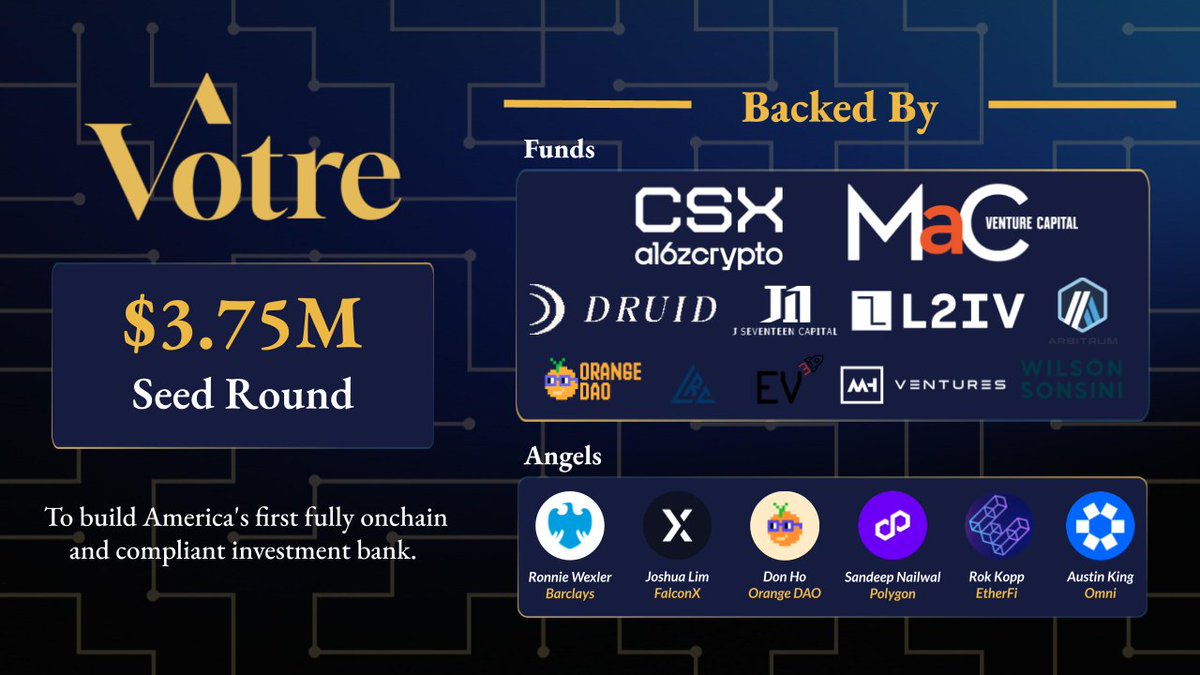
We are pleased to announce that Votre, America’s first fully onchain investment bank has raised a $3.75 million seed round. The round was led by @a16zcrypto CSX, with additional participation from @MaCVentureCap , @DruidVentures, @l2iterative, @J17Crypto , Long Run Capital, https://t.co/3UTjNwxJ8d Ventures, @IDGCapital , @sandeepnailwal , @EV3ventures , @mhventures , @wilsonsonsini , Scombridae, and strategic angels from @GoldmanSachs , @Harvard , and @OrangeDAOxyz as well as Josh Lim and @cory Levy from @zfellows .
"We’re proud to back Votre as they bring a measured, compliant approach to the crypto space,” said @adrianfenty of MaC Ventures, the former mayor of the District of Columbia. “With a strong technical foundation and a clear regulatory strategy, they’re well-positioned to succeed as crypto markets evolve in the US.”
Legally, today, Votre Inc is a nonbank lender and may be viewed as a swap dealer, operating under the de minimis exemption and does not provide tax, legal, or financial advice (yet!)
Our first product is a proprietary, hedged Bitcoin-backed loan product focused on allowing HNWIs to access liquidity. We plan to pursue other regulatory designations over time as we expand our business.
Thank you to our incredible backers - back to building!
Old world: numbers.
New world: narratives.
Ares — the first terminal for meme & prediction assets and more.
See full narratives, arbitrage sentiment, trade the future.
Powered by real-time signals + social data.
Beta waitlist → https://t.co/f1eASntRj6
How do you be the answer that AI shows?
https://t.co/qW3kamG1zR lets your brand own its voice in the age of AI. Track how AI answer engines (ChatGPT, Gemini, Claude, Perplexity) mention you; benchmark your visibility; audit and optimize your content so that you get cited. A @DruidVentures portfolio company!
🚨 Relays at the lowest price in the industry 🚨
From now → Jan 1🗓️:
⚡ Route relays for just $1 per million
🎁 Use code RELAY2025 at checkout in Grove Portal
🌐 Strengthen the Unstoppable Pocket Network while you save
👉 https://t.co/58jN4AMVc7
Imagine finding thousands of vulnerabilities in your codebase.
There are no labels and no context. To secure your code effectively, you need prioritization of issues.
But where do you even start when the bugs look like this? 👇
Security, from the first commit.
@octane_security, an AI-powered smart contract security platform, is now live on Avalanche, bringing continuous, real-time vulnerability detection directly into developer workflows.
Build faster. Launch safer 🔺
My recent trip to @VidCon 2025, inspired by my VR-obsessed son, was quite a change from my usual world of national security and tracking down cyber criminals. What started as a much-needed break from my serious day job turned into something unexpected—a revelation about the genuine communities that kids are building in virtual spaces.
I was amazed by the incredible creativity and positive culture that's grown around the YouTube creator community where my son is an active member. For years, I've heard him excitedly talking about his online friends with names like @jmancurly, DoeVR, Fizzy, Mellomelt, Toasty, and Indigo. These names have become regular characters in our dinner conversations.
These friendships started in @GorillaTagVR, a virtual reality game where players run around a forest using only their hands, playing the classic game of tag. It sounds simple, but it's brilliant in its simplicity. As someone who's familiar with the online handles hackers used back in my day, these playful usernames brought back memories and reminded me that people have always created identities in digital spaces - this is just a generational iteration.
But here's what really surprised me: these aren't just casual online friendships. When I saw my son meet his gaming buddies in person at VidCon, I witnessed something real and powerful. The connections these kids have built are genuine. They've created a community based on shared adventures, supporting each other, and genuinely caring about one another's success.
The culture they've built is refreshingly positive. Instead of the toxic behavior you often hear about in online gaming, these kids encourage each other. They celebrate when someone masters a difficult move or reaches a milestone in creating content. They've developed their own language, traditions, and ways of helping each other that go far beyond any single game.
What impressed me most at VidCon was meeting other parents who have chosen to embrace this digital world rather than fear it. These families understand that dismissing virtual friendships as "not real" misses the point entirely. These parents have decided to engage with their children's online communities—not as worried supervisors, but as people genuinely curious about this new way of connecting.
These families represent something important—parents who traded worry for open-mindedness and chose to see opportunities where others only see problems. They understand that their kids aren't running away from real life but expanding it, building meaningful friendships and developing social skills that will benefit them for years to come.
What I saw at VidCon wasn't the antisocial behavior that critics of virtual reality often worry about. It was exactly the opposite: a thriving, supportive community that has naturally developed positive values and practices. These young people aren't avoiding human connection—they're pioneering new forms of it, building bridges between the physical and digital worlds that many adults are just beginning to understand.
In my work, I see how technology can be misused and weaponized. But VidCon reminded me that technology itself isn't good or bad—it's what people do with it that matters. In the hands of these remarkable kids, virtual reality has become something beautiful: a space for friendship, creativity, and real human connection that crosses geographical boundaries and breaks down social barriers that might exist in traditional settings.
The culture these children have created isn't a cheap imitation of "real" social interaction—it is real social interaction, just evolved for a new era. They're meeting the same human needs for belonging, recognition, and shared adventure that every generation has, but they're doing it in ways that embrace the incredible possibilities that technology offers.