The biggest bubble warning in 100 years.
And this pattern has NEVER failed.
1972 → Nifty-Fifty bubble
1989 → Japanese bubble
1999 → Dot-com bubble
2026 → AI bubble
Each cycle reached the same final stage.
1972 → Stocks crashed
1989 → Japan crashed
1999 → Nasdaq crashed
2026 → S&P 500 cra...
And SpaceX is the final liquidity event before the AI bubble breaks.
Follow and turn notifications on.
I'll post the warning BEFORE it hits the headlines.
markov chains are simple but powerful.
they model systems where the next state depends on the current state.
not the whole past.
• states → possible conditions
• transitions → ways the system moves
• probabilities → uncertainty with structure
• memorylessness → only now matters
• steady state → long term behavior emerges
weather.
markets.
language.
biology.
robot navigation.
queues.
markov chains teach you a brutal systems lesson:
complex behavior can emerge from simple transition rules.
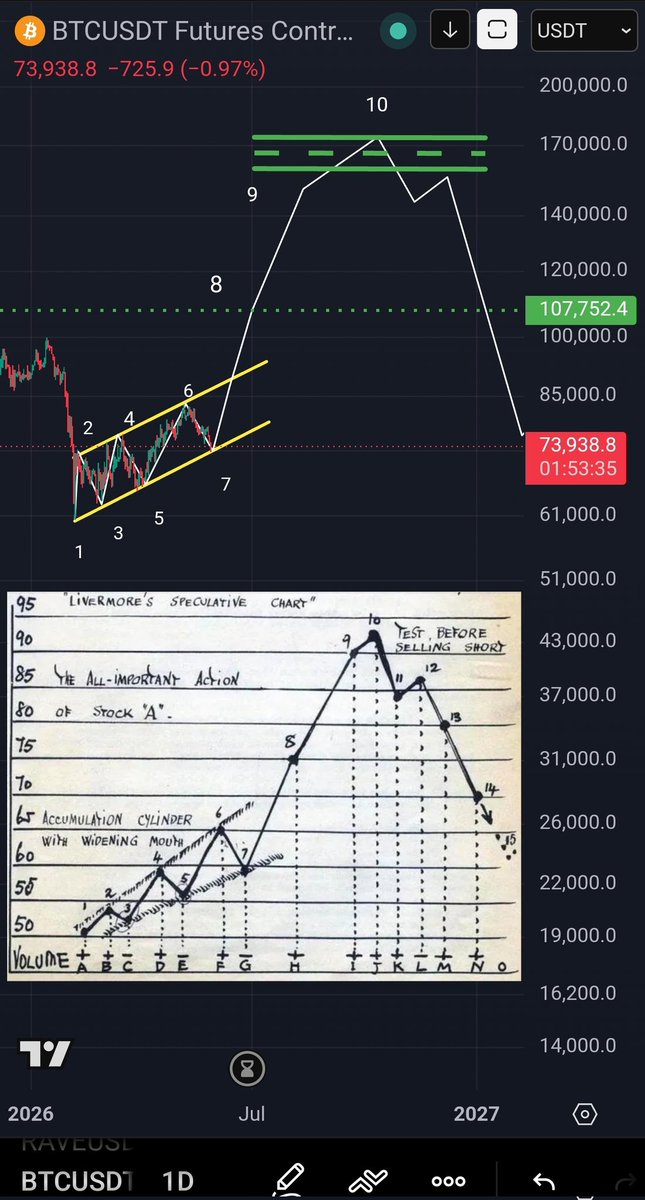
Nếu kịch bản này xảy ra với vàng thì căng thật.
Nhìn 1981 với 2011 đều có cú dựng đứng xong rơi khá đau.
Giờ chart 2026 cũng đang dựng kiểu đó, ae nào đang đu chắc cũng rén.
If you want to get ahead of 99% of software engineers, then read these 12 books:
1 Designing Data-Intensive Applications
2 Clean Code
3 The Pragmatic Programmer
4 The Mythical Man-Month
5 Introduction to Algorithms
6 Code Complete
7 The C Programming Language
8 Refactoring
9 The Art of Computer Programming
10 Structure and Interpretation of Computer Programs
11 Peopleware
12 Design Patterns
What else should make this list?
🚨 S&P 500 REPEATING 1999 SCENARIO AGAIN
Every time SPX/M2 spikes vertical like this, the market has locked onto one story and ran blindly with it
1999 - internet was changing everything, SPX/M2 went parabolic, dropped -11%, then -8%, then -49%
2026 - US-Iran war ending euphoria is the story, same parabolic move, same dot-com level valuations
Trump said the ceasefire deal is "in final stages, to be announced shortly"
The day that deal officially prints is the day the catalyst disappears
Markets don't reward good news - they sell it
This isn't a new bull run, instead it's the last squeeze before the flush
$9,000 on SPX isn't happening before a real correction first
Save this tweet. Let's see who's right by Q4
If you want to become a world-class software engineer (in 6 months), read these 12 books:
1 The Pragmatic Programmer
2 Designing Data-Intensive Applications
3 Clean Code
4 The Mythical Man-Month
5 Refactoring
6 Working Effectively with Legacy Code
7 Software Architecture: The Hard Parts
8 Database Internals
9 Staff Engineer
10 Extreme Ownership
11 Philosophy of Software Design
12 Why Programs Fail
What else should make this list?
This talk is not about C++. This talk is about something more fundamental than C++. This talk is about the hardware. I want to talk about CPU caches because this is what is ultimately going to determine the performance of your program - Scott Meyers
You are in for a treat with an opener like this!
CPU Caches and Why You Care
https://t.co/51D78clTSK.
🚨 S&P 500 IS MIRRORING 2000 DOT-COM BUBBLE AGAIN...
Сurrent market structure looks almost identical to 1997–2000 setup
1997-2000:
Capital was heavily concentrated in a few tech giants - Cisco, Intel, Microsoft, AOL
2025-2026:
Now the entire market is being carried by “Magnificent Seven” - Nvidia, Apple, Microsoft, Alphabet, Amazon, Meta, Tesla.
Back then, rally was fueled by internet mania
Today, same role is being played by AI hype - driving valuations to extreme levels and pushing markets into pure euphoria
Global corporations are pouring BILLIONS into AI infrastructure, agents, and model training every single month...
Despite all of this, market keeps printing fresh highs and inflating bubble even further...
Unwind could begin at any moment and most people still aren’t prepared
Turn on notifs, I’ll update SOON
Đây là hình ảnh cú sập 5 năm trước vào năm 2021
Bạn có thấy điều gì bất thường không?
Là hiệu suất của ETH có vấn đề.
Sau 5 năm giá ETH vẫn đang ở mức 1800- 2100$.
Networking Fundamentals for Developers, DevOps, and Platform Engineers (free course) 🔽
It doesn't matter if you work with real servers, virtual machines, Docker containers, Kubernetes pods, microVM-powered agent sandboxes, or full-blown cloud VPCs - all this tech relies on the same L2/L3 "magic" under the hood.
Gaining at least a basic understanding of how traffic flows on the Ethernet and IP layers will allow you to troubleshoot connectivity issues and design your own networking solutions. And this highly-illustrated course is a good start: https://t.co/Cm4NTgcjK9
LINUX LAYERS
USER LAYER
→ Represents users interacting with the Linux system
→ Includes system administrators, developers, and end users
→ Executes commands and accesses system resources
→ Interfaces: Terminal, GUI, Remote Access Tools
APPLICATION LAYER
→ Contains software applications running on Linux
→ Includes web browsers, editors, servers, and development tools
→ Interacts with the operating system through system calls
→ Examples: VS Code, Firefox, Apache, Docker
SHELL LAYER
→ Acts as the command interpreter between users and the kernel
→ Executes commands and shell scripts
→ Automates tasks and manages processes
→ Examples: Bash, Zsh, Fish Shell
SYSTEM UTILITIES LAYER
→ Provides essential Linux management tools and utilities
→ Handles file operations, networking, and system monitoring
→ Includes package managers and administration tools
→ Examples: grep, systemctl, apt, yum
FILE SYSTEM LAYER
→ Organizes and manages files and directories
→ Controls file permissions and storage structure
→ Supports multiple file systems and mounting operations
→ Examples: EXT4, XFS, Btrfs
PROCESS MANAGEMENT LAYER
→ Handles execution and scheduling of system processes
→ Manages multitasking and resource allocation
→ Controls background and foreground jobs
→ Commands: ps, top, kill, htop
MEMORY MANAGEMENT LAYER
→ Allocates and manages system memory efficiently
→ Handles virtual memory and caching
→ Optimizes system performance and resource usage
→ Technologies: Swap Space, Paging, Buffers
DEVICE DRIVER LAYER
→ Enables communication between hardware and the operating system
→ Controls devices like keyboards, disks, and network cards
→ Ensures hardware compatibility and performance
→ Examples: GPU Drivers, Network Drivers, USB Drivers
KERNEL LAYER
→ Core component of the Linux operating system
→ Manages hardware resources and system operations
→ Handles process scheduling, memory, and device communication
→ Provides security and low-level system control
HARDWARE LAYER
→ Physical components of the computer system
→ Includes CPU, RAM, storage devices, and peripherals
→ Executes instructions and stores system data
→ Forms the foundation of the Linux environment
FLOW OVERVIEW
USER
→ APPLICATION LAYER
→ SHELL LAYER
→ SYSTEM UTILITIES LAYER
→ FILE SYSTEM & PROCESS MANAGEMENT
→ KERNEL LAYER
→ HARDWARE
This layered Linux architecture ensures stability, performance, scalability, and efficient resource management.
Grab Linux ebook: https://t.co/DeHjJ1Wubf