Built a RAG system that scores 67% on OfficeQA Pro V2, a benchmark testing AI’s ability to find and reason across roughly 120,000 pages of financial documents.
Here is how it works:
@damitour@neilpatel I think we are all ignoring one major thing. If agents are searching and humans are not the incentive to create content online dissapears slowly.
You wouldnt invalidate prefix since its static. Access rights are enforced later(check image you attached under access check + group cache).
Short ttl would be like 30-60s.
Answer cache is not required for most use cases unless you have a huge amount of users or you run something that expects repeat questions.
Programming languages made for AI are the future.
We will start seeing more and more of them and i believe it will eventually “replace” most current programming languages which is made for humans.
Bend 2 is here!
It is a new programming language that blocks AI mistakes via *proof checking* - the same technique big AI labs used to solve open math problems, like Navier-Stokes.
It is also very fast, and runs on GPUs.
Watch the video. Link in the comments.
@luckeyfaraday AI code quality is better than most human code quality but AI with human direction from someone who actually understands what he is doing and knows what he wants will elevate it to a level where its near perfection
Search that can learn from past is an interesting idea, but 2 concerns i have is:
1. If the reasoning model gets relevance wrong, wouldn't weight updates reinforce that mistake across future searches and basically create a bad feedback loop?
2. How computationally intensive is gradient descent updates especially if you update it in between queries?
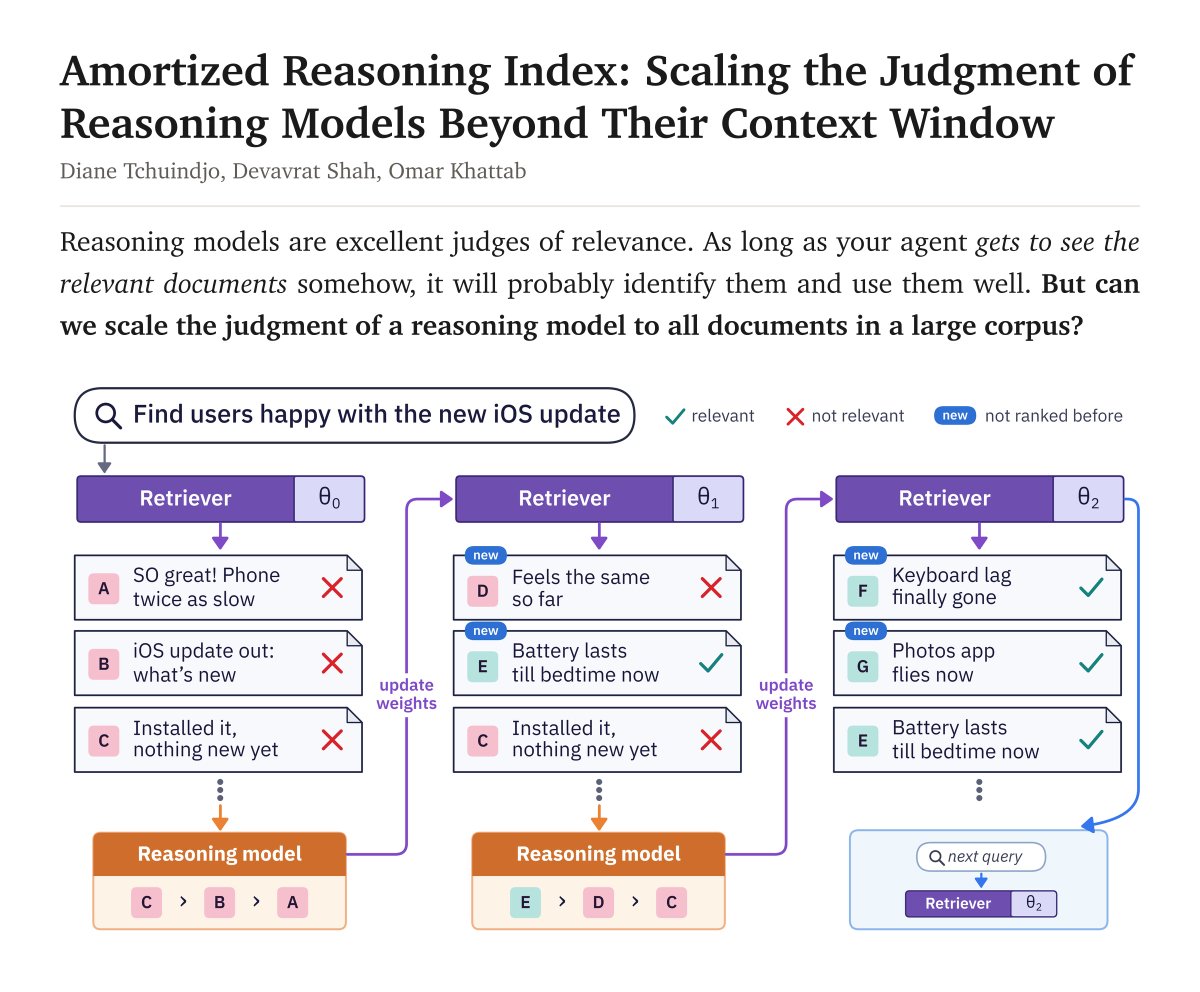
Is there a way to scale a reasoning model’s judgment for searching a massive corpus?
We introduce the Amortized Reasoning Index (ARI), a new kind of retriever that updates its weights during search, using gradients derived at inference time from the ranking preferences of a reasoning model.
Every session, current agents spend lots of reasoning deciding which search results matter, and then throw all of that judgment away upon compaction. ARI is our attempt to “amortize” that judgment, so that reasoning spent on past queries keeps improving search on future ones.
With no relevance labels, ARI takes a 400M cross-encoder that starts out weak and grows its Recall@100 on held-out queries by up to 7×, ending above Qwen3-Embedding-8B on various oblique/reasoning-intensive search tasks.
Read our blogpost: https://t.co/UEPpEpw22d
Preliminary results and discussions are below!
Had a lot of fun working and researching this. This approach still has its flaws and my goal if i continue this is to see how to allow agents to work and reason over enterprise data autonomously with high accuracy.
Built a RAG system that scores 67% on OfficeQA Pro V2, a benchmark testing AI’s ability to find and reason across roughly 120,000 pages of financial documents.
Here is how it works:
4. Retrieval also includes source inspection: opening passages, searching within documents and reconstructing table views with headers and row/column context.
The agent can check an extracted claim against its original evidence before following a lead.