New paper shows that anxiety and antisocial behavior each explain unique variance in real-world cognitive failures (e.g., daydreaming when you should be listening), and together explain over 40% of the variance in cognitive failures https://t.co/WqxuvEPCCU
Selectivity in psychopathy-empathy associations: Primary psychopathic traits associated with the reduced affective empathy and empathic concern, while secondary psychopathic traits associated with reduced cognitive empathy: https://t.co/ZhvBTs1hwO
A registered conceptual replication of Gable and Harmon-Jones (2008): What drives attentional breadth: valence, motivational intensity, or perceptual focality? https://t.co/10LU0hGN3e
Autism-related shifts in the brain’s information processing hierarchy
Review by Boris C. Bernhardt, Sofie L. Valk (@sofievalk), Seok-Jun Hong (@hong_seok_jun), Isabelle Soulières, & Laurent Mottron
https://t.co/RMYZaQKV0q
How rethinking difficulties can shape important life outcomes
Review by Veronika Job (@VeronikaJob), Christopher Mlynski, & Christina A. Bauer (@ChristinaBauerA)
https://t.co/Oit924LiwK
Here we took a novel social-cognitive lens to driving and road safety: we found that theory of mind predicts hazard perception, an important determinant of crash risk: https://t.co/YpMoJennXW
Why not let students farm out all of their writing to AI? Because the process of writing is how we train our brains to think logically and critically. And people with those skills will always be the ones we want in charge, argues @MoralityLab@Harvard. https://t.co/6c3Z9FejnQ
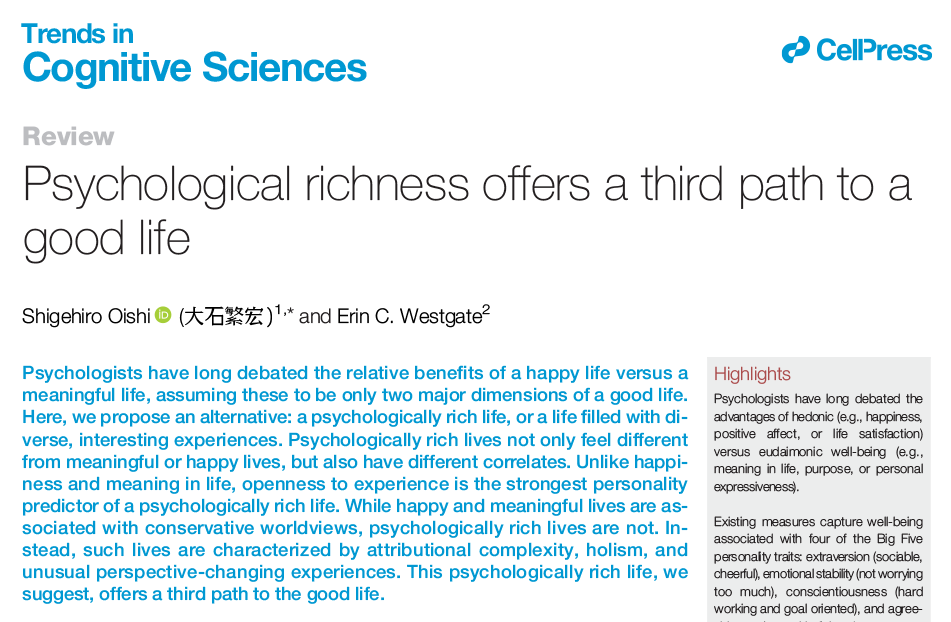
Psychological richness offers a third path to a good life
Review by Shigehiro Oishi (@Shige_Oishi) & Erin Westgate (@ErinWestgate)
https://t.co/g4CMk2iPtA
Antisocial and prosocial behaviors differ qualitatively in terms of the neurocognitive processes that underlie them and variables that promote or inhibit them. Here is a taxonomy from my Moral Behaviors chapter in the new Handbook of Social Psychology. https://t.co/0LwW5e76dZ
Can you improve student outcomes by promoting growth mindsets?
Authors with financial conflicts of interest—for example, with growth mindset books or offering corporate trainings—publish studies that say 'YES!'
Authors without financial incentives to say 'yes'... they say 'no'.
Overconfidence isn't rampant among experts or novices. It peaks among dilettantes.
Evidence: People who are somewhat informed tend to give wrong answers instead of admitting they don't know—and lack interest in learning.
A little knowledge can be more dangerous than none.
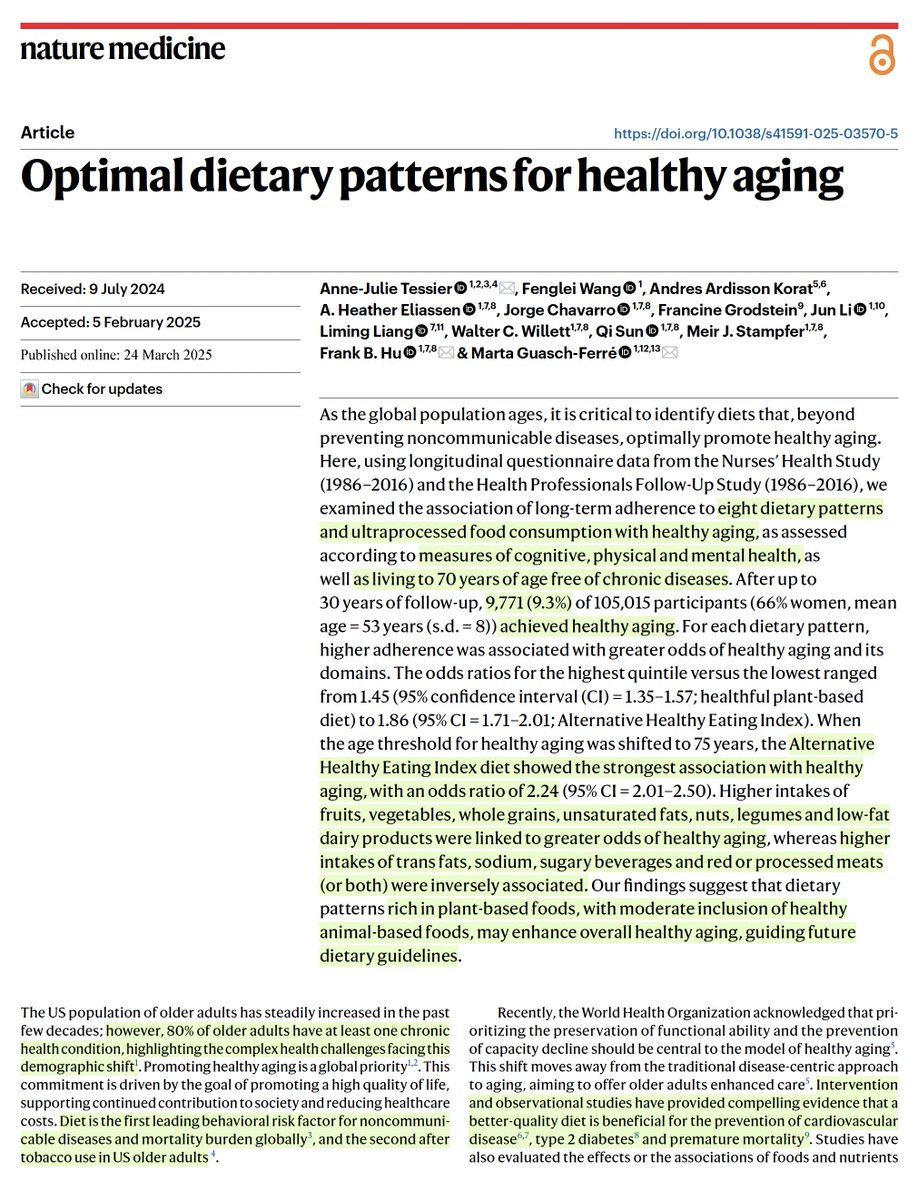
Of >105,000 participants with 30-year follow-up, only 9.3% achieved healthy aging (age 70, w/o any chronic diseases). Their diet was significantly associated with this outcome🧵 @NatureMedicine
Remember the expression “don’t bottle up your feelings”? Somehow this idea became conventional wisdom and I heard it constantly growing up—but it never intuitively made sense to me.
The same goes for the idea that we need to talk about our traumas. I once had a therapist who insisted I had to revisit the traumatic things that happened when I was young. But what actually helped me was not thinking about it or talking about it. I coped by distancing myself from those experiences—like they happened to someone else. The more space I put between myself and that girl, the better.
Something has always felt off about the idea that healing requires dwelling, ruminating, and rehashing the past. We need to start rethinking our approaches to mental distress because they aren’t working.
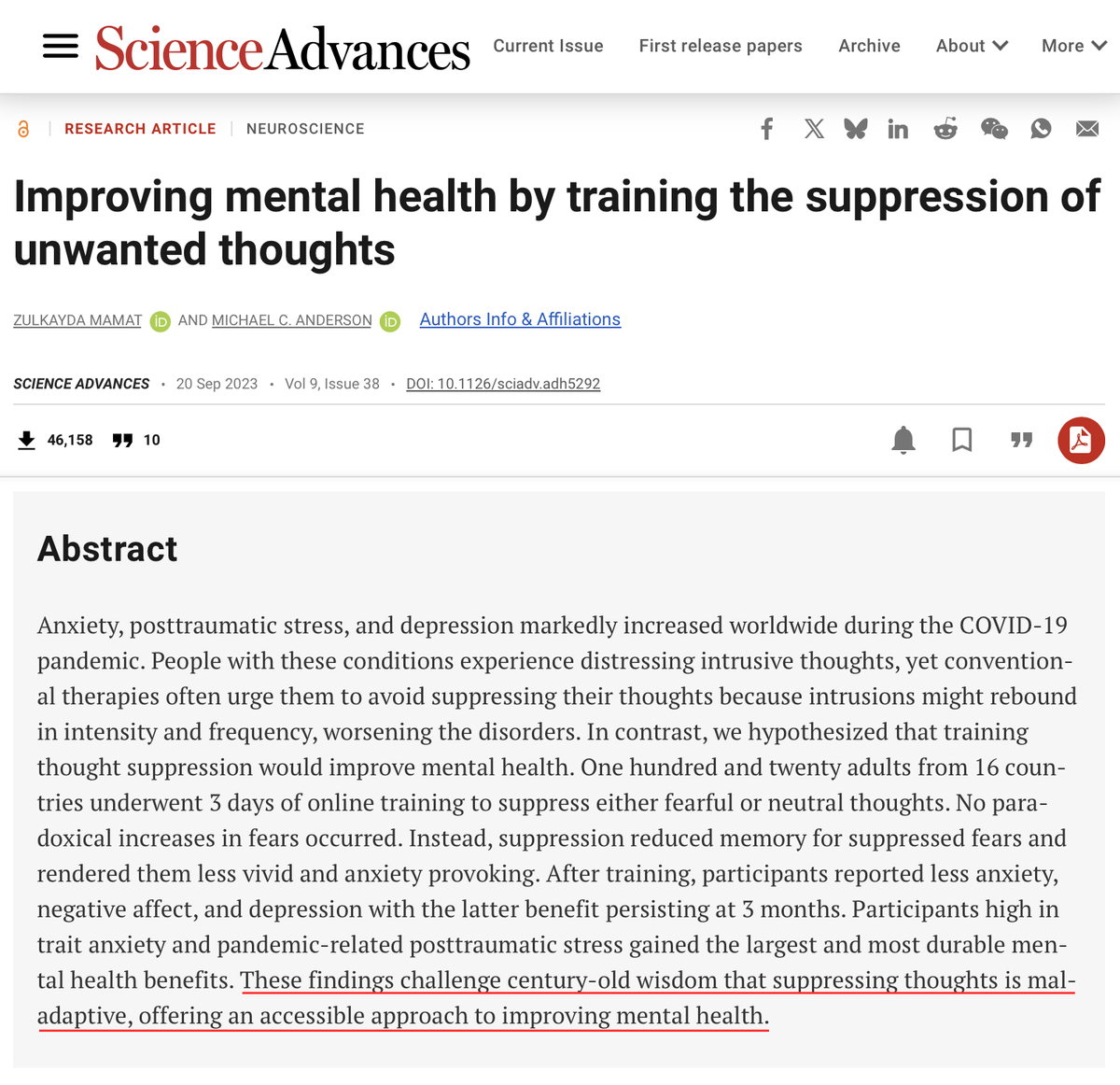
I'm glad some are trying to challenge the old practices. I came across this 2023 study: "Improving mental health by training the suppression of unwanted thoughts."