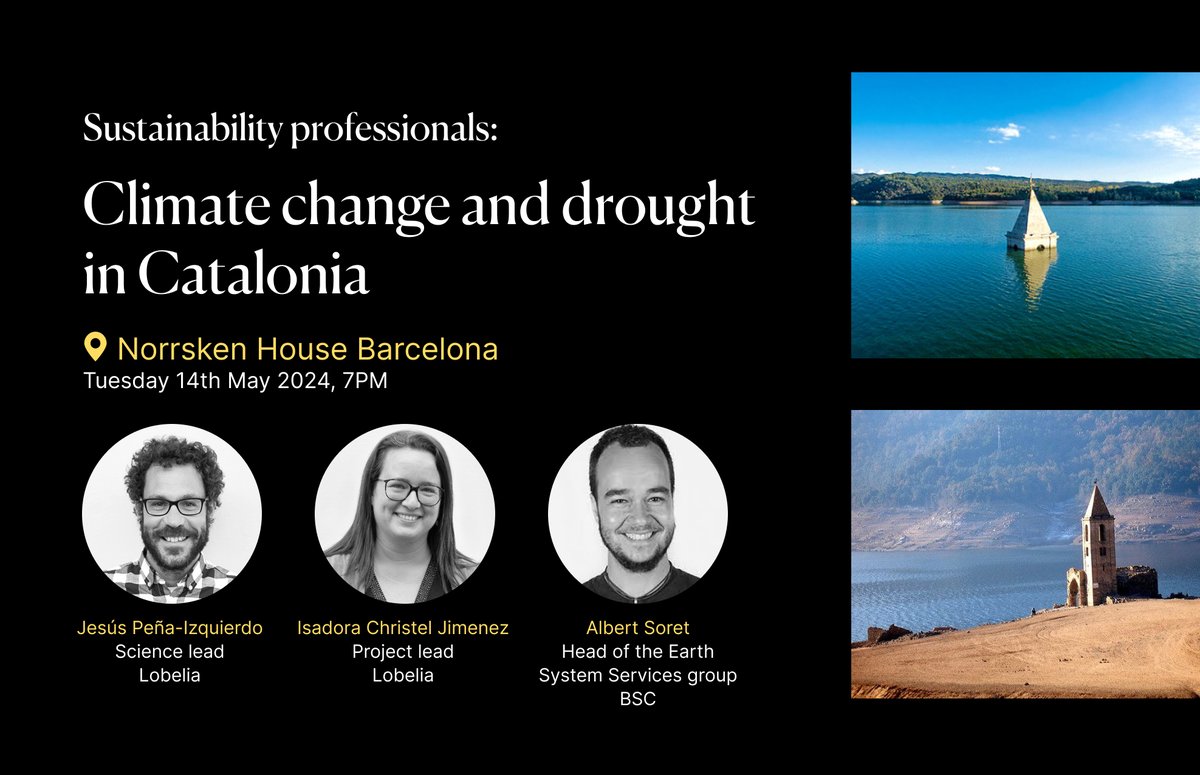
Sustainability professionals in Barcelona!
Join us next Tuesday at @norrskenBCN, we'll delve into Climate Change and Drought in Catalonia and discuss how climate science and satellite data can provide key insights to support decision making.
https://t.co/yJInG9vA1f
New paper published on microtensiometers. More validation in apples!
Relating microtensiometer-based trunk water potential with sap flow, canopy temperature, and trunk and fruit diameter variations for irrigated 'Honeycrisp' apple
https://t.co/dtR0Bd4oTG
Dr. Neil Hansen talks about how they co-locate both soil moisture sensors and water potential sensors in row crops to increase quality and yield and reduce nutrient leaching, disease, and irrigation costs (pumping costs).
Read the story: https://t.co/M9G29K0hrV
Check out our new LinkedIn newsletter, METER Group Tech Talk.
https://t.co/hDbS70raMf
Click subscribe to get stay current on environmental research, measuring methods, best practices, experimental design considerations, and much more!
We designed the TEROS 54 profile probe to make every step of your measurement process easier—without sacrificing accuracy or durability.
You get the convenience of profile measurements combined with the research-grade accuracy you’ve come to expect from METER.
The HYDROS 21 conductivity, temperature, and depth sensor measures water depth, temperature, and electrical conductivity. Low-complexity, low-maintenance, and low-cost design saves you time, hassle, and money.
Discover HYDROS 21: https://t.co/rLZO7dSBfW
📢#OfertadePràctiques Estem buscant un/a enginyer/a d'R+D (grau o màster) per al projecte MARE, una iniciativa per mesurar la humitat del sòl a #Catalunya amb dades òptiques del nanosatèl·lit #Menut.
Més informació 👇
https://t.co/D4FnhAecYC
#Pràctiques#NewSpace@IEEC_space
Apogee Instruments's 2024 catalog is now available! Check out the catalog for insight into our new products! What new product are you most excited to learn more about?
https://t.co/ii9xE0z7zm
Aquest cap de setmana, a la Fira de la #tòfona negra a Vimbodí, @DOliach parlarà de l'efecte dels diferents tipus de #nius de #turba i de la dosi del reg en l'època de recol·lecció i la quantitat de tòfona, #DemosPATT@agriculturacat@ruralcat@AjtViP
https://t.co/BFfxy3mzr8
Leaf Area Index (LAI) has vast implications across land use management, ecology, and any project impacted by gross primary productivity (GPP).
Join us for this 30-minute webinar where METER's Jeff Ritter will discuss what an understanding of LAI could do for your research.
Unlike typical contraptions, the KSAT comes with everything you need to make a saturated hydraulic conductivity measurement, right out of the box, using minimal bench space. But its biggest benefit is how it complements the HYPROP. Both the HYPROP and the KSAT use the same soil core, so you can take saturated and unsaturated hydraulic conductivity measurements and generate a complete hydraulic conductivity curve.
Discover the KSAT: https://t.co/SUmLExRQk4
#ksat #soilscience #soilhealth #soil
SATURO at sunset.
We love seeing our instrumentation in the field! @ShansSoilLife, Director of Research at GO Seed recently sent us photos of her field work with SATURO.
Automate your field saturated hydraulic conductivity measurements with the SATURO infiltrometer.
Is it possible to develop an accurate release curve using only volumetric water content?
In case you missed it, you can now rewatch this 30-minute webinar, "How to Interpret Soil Moisture Release Curve Data."
Watch the full webinar at the link below.
Creating soil moisture release curves has always been tricky.
The HYPROP 2 takes only days vs. months to generate a soil water characteristic curve in the wet range, and it does this automatically.
Nothing else is capable of doing that—not at this level of detail.
You can harness powerful insights from a soil moisture release curve.
In this 30-min webinar, join research scientist Leo Rivera as he illustrates what insights you can glean from your soil moisture release curve data and how to get everything you can from this soil fingerprint.
With the ATMOS 14, all your bases are covered.
Versatile, low-maintenance, and fast, we engineered the ATMOS 14 temperature and humidity sensor to be four sensors in one—air temperature, relative humidity, barometric pressure, and vapor pressure.
Soil scientist, Leo Rivera, talks about the many hours he saved installing TEROS soil moisture sensors at a recent Soil Health Institute project with the newly upgraded TEROS Borehole Installation Tool.
See it here: https://t.co/JndzSXDUcr