A large US-Australian study on COVID-19 has uncovered a genetic explanation as to why some people test positive but remain asymptomatic.
Prof Stephanie Gras, who led the Australian contingent, it opens the way for better vaccines and treatments 💉 https://t.co/gvZhVOP5ta
New publication from the Nematode and Vector Genomics lab @SABE_latrobe !
Researchers in DRC, South Sudan, US, Australia, & Belgium sequenced >800 mitochondrial genomes to assess genetic diversity on the path to elimination of River blindness.
@Mak_Mitreva https://t.co/SUNHICt9L5
Stimulating talk from Prof Uma Ramakrishnan (@uramakri) on how genetics 🧬 is being used to inform 🐯 tiger conservation in India. Interesting simulations and evidences presented @ICG2023 #GeneticsForConservation#TigerConservation 🐾
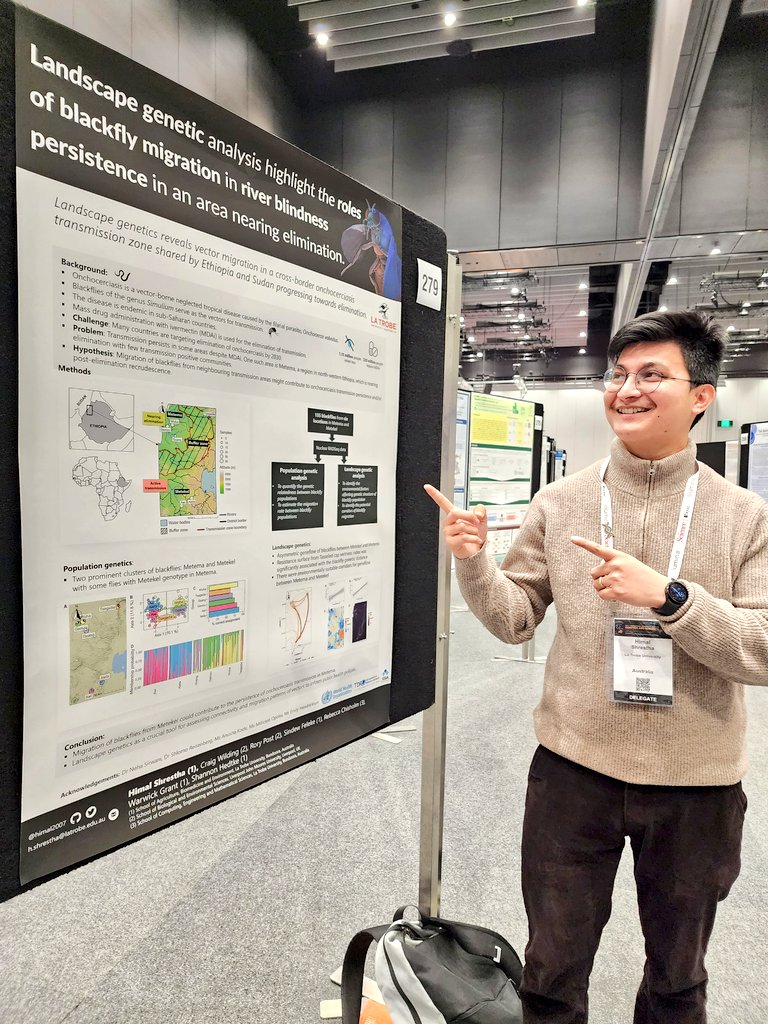
Congratulations to all @GeneticsAus student presentations @ComBio2022 We had three winners: The Mayo Prize for best long talk to Harry Eyck; the Jenny Graves Prize for best short talk to Himal Shrestha; the Sidney James Prize for best poster to Nick O’Brien 🧬#ComBio2022
Super happy to share my first first-authored publication. ☺ It is about geostatistical modeling that could be useful in planning the elimination of river blindness in Ethiopia, in this case, a neglected tropical disease in Africa.
#PLOSNTDs#modeling
https://t.co/rDAqTIQWE9
Our 4th post in our researcher PRIDE series has gone up today! 🏳️⚧️
In this post, titled "Going through puberty whilst doing my PhD", @aqueerscientist (Haylo Roberts) describes his various transitions as a transgender man & doctoral student.
https://t.co/eb7Esjdi71
Parasites do regulate immune systems of their human host. Does it have any implications with low COVID mortality in LMICs? An interesting hypothesis.. https://t.co/dwETT0avFj #parasites#COVID19#NTDs
Nematodes are the most abundant animals on earth... they account for 4/5 land animals! The highest abundances are found in tundra which is the opposite of above-ground animals. Soil biota are so important and we need to know more...
https://t.co/ibA1EFxrVm