@PurePepLab Analyzer class is actually the most important part for identity, or I would just grab a cheap triple quad and pretend that is good enough for identity.
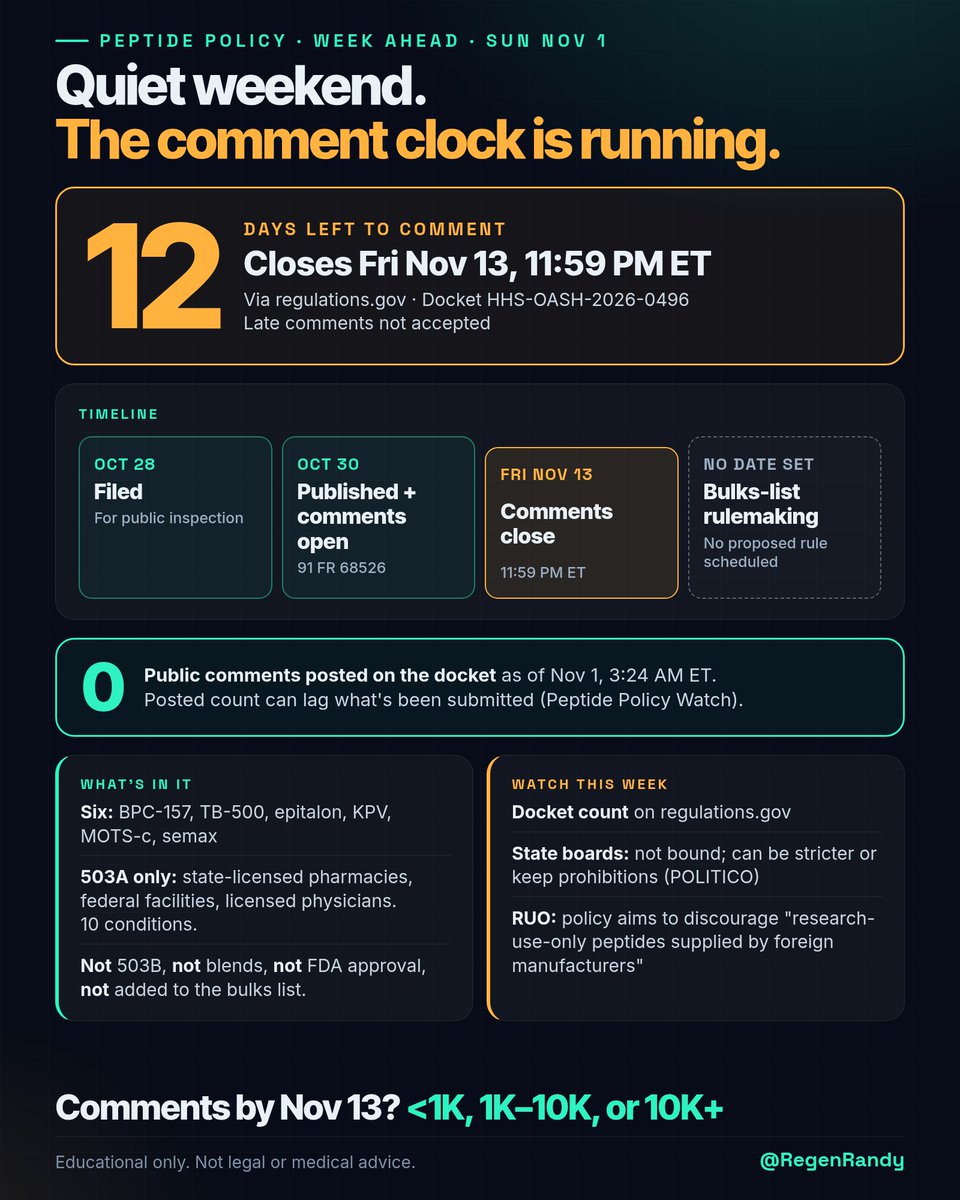
12 days left to comment on HHS's peptide policy.
As of early Sunday, zero public comments were posted on the docket.
That count can lag what's actually been submitted, per Peptide Policy Watch. But the clock is real: comments close at 11:59 PM ET on Fri Nov 13, and late comments are not accepted.
It was a quiet weekend. There's been no new federal action since the Oct 30 Federal Register notice (91 FR 68526, docket HHS-OASH-2026-0496).
Quick recap of what's in it:
• Six peptides: BPC-157, TB-500, epitalon, KPV, MOTS-c, semax
• Applies only to state-licensed 503A pharmacies, federal facilities and licensed physicians
• 10 conditions, including an FDA-registered CGMP manufacturer, valid COAs, patient-specific prescriptions, single-API products and MedWatch reporting
• Not 503B outsourcing facilities, and not blends
• Not FDA approval, and it doesn't add the peptides to the 503A bulks list
On RUO: the policy text says it aims to discourage "research-use-only peptides supplied by foreign manufacturers." It gives no path for RUO sellers.
What to watch this week:
• The comment count on the docket at https://t.co/smgSMg28SM
• State pharmacy boards. States aren't bound, and boards can be stricter or keep prohibitions (POLITICO). InsideHealthPolicy reports NABP and attorneys expect a state patchwork.
• Any FDA proposed rule adding the six to the 503A bulks list. None has been scheduled.
How to comment: through https://t.co/smgSMg28SM, under docket HHS-OASH-2026-0496, by 11:59 PM ET Nov 13.
How many public comments will the docket show by Nov 13: under 1,000, 1,000 to 10,000, or over 10,000?
@AcctMytwit@BigBrainBizness The ones who rise to the top without the process know how to build their own ladder. These are the rarest and most self-actuated type. They can't be made, they have to make themselves.
@PurePepLab@LvrVgk@PeptideSupplyCo It's going to shift the RT, might see something on spectra depending on what residues are affected, and it will fail against the control. And if the sequence us scrambled MS isn't going to pick that up either.
@LvrVgk@PeptideSupplyCo The question isn't "what is it?". That is an MS question. The question is "is this what it's supposed to be? ". And that is sufficiently answered by UV in the vast majority of cases.
Valid question. Truncated or wrong sequences will change how the sample performs during the test. The RT will be off, or the spectral signature won't match. Or you will have other peaks form altogether. We have 3 points of identification for UV. The first is you telling us what it is supposed to be, I consider that an educated guess. Then we have the RT, that has to match what our standards produced under the same conditions. Then we have the spectral fingerprint, which also has to match our reference material. We record how the sample absorbs across all of the wavelengths. Different residues in different configurations might look similar at 214nm, but not at a dozen other wavelengths. The chances of all 3 of these things matching in the same way at the same time are remote. The differences between the right thing and the wrong thing are dramatic.
A well designed method will prevent coelution (2 compounds combining into 1 peak) and reveal other deformities/nonconfomities in the compound (isomers, deamidation, etc). It just doesn't tell you exactly what those are, that's what LCMS is good at. But if you have a sample come back 85% pure with 14% isomer or whatever ran by LCMS, does that tell you anything useful? Are you going to be like "oh, this isomer is harmless I'll just sell it"? No, it's 85% of what it needs to be and you are throwing it out.
Good method development also includes performing certain stress tests to produce these kinds of impurities so you have something to compare to if you have nonconforming material.
I've said it in other places and I'll say it here too. We will spin up whatever kind of testing makes you feel confident in your product. You want to pay $2k per sample to do research grade work on what is essentially a process QC sample? No problem. I love developing this kind of stuff and I will take your money so I can buy other cool instruments.
Do you need it? It depends. Usually no. New vendor or UV come back weird? Ya, I want MS. Same stuff I have been shipping that I've tested a bunch of times? 🤷🏼♂️
For a blend there is only 1 purity number. You can't say "cartalax is 99.25% while KPV is 99.18%". It's peak area % based and since each component is part of that I can't really say this impurity applies to KPV and that one applies to cartalax. It's all 1 bin. Make sense?
And that's my fault for not thinking to filter out the duplicated purity numbers in our report generator. After we printed it I saw the problem, but we can't change them because of the crypto hash that makes them verifiable. Future COAs do not have this issue.
I'm buying an LCMS, but it's really overkill for this kind of testing. If I didn't think it was fun I probably wouldn't bother. I'm way more I terested in NMR (and some other things) as far as providing higher quality information in this space. A well designed UV method is going to be very specific to each compound. Knowing what an impurity actually is seems outside the scope. Are people trying to decide if this or that impurity is OK to send to customers? Probably not.
Everything is run on separate product vials from the same lot.
Parent lab is EFFEX Analytical. And parent probably isn't the right word. EFFEX owns the building. Synthesyx is totally separate. My family does own EFFEX (this is a family business) but my dad mostly owns that, and Synthesyx is mostly mine. EFFEX is environmental compliance and that's a NELAC structured regulatory body. I built Synthesyx for ISO compliance though, and we will definitely be acquiring that certification as soon as feasible. We have been in this business since 1983.
What would you like to know? Our parent lab has been at that address for over 20yrs and Synthesyx is also registered there. I have been developing methods for 6 months, Peptide Supply is one of the first companies I talked to when I was speccing out this project and was one of our first customers.
@MrPatKat@kverdek@Xil3nt1@PepProtocols@PeptideSupplyCo Sure you can use test strips. I don't have specific experience with those ones and I'm not in general a huge fan of test strips, but if that's all you guys want sure I guess haha.
@MrPatKat@kverdek@Xil3nt1@PepProtocols@PeptideSupplyCo I've put some thought in that. I'm not going through the DEA process to handle controlled substances at this time. But fentanyl has specific characteristics that can be screened for and we could identify those and recommend taking it to a qualified resource for eval when found.
To me, low quality would be a product manufactured incorrectly or handled in such a way that the complex breaks. But yes if the complex is broken it's just GHK and a copper supplement. I think high quality is mostly what I see. GHK-Cu is cheap. It's not hard to make. But handling is a big deal. That is a very delicate complex.
@thefreightnerd What I think is being missed is you can take someone with unique skills and experience you could never translate through a development team and have them build tools that solve important problems that were basically inconceivable 5 years ago.
@PepProtocols What's cool about GHK-Cu is you can pick up whether the copper is actually complexed (the whole point of the compound) by running an extra 246nm channel to catch the charge transfer between metal and ligand (is the copper bound?), and 608-630nm to verify the complex.