Happy Veterans Day from Lab Symplified!
To all veterans, including those who continue to serve their communities through healthcare, laboratory science, and beyond, we thank you for your service and commitment.
Lactobacillus is a great example of how not all bacteria are harmful! These beneficial microorganisms help maintain a balanced microbial environment and support our body's natural defenses.
#FridayFunFact#Microbiology#Lactobacillus
How are laboratory reference ranges established, and why do they vary between labs?
The following blog explores the science behind reference ranges, their limitations, and what laboratory professionals should know.
Read the full blog at:
https://t.co/8bHR9yqpZ5
A pulmonary embolism doesn't just affect the lungs, it can put significant strain on the heart too.
Did you know that cardiac biomarkers like troponin and BNP can help assess the severity of a pulmonary embolism?
While reagent shortages aren't always avoidable, better inventory management can help prevent unnecessary surprises.
Learn how Lab Symplified can help simplify your laboratory's inventory management. Visit https://t.co/jLCft4zour
Did you know that approximately 1 in 5 people worldwide have elevated levels of lipoprotein(a), a genetically influenced risk factor for cardiovascular disease? Ask specifically for Lp(a) testing.
#heartdisease#health#clinicallab
The parathyroid glands may be tiny, but PTH plays a major role in maintaining calcium balance.
PTH helps regulate calcium, phosphorus, and vitamin D. PTH results are often most meaningful when interpreted alongside serum calcium.
#FridayFunFact#LabMedicine#ClinicalLaboratory
Can you calculate the ±3 SD range using the mean and standard deviation provided?
A laboratory QC material has a mean of 120 and a standard deviation (SD) of 4.
What is the ±3 SD range? 🧐
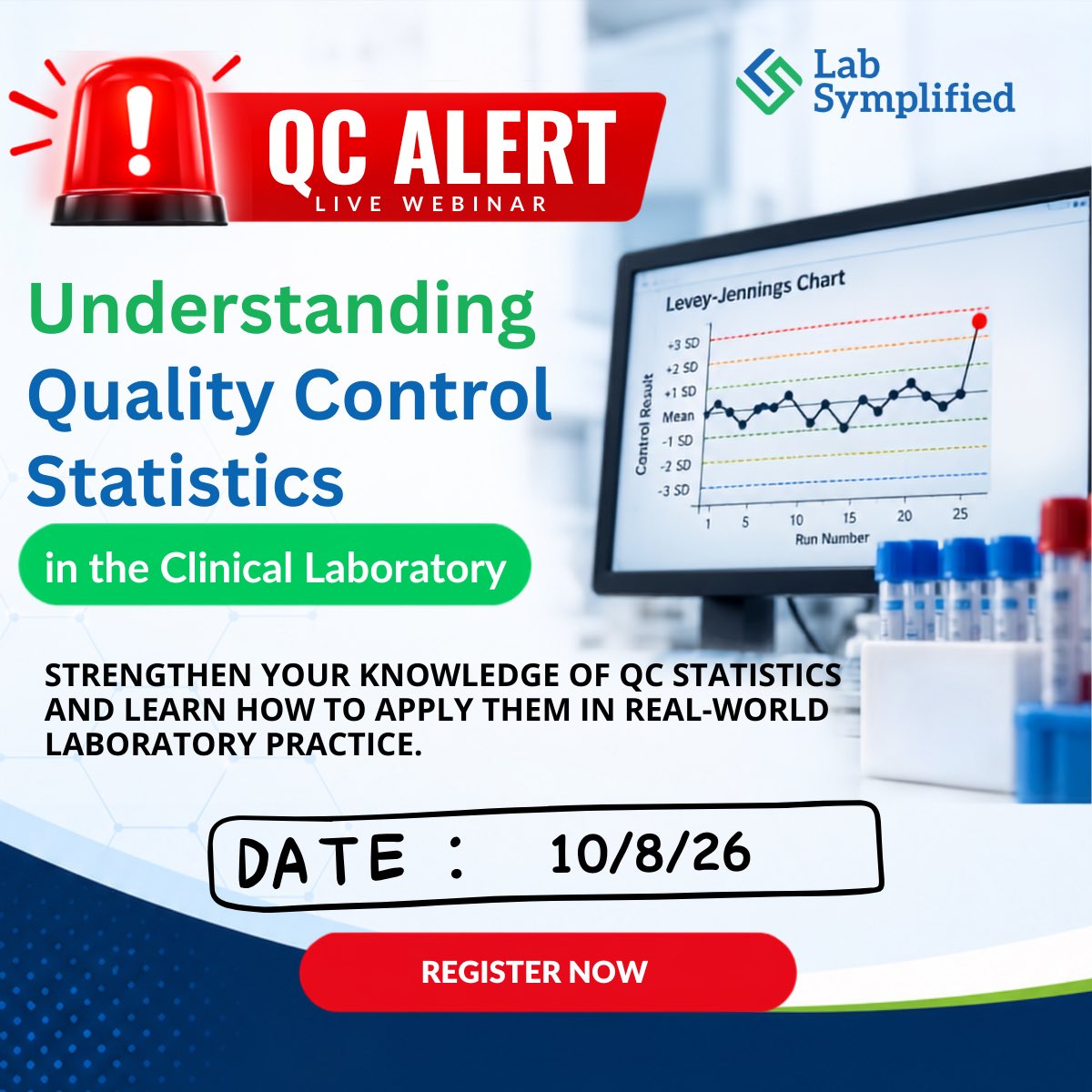
Join Lab Symplified for Understanding Quality Control Statistics in the Clinical Laboratory and strengthen your understanding of mean, SD, CV, bias, accuracy, precision, and more.
Presented by: Amari Henderson, MBA, MLS (ASCP)
Register today at https://t.co/k0MXJImXL3
Complement C4 is cleaved into C4a and C4b when activated. C4b helps tag pathogens for elimination, while C4a contributes to inflammation as part of the immune response. Understanding these roles is key to interpreting complement-related laboratory testing.
#Fridayfunfact
The right laboratory inventory management software provides real-time visibility, reduces waste, strengthens compliance, and helps keep your lab running efficiently without relying on spreadsheets or paper logs.
Read our latest blog: https://t.co/XP0FN1vhBG
Lab Symplified is excited to attend the ASCP Chicago Chapter Fall Educational Meeting on September 30th! Stop by to connect with our team!
Link to register: https://t.co/wkOPSTr0Tv
Higher Alkaline phosphatase levels are not always a sign of disease. Children and adolescents naturally have higher levels due to increased bone growth and osteoblast activity. This is why age matters when interpreting laboratory results.
#FridayFunFact#MedicalLaboratoryScience
Cholinesterase testing can provide an important window into both nervous system function and potential pesticide exposure. A decrease in cholinesterase activity may be an early indicator of organophosphate exposure before symptoms develop.
Join our live webinar, Understanding Quality Control Statistics in the Clinical Laboratory, to explore the statistical concepts that support reliable QC interpretation, error detection, and laboratory quality.
https://t.co/vKQjLiEunP
We look forward to connecting with laboratory professionals and supporting a day of education, innovation, and networking!
📍 NIU Naperville Campus
Wednesday, September 30th, 2026
Link to register: https://t.co/wkOPSTr0Tv
Cholesterol isn't the only lab measurement that can provide clues about heart health!
High-sensitivity CRP (hs-CRP) detects low levels of inflammation and may provide additional insight into cardiovascular risk.
#FridayFunFact#LabMedicine#heartdisease