HTML is the new markdown.
I've stopped writing markdown files for almost everything and switched to using Claude Code to generate HTML for me. This is why.
Kubernetes is beautiful.
Every Concept Has a Story, you just don't know it yet.
In k8s, you run your app as a pod. It runs your container. Then it crashes, and nobody restarts it. It is just gone.
So you use a Deployment. One pod dies and another comes back. You want 3 running, it keeps 3 running.
Every pod gets a new IP when it restarts. Another service needs to talk to your app but the IPs keep changing. You cannot hardcode them at scale.
So you use a Service. One stable IP that always finds your pods using labels, not IPs. Pods die and come back. The Service does not care.
But now you have 10 services and 10 load balancers. Your cloud bill does not care that 6 of them handle almost no traffic.
So you use Ingress. One load balancer, all services behind it, smart routing. But Ingress is just rules and nobody executes them.
So you add an Ingress Controller. Nginx, Traefik, AWS Load Balancer Controller. Now the rules actually work.
Your app needs config so you hardcode it inside the container. Wrong database in staging. Wrong API key in production. You rebuild the image every time config changes.
So you use a ConfigMap. Config lives outside the container and gets injected at runtime. Same image runs in dev, staging and production with different configs.
But your database password is now sitting in a ConfigMap unencrypted. Anyone with basic kubectl access can read it. That is not a mistake. That is a security incident.
So you use a Secret. Sensitive data stored separately with its own access controls. Your image never sees it.
Some days 100 users, some days 10,000. You manually scale to 8 pods during the spike and watch them sit idle all night. You cannot babysit your cluster forever.
So you use HPA. CPU crosses 70 percent and pods are added automatically. Traffic drops and they scale back down. You are not woken up at 2am anymore.
But now your nodes are full and new pods sit in Pending state. HPA did its job. Your cluster had nowhere to put the pods.
So you use Karpenter. Pods stuck in Pending and a new node appears automatically. Load drops and the node is removed. You only pay for what you actually use.
One pod starts consuming 4GB of memory and nobody told Kubernetes it was not supposed to. It starves every other pod on that node and a cascade begins. One rogue pod with no limits takes down everything around it.
So you use Resource Requests and Limits. Requests tell Kubernetes the minimum your pod needs to be scheduled. Limits make sure no pod can steal from everything around it. Your cluster runs predictably.
The jump in latency comes from garbage collection in V8.
More requests mean objects get created much faster. Heap fills quicker. Full GC cycles start. Those block the event loop for long stretches, hundreds of ms or more once the heap grows.
That’s why average response time can still look decent while the slowest requests explode. Everything queues behind the pause.
You run into this pattern whenever code spins up lots of temporary objects per request — json parsing, building responses, string work in loops, that kind of thing.
Run with --trace-gc and you’ll see long MarkSweepCompact lines that match your bad moments.
Start by cutting how many objects get made: reuse buffers, skip creating stuff you throw away right after, avoid new objects in hot paths. Pools can work sometimes but check first. Bumping max-old-space-size just moves the problem later.
If there’s any blocking sync code in there too it makes it feel worse, but the shape points at GC pressure.
Cache revalidation is now fully asynchronous. The first visitor no longer waits for an origin round-trip while the asset updates in the background.
https://t.co/uqHeXLiNL4
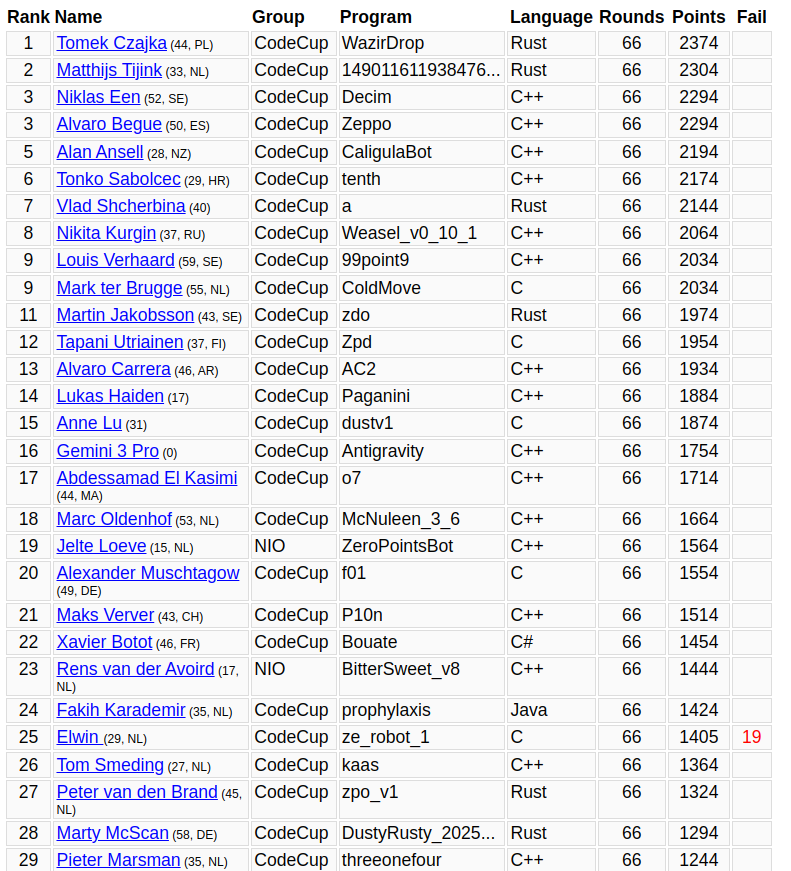
I trained a board game playing bot that won an AI tournament: CodeCup 2026.
It learned to play by playing 100 million games against itself on 32 cores over the course of a week.
Your Nginx logs show the client IP for every request is 10.0.0.5 (The Load Balancer's IP).
You want the real user IP.
You enable 'X-Forwarded-For' on the Load Balancer.
However, you are using a TCP (Layer 4) Load Balancer for performance, not HTTP (Layer 7).
Since the LB doesn't inspect packets, it can't inject an HTTP header.
What protocol extension must you enable on both the ELB and Nginx to pass the client IP connection information?
Do you know how to turn a single moment of root access into long-term persistence?
Using sudo chmod +s /bin/bash is a classic technique.👇
#Linux#Linuxcommand
Jeremy, a 19-year veteran of 37signals, calmly walks through the process moving 5+ petabytes of data and billions of individual files off AWS and onto our own on-prem storage setup without a second of downtime.
The how, the time, and the tooling, it's all in here. Watch: