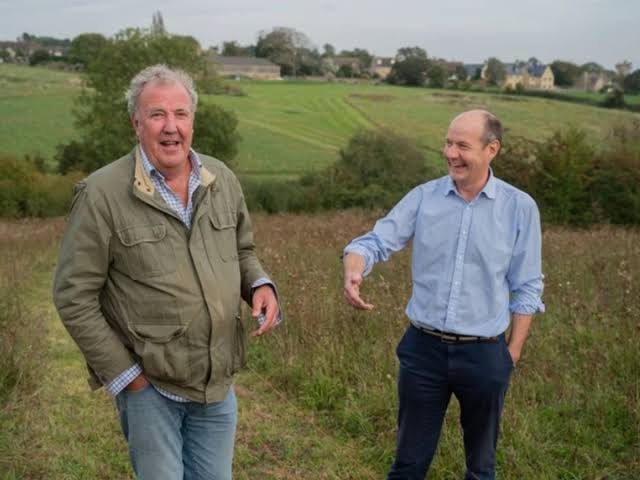
A timeline of one man's cunning inheritance tax scheme.
2008: Buy a thousand acres in Oxfordshire. Tell The Times that dodging inheritance tax is the critical thing. Scheme live.
2009 to 2018: Do absolutely nothing. A villager farms it on contract. Flawless.
2019: The villager retires. Rather than hire another one, decide to farm a thousand acres yourself, having never grown anything.
Also 2019: Invite a film crew.
2020: Rain for nine weeks. Profit on a thousand acres: £144.
2021: Broadcast the £144 to the largest streaming platform on earth, thereby informing the entire planet that farmland makes nothing.
2021: Open a farm shop. Acquire a queue down a lane and the undivided attention of West Oxfordshire District Council.
2022: Restaurant refused. Enforcement notice. Six weeks to take a barn apart.
2023: Lose the appeal. Lose it again.
May 2024: Accidentally get English planning law rewritten. Lawyers name it Clarkson's Clause.
August 2024: Open a pub selling only British food. Sell your own sausage at 74p against 18p imported, and eat the difference on every plate.
October 2024: The Chancellor caps agricultural property relief at a million. Scheme dead.
November 2024: Stand on a platform in Westminster in front of thirteen thousand farmers, drawing maximum national attention to the exact tax break you were supposedly hiding behind.
July 2025: Go down with TB. First calf ever born on the farm destroyed, pregnant with twins. Gate padlocked.
23 December 2025: Government retreats. The threshold goes from one million to two and a half. Five million for a couple.
March 2026: Farm declared clear.
July 2026: Drive four hundred miles to Scotland and buy more cows.
Eighteen years.
Planning law changed. Agricultural degree applications climbing. Cited in the Commons more times than most ministers manage. Half the estates that were going to be caught by the tax are no longer caught by it.
He was accused of buying a farm to dodge inheritance tax, and then spent eighteen months getting the relief raised for everybody else's.
Worst tax dodger in British history.
Best thing to happen to British farming in fifty years.
Jeremy Clarkson calls his land agent Cheerful Charlie because the man has never once brought him good news. Five series. Not a single piece of it.
Watch the pattern and it stops being a running joke.
Clarkson has an idea. Charlie opens the folder. The idea costs more than it earns, or the yield will not carry it, or the rules do not allow it, or the money runs out in March. Clarkson goes ahead anyway. Charlie is right. Nobody thanks him, and next episode the same thing happens again.
Now notice what he is actually doing in every one of those scenes. He is not being pessimistic. He is reading out the arithmetic of British farming to a man who does not want to hear it, and the arithmetic never says yes.
The nickname is a joke about Charlie's manner. It is a description of the industry.
Because look at what the job now consists of. Harper Adams lists what a land agent has to handle: planning law, agricultural management, budgeting, finance, construction, property law, machinery purchasing, valuation and negotiation. Nine trades. Charlie has an agriculture degree from Nottingham, is a registered agricultural valuer and a qualified agronomist, spent years at Strutt and Parker, has over two decades in the field and is a partner at Ceres Rural.
Clarkson could have hired anybody in Britain. He hired the real thing in 2019, and the real thing has spent five years saying no.
That is the state of it. The best-qualified man on the farm, applying twenty years of training to a thousand acres, and the professional answer is almost always that it will not work.
Then the bit that turns the whole story over.
Harper Adams says applications and open day numbers on its Land and Property Management course have felt a ripple effect from the show, and their lecturer names Charlie as the reason. He praised exactly the thing Clarkson mocks him for: the no-nonsense approach, the refusal to dress anything up.
So a generation of teenagers watched a middle-aged man deliver bad news on television for five years, and a chunk of them thought, that is the job I want.
Not the tractor. Not the pub. Not the fame.
The folder.
They watched somebody be quietly, unglamorously right in a room full of people who did not want to hear it, and they recognised it as a kind of competence worth having. That is a better advert for a profession than any campaign has ever managed, and nobody designed it.
Every trade in this country has a Charlie. The one who tells you what it will actually cost, who gets ignored, and who turns out to be right in about eight weeks.
He is never the one they make the programme about.
He is the reason there is a farm left to film.
So the broad story out of China remains incredibly sustained weakness in the domestic economy -- and a crazy and sustained export boom that makes it ever harder to deny the second China shock
15/15
https://t.co/30KMrv6bf9
A practical guide about how to choose a good restaurant using Dazhong Dianping (大众点评), which is China's main restaurant directory/review/coupon platform, based on my 10+ years of experience using it almost daily...
But first, some general background information: Thread.🧵
🚆🇹🇭 I was delighted to be invited aboard the inaugural journey of Beyond Horizon, Thailand’s first luxury passenger rail carriage designed and built by Thai engineers. The special run marked the official handover of the prototype to the State Railway of Thailand and showcased an exciting new chapter in the country’s railway innovation and premium rail tourism.
📷 Photo by SRT Governor
#BeyondHorizon #ThaiMakesTrain #SRT #ThaiRailways #RailTourism #MadeInThailand #ThaiEngineering #RailNews #TrainTravel #ThaiTrainGuide #ThaiTracks #RailTourism #Thailand
One battery company made more profit last quarter than seven of China's biggest carmakers combined. CATL: 20.7 billion yuan. Geely, Chery, BYD, SAIC, Great Wall, Seres, and Changan added together: 17.7 billion.
The company that makes the battery out-earns the companies that make the cars. By a wide margin.
In any manufactured product, value concentrates at the ends of the chain (design and key components on one side, brand and distribution on the other) while the middle, final assembly, earns the thinnest margins. CATL sits at the high-value component end. The carmakers do the assembly. The battery is the most expensive and most differentiated part of an EV, and CATL owns that part for a huge share of the industry.
CATL has become the "Intel Inside" of the global EV industry. As consumers come to associate CATL with safety and quality, carmakers find it harder to switch to cheaper battery suppliers without risking weaker sales. The component brand became more trusted than the car brand. Buyers want the CATL battery the way PC buyers once wanted the Intel chip, regardless of which box it came in.
The automakers see the trap. They're hedging. Investing in rival battery suppliers. Building in-house battery production. Trying to claw back leverage. But it's hard to escape a supplier whose name your customers now check before they buy.
Isn't this the "Chinese overcapacity and dumping" story the Western press keeps pushing? Again: look at the profit. CATL earned more than all seven carmakers combined and more than the EU's tier-1 auto suppliers combined. A company drowning in unprofitable overcapacity doesn't post the highest profit in its entire industry.
In the EV transition, the battery is the engine, the fuel tank, and the single most expensive component fused into one part. Whoever controls battery manufacturing controls the margin pool of the entire industry. The carmakers compete on price, design, and software, grinding each other down in a brutal price war. CATL sells all of them the one part none of them can do without, and collects the profit they're too busy fighting each other to keep.
For anyone interested in China’s economic development, local governance, and the electric vehicle supply chain, I highly recommend following Fengming. His timely and in-depth analysis consistently provides valuable insights into the forces shaping China’s economy and EV industry,
🚗🔋 Many think Beijing masterfully planned China's EV takeover. Fengming Lu (@ANUBellSchool ) and I spent 3 years and 60+ interviews finding out what actually happened in our latest article @TheChinaJournal. A thread 🧵
#CNOOC#HKSE:883
Upcoming dividend of HK$0.66 per shareEligible shareholders must have bought the stock before 12 June 2025.
Payment date: 11 July 2025.
Payout ratio is a comfortable 46% and this is well supported by cash flows.
Trailing yield: 7.7%
#PADINI
2025 revenue forecast increased from RM2.01b to RM2.04b.
EPS estimate increased from RM0.153 to RM0.179 per share.
Net income forecast to grow 6.3% next year vs 8.9% growth forecast for Specialty Retail industry in Malaysia.
Consensus price target up RM2.20 to RM2.54