Spicy take:
The older, slower path of developing ideas through canvas-based tools, paired with Claude Code for prototyping, is producing more intentional and better creative outcomes than these insanely over-processed AI workflows.
the issue with Claude design is that it’s not a canvas. might be a skill issue but my visual thinking is faster than my ability to translate it into words. until i can move things around in a canvas, i’m not leaving Figma.
i don’t want to prompt every change when i already know what i’m trying to do
if you're a woman in tech, and under consistent, intense stress, I would get a full blood test panel with thyroid coverage.
we don't talk enough about how there is real irreparable damage that can be caused, specific to women's bodies
and it's simply not worth it.
there is always a peaceful & joyful path to creating.
This is really neat but it’s not a design tool as much as it’s a design _production_ tool.
The practice of design is mostly about what comes before production.
There’s no doubt in my mind that all parts of software production will become automated very soon. Writing code, making web pages, putting pieces of a design system together etc.
And that’s fine. I think few people actually enjoy this kind of production work. Wouldn’t it be better if we spent our precious time in life on what is more meaningful?!
At the core, the practice of design is methodical; like architecture, not like art. In a nutshell: We find constraints, form comprehension of the whole and propose solutions that honor those constraints. First after that do we enter some form of production phase, usually prototypes first, learn about some constraints that were hidden before, loop back, prototype and then build the production-grade “final” artifact.
These last few tasks are quickly losing value because AI tools can do it much faster (not yet better though) than humans. It’s simply just what has the best RoI for a business.
Some companies and individuals will continue to spend human time on certain parts of the “production line” as a market differentiator, but it will cost them a relatively high price compared to competitors.
Anyhow, I still haven’t seen a tool better than Figma that supports the actually-interesting part of the design process.
I wouldn’t be surprised if Figma focused their products on that, maybe separating “products for production” of “products for ideation & exploration.” The latter would obviously still leverage AI, but not to do the work for me but rather to support my efforts the way a therapist helps me live a better life (not living my life for me.)
Please help spread the word:
I’m honestly shocked to see my illustration being used on T-shirts sold at the Monte-Carlo Masters without my permission or a licence.
I never expected something like this from such a major tournament.
If someone from the organisers sees this, please contact me so we can resolve this properly.
@montecarlorolex@atptour
There has to be some word for this concept
It's why designers from tech who design touchscreens like Jony Ive won't put a touch screen in a car but use real knobs
Or why programmers don't actually like smart homes and smart appliances at all but want things analog
Or why tech people raise their kids without mobile devices
Like knowing things so well from inside of it (tech) that you choose to NOT use it because you know the negatives that come with it in specific contexts
Why I'll always use Illustrator over Figma for logos:
1. Everything you need is built in.
In Figma, I feel like I'm often hunting for a specific plugin that may or may not actually work for what I need. Illustrator has everything I need (for the most part) built it.
2. More control over your shapes.
Puppet warp, envelope distort, the blend tool, everything flows. Less friction between what you're thinking and what you're making.
3. Illustrator was literally built for this.
Figma is incredible for decks, digital assets, brand exploration I literally use it daily. But for logos? I'm still not hitting that flow state with it.
There's probably plugins or new features for all of these things, but I think I'm maybe just too old school and stuck in my ways.
sketch took design from photoshop.
figma took it from sketch.
ai is taking it from figma.
designers keep surviving.
because the tool was never the point.
Yoh guys AI is great and all but I think if you running a business still hire a designer hey. People’s logos, flyers and marketing material is looking the same. Just saw two different brands with identical artwork.
@javilopen A lot of hasty decisions being made in the name of regulation.
My hot take is that people aren’t against AI tools, rather against automation.
Unfortunately most think these two terms are inherently synonymous so they’re opting to gatekeep education and productivity instead.
lovable is free for everyone on sunday to celebrate international womens day & shebuilds <3 make my life harder by telling your friends
best regards,
weekend AI ops
I was at Uber in 2017 when #DeleteUber happened. Almost a decade later, I'm watching the same movie play out on how consumers choose with their wallets in response to the actions the DoW took against Anthropic this weekend.
Same administration. Same pressure to bend the knee. Very different ending.
When Trump signed his travel ban executive order in January 2017, NYC taxi drivers staged a strike at JFK Airport in protest. Uber turned off surge pricing - not to break the strike, but to avoid price gouging people during chaos.
It didn't matter. Activists interpreted it as strike-breaking. Travis joined the president's economic advisory council, trying to smooth things over. The calculus was: keep access, minimize damage.
It was the wrong bet. 200,000 people deleted the app.
You can't recover trust that way once you've lost it.
Now at Anthropic, there’s the same pressure from the administration, but I’m watching the movie play out differently.
Anthropic drew two hard lines:
No mass domestic surveillance.
No fully autonomous weapons.
When pressured to move those lines by the administration, the leadership at Anthropic held steadfast.
It’s one thing to put values on a wall. It’s another to make hard decisions in service of them - decisions that cost you commercially, that invite criticism, that require real courage when a powerful institution is telling you to back down.
Most companies discover, under that kind of pressure, that their values were performative.
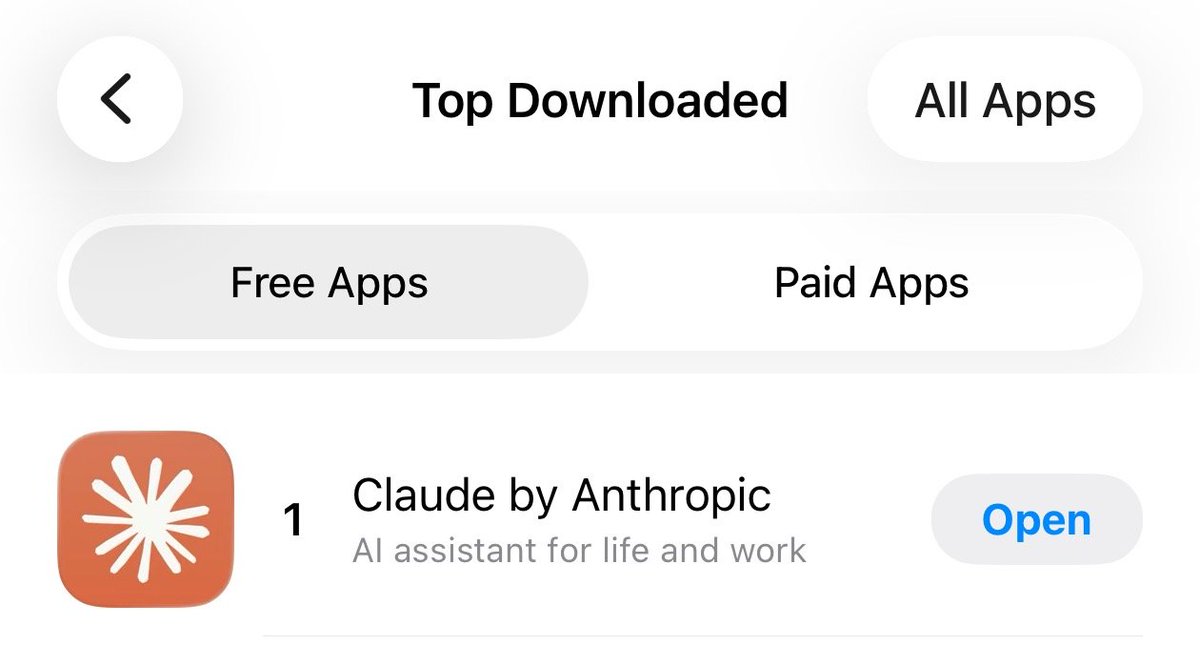
What’s currently playing out is a demonstration on how trust actually works: Claude just hit #1 on the App Store today. Not because Anthropic is perfect, but because Anthropic is principled.
"No amount of intimation will change our position on mass domestic surveillance or fully autonomous weapons because it's incompatible with our democratic values."
The First Amendment exists so citizens can hold their government accountable. The moment AI enables mass surveillance of its own people, that accountability disappears. That's not a line we'll cross for any revenue upside.
Uber learned this the hard way. Anthropic chose the principled path. The public noticed and are choosing with their wallets and downloading Claude.
This is the thing about integrity - it's not a PR strategy, you have to actually live by your values.
As the Al frontier advances, we are entering unprecedented territory.
More than ever, a commitment to ensure that powerful AI remains beneficial to humanity beyond profits is critical.
The real test of values isn't what you say when things are easy. It's what you do when a powerful institution is telling you to back down.
Today and everyday, I am proud of the integrity of the team at Anthropic and I am proud to say I work at Anthropic.