The oldest financial trick in history is being used on you right now. Ancient Rome couldn't stop using it either, and it played a part in bringing down the whole empire...
For two hundred years the Roman denarius was one of the most trusted coins in the world: under Augustus it was struck from silver that ran around 95% to 98% pure, a small disc of real metal that a soldier or a shopkeeper could hold and believe in. It held its value across the whole Mediterranean because there was something genuinely valuable inside it.
Then the emperors discovered a trick that every government since has been tempted by. If you melt down the coins, mix in a little cheap copper, and mint them again, you get more coins out of the same silver. To the eye, nothing has changed. The face on the front is the same. But now the state has more money to spend, and it costs them nothing to make.
Nero began it after the great fire of Rome in AD 64, dropping the silver to about 90%. It was barely noticeable, which was precisely the point. But once the door was open, no emperor could resist walking through it. Each one who needed to pay the army or fund his ambitions shaved off a little more.
By the reign of Septimius Severus the denarius was down to about half silver. His son Caracalla went further, and by the time of Gallienus in the 260s the coinage that had once been nearly pure held around 5% silver. It had become a copper token dipped in a thin silver wash, and everyone knew it...
The result was exactly what you would expect, and exactly what we fear today: prices spiraled. The more coins the mint stamped out, the less each one was worth, and the cost of everything climbed to catch up. Trust in the money collapsed so completely that soldiers began refusing to be paid in it and demanded grain and goods instead.
The same thing is happening to your money right now: according to the U.S. Bureau of Labor Statistics, the dollar has lost more than 96% of its purchasing power since 1913, the year the Federal Reserve was created. What a single dollar bought then takes more than thirty dollars to buy today.
The coin was silver and the modern equivalent is paper, but the pattern is the same that ate the denarius: a slow, relentless erosion of value that the people holding the money can feel but cannot stop.
Keynes called it by its real name: theft. "By a continuing process of inflation," he wrote, "governments can confiscate, secretly and unobserved, an important part of the wealth of their citizens." And Milton Friedman put it even more bluntly: "Inflation is the one form of taxation that can be imposed without legislation."
This is one of the most important lessons Rome has to teach: a currency almost never dies in one dramatic stroke, it is always worn away a little at a time by rulers who tell themselves that this once, in this emergency, it will be fine, and by citizens who do not notice until the coin in their hand is copper wearing a thin coat of silver. As Ludwig von Mises, who watched the great European currencies collapse in the twentieth century, put it:
"Government is the only agency that can take a useful commodity like paper, slap some ink on it, and render it totally worthless."
@IkkoIkki3@Baron_Dudee Niye daha öncesinde sormamış? O diyalog tamamen palavra. Bütçe planlamasını devlet yapıyor, onayı devlet veriyor. Sadece tek bir büro 81 ilin valiliklerini, belediyelerini, kolluk kuvvetlerini, jandarmayı kontrol ediyor hükümet aciz kalıyor öyle mi? Tek bir kararnameye bakar.
Hans-Hermann Hoppe turns 77 today. Few living thinkers have pushed libertarian theory as far as he has.
A German economist and philosopher who studied with Jürgen Habermas before crossing over to the Austrian School, Hoppe became Murray Rothbard’s most important student. He took Misesian praxeology and Rothbardian natural rights and tried to give them a harder foundation. In his “argumentation ethics” he argued that the very act of reasoned debate presupposes self-ownership and the non-aggression principle. To argue is already to concede that persons, not collectives, are the basic moral units.
His most famous book, Democracy: The God That Failed, attacked a piety almost no one on the modern right or left wanted examined. Democracy, he claimed, is not the crown of liberty but a system that shortens time horizons. A hereditary monarch has some incentive to preserve the capital value of the realm; an elected official is a temporary caretaker who may loot it. Mass democracy, on this view, rewards present consumption, high time preference and the politics of redistribution. The argument is easy to caricature. It is harder to dismiss once you notice how public debt, monetary expansion, and welfare coalitions behave.
Hoppe’s political conclusion is anarcho-capitalism: law and defence supplied by private agencies and covenant communities rather than the state. From the same property-rights logic he drew a fierce defence of freedom of association - including the right of communities to exclude.
His influence runs through paleo libertarianism and a generation that treats the state not as a referee but as the principal aggressor. You need not accept every conclusion but it is impossible to deny that Hoppe forced the question most polite theory avoids: if private property is the foundation of peace, how much of the modern democratic state is compatible with it?
It is often claimed that Denmark is proof that socialism works.
But there is a problem: Denmark is very far from socialist. Its economy is built on private property, free enterprise, open trade and competitive markets.
In the 2026 Heritage Foundation Index of Economic Freedom, Denmark scores 79.0 - the 7th freest economy in the world and 4th in Europe - and is classified as “Mostly Free”. Its labour market is flexible, property rights are strongly protected and businesses face relatively light regulation. The wealth that funds Denmark’s generous welfare state is created by one of the most competitive capitalist economies on the planet, not by state ownership of the means of production.
One important factor makes the Danish model appear to “work” is not socialism but the extraordinary cohesiveness of Danish society. For decades Denmark was one of the most culturally homogeneous nations in Europe, with high levels of social trust, low corruption and a strong work ethic. Citizens were willing to pay very high taxes because they trusted that others would do the same and that the system would not be gamed. That cultural foundation is what allowed the welfare state to function without the collapse seen in more diverse or lower-trust societies.
So in fact, Denmark proves the opposite of what its admirers claim: big government can only sustain generous entitlements on the back of a dynamic, free-market economy and a high-trust, culturally cohesive population. Remove either pillar and the model fails.
Free markets are highly efficient if they are allowed to thrive, and to a large extent, that is what Denmark has done. Rather than being evidence for socialism, the small Scandinavian country shows that the very things many Western countries are actively undermining in fact provide the foundation for the model of society they claim to protect.
The Socialist myth is that governments can promise more & more, and take more & more, but that we can still keep our freedom. The truth is that if government does everything for you, it will take everything from you - first your money, then your dignity, & finally your freedom.
“El culto al Estado es el culto a la fuerza. No hay amenaza más peligrosa para la civilización que un gobierno de hombres incompetentes, corruptos o viles. Los peores males que la humanidad ha tenido que soportar han sido infligidos por malos gobiernos.”
Ludwig von Mises
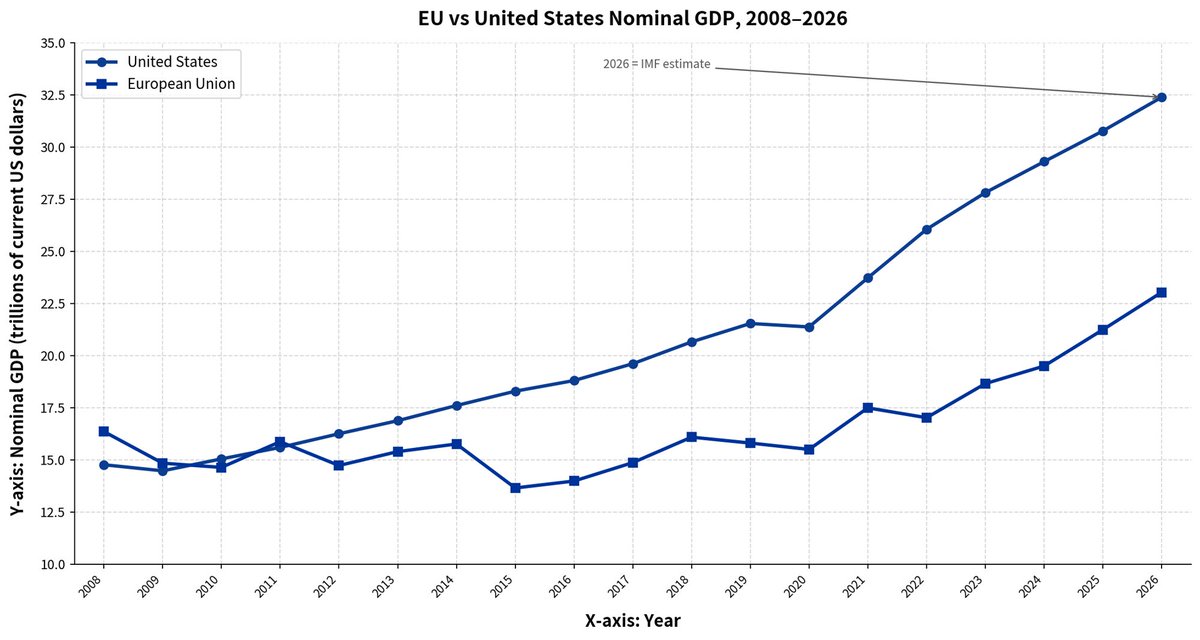
Remember: the EU’s economy was larger than the US’s in 2011. Thanks to its self-defeating ‘green’ and GDPR policies (and U.S. tech dominance) the US economy is now 44% larger than Europe’s. Europe needs to wake up. 🇺🇸 🇪🇺
The Bolshevik seizure of October 1917 was a coup by a disciplined minority, the Bolsheviks numbering perhaps 25,000 party members in a country of 160 million, who exploited the provisional government's catastrophic decision to keep Russia in World War I.
Lenin grasped one essential truth: whoever controls the state controls everything. Property rights collapsed within months. The decree on land nationalization in November 1917 handed bureaucrats power over all agricultural production, and by 1921 famine killed roughly five million Russians. The famine was deliberate extraction, not drought.
Ludwig von Mises published his socialist calculation argument in 1920, explaining precisely why this would happen. Without prices generated by voluntary exchange, planners have no mechanism to allocate resources rationally. They guess. Millions pay with their lives for them guessing wrong.
The Cheka, Lenin's secret police, executed thousands without trial before 1920. Trotsky militarized labor. The banking system became a printing press, and hyperinflation destroyed the savings of every Russian who had accumulated anything.
The Bolsheviks built capitalism's photographic negative: every productive incentive inverted. Entrepreneurs faced execution. Profit became criminal. The peasants who fed Russia slaughtered their own livestock rather than surrender them to collectivization. By destroying the price system, the Bolsheviks destroyed the only tool capable of coordinating a complex economy. What replaced it was terror, chronic shortage, and seventy years of organized poverty dressed in ideological theater.
@Hsniye73@turkic_men1907 Sana yeni biyografi önerisi
Tercihen Hümanist | Faşizan | Devletsever
Kişiliğine daha uygun oldu
Birisine vatansız diyenin faşist karşıtı olma ihtimali var mı ?
@n30n5223434 developed diplomatic relations with states in the Far East. This was precisely what European colonialists did in the beginning. Had they not been forced to retreat by the Portuguese, and had their borders not been threatened by Russia and Austria +
The First World War did not erupt. Governments built it, financed it, and kept it running long past the point where any rational army would have quit the field.
Franz Ferdinand's assassination in Sarajevo on June 28, 1914, gave chancelleries and foreign ministries the pretext they needed. The war itself required something more durable than a pretext. It required central banks.
Every major belligerent suspended the gold standard within weeks of the opening shots. Britain suspended convertibility in August 1914. Germany, France, and Austria-Hungary followed. This mattered enormously. Under a true gold standard, you cannot fund a four-year industrial slaughter. Governments run out of money and populations refuse further sacrifice. The war ends. Instead, central banks printed currency to buy government bonds, transferring the cost of the war to ordinary wage earners through inflation, a tax nobody voted for and most never identified as a tax.
Ludwig von Mises watched this from Vienna and identified the mechanism precisely: inflation allows states to conscript private purchasing power without explicit confiscation. Every loaf of bread that cost more in 1917 than in 1913 represented a transfer from the buyer to the war machine.
The death toll reached approximately 20 million people. The fiscal cost exceeded $200 billion in 1914 dollars. Neither number was achievable under honest money. Politicians and generals sustained the catastrophe because central banking made it financially possible to keep going. Remove the printing press and the trenches empty themselves inside three months.
Sound money is a hard constraint on state violence. States hate hard constraints.
Todos estos comen con tus impuestos:
Filósofo
Catedrático
Sociólogo
Antropólogo
Investigadora de género
Politólogo
Historiador
Crítico cultural
Investigador social
Activista
Trabajadora social
Comunicadora
Periodista
Crítico literario
Curadora de arte
Gestor cultural
Artista
Cineasta “independiente”
Documentalista
Escritor
Editor
Bibliotecario
Político
Arqueólogo
Etnógrafo
Urbanista
Especialista en estudios culturales
Especialista en estudios de género
Investigadora de desigualdad
Consultor de políticas públicas
Funcionario de ONG
Coordinadora de derechos humanos
Investigadora decolonial
Especialista en teoría crítica
Asesor parlamentario
Consultor de desarrollo sostenible
Especialista en diversidad e inclusión
Director de programas sociales
Experto en justicia social
Especialista en interculturalidad
Promotor cultural
Gestor de proyectos sociales
Investigador de memoria histórica
Orientadora de género
Filólogo
Historiadora del arte
Crítico de arte
Curadora de museo
Investigadora de desigualdad
Especialista en interculturalidad
Especialista en diversidad
Especialista en políticas públicas
Corresponsal internacional
Investigador de masculinidades
Investigador de feminismos
Investigador de discursos de odio
Investigador de identidades
Especialista en teoría queer
Especialista en pedagogía de género
Investigadora en poliamor
Y la gran pregunta es: ¿Hasta cuándo lo vas permitir?
@Hsniye73@turkic_men1907 Onlar senden daha insan. Rahatlık düşkünü olsaydılar Avrupaya kaçar lüks içinde yaşarlardı. Bazı şeylerden feragat etmişlerse bunu görmek sebeplerini araştırmak lazım, sevilmeyecek olsalar bile.
@IkkoIkki3@Baron_Dudee Gladyo Türkiye'nin işbirliğiyle kurulmuştur. Aptalı oynamaktan vazgeçin. Kontrol edilemediği söylenen her organizasyon Türkiye'nin gayri resmi işlerini sürdürmekle yükümlüdür. Zamanında Solcuları baskılayan, dincileri kışkırtan da bunlardı