1. Event-Driven Architecture
Services publish events and other services react asynchronously. Improves decoupling and scalability but makes flow harder to trace.
2. Saga Pattern
Handles distributed transactions by breaking them into steps with compensating actions. Avoids 2-phase commits but introduces eventual consistency.
3. CQRS
Separates command (write) and query (read) models. Enables independent scaling and optimized schemas, at the cost of added complexity.
4. Event Sourcing
Persists state changes as a sequence of immutable events. Enables auditability and replay, but requires careful event versioning.
5. Circuit Breaker Pattern
Prevents repeated calls to failing services by failing fast. Protects systems from cascading failures and overload.
6. Distributed Tracing
Follows a request across multiple services using trace and span IDs. Essential for debugging latency in microservice systems.
7. CAP Theorem
In the presence of network partitions, a system must choose between consistency and availability. Partition tolerance is non-negotiable in distributed systems.
8. Idempotency
Ensures the same request can be safely retried without side effects. Critical for APIs, retries, and message processing.
9. Data Sharding
Distributes data across multiple databases or nodes. Improves scalability but complicates joins and transactions.
10. API Gateway
Acts as a single entry point for clients. Handles auth, routing, rate limiting, and observability while shielding backend services.
Cons of being a software engineer no one really talks about 👇
Everyone sees the salaries, WFH perks, and fancy titles.
Here’s the other side:
• Your learning never ends
If you stop learning for even 6–12 months, you start falling behind. Tech doesn’t wait.
• Mental fatigue is real
Staring at screens, debugging for hours, context switching—your brain gets tired before your body.
• You’re judged by output, not effort
10 hours of hard thinking can look like “nothing” if the feature didn’t ship.
• Imposter syndrome never fully goes away
New stack, new company, smarter peers → constant self-doubt.
• Deadlines don’t care about bugs
Management promises dates. Engineers deal with reality.
• Work-life balance depends on the team, not the role
One bad manager can ruin a “dream job”.
• Rejections hit differently
You can be good and still fail interviews because of luck, timing, or niche questions.
• Side projects feel mandatory
To grow or switch jobs, your free time often becomes “resume time”.
• AI pressure is increasing
You’re expected to be faster, smarter, and more productive—constantly.
• Your worth can feel tied to your skills
When code breaks, confidence breaks with it.
Still a great career.
Just not the “easy money” path social media sells.
If you’re choosing this field—choose it with eyes open.
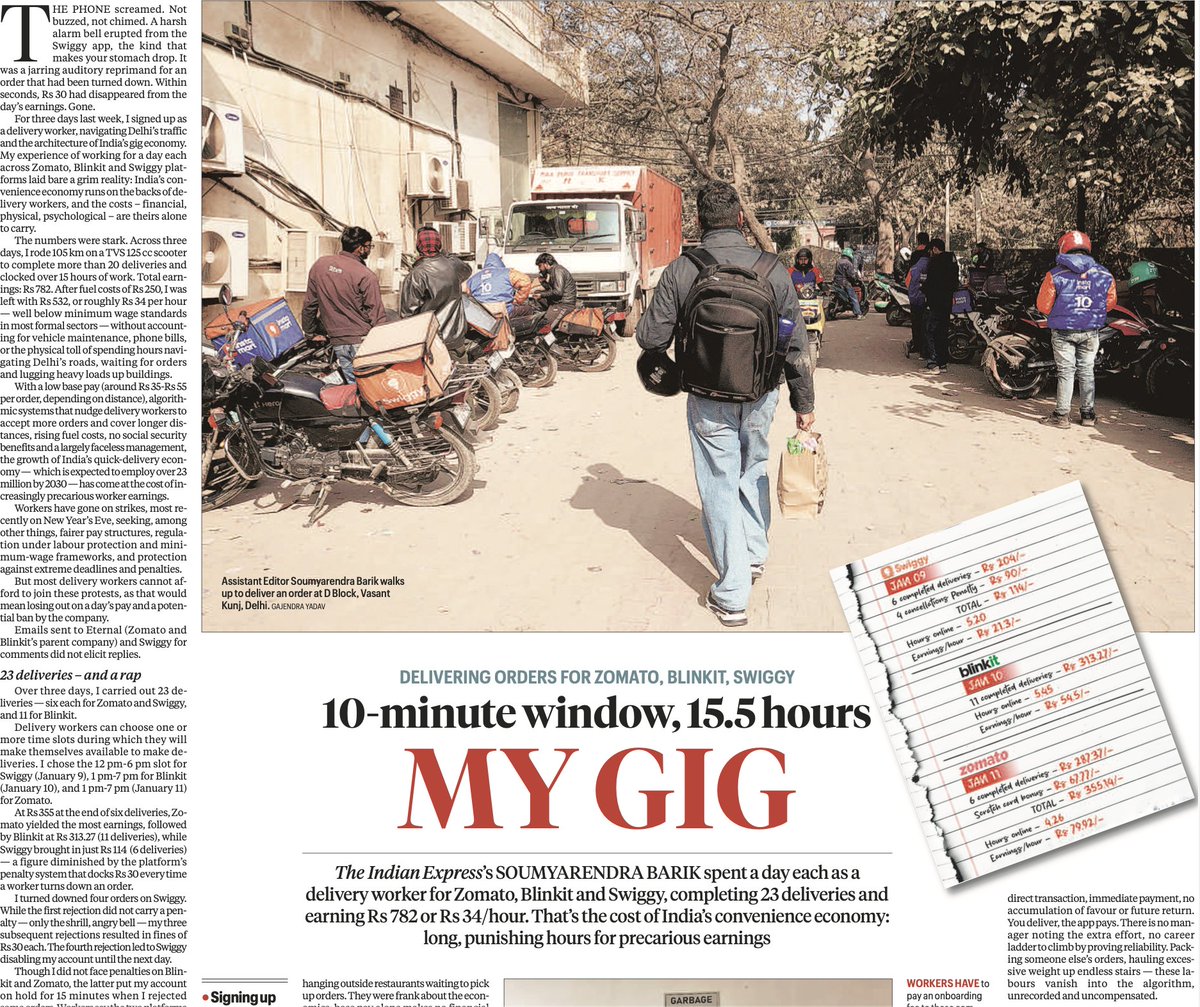
🚨Ground report: I spent 3 days as a gig worker for Zomato, Blinkit & Swiggy in Delhi.
23 deliveries. 15.5 hours. 105 km.
Total earnings: Rs 782 (Rs 34/hour)
After fuel: ₹532
This is India's convenience economy. A thread on what I learned @IndianExpress
Get your Milton Friedman and Ayn Rand right: Zomato and Blinkit aren’t capitalism https://t.co/whDipc8FyF
@kaul_vivek amazingly well explained. loved it!
Delivery partners across India went on strike demanding basic dignity, fair pay, safety, predictable rules and social security. The response from the Platform was to call them "miscreants" and turn a labour demand into a law & order narrative. That is not just insulting, it is dangerous. Workers asking for fair pay are not criminals. And if your system needs police to keep running on its biggest day, that is not proof the system works. That is an admission it doesn't. If you needed police to have your workers stay on the road, they're not employees. They're hostages with helmets.
I am glad my intervention in Parliament has started a nationwide debate. Let me be clear. I am pro-business and pro-startups. I have stood for innovation and entrepreneurship in Parliament. India needs its builders and risk-takers. I will always back them. But I will never back exploitation dressed as progress. I am pro-industry, not pro-exploitation. Success cannot be built by squeezing the last ounce out of the people doing the hardest work.
And apparently asking for fair pay is politics now. Strange how everything becomes 'political agenda' the moment it threatens margins or stock prices.
Now, the favourite defence: "If the system were unfair, why do so many people work in it?"
By that logic, zamindari was not exploitative because it ran for two centuries. Bonded labour was fair because people kept showing up. Every extractive system in history made the same argument. "They're still here, aren't they? Must be working."
When one day’s income decides rent, electricity, or a child’s school fee, logging in on a strike day is not approval, it is survival. It is desperation. People remain trapped when better options do not exist. And please don’t sell people a distant dream to justify a present injustice. Promising that workers’ children will do better someday is not an answer to exploitation today.
Record order numbers do not measure dignity. Lakhs of orders is a business metric, not a moral one. And it should make anyone pause when those numbers are celebrated on a night that is already known for higher-than-usual payouts compared to a regular day, while Platforms also credits ‘police action’ for keeping things under control. When scale is being applauded under those conditions, the obvious question is what is being counted and what is being ignored. That is a model being held up by pressure, not trust.
This is also about Road Safety. Incentive structures that reward speed and punish delay put everyone at risk. Not just the delivery partner on the bike. The pedestrian crossing the street. The family in the car next to them. When we celebrate a 10-minute delivery, we should ask who pays the price when something goes wrong.
Yes, technology can optimise logistics. But technology cannot replace transparency, protections and due process. A system where pay hides behind formulas no worker can see. Where incentives change overnight without notice. Where you are penalised for rain, traffic, app crashes. Where your livelihood can be switched off with one click and no hearing. That is not flexibility. That is control without accountability.
If anyone broke the law that day, act against them. But do not use a few incidents to brand protesting workers as “miscreants” and crush a legitimate demand for fair pay and dignity. Silencing questions by insulting the people asking them, is not leadership. The answer to criticism is reform and accountability.
I did not want to write a post this long. I would have preferred a healthy discussion on pay, safety, and protections. What came instead was coordinated noise. Within hours, identical talking points flooded our feeds. Board members who never discuss labour discovered social media. Influencers with no history of caring about workers began posting defences. As if someone had sent out a script. I have been in this long enough to recognise a paid campaign when I see one.😉
To those in the Platforms making personal calls and sending messages requesting for tweets in their favour: your efforts reached me before your tweets did. Many of those people are friends. They told me everything. Choose your contact list more carefully next time.
Also, the sad part is that the PR agencies got paid. Influencers got paid. Hashtags got bought. The only people still waiting for fair payment are the ones delivering your orders.
And when the arguments ran out, the attacks turned personal, on my family and my lifestyle. That is when you know the platform is panicking. When someone runs out of answers, they reach for insinuations. My life is transparent. I wonder if the same can be said for the algorithms that decide a worker's pay.
Do not waste time debating my lifestyle. Focus on improving the lifestyle of gig workers. I have been fortunate and that’s exactly why I will use my position to raise these demands. If we have been given more, our duty is to demand fairness for those who are given less.
Stop polarising a basic issue. The question is simple. Will we build India’s growth on dignity and safety, or on pressure and insecurity?
I want Indian startups to scale. I am not here for agitation or disruption. I want these businesses to grow leaps and bounds, but not on the backs of the people who keep them running.
As I said in Parliament, gig workers are the invisible wheels of the Indian economy. Platforms did not scale on code alone. They scaled on human labour. Real progress is simple and measurable. Fair and transparent pay, safety and insurance, social security, predictable rules and a grievance system with real due process. Progress is not how fast we deliver. Progress is whether the people who make the system run can live with dignity.
This is a fight I will see through. In Parliament. Outside Parliament. Until there is accountability. The workers who built these platforms order by order, kilometre by kilometre, deserve better than to be called “miscreants" for asking to be treated as human beings.
Jai Hind. Jai Bharat.🇮🇳