We love puzzles, so we acquired the secret to one of the most notorious puzzles in cryptographic history.
Kryptos is a sculpture at CIA headquarters with an encrypted message on it. The final 97 characters of it have never been solved.
Here's what we're doing with the solution.
hardware is hard, hardware in space is even harder. this mission success demonstrates what we always knew about this team, exceptionalism to the bone.
inspired to be supporting @jollyrogersta and team at @The_TrueAnomaly
"Value capture is incredibly difficult, and the market is leaking its value at an unbelievable pace at all times."
@eddylazzarin with a counterintuitive take:
"Entrepreneurs are so obsessed with value capture... not because it's serving their greed at every turn. It's actually because value capture is incredibly difficult."
"There's this idea, something called Schumpeterian profits... According to Nordhaus, 97.8% of the value is externalized. Very little of the value is captured by the company."
"Every price that's posted is an advertisement for other competitors to jump in. If you're charging a high price and a competitor sees that, that's just like a blinking, blaring red signal sign for them to jump in and compete."
"Think of capitalism as this ship, and it's just sinking all the time, but we're building it faster than it's sinking. It's actually in a runaway feedback loop where it's growing and leaking at an accelerating pace... It's a perma-boom, perma-crisis at all times."
Incoming: A new podcast mini-series, First Principles, via @a16zcrypto. Topic: fundamental research breakthroughs that underpin modern digital technology, and the pioneers who discovered them. Amazing line-up of guests and co-hosts!
Prediction markets hit a record $10.8 billion in weekly trading volume in the week ending June 15 — their biggest week ever. Several big events coincided that contributed to the all-time high: the SpaceX IPO, a U.S.-Iran peace deal, the NBA Finals, the Stanley Cup, and the opening of the World Cup, among them.
A year ago, a typical week on prediction markets ran around half a billion dollars, and even the busiest weeks stayed under $1 billion. That floor has climbed steadily since. It climbed past $1 billion last fall, past $4 billion by winter, and into the $6–7 billion range this spring.
Even a quiet week today dwarfs the biggest week of a year ago.
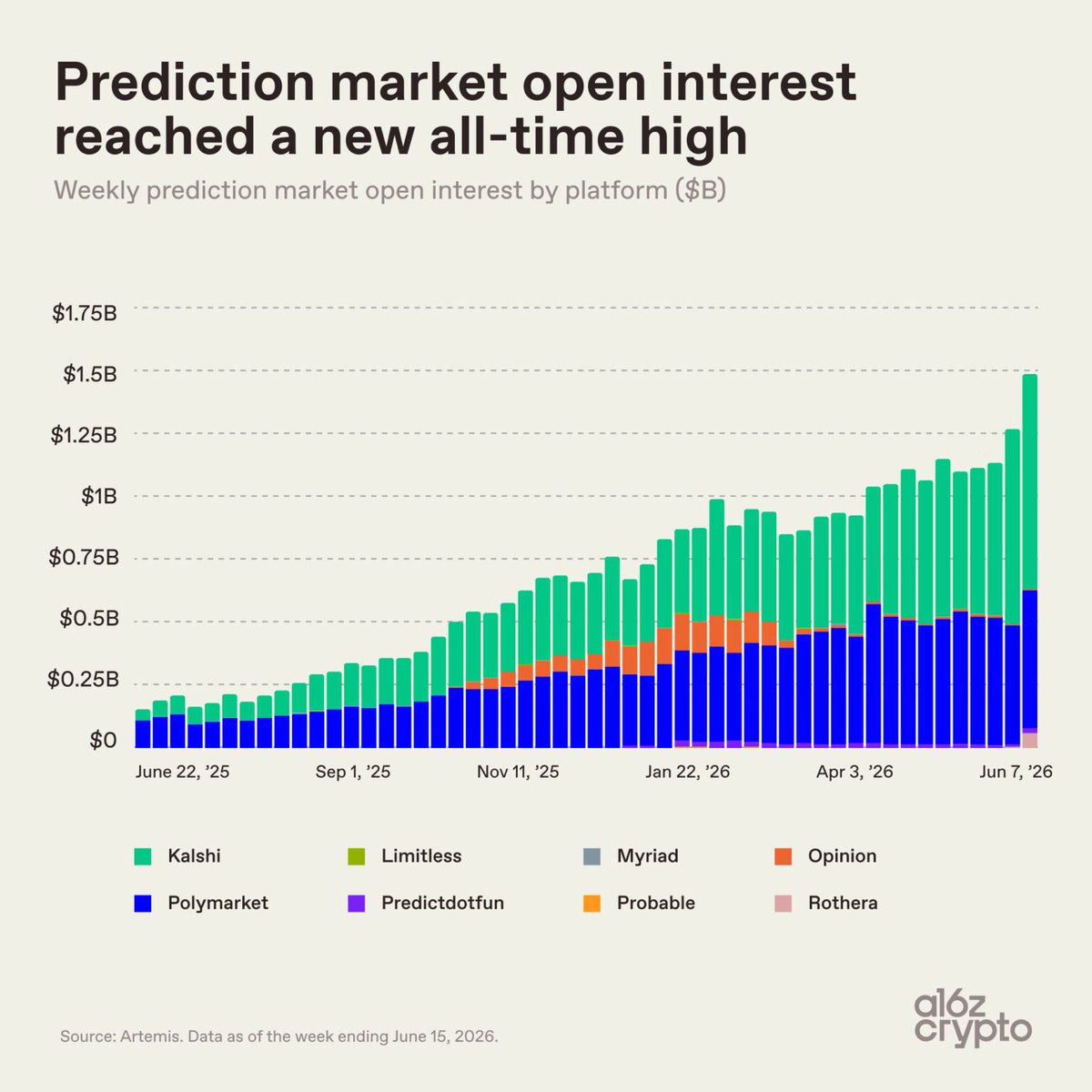
Prediction market open interest — the sum of outstanding contracts that remain “open” in the market — has reached a record weekly high. It hit $1.48 billion in the week ending June 15, the second record-setting week in a row.
Unlike trading volume, which reflects daily activity, open interest tracks the capital that participants have deployed and which remains at risk. The recent surge represents a roughly sixfold increase over the past year, highlighting how users are maintaining longer-term financial positions and how prediction markets are maturing into durable market infrastructure.
Big events bring in the crowds, and more traders are staying to participate in a wide range of markets across politics, economics, culture, crypto, and more.
First Principles Ep. 1
Bitcoin gets credited with inventing trustless consensus. It didn’t. The problem was named in the 1980s, and it took the research world years to even notice Satoshi had solved it.
A new series hosted by @Tim_Roughgarden, with @ittaia.
00:00 Introduction to First Principles: The Scientific Roots of Blockchain Technology
00:56 Why consensus matters for blockchains
02:30 Byzantine agreement: The old computer science problem Bitcoin made practical
04:34 Blockchains as a shared system of record: State machine replication and blockchain state
06:41 How two research worlds — distributed computing and crypto — began to converge
07:49 Proof of work vs. proof of stake
09:27 Why Ethereum’s move to proof-of-stake took years
11:08 When crypto rediscovered decades of distributed systems research
12:49 Throughput, latency, and modern consensus design
14:05 DAG-based protocols and faster blockchains
15:25 Peace time vs. war time: why modern blockchains need two modes
16:47 Theory, practice, and the future of blockchain research
A handful of ideas hold up the entire digital world, but most of us never learn where they came from.
So we went to the source: the people who solved these problems, and won Turing Awards and Nobel Prizes for it.
First Principles, hosted by @Tim_Roughgarden. First episode out now.