(Post en español) .
Desde el olimpo de las Ciencias de la Computación al usuario más básico de Internet:
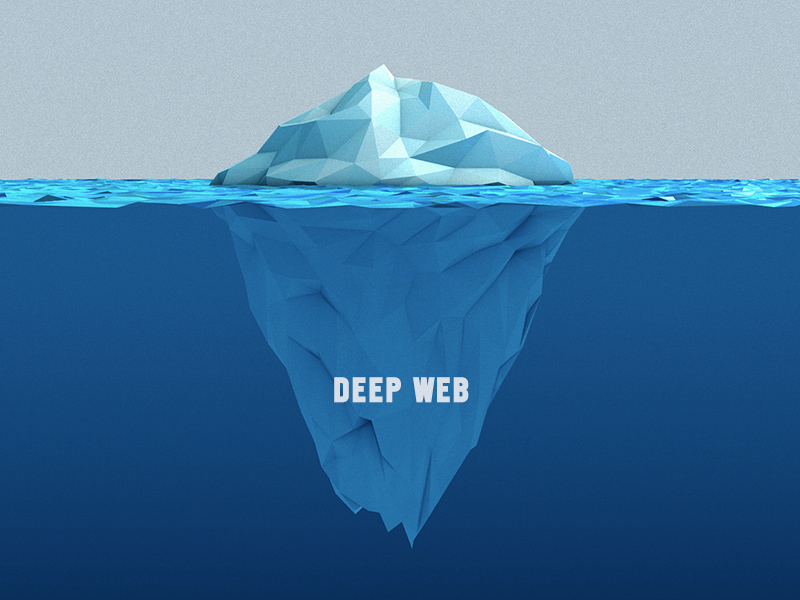
** La Internet que conocemos y desconocemos.
Lee, piensa y comenta en:
https://t.co/Opu7Ogho7R
#internet#computerscience#web#network and #computing#blog#NewPost
25 years ago Steve Ballmer called Linux a cancer.
Today Microsoft shipped its own Linux distribution.
Called it Azure Linux 4.0.
Free. Open source. Maintained by Microsoft.
But there is a catch.
It has no desktop.
No GUI.
No Vim.
No less pager.
No manual pages.
Just a bare-bones command line.
Two-thirds of Azure cores run Linux.
Not Windows.
Microsoft 365. GitHub. ChatGPT. All sit on Linux.
So Microsoft built a distro for itself.
Then realized it could sell that to other companies.
Azure Linux is what Linux looks like when built by the company that tried to destroy it.
Minimal by choice. Secure by default.
No bloat.
Just infrastructure.
Microsoft already uses it everywhere internally.
LinkedIn moved massive workloads to it.
Databricks moved too.
The desktop users get Ubuntu.
The enterprise gets Microsoft’s lean, hardened, purpose-built Linux.
The man who called Linux cancer.
Is dead.
Azure Linux 4.0 is alive.
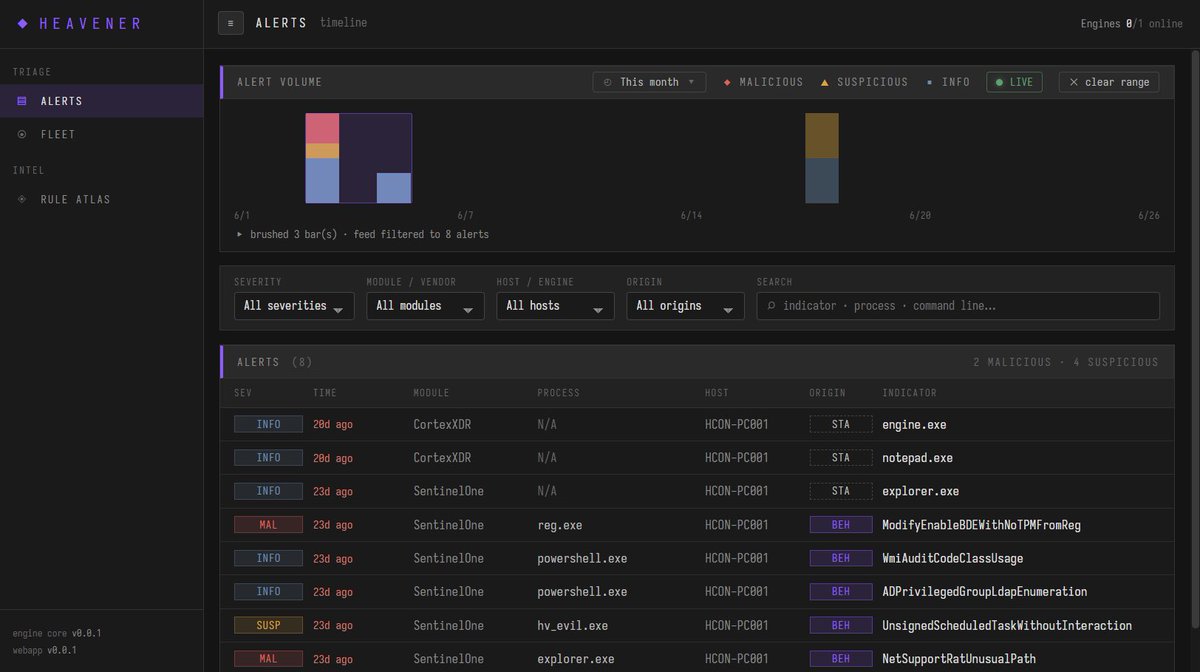
Someone released what is basically an offline VirusTotal without burning your payload: a security researcher reverse-engineered four major EDRs (SentinelOne, Cortex XDR, CrowdStrike, and Sophos) and extracted their detection logic from on-disk agent binaries, ML models, YARA rules, and behavioral scripts.
The project rebuilds the kernel telemetry stack those products run on, including Windows process, thread, registry, and handle callbacks plus a file-system minifilter. It even reconstructs access to the ETW Threat Intelligence provider that Windows normally reserves for protected anti-malware processes. Thus, both the detection rules and the sensor layer can be replicated outside the vendor’s agent.
SonicDE is a new community project focused on preserving KDE’s X11 desktop components as upstream Plasma moves fully to Wayland.
https://t.co/ZKo300yNwH
#KDE#OpenSource
Yesterday's #GNUstep meeting dropped news about #NextBSD, a new OS using components from #FreeBSD and #Darwin: launchd, services described by .plist files, in-kernel IOKit over Mach IPC, network stack configured by IPConfiguration talking to configd... https://t.co/AVGj4qZ8Rp
Microsoft is facing backlash after a leaked internal document reportedly included the phrase “Make people addicted” as part of a strategy for an AI assistant project.
According to the report, the document outlined plans to build habits around the product and increase daily reliance on it.
After the leak became public, Microsoft CEO Satya Nadella pushed back, saying that making users addicted is “absolutely a non goal” and adding, “Not sure what this document is or who is writing and leaking this nonsense!”
The document reportedly identified its authors, adding to the backlash
The story of FCKGW-RHQQ2-YXRKT-8TG6W-2B7Q8.
If you're not the type to pay for your software, you probably know this key. What you might not know is that I worked on the first version of Windows Product Activation, and this was our first major "hack".
And yet, it wasn't a 'hack' at all - it was a disastrous leak.
The FCKGW key was a valid volume licensing key, so all you needed was special volume media to go with it. Eventually, they were bundled and put online by pirates.
WPA worked by generating a hardware ID from your CPU, RAM, and other components, then sending it to Microsoft alongside your product key for validation. A mismatched or suspicious key would flag the install as pirated.
But as a legitimate VLK, FCKGW-RHQQ2-YXRKT-8TG6W-2B7Q8 was whitelisted in XP's activation logic—it told the system, "This is corporate volume licensing; no need to phone home." During installation, users selected the "Yes, I have a product key" option, entered the code, and WPA simply... skipped the activation prompt.
The OS booted fully functional, with no 30-day timer or watermarks. It even fooled early validation checks for updates. This loophole let pirates distribute "pre-activated" ISOs, making XP as easy to "acquire" as a free mixtape. Technically, you could still use it today on an old XP disc (if you can find one), but Microsoft's servers shut down validation years ago, and the key's long since been blacklisted.
If you were among the very few selecting option 5 back in the day, you lived the dream man!
I went from 1 to 9 to 2. And anyone else who did, knows how massive the leap from 9 to 2 was...
What was your path along the sound evolution in the early days?
Dennis Ritchie invented C in 1972, co-built Unix in 1969, and his code is running inside every device you are reading this on right now and the colleague who announced his death had to do it through a Google+ post because no journalist thought to check.
He worked at Bell Labs in New Jersey for 44 years. He never gave a keynote. He never ran a company. He never appeared on a magazine cover. He just wrote code that became the invisible foundation everything else is built on.
Here is what he actually built, and why it matters more than almost anything that happened in tech.
In 1969, Bell Labs had just walked away from one of the most ambitious computing projects in history. The Multics project, a joint effort between MIT, Bell Labs, and General Electric, had collapsed under its own weight. Too complex. Too expensive. Too slow. Bell Labs pulled out.
Ken Thompson and Dennis Ritchie refused to let the ideas die.
Working in a small office in Murray Hill, New Jersey, Thompson wrote the first version of Unix in three weeks during the summer of 1969. One week for the file system. One week for the process management. One week for the command shell. Ritchie was working alongside him, and when the system needed a language that could express what they were building, he built one.
In 1972 he completed C.
C was not just another programming language. It was a different philosophy about what a programming language should be. Before C, most systems code was written in assembly, which meant every program was tied to the specific hardware it ran on. You could not move code between machines. You rewrote it from scratch every time.
C changed that. It sat close enough to the hardware to be fast, but abstract enough to run on anything. When Thompson rewrote the Unix kernel in C in 1973, it became the first operating system that could be picked up and moved to a completely different machine without starting over. Portability was a new idea. Ritchie made it real.
The branching that followed is almost impossible to overstate.
Unix spread from Bell Labs to universities. At Berkeley, it became BSD. BSD became the foundation of macOS and iOS. Unix influenced Linus Torvalds, who built Linux in 1991. Linux now runs every Android phone, every major web server, every supercomputer on the Top500 list, and the overwhelming majority of cloud infrastructure at AWS, Google, and Microsoft.
C became the parent language of C++, Java, JavaScript, Python, and Objective-C. Rob Pike, who worked across the hall from Ritchie at Bell Labs for 20 years, said it plainly: "The browsers are written in C. The Unix kernel that the entire internet runs on is written in C. Web servers are written in C, and if they're not, they're written in Java or C++, which are C derivatives, or Python or Ruby, which are implemented in C."
Ritchie won the Turing Award in 1983. He won the National Medal of Technology in 1998, presented by President Clinton. He was head of System Software Research at Bell Labs for decades.
He answered emails from strangers with technical questions until the end of his life. His home address stayed listed in the phone book. His colleague Brian Kernighan, who co-authored the definitive C textbook with him, said Ritchie was a private person who did no self-salesmanship. That was not false modesty. It was just who he was.
He died on October 12, 2011, at his home in Berkeley Heights, New Jersey. He was 70. He had been ill for some time. The world did not notice until Rob Pike posted a quiet announcement on Google+, and the news spread through the programming community in hushed tones.
No front pages. No tributes from heads of state. No candlelight vigils outside corporate campuses.
The device you are reading this on runs code that traces directly back to what he built. So does the server that delivered it to you. So does the browser or app you opened to get here.
Most people will never know his name.
The ones who built everything you use every day do.
If you're a fan of pre-reset Longhorn you might know the "urban legend" of builds ~4033 having broken DCE due to a Direct3D shader mishap.
Turns out that's been wrong all along and it's just poor order of operations at init. 23 years and a fair bit of ASM later, 4033 glass! 🎉🪟